brake VAUXHALL CASCADA 2015.5 Service Manual
[x] Cancel search | Manufacturer: VAUXHALL, Model Year: 2015.5, Model line: CASCADA, Model: VAUXHALL CASCADA 2015.5Pages: 255, PDF Size: 7.56 MB
Page 214 of 255

212Vehicle care
Tyres age, even if they are not used.
We recommend tyre replacement
every 6 years.
Changing tyre and wheel
size
If tyres of a different size than those
fitted at the factory are used, it may be necessary to reprogramme the
speedometer as well as the nominal
tyre pressure and make other vehicle modifications.
After converting to a different tyre
size, have the label with tyre
pressures replaced.9 Warning
Use of unsuitable tyres or wheels
may lead to accidents and will
invalidate the vehicle type
approval.
Wheel covers
Wheel covers and tyres that are
factory approved for the respective
vehicle and comply with all of the
relevant wheel and tyre combination requirements must be used.
If the wheel covers and tyres used are
not factory approved, the tyres must
not have a rim protection ridge.
Wheel covers must not impair brake
cooling.9 Warning
Use of unsuitable tyres or wheel
covers could lead to sudden
pressure loss and thereby
accidents.
Vehicles with steel wheels: When
using locking wheel nuts, do not
attach wheel covers.
Tyre chains
Use tyre chains only on front wheels.
Tyre chains are permitted on tyres of
size 225/55 R17. Always use fine
mesh chains that add no more than
10 mm to the tyre tread and the
inboard sides (including chain lock).
9 Warning
Damage may lead to tyre blowout.
The use of tyre chains is not permitted
on the temporary spare wheel.
Page 215 of 255

Vehicle care213Tyre repair kit
Minor damage to the tyre tread can be
repaired with the tyre repair kit.
Do not remove foreign bodies from
the tyres.
Tyre damage exceeding 4 mm or that is at tyre's sidewall cannot be repairedwith the tyre repair kit.9 Warning
Do not drive faster than 50 mph.
Do not use for a lengthy period.
Steering and handling may be
affected.
If you have a flat tyre:
Apply the parking brake and engage
first gear, reverse gear or P.
The tyre repair kit is in a box under the
floor cover in the load compartment.
On another version, a bag with the
tyre repair kit is fixed at the left rear
lashing eye in the load compartment.
1. Take the tyre repair kit from the load compartment.
2. Remove the compressor.
3. Remove the electrical connection cable and air hose from the
stowage compartments on the
underside of the compressor.
Page 218 of 255

216Vehicle care
Notice
The driving characteristics of the repaired tyre are severely affected,therefore have this tyre replaced.
If unusual noise is heard or the
compressor becomes hot, turn
compressor off for at least
30 minutes.
The built-in safety valve opens at a
pressure of 102 psi.
Note the expiry date of the kit. After
this date its sealing capability is no
longer guaranteed. Pay attention to
storage information on sealant
bottle.
Replace the used sealant bottle. Dispose of the bottle as prescribed
by applicable laws.
The compressor and sealant can be used from approx. -30 °C.
The adapters supplied can be used
to pump up other items e.g.
footballs, air mattresses, inflatable
dinghies etc. They are located on the underside of the compressor. To
remove, screw on compressor air hose and withdraw adapter.Wheel changing
Some vehicles are equipped with a
tyre repair kit instead of a spare wheel
3 213.
Make the following preparations and
observe the following information:
■ Park the vehicle on a level, firm and
non-slippery surface. The frontwheels must be in the straight-ahead position.
■ Apply the parking brake and engage first gear, reverse gear or
P .
■ Remove the spare wheel 3 218.
■ Never change more than one wheel
at once.
■ Use the jack only to change wheels
in case of puncture, not for
seasonal winter or summer tyre
change.
■ The jack is maintenance-free.
■ If the ground on which the vehicle is standing is soft, a solid board
(max. 1 cm thick) should be placed
under the jack.■ Take heavy objects out of the vehicle before jacking up.
■ No people or animals may be in the
vehicle when it is jacked-up.
■ Never crawl under a jacked-up vehicle.
■ Do not start the vehicle when it is raised on the jack.
■ Clean wheel nuts and thread with a
clean cloth before mounting the
wheel.9 Warning
Do not grease wheel bolt, wheel
nut and wheel nut cone.
1. Disengage wheel nut caps with a screwdriver and remove. Pull off
the wheel cover. Vehicle tools
3 205.
Alloy wheels: Disengage wheel
nut caps with a screwdriver and
remove. To protect the wheel,
place a soft cloth between the
screwdriver and the alloy wheel.
Page 224 of 255

222Vehicle care
■ Never expose the battery to nakedflames or sparks.
■ A discharged vehicle battery can already freeze at a temperature of
0 °C. Defrost the frozen battery
before connecting jump leads.
■ Wear eye protection and protective
clothing when handling a battery.
■ Use a booster battery with the same voltage (12 Volts). Its
capacity (Ah) must not be much less than that of the discharged
battery.
■ Use jump leads with insulated terminals and a cross section of at
least 16 mm 2
(25 mm 2
for diesel
engines).
■ Do not disconnect the discharged battery from the vehicle.
■ Switch off all unnecessary electrical
consumers.
■ Do not lean over the battery during jump starting.
■ Do not allow the terminals of one lead to touch those of the other
lead.■ The vehicles must not come into contact with each other during the
jump starting process.
■ Apply the parking brake, transmission in neutral, automatictransmission in P.
■ Open the positive terminal protection caps of both batteries.
Lead connection order:
1. Connect the red lead to the positive terminal of the booster
battery.
2. Connect the other end of the red lead to the positive terminal of the
discharged battery.
3. Connect the black lead to the negative terminal of the booster
battery.
4. Connect the other end of the black
lead to a vehicle grounding point,
such as the engine block or an
engine mounting bolt. Connect as far away from the discharged
battery as possible, however at
least 60 cm.
Route the leads so that they cannot
catch on rotating parts in the engine
compartment.
To start the engine: 1. Start the engine of the vehicle providing the jump.
2. After 5 minutes, start the other engine. Start attempts should be
made for no longer than
15 seconds at an interval of
1 minute.
3. Allow both engines to idle for approx. 3 minutes with the leads
connected.
Page 225 of 255

Vehicle care223
4. Switch on electrical consumers(e.g. headlights, heated rear
window) of the vehicle receiving
the jump start.
5. Reverse above sequence exactly when removing leads.Towing
Towing the vehicle
Insert a screwdriver in the slot at the
lower part of the cap. Release the cap
by carefully moving the screwdriver
downwards.
The towing eye is stowed with the
vehicle tools 3 205.
Screw in the towing eye anticlockwise
as far as it will go until it stops in a
horizontal position.
Attach a tow rope – or better still a tow rod – to the towing eye.
The towing eye must only be used for
towing and not for recovering the
vehicle.
Switch on ignition to release steering
wheel lock and to permit operation of
brake lights, horn and windscreen
wiper.
Transmission in neutral.
Page 226 of 255
224Vehicle careCaution
Drive slowly. Do not drive jerkily.
Excessive tractive force can
damage the vehicle.
When the engine is not running,
considerably more force is needed to
brake and steer.
To prevent the entry of exhaust gases from the towing vehicle, switch on the
air recirculation and close the
windows, when soft top is closed.
Vehicles with automatic transmission: The vehicle must be towed facing
forwards, not faster than 50 mph nor further than 60 miles. In all other
cases and when the transmission is
defective, the front axle must be
raised off the ground.
Seek the assistance of a workshop. After towing, unscrew the towing eye
clockwise.
Insert cap at the top and engage
downwards.
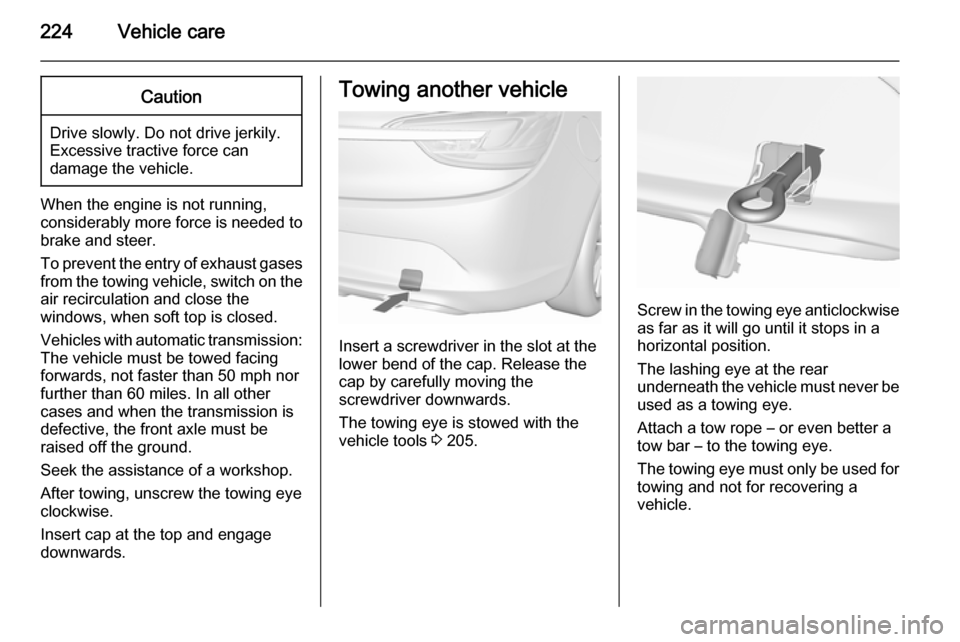
Towing another vehicle
Insert a screwdriver in the slot at the
lower bend of the cap. Release the
cap by carefully moving the
screwdriver downwards.
The towing eye is stowed with the
vehicle tools 3 205.
Screw in the towing eye anticlockwise
as far as it will go until it stops in a
horizontal position.
The lashing eye at the rear
underneath the vehicle must never be used as a towing eye.
Attach a tow rope – or even better a
tow bar – to the towing eye.
The towing eye must only be used for
towing and not for recovering a
vehicle.
Page 232 of 255

230Service and maintenance
Additional engine oil additives
The use of additional engine oil
additives could cause damage and
invalidate the warranty.
Engine oil viscosity grades
The SAE viscosity grade gives
information on the thickness of the oil.
Multigrade oil is indicated by two
figures, e.g. SAE 5W-30. The first
figure, followed by a W, indicates the
low temperature viscosity and the
second figure the high temperature
viscosity.
Select the appropriate viscosity grade depending on the minimum ambient
temperature 3 233.
All of the recommended viscosity
grades are suitable for high ambient
temperatures.
Coolant and antifreeze
Use only organic acid type-long life
coolant (LLC) antifreeze approved for
the vehicle. Consult a workshop.
The system is factory filled with
coolant designed for excellent
corrosion protection and frostprotection down to approx. -28 °C. In
northern countries with very low
temperatures the factory filled coolant provides frost protection down to
approx. -37 °C. This concentration
should be maintained all year round.
The use of additional coolant
additives that intend to give additional
corrosion protection or seal against
minor leaks can cause function
problems. Liability for consequences resulting from the use of additional
coolant additives will be rejected.
Brake and clutch fluid Over time, brake fluid absorbs
moisture which will reduce braking
effectiveness. The brake fluid should
therefore be replaced at the specified interval.
AdBlue
Only use AdBlue to reduce the
nitrogen oxides in the exhaust
emission 3 140.
Page 248 of 255

246Customer information
Jack
Translation of the original declaration of conformity
Declaration of conformity according
to EC Directive 2006/42/EC
We declare that the product:
Product designation: Jack
Type/GM part number: 13348505,
13504504
is in compliance with the provisions of
Directive 2006/42/EC.
Applied technical standards:GMN9737=JackingGM 14337=Standard
Equipment Jack –
Hardware TestsGMN5127=Vehicle Integrity –
Hoisting and
Service Station
JackingGMW15005=Standard
Equipment Jack
and Spare Tire,
Vehicle TestISO TS 16949=Quality
management
systems
The signatory is authorised to
compile the technical documentation.
Rüsselsheim, 31st January 2014
signed by
Hans-Peter Metzger
Engineering Group Manager Chassis & Structure
Adam Opel AG
D-65423 Rüsselsheim
Vehicle data recording
and privacy
Event data recorders The vehicle has a number of
sophisticated systems that monitor
and control several vehicle data.
Some data may be stored during
regular operation to facilitate repair of
detected malfunctions, other data is
stored only in a crash or near crash event by modules in your vehicle
systems that have an event data
recording function such as the airbag
control module.
The systems may record diagnostic
data about the condition of the vehicle
(e.g. oil level or vehicle mileage) and
information how it was operated
(e.g. engine speed, brake application
and seat belt usage).
To read this data, special equipment
and access to the vehicle is required. Some diagnostic data is electronically
fed into Vauxhall global systems
when the vehicle is serviced in a
workshop, in order to document the
Page 250 of 255

248IndexAAccessories and vehicle modifications .......................... 184
Active head restraints ...................46
Adaptive forward lighting ....94,
113, 194
AdBlue .................................. 93, 140
Adjustable air vents ...................130
Airbag, belt tensioners and anti- roll bars ..................................... 89
Airbag deactivation ................62, 89
Airbag label................................... 57 Airbag system .............................. 57
Air conditioning regular operation ................................ 131
Air conditioning system .............. 123
Air intake .................................... 131
Air vents...................................... 130
Antilock brake system ................ 146
Antilock brake system (ABS) .......91
Anti-theft alarm system ................27
Anti-theft locking system .............. 26 Appearance care ........................225
Armrest ......................................... 53
Armrest storage ........................... 71
Ashtrays ....................................... 84
Automatic anti-dazzle ..................31
Automatic light control ...............110
Automatic locking ........................24Automatic transmission .............142
Auxiliary heater ........................... 130
B Battery discharge protection ......120
Battery voltage ........................... 103 BlueInjection ............................... 140
Bonnet ....................................... 186
Brake and clutch fluid .................229
Brake and clutch system .............90
Brake assist ............................... 149
Brake fluid .................................. 189
Brakes ............................... 146, 189
Breakdown.................................. 223
Bulb replacement ....................... 192
C Capacities .................................. 241
Car Pass ...................................... 20
Catalytic converter .....................139
Central locking system ................22
Centre console storage ...............71
Changing tyre and wheel size ...212
Charging system .......................... 90
Child restraint installation locations ................................... 65
Child restraints.............................. 63
Child restraint systems ................63
Cigarette lighter ........................... 84
Climate control ............................. 16
Page 251 of 255

249
Climate control systems.............122
Clock............................................. 81
Code ........................................... 102
Control indicators.......................... 87
Control of the vehicle .................132
Controls ........................................ 77
Convex shape .............................. 29
Coolant and antifreeze ...............229
Cruise control ...................... 94, 153
Cupholders .................................. 70
Curve lighting.............................. 113
D
Danger, Warnings and Cautions ...3
Daytime running lights ...............113
Declaration of conformity ............244
DEF ............................................ 140
Diesel exhaust fluid ....................140
Diesel fuel system bleeding .......191
Diesel particle filter ...............92, 138
Door open .................................... 95
Doors ............................................ 25
Driver assistance systems ..........153
Driver Information Centre .............95
Driving characteristics and towing tips .............................. 179
Driving hints ................................ 132E
Electric adjustment ......................29
Electrical system......................... 200
Electric parking brake ...........91, 147
Electric parking brake fault ...........91
Electronic climate control system 125
Electronic driving programmes ..144
Electronic Stability Control.......... 150
Electronic Stability Control and Traction Control system ............92
Electronic Stability Control off....... 92 End-of-life vehicle recovery .......185
Engine compartment fuse box ...201
Engine coolant ........................... 188
Engine coolant temperature gauge ....................................... 86
Engine data ............................... 236
Engine exhaust .......................... 138
Engine identification ...................232
Engine oil ................... 186, 229, 233
Engine oil pressure ......................93
Entry lighting .............................. 119
Event data recorders ..................246
Exit lighting ................................ 120
Exterior care .............................. 225
Exterior light ................................. 94
Exterior lighting ....................13, 109
Exterior mirrors ............................. 29F
Fault ........................................... 145
First aid ......................................... 75
First aid kit ................................... 75
Fixed air vents ........................... 130
Fog light ....................................... 94
Fog lights ................................... 195
Folding mirrors ............................. 30
Following distance indication ......158
Forward collision alert................. 156
Front airbag system .....................60
Front fog lights ........................... 117
Front seats.................................... 47
Front storage ................................ 70
Front turn signal lights ...............195
Fuel............................................. 175
Fuel consumption - CO 2-
Emissions ............................... 177
Fuel for diesel engines ..............175
Fuel for petrol engines ...............175
Fuel gauge ................................... 86
Fuses ......................................... 200
G Gauges ......................................... 84
General information ...................178
Glovebox ..................................... 69