spare wheel VAUXHALL CASCADA 2015 Owner's Manual
[x] Cancel search | Manufacturer: VAUXHALL, Model Year: 2015, Model line: CASCADA, Model: VAUXHALL CASCADA 2015Pages: 251, PDF Size: 7.47 MB
Page 76 of 251
74Storage
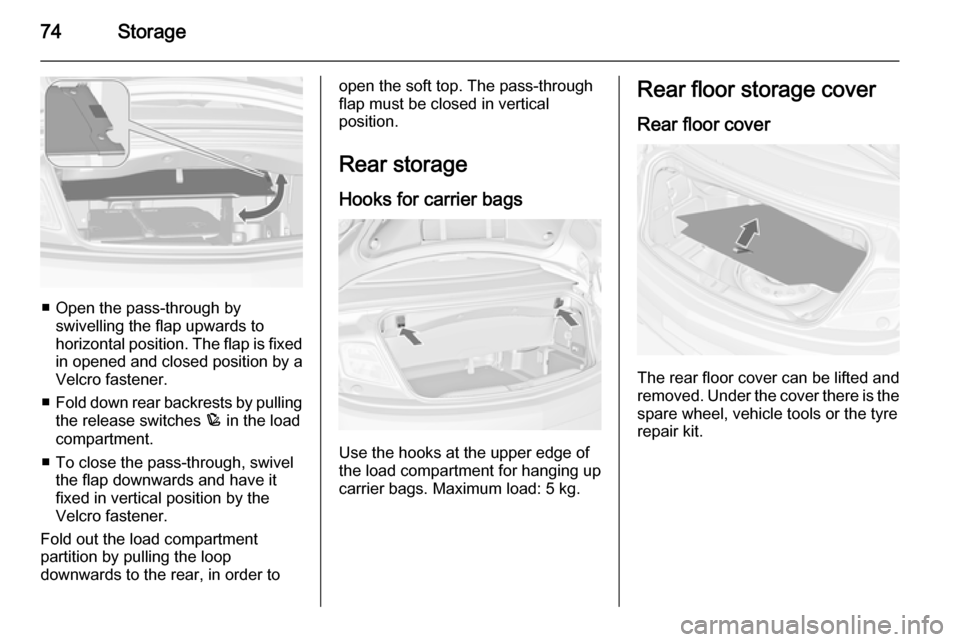
■ Open the pass-through byswivelling the flap upwards to
horizontal position. The flap is fixed
in opened and closed position by a
Velcro fastener.
■ Fold down rear backrests by pulling
the release switches p in the load
compartment.
■ To close the pass-through, swivel the flap downwards and have it
fixed in vertical position by the
Velcro fastener.
Fold out the load compartment
partition by pulling the loop
downwards to the rear, in order to
open the soft top. The pass-through flap must be closed in vertical
position.
Rear storage Hooks for carrier bags
Use the hooks at the upper edge of
the load compartment for hanging up carrier bags. Maximum load: 5 kg.
Rear floor storage cover
Rear floor cover
The rear floor cover can be lifted and
removed. Under the cover there is the
spare wheel, vehicle tools or the tyre
repair kit.
Page 95 of 251
Instruments and controls93
The diesel particle filter requires
cleaning.
Continue driving until %
extinguishes. If possible, do not allow engine speed to drop below
2000 rpm.
Illuminates The diesel particle filter is full. Start
cleaning process as soon as
possible.
Flashes The maximum filling level of the filteris reached. Start cleaning process
immediately to avoid damage to the
engine.
Diesel particle filter 3 138, Stop-start
system 3 135.
Tyre pressure monitoring system
w illuminates or flashes yellow.
Illuminates Tyre pressure loss. Stop immediately
and check tyre pressure.Flashes
Fault in system or tyre without
pressure sensor mounted (e.g. spare wheel). After 60-90 seconds the
control indicator illuminates
continuously. Consult a workshop.
Tyre pressure monitoring system
3 204.
Engine oil pressure
I illuminates red.
Illuminates when the ignition is
switched on and extinguishes shortly
after the engine starts.
Illuminates when the engine isrunningCaution
Engine lubrication may be
interrupted. This may result in
damage to the engine and/or
locking of the drive wheels.
1. Depress clutch.
2. Select neutral gear, set selector lever to N.
3. Move out of the flow of traffic as quickly as possible without
impeding other vehicles.
4. Switch off ignition.9 Warning
When the engine is off,
considerably more force is needed
to brake and steer. During an
Autostop the brake servo unit will still be operational.
Do not remove key until vehicle is stationary, otherwise the steeringwheel lock could engage
unexpectedly.
Check oil level before seeking the
assistance of a workshop 3 182.
Low fuel
i illuminates or flashes yellow.
Page 178 of 251

176Driving and operating
Vehicle with spare wheel
The bag with the coupling ball bar is
placed near the spare wheel under
the load floor cover.
Direct the strap through the rim and around the wheel, wrap it around the
coupling ball bar and tighten the strap
to secure the bag.
Vehicles with tyre repair kit
The bag with the coupling ball bar is
placed near the tyre repair kit box
under the load floor cover.
The strap is directed around the
threaded bolt under the tyre repair kit box. Wrap the strap around the
coupling ball bar and tighten the strap
to secure the bag.
Vehicles with flat load compartment
floor
The bag with the coupling ball bar is
stowed on the right side of the load
compartment floor.
Direct the strap through the rear right
lashing eye, wrap it twice around the
coupling ball bar and tighten the strap
to secure the bag.
Page 204 of 251

202Vehicle careVehicle toolsTools
Vehicles with spare wheel
Open the load floor cover. The jack,
the tools and a strap for securing a
damaged wheel are in the tool box
below the spare wheel in the load
compartment. The wheel wrench and the towing eye are in the tool bag
located in the spare wheel well near
the tool box. Spare wheel 3 215.
Vehicles with tyre repair kit
Some tools and the towing eye are
located together with the tyre repair
kit in a tool box in the load
compartment below the floor cover.
Vehicles with tyre repair kit and
flat load compartment floor
Some tools and the towing eye are
located together with the tyre repair
kit in a bag, which is fixed at the front left lashing eye in the load
compartment.
Page 205 of 251

Vehicle care203Wheels and tyresWheels
On vehicles with Diesel engines no steel rims and only special, for this
vehicle approved alloy wheels are
permitted.
Tyre condition, wheel condition
Drive over edges slowly and at right
angles if possible. Driving over sharp
edges can cause tyre and wheel
damage. Do not trap tyres on the kerb when parking.
Regularly check the wheels for
damage. Seek the assistance of a
workshop in the event of damage or
unusual wear.
Winter tyres Winter tyres improve driving safety at
temperatures below 7 °C and should
therefore be fitted on all wheels.
All tyre sizes are permitted as winter
tyres 3 238.Use tyre size 225/55 R17 only as
winter tyres.
On vehicles with Diesel engines, no
steel rims and only special, vehicle-
approved alloy wheels are permitted.
In accordance with country-specific
regulations, affix the speed sticker in
the driver's field of view.
Tyre designations E.g. 235/55 R 17 99 V235=Tyre width, mm55=Cross-section ratio (tyre height
to tyre width), %R=Belt type: RadialRF=Type: RunFlat17=Wheel diameter, inches99=Load index e.g. 99 is
equivalent to 775 kgV=Speed code letter
Speed code letter:
Q=up to 100 mphS=up to 112 mphT=up to 118 mphH=up to 130 mphV=up to 150 mphW=up to 168 mphDirectional tyres
Fit directional tyres such that they roll in the direction of travel. The rolling
direction is indicated by a symbol
(e.g. an arrow) on the sidewall.
Tyre pressure Check the pressure of cold tyres atleast every 14 days and before any
long journey. Do not forget the spare
wheel. This also applies to vehicles
with tyre pressure monitoring system.
Unscrew the valve cap.
Tyre pressure 3 238.
Page 206 of 251
204Vehicle care
The tyre pressure information labelon the left door frame indicates the
original equipment tyres and the
correspondent tyre pressures.
The tyre pressure data refers to cold
tyres. It applies to summer and winter tyres.
Always inflate the spare tyre to the
pressure specified for full load.
The ECO tyre pressure serves to
achieve the smallest amount of fuel
consumption possible.
Incorrect tyre pressures will impair
safety, vehicle handling, comfort and fuel economy and will increase tyre
wear.
Tyre pressures differ depending on
various options. For the correct tyre
pressure value, follow the procedure
below:
1. Identify the engine identifier code.
Engine data 3 233.
2. Identify the respective tyre.
The tyre pressure tables show all
possible tyre combinations 3 238.For the tyres approved for your
vehicle, refer to the EEC Certificate of
Conformity provided with your vehicle
or other national registration
documents.
The driver is responsible for correct
adjustment of tyre pressure.9 Warning
If the pressure is too low, this can
result in considerable tyre warm-
up and internal damage, leading to tread separation and even to tyre
blow-out at high speeds.
If the tyre pressure must be reduced
or increased on a vehicle with tyre
pressure monitoring system, switch
off ignition. After adjusting tyre
pressure switch on ignition and select the relevant setting on the page Tyre
load on the Driver Information Centre,
3 95.
Tyre pressure monitoring
system The tyre pressure monitoring system
(TPMS) checks the pressure of all
four wheels once a minute when
vehicle speed exceeds a certain limit.Caution
Tyre pressure monitoring system
warns only about low tyre pressure
condition and does not replace
regular tyre maintenance by the
driver.
All wheels must be equipped with pressure sensors and the tyres must
have the prescribed pressure.
Notice
In countries where the tyre pressure
monitoring system is legally
required, the use of wheels without
pressure sensors will invalidate the
vehicle type approval.
Page 208 of 251

206Vehicle care
If w illuminates at lower temperatures
and extinguishes after some driving,
this could be an indicator for getting low pressure. Check tyre pressure.
Vehicle messages 3 101.
If the tyre pressure must be reduced
or increased, switch off ignition.
Only mount wheels with pressure
sensors, otherwise the tyre pressure
will not be displayed and w
illuminates continuously.
A temporary spare wheel is not
equipped with pressure sensors. The
tyre pressure monitoring system is
not operational for these wheels.
Control indicator w illuminates. For
the further three wheels the system
remains operational.
The use of commercially available
liquid tyre repair kits can impair the
function of the system. Factory-
approved repair kits can be used.
External high-power radio equipment
could disrupt the tyre pressure
monitoring system.Each time the tyres are replaced, tyre
pressure monitoring system sensors
must be dismounted and serviced.
For the screwed sensor: replace
valve core and sealing ring. For
clipped sensor: replace complete
valve stem.
Vehicle loading statusAdjust tyre pressure to load condition
according to tyre information label or
tyre pressure chart 3 238, and select
the relevant setting in the menu Tire
Load in the DIC, Vehicle Information
Menu 3 95.Select:
■ Light for comfort pressure up to
3 people
■ Eco for Eco pressure up to
3 people
■ Max for full loading
TPMS Sensor Matching
Process
Each TPMS sensor has a unique
identification code. The identification
code must be matched to a new tyre/
wheel position after rotating the tyres
or exchanging the complete wheel set and if one or more TPMS sensors
were replaced. The TPMS sensor matching process should also be
performed after replacing a spare tyre
with a road tyre containing the TPMS
sensor.
The malfunction light and the warning
message or code should go off at the
next ignition cycle. The sensors are
matched to the tyre/wheel positions,
using a TPMS relearn tool, in the
following order: left side front tyre,
right side front tyre, right side rear tyre
Page 211 of 251

Vehicle care209Tyre chains
Use tyre chains only on front wheels.
Tyre chains are permitted on tyres of
size 225/55 R 17. Always use fine
mesh chains that add no more than
10 mm to the tyre tread and the
inboard sides (including chain lock).
9 Warning
Damage may lead to tyre blowout.
The use of tyre chains is not permitted
on the temporary spare wheel.
Tyre repair kit
Minor damage to the tyre tread can be
repaired with the tyre repair kit.
Do not remove foreign bodies from
the tyres.
Tyre damage exceeding 4 mm or that
is at tyre's sidewall cannot be repaired with the tyre repair kit.9 Warning
Do not drive faster than 50 mph.
Do not use for a lengthy period.
Steering and handling may be
affected.
If you have a flat tyre:
Apply the parking brake and engage
first gear, reverse gear or P.
The tyre repair kit is in a box under the
floor cover in the load compartment.
Page 214 of 251

212Vehicle care
If tyre pressure is more than
1.3 bar , set it to the correct value.
Repeat the procedure until there
is no more loss of pressure.
If the tyre pressure has fallen
below 1.3 bar, the vehicle must
not be used. Seek the assistance
of a workshop.
18. Stow away the tyre repair kit in the
load compartment.
Notice
The driving characteristics of the
repaired tyre are severely affected,therefore have this tyre replaced.
If unusual noise is heard or the
compressor becomes hot, turn
compressor off for at least
30 minutes.
The built-in safety valve opens at a
pressure of 102 psi.
Note the expiry date of the kit. After
this date its sealing capability is no
longer guaranteed. Pay attention to
storage information on sealant
bottle.
Replace the used sealant bottle. Dispose of the bottle as prescribed
by applicable laws.
The compressor and sealant can be
used from approx. -30 °C.
The adapters supplied can be used
to pump up other items e.g.
footballs, air mattresses, inflatable
dinghies etc. They are located on the underside of the compressor. To
remove, screw on compressor air hose and withdraw adapter.
Wheel changing Some vehicles are equipped with a
tyre repair kit instead of a spare wheel 3 209.Make the following preparations and
observe the following information:
■ Park the vehicle on a level, firm and
non-slippery surface. The front wheels must be in the straight-
ahead position.
■ Apply the parking brake and engage first gear, reverse gear or
P .
■ Remove the spare wheel 3 215.
■ Never change more than one wheel
at once.
■ Use the jack only to change wheels
in case of puncture, not for
seasonal winter or summer tyre
change.
■ The jack is maintenance-free.
■ If the ground on which the vehicle is standing is soft, a solid board
(max. 1 cm thick) should be placed
under the jack.
■ Take heavy objects out of the vehicle before jacking up.
■ No people or animals may be in the
vehicle when it is jacked-up.
Page 216 of 251

214Vehicle care
4. Set the jack to the necessaryheight. Position it directly below
the jacking point in a manner that
prevents it from slipping.
Attach wheel wrench and with the
jack correctly aligned rotate
wrench until wheel is clear of the
ground.
5. Unscrew the wheel nuts. 6. Change the wheel. Spare wheel 3 215.
7. Screw on the wheel nuts.
8. Lower vehicle.
9. Install the wheel wrench ensuring that it locates securely and tighten
each nut in a crosswise
sequence. Tightening torque is
140 Nm.
10. Align the valve hole in the wheel cover with the tyre valve before
installing.
Install wheel nut caps.
Install centre cap on alloy wheels.
11. Stow the replaced wheel 3 215,
the vehicle tools 3 202 and the
key adapter 3 69.
12. Check the tyre pressure of the installed tyre and the wheel nut
torque as soon as possible.Have the defective tyre renewed or
repaired as soon as possible.
Jacking position for lifting
platform
Rear arm position of the lifting
platform centrically under the recess
of the sill.