ECU VAUXHALL CASCADA 2016.5 User Guide
[x] Cancel search | Manufacturer: VAUXHALL, Model Year: 2016.5, Model line: CASCADA, Model: VAUXHALL CASCADA 2016.5Pages: 263, PDF Size: 7.72 MB
Page 63 of 263
Seats, restraints61Fit the seat belt correctly and
engage securely. Only then is the
airbag able to protect.
Side airbag system
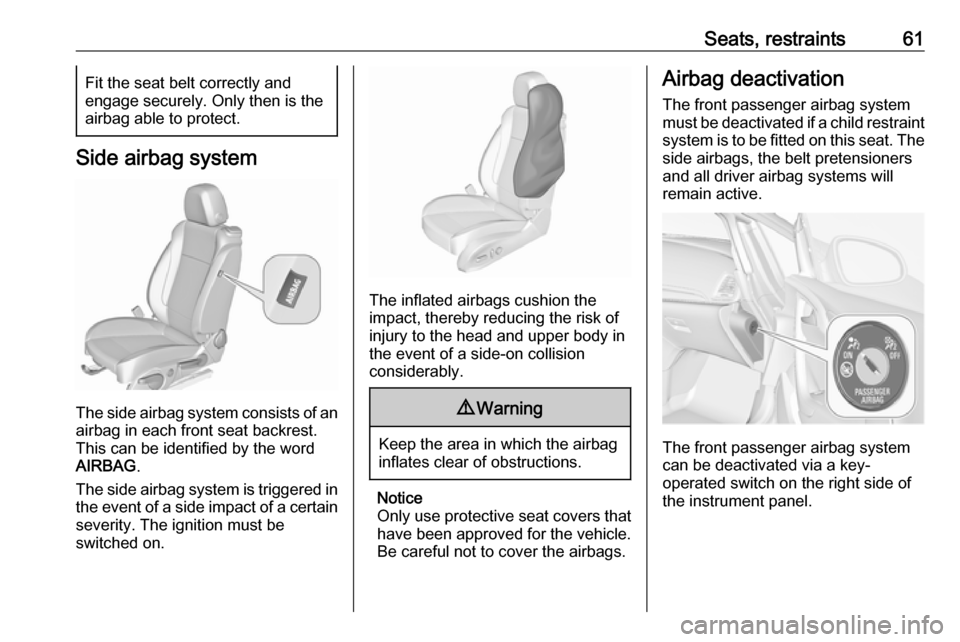
The side airbag system consists of an
airbag in each front seat backrest.
This can be identified by the word
AIRBAG .
The side airbag system is triggered in the event of a side impact of a certain
severity. The ignition must be
switched on.
The inflated airbags cushion the
impact, thereby reducing the risk of
injury to the head and upper body in
the event of a side-on collision
considerably.
9 Warning
Keep the area in which the airbag
inflates clear of obstructions.
Notice
Only use protective seat covers that
have been approved for the vehicle.Be careful not to cover the airbags.
Airbag deactivation
The front passenger airbag system
must be deactivated if a child restraint
system is to be fitted on this seat. The side airbags, the belt pretensioners
and all driver airbag systems will
remain active.
The front passenger airbag system
can be deactivated via a key-
operated switch on the right side of the instrument panel.
Page 65 of 263

Seats, restraints639Warning
When using a child restraint
system on the front passenger
seat, the airbag systems for the
front passenger seat must be
deactivated; if not, the triggering of the airbags poses a risk of fatal
injury to the child.
This is especially the case if rear-
facing child restraint systems are
used on the front passenger seat.
Airbag deactivation 3 61.
Airbag label 3 57.
9 Warning
When using child restraint
systems on the rear seats, ensure that the backrests are engaged
securely in upright position.
Selecting the right system
The rear seats are the most
convenient location to fasten a child
restraint system.
Children should travel facing
rearwards in the vehicle as long as
possible. This makes sure that the child's backbone, which is still very
weak, is under less strain in the event of an accident.
Suitable are restraint systems that
comply with valid UN ECE
regulations. Check local laws and
regulations for mandatory use of child restraint systems.
Ensure that the child restraint system
to be installed is compatible with the
vehicle type.
Ensure that the mounting location of
the child restraint system within the
vehicle is correct, see following
tables.
Allow children to enter and exit the
vehicle only on the side facing away
from the traffic.
When the child restraint system is not in use, secure the seat with a seat beltor remove it from the vehicle.
Notice
Do not affix anything on the child
restraint systems and do not cover
them with any other materials.A child restraint system which has
been subjected to stress in an
accident must be replaced.
Page 66 of 263

64Seats, restraintsChild restraint installation locations
Permissible options for fitting a child restraint system
Weight and age class
On front passenger seat
On rear seats
activated airbagdeactivated airbagGroup 0: up to 10 kg
or approx. 10 monthsXU 1UGroup 0+: up to 13 kg
or approx. 2 yearsXU 1UGroup I: 9 to 18 kg
or approx. 8 months to 4 yearsXU 1U2Group II: 15 to 25 kg
or approx. 3 to 7 yearsXXUGroup III: 22 to 36 kg
or approx. 6 to 12 yearsXXU1:If the child restraint system is being secured using a three-point seat belt, move seat into the rear adjustment area and set seat height to uppermost position. Adjust seat backrest inclination as far as necessary to a vertical position
to ensure that the belt is tight on the buckle side.2:Remove rear head restraint when using child restraint systems in this weight group 3 45.U:Universal suitability in conjunction with three-point seat belt.X:No child restraint system permitted in this weight class.
Page 74 of 263
72Storage9Warning
Take care when operating the
electric foldable rear seats. The seat backrest is folded with
considerable power. Risk of injury, particularly to children.
Ensure that nothing is attached to
the rear seats or located on the
seat cushion.
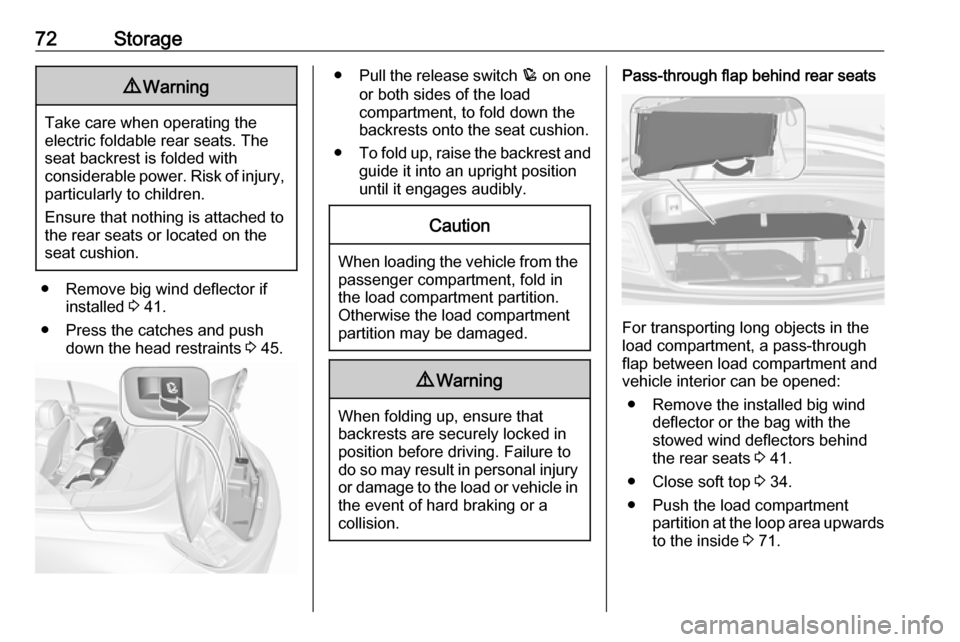
● Remove big wind deflector if installed 3 41.
● Press the catches and push down the head restraints 3 45.
● Pull the release switch p on one
or both sides of the load
compartment, to fold down the
backrests onto the seat cushion.
● To fold up, raise the backrest and
guide it into an upright position
until it engages audibly.Caution
When loading the vehicle from the passenger compartment, fold in
the load compartment partition.
Otherwise the load compartment
partition may be damaged.
9 Warning
When folding up, ensure that
backrests are securely locked in
position before driving. Failure to
do so may result in personal injury or damage to the load or vehicle in the event of hard braking or a
collision.
Pass-through flap behind rear seats
For transporting long objects in the
load compartment, a pass-through
flap between load compartment and
vehicle interior can be opened:
● Remove the installed big wind deflector or the bag with the
stowed wind deflectors behind
the rear seats 3 41.
● Close soft top 3 34.
● Push the load compartment partition at the loop area upwards
to the inside 3 71.
Page 76 of 263

74StorageLashing eyes
The lashing eyes are designed to
secure items against slippage, e.g.
using lashing straps or luggage net.
Warning triangle
Warning triangle is stowed in the
space on the inside of the boot lid
behind the straps.
First aid kit
The first aid kit is stowed on the right
side in the load compartment behind
a strap.
Page 77 of 263
Storage75Loading information● Heavy objects in the load compartment should be placed
as far forward as possible.
Ensure that the backrests are
securely engaged. If objects can
be stacked, heavier objects
should be placed at the bottom.
● Secure objects with lashing straps attached to the lashing
eyes 3 74.
● Use the hooks in the load compartment for hanging up
carrier bags 3 73. Maximum
load: 5 kg per hook.
● Secure loose objects in the load compartment to prevent themfrom sliding.
● When transporting objects in the load compartment, the backrestsof the rear seats must not be
angled forward.
● Do not place any objects on the instrument panel, and do not
cover the sensor on top of the
instrument panel.● The load must not obstruct the operation of the pedals, parking
brake and gear selector lever, or
hinder the freedom of movement of the driver. Do not place any
unsecured objects in the interior.
● Do not place any objects on the covers of the roll bars behind the
head restraints.
● Do not drive with an open load compartment.9Warning
Always ensure that the load in the
vehicle is securely stowed.
Otherwise objects can be thrown
around inside the vehicle and
cause personal injury or damage
to the load or vehicle.
● The payload is the difference between the permitted grossvehicle weight (see identification
plate 3 236) and the EC kerb
weight.
To calculate the payload, enter the data for your vehicle in the
weights table at the front of this
manual.
The EC kerb weight includes
weights for the driver (68 kg),
luggage (7 kg) and all fluids (fuel
tank 90% full).
Optional equipment and
accessories increase the kerb
weight.
Page 105 of 263

Instruments and controls103Battery voltageWhen the vehicle battery voltage isrunning low, a warning message will
appear in the Driver Information
Centre.
1. Switch off immediately any electrical consumers which are
not required for a safe ride, e.g.
seat heating, heated rear window or other main consumers.
2. Charge the vehicle battery by driving continuously for a while or
by using a charging device.
The warning message will disappear
after the engine has been started
twice consecutively without a voltage
drop.
If the vehicle battery cannot be
recharged, have the cause of the fault
remedied by a workshop.Vehicle personalisation
The vehicle's behaviour can be
personalised by changing the settings in the Info-Display.
Some of the personal settings for
different drivers can be memorised
individually for each vehicle key.
Memorised settings 3 21.
Depending on vehicle equipment and
country-specific regulations, some of
the functions described below may
not be available.
Some functions are only displayed or
active when the engine is running.
Personal settings in the
Graphic-Info-Display
CD 400plus/CD 400/CD 300
Press CONFIG . The menu Settings is
displayed.
Page 113 of 263

Instruments and controls111Notice
The vehicle location always remains
accessible to OnStar in the case of
an emergency.
Find the privacy policy in your
account.
Software updates
OnStar may remotely carry out
software updates without further
notice or consent. These updates are
to enhance or maintain safety and
security or the operation of the
vehicle.
These updates may concern privacy
issues. Find the privacy policy in your account.
Page 150 of 263

148Driving and operatingParking
Apply the parking brake and engage
P .
The ignition key can only be removed
when the selector lever is in position
P .
Manual mode
Move selector lever out of position D
towards the left to select manual
mode M.
Tap selector lever
forwards <:shift to a higher gearbackwards ]:shift to a lower gearThe selected gear is indicated in the
instrument cluster.
If a higher gear is selected when
vehicle speed is too low, or a lower
gear when vehicle speed is too high,
the shift is not executed. This can
cause a message in the Driver
Information Centre.
In manual mode, no automatic
shifting to a higher gear takes place
at high engine revolutions.
Electronic driving programmes
● Following a cold start, the operating temperature
programme increases engine
speed to quickly bring the
catalytic converter to the required
temperature.
● The automatic neutral shift function automatically shifts to
idling when the vehicle is stopped with a forward gear engaged andthe brake pedal is pressed.● When SPORT mode is engaged,
the vehicle shifts at higher engine
speeds (unless cruise control is
on). SPORT mode 3 155.
● Special programmes automatically adapt the shifting
points when driving up inclines or
down hills.
Kickdown If the accelerator pedal is pressed
down completely in automatic mode,
the transmission shifts to a lower gear
depending on engine speed.
Fault
In the event of a fault, a vehicle message is displayed in the Driver
Information Centre. Vehicle
messages 3 101.
The transmission no longer shifts automatically. Continued travel is
possible with manual shifting.
Only the highest gear is available.
Depending on the fault, 2nd gear may also be available in manual mode.
Shift only when vehicle is at a
standstill.
Page 185 of 263
Driving and operating183Rear axle loadWhen the trailer is coupled and the
towing vehicle fully loaded, the
permissible rear axle load (see
identification plate or vehicle
documents) may be exceeded by
100 kg, the gross vehicle weight
rating may be exceeded by 100 kg. If
the permissible rear axle load is
exceeded, a maximum speed of
60 mph applies.
Towing equipmentCaution
When operating without a trailer,
remove the coupling ball bar.
Stowage of coupling ball bar
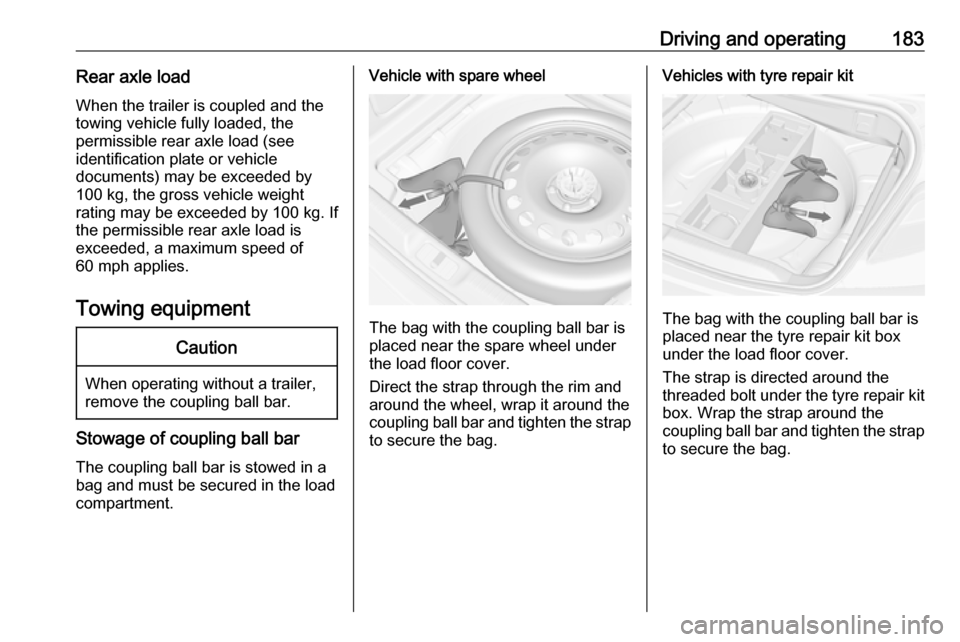
The coupling ball bar is stowed in a
bag and must be secured in the load
compartment.
Vehicle with spare wheel
The bag with the coupling ball bar is
placed near the spare wheel under
the load floor cover.
Direct the strap through the rim and around the wheel, wrap it around the
coupling ball bar and tighten the strap
to secure the bag.
Vehicles with tyre repair kit
The bag with the coupling ball bar is
placed near the tyre repair kit box
under the load floor cover.
The strap is directed around the
threaded bolt under the tyre repair kit box. Wrap the strap around the
coupling ball bar and tighten the strap
to secure the bag.