transmission VAUXHALL CASCADA 2017.5 Owner's Guide
[x] Cancel search | Manufacturer: VAUXHALL, Model Year: 2017.5, Model line: CASCADA, Model: VAUXHALL CASCADA 2017.5Pages: 263, PDF Size: 7.71 MB
Page 207 of 263
Vehicle care205No.Circuit35Power windows, rain sensor,
exterior mirror36Climate control37–38Vacuum pump39Fuel system control module40Windscreen washer system41Right high beam (Halogen)42Radiator fan43Windscreen wiper44–45Radiator fan46–47Horn48Radiator fan49Fuel pump50Headlamp levelling, adaptive
forward lightingNo.Circuit51–52Auxiliary heater, diesel engine53Transmission control module,
Engine control module54Vacuum pump, instrument
panel cluster, heating ventila‐
tion, air conditioning system
After having changed defective fuses,
close the fuse box cover and press
until it engages.
If the fuse box cover is not closed
correctly, malfunctions may occur.
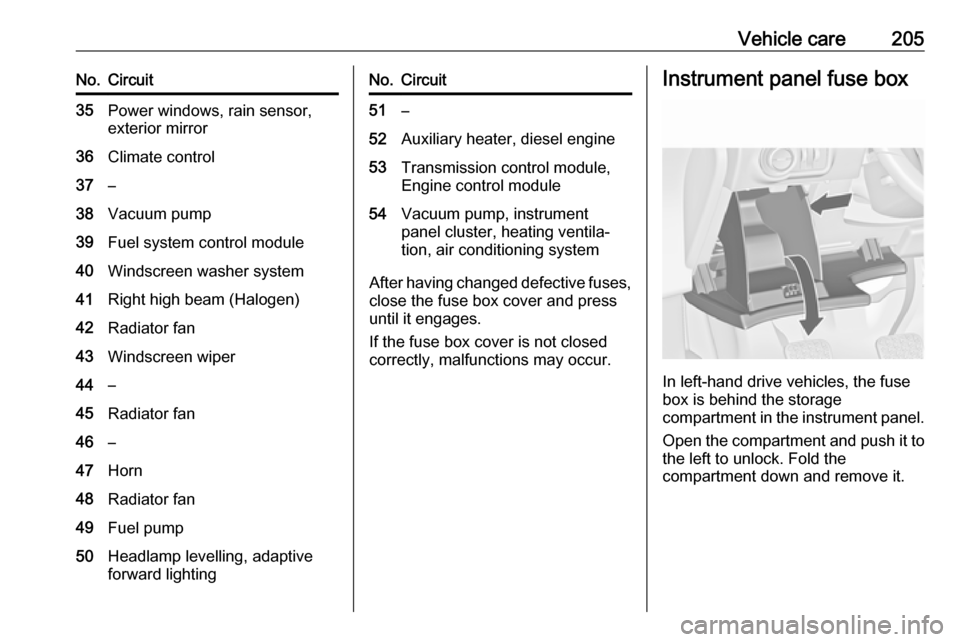
Instrument panel fuse box
In left-hand drive vehicles, the fuse
box is behind the storage
compartment in the instrument panel.
Open the compartment and push it to the left to unlock. Fold the
compartment down and remove it.
Page 213 of 263

Vehicle care211
A detected low tyre pressure
condition is indicated by illumination
of control indicator w 3 91.
If w illuminates, stop as soon as
possible and inflate the tyres as
recommended 3 246.
If w flashes for 60-90 seconds then
illuminates continuously, there is a
fault in the system. Consult a
workshop.
After inflating, driving may be
required to update the tyre pressure
values in the Driver Information
Centre. During this time w may
illuminate.
If w illuminates at lower temperatures
and extinguishes after driving, this
could be an indicator for approaching a low tyre pressure condition. Check
tyre pressure.
Vehicle messages 3 99.
If the tyre pressure must be reduced
or increased, switch off ignition.
Only mount wheels with pressure
sensors, otherwise the tyre pressure
will not be displayed and w
illuminates continuously.
A spare wheel or temporary spare
wheel is not equipped with pressure
sensors. The tyre pressure
monitoring system is not operational
for these tyres. Control indicator w
illuminates. For the further three
wheels the system remains
operational.
The use of commercially-available liquid tyre repair kits can impair the
function of the system. Factory-
approved repair kits can be used.
Operating electronic devices or being
close to facilities using similar wave
frequencies could disrupt the tyre
pressure monitoring system.Each time the tyres are replaced, tyre pressure sensors must be
dismounted and serviced. For the
screwed sensor: replace valve core
and sealing ring. For clipped sensor:
replace complete valve stem.
Vehicle loading status
Adjust tyre pressure to load condition according to the tyre information labelor tyre pressure chart 3 246, and
select the appropriate setting in the
Tyre load menu in the Driver
Information Centre 3 93. This setting
is the reference for the tyre pressure
warnings.
The menu Tyre Load only appears if
the vehicle is at a standstill and the parking brake is applied. On vehicles
with automatic transmission, the
selector lever must be in P.
Page 214 of 263

212Vehicle care
Select:● Light for comfort pressure up to
3 people
● Eco for Eco pressure up to
3 people
● Max for full loading
Tyre pressure sensor matching
process
Each tyre pressure sensor has a
unique identification code. The
identification code must be matched
to a new wheel position after rotating the wheels or exchanging the
complete wheel set and if one or more tyre pressure sensors were replaced.
The tyre pressure sensor matching
process should also be performed
after replacing a spare wheel with a
road wheel containing a tyre pressure
sensor.
The malfunction light w and the
warning message or code should
extinguish at the next ignition cycle.
The sensors are matched to the
wheel positions using a relearn tool,
in the following order: left side front
wheel, right side front wheel, right
side rear wheel and left side rear
wheel. The turn signal light at the
current active position is illuminated
until the sensor is matched.
Consult your workshop for service.
There are two minutes to match the
first wheel position, and five minutes
overall to match all four wheel
positions. If it takes longer, the
matching process stops and must be
restarted.
The tyre pressure sensor matching process is as follows:
1. Apply the parking brake.
2. Turn the ignition on.3. On vehicles with automatic transmission: set the selector
lever to P.
On vehicles with manual
transmission: select neutral.
4. Use MENU on the turn signal
lever to select the Vehicle
Information Menu in the Driver
Information Centre.
5. Turn the adjuster wheel to scroll to
the tyre pressure menu.
6. Press SET/CLR to begin the
sensor matching process. A
message requesting acceptance
of the process should be
displayed.
7. Press SET/CLR again to confirm
the selection. The horn sounds
twice to indicate that the receiver
is in relearn mode.
8. Start with the left side front wheel.
9. Place the relearn tool against the tyre sidewall, near the valve stem.Then press the button to activate
the tyre pressure sensor. A horn
chirp confirms that the sensor
identification code has been
matched to this wheel position.
Page 227 of 263
Vehicle care225Jump starting
Do not start with quick charger.
A vehicle with a discharged vehicle
battery can be started using jump
leads and the vehicle battery of
another vehicle.9 Warning
Be extremely careful when starting
with jump leads. Any deviation
from the following instructions can
lead to injuries or damage caused
by battery explosion or damage to the electrical systems of both
vehicles.
9 Warning
Avoid contact of the battery with
eyes, skin, fabrics and painted
surfaces. The fluid contains
sulphuric acid which can cause
injuries and damage in the event
of direct contact.
● Never expose the battery to naked flames or sparks.
● A discharged vehicle battery canalready freeze at a temperature
of 0 °C. Defrost the frozen battery
before connecting jump leads.
● Wear eye protection and protective clothing when
handling a battery.
● Use a booster battery with the same voltage (12 Volts). Its
capacity (Ah) must not be much less than that of the discharged
battery.
● Use jump leads with insulated terminals and a cross section of
at least 16 mm 2
(25 mm 2
for
diesel engines).
● Do not disconnect the discharged
battery from the vehicle.
● Switch off all unnecessary electrical consumers.
● Do not lean over the battery during jump starting.
● Do not allow the terminals of one
lead to touch those of the other
lead.
● The vehicles must not come into contact with each other during
the jump starting process.● Apply the parking brake, transmission in neutral,
automatic transmission in P.
● Open the positive terminal protection caps of both batteries.
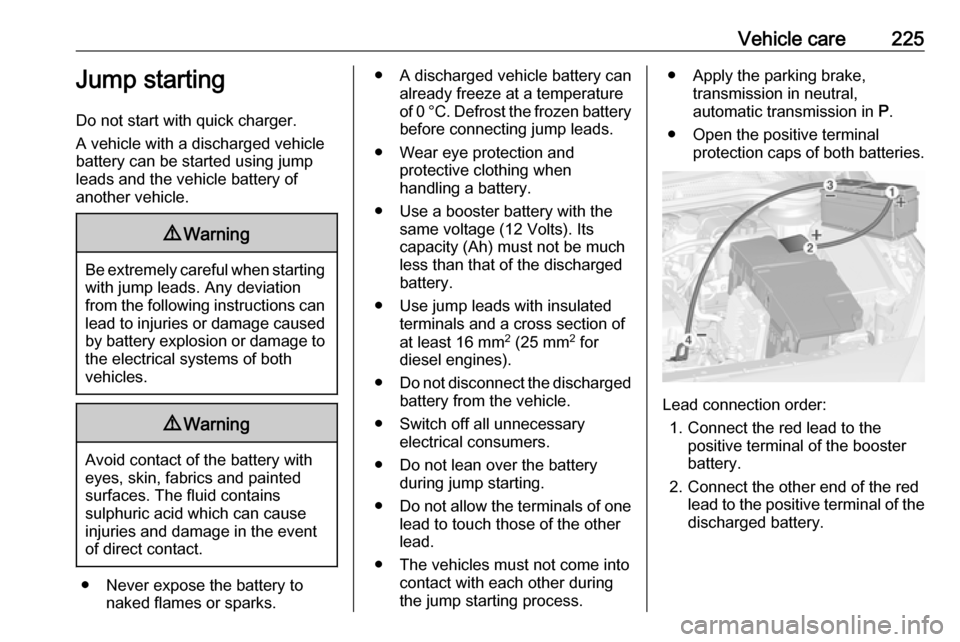
Lead connection order:
1. Connect the red lead to the positive terminal of the booster
battery.
2. Connect the other end of the red lead to the positive terminal of the
discharged battery.
Page 229 of 263

Vehicle care227
Screw in the towing eye anticlockwise
as far as it will go until it stops in a
horizontal position.
Attach a tow rope – or better still a tow
rod – to the towing eye.
The towing eye must only be used for
towing and not for recovering the
vehicle.
Switch on ignition to release steering
wheel lock and to permit operation of
brake lights, horn and windscreen
wiper.
Transmission in neutral.
Caution
Drive slowly. Do not drive jerkily.
Excessive tractive force can
damage the vehicle.
When the engine is not running,
considerably more force is needed to
brake and steer.
To prevent the entry of exhaust gases from the towing vehicle, switch on the
air recirculation and close the
windows, when soft top is closed.
Vehicles with automatic transmission: The vehicle must be towed facing
forwards, not faster than 50 mph nor further than 60 miles. In all other
cases and when the transmission is
defective, the front axle must be
raised off the ground.
Seek the assistance of a workshop. After towing, unscrew the towing eye
clockwise.
Insert cap at the top and engage
downwards.
Towing another vehicle
Insert a screwdriver in the slot at the
lower bend of the cap. Release the
cap by carefully moving the
screwdriver downwards.
The towing eye is stowed with the
vehicle tools 3 208.
Page 243 of 263
![VAUXHALL CASCADA 2017.5 Owners Guide Technical data241Sales designation2.0 CDTI2.0 CDTIEngine identifier codeA20DTHB20DTHEngineering codeA20DTHB20DTHPiston displacement [cm3
]19561956Engine power [kW]121125at rpm40003750Torque [Nm]350400](/img/38/19385/w960_19385-242.png "VAUXHALL CASCADA 2017.5 Owners Guide Technical data241Sales designation2.0 CDTI2.0 CDTIEngine identifier codeA20DTHB20DTHEngineering codeA20DTHB20DTHPiston displacement [cm3
]19561956Engine power [kW]121125at rpm40003750Torque [Nm]350400")
Technical data241Sales designation2.0 CDTI2.0 CDTIEngine identifier codeA20DTHB20DTHEngineering codeA20DTHB20DTHPiston displacement [cm3
]19561956Engine power [kW]121125at rpm40003750Torque [Nm]350400at rpm1750-25001750-2500Fuel typeDieselDieselPerformanceEngineB14NELB14NETA16XHTB16SHTB16SHLMaximum speed [mph]Manual transmission121129138146–Automatic transmission––––136
Page 244 of 263
![VAUXHALL CASCADA 2017.5 Owners Guide 242Technical dataEngineA20DTHB20DTHMaximum speed [mph]Manual transmission135135Automatic transmission132–](/img/38/19385/w960_19385-243.png "VAUXHALL CASCADA 2017.5 Owners Guide 242Technical dataEngineA20DTHB20DTHMaximum speed [mph]Manual transmission135135Automatic transmission132–")
242Technical dataEngineA20DTHB20DTHMaximum speed [mph]Manual transmission135135Automatic transmission132–
Page 245 of 263
![VAUXHALL CASCADA 2017.5 Owners Guide Technical data243Vehicle weightKerb weight, basic model without any optional equipmentEngineManual transmissionAutomatic transmissionwithout/with air conditioning
[kg]B14NEL1701/1714–B14NET1701/1714](/img/38/19385/w960_19385-244.png "VAUXHALL CASCADA 2017.5 Owners Guide Technical data243Vehicle weightKerb weight, basic model without any optional equipmentEngineManual transmissionAutomatic transmissionwithout/with air conditioning
[kg]B14NEL1701/1714–B14NET1701/1714")
Technical data243Vehicle weightKerb weight, basic model without any optional equipmentEngineManual transmissionAutomatic transmissionwithout/with air conditioning
[kg]B14NEL1701/1714–B14NET1701/1714–A16XHT–/1733–B16SHT–/1733–B16SHL––/1733A20DTH–/1816–/1816B20DTH–/1843–
Optional equipment and accessories increase the kerb weight.
Loading information 3 75.
Vehicle dimensionsLength [mm]4696Length max. when operating soft top [mm]4760Width without exterior mirrors [mm]1839Width with two exterior mirrors [mm]2020Height (without antenna) [mm]1443
Page 250 of 263

248Customer informationCustomer
informationCustomer information ................248
Declaration of conformity .........248
Collision damage repair ...........251
Software acknowledgement ....251
Registered trademarks ............253
Vehicle data recording and pri‐
vacy ........................................... 253
Event data recorders ...............253
Radio Frequency Identification (RFID) ..................................... 254Customer information
Declaration of conformity
Transmission systems
This vehicle has systems that
transmit and/or receive radio waves
subject to Directive 1999/5/EC or 2014/53/EU. These systems are incompliance with the essential
requirements and other relevant
provisions of Directive 1999/5/EC or 2014/53/EU. Copies of the original
Declarations of Conformity can be
obtained on our website.
Radar systems
Country-specific Declarations of
Conformity for radar systems are
shown on the following page:
Page 258 of 263

256IndexAAccessories and vehicle modifications .......................... 187
Active head restraints ...................46
Adaptive forward lighting ....92,
114, 196
AdBlue .................................. 91, 141
Adjustable air vents ...................131
Airbag, belt tensioners and roll bars ........................................... 87
Airbag deactivation ................61, 88
Airbag label................................... 57 Airbag system .............................. 57
Air conditioning regular operation ................................ 132
Air conditioning system .............. 124
Air intake .................................... 131
Air vents...................................... 131
Antilock brake system ................ 148
Antilock brake system (ABS) .......89
Anti-theft alarm system ................26
Anti-theft locking system .............. 26
Appearance care ........................228
Armrest ......................................... 53
Armrest storage ........................... 70
Ashtrays ....................................... 82
Automatic anti-dazzle ..................30
Automatic light control ...............111
Automatic locking ........................23
Automatic transmission .............144Autostop..................................... 136
Auxiliary heater ........................... 130
B Battery discharge protection ......122
Battery voltage ........................... 100 BlueInjection ............................... 141
Bonnet ....................................... 188
Brake and clutch fluid .................233
Brake and clutch system .............88
Brake assist ............................... 151
Brake fluid .................................. 192
Brakes ............................... 148, 192
Breakdown.................................. 226
Bulb replacement ....................... 194
C Capacities .................................. 245
Car Pass ...................................... 20
Catalytic converter .....................141
Central locking system ................22
Centre console storage ...............70
Changing tyre and wheel size ...215
Charging system .......................... 88
Child restraint installation locations ................................... 64
Child restraints.............................. 62
Child restraint systems ................62
Cigarette lighter ........................... 82
Climate control ............................. 14
Climate control systems .............123