door lock VAUXHALL CASCADA 2017 User Guide
[x] Cancel search | Manufacturer: VAUXHALL, Model Year: 2017, Model line: CASCADA, Model: VAUXHALL CASCADA 2017Pages: 263, PDF Size: 7.74 MB
Page 30 of 263

28Keys, doors and windowsAlarmWhen triggered, the alarm horn
sounds and the hazard warning lights flash simultaneously. The number
and duration of alarm signals are
stipulated by legislation.
The alarm can be silenced by
pressing any button on the radio
remote control or by switching on the
ignition.
The anti-theft alarm system can be
deactivated only by pressing c or by
switching on the ignition.
A triggered alarm, which has not been
interrupted by the driver, will be
indicated by the hazard warning
lights. They will flash quickly three
times the next time the vehicle is
unlocked with the radio remote
control. Additionally, a warning
message is displayed in the Driver
Information Centre after switching on
the ignition.
Vehicle messages 3 100.
If the vehicle's battery is to be
disconnected (e.g. for maintenance
work), the alarm siren must be
deactivated as follows: Switch theignition on then off, then disconnect
the vehicle's battery within
15 seconds.
Immobiliser
The system is part of the ignition
switch and checks whether the
vehicle is allowed to be started with
the key being used.
The immobiliser is activated
automatically after the key has been
removed from the ignition switch.
If the control indicator d flashes when
the ignition is on, there is a fault in the
system; the engine cannot be started. Switch off the ignition and repeat the
start attempt.
If the control indicator continues
flashing, attempt to start the engine
using the spare key and seek the
assistance of a workshop.
Notice
The immobiliser does not lock the
doors. You should always lock the
vehicle after leaving it.
Switch on the anti-theft alarm
system 3 22, 3 26.Control indicator d 3 92.
Page 35 of 263
Keys, doors and windows33
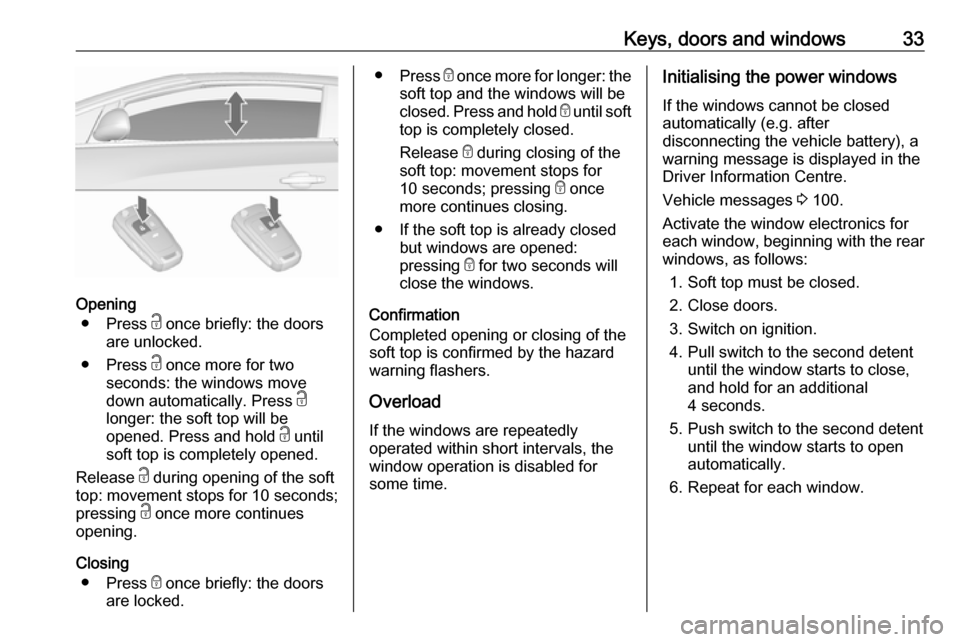
Opening● Press c once briefly: the doors
are unlocked.
● Press c once more for two
seconds: the windows move
down automatically. Press c
longer: the soft top will be
opened. Press and hold c until
soft top is completely opened.
Release c during opening of the soft
top: movement stops for 10 seconds;
pressing c once more continues
opening.
Closing ● Press e once briefly: the doors
are locked.
● Press e once more for longer: the
soft top and the windows will be
closed. Press and hold e until soft
top is completely closed.
Release e during closing of the
soft top: movement stops for
10 seconds; pressing e once
more continues closing.
● If the soft top is already closed but windows are opened:
pressing e for two seconds will
close the windows.
Confirmation
Completed opening or closing of the soft top is confirmed by the hazard
warning flashers.
Overload If the windows are repeatedly
operated within short intervals, the
window operation is disabled for
some time.Initialising the power windows
If the windows cannot be closed
automatically (e.g. after
disconnecting the vehicle battery), a
warning message is displayed in the
Driver Information Centre.
Vehicle messages 3 100.
Activate the window electronics for
each window, beginning with the rear windows, as follows:
1. Soft top must be closed.
2. Close doors.
3. Switch on ignition.
4. Pull switch to the second detent until the window starts to close,
and hold for an additional
4 seconds.
5. Push switch to the second detent until the window starts to open
automatically.
6. Repeat for each window.
Page 41 of 263

Keys, doors and windows39
5. Lift up soft top lid from both sidessimultaneously up to approx. the
half raised position.
6. Insert the 4 mm Allen key into the
marked position of the flap-drive unit. Turn the Allen key clockwise
all the way to the stop, so that the sideways flaps are swivelled in.
7. Open the soft top lid to its end position.
8. Remove plastic covers on bothsides by pushing and sliding
backwards, see illustration.
9. At the hinges on each side there are visible marks.
Page 42 of 263

40Keys, doors and windows10. Haul in the attached stringsaround the marked position at thehinge on both sides and pull the
end of the string through the loop, as shown in the illustration.
11. Deposit the end of the strings at the front.
12.Pull out the soft top by lifting up the
front bow ( 1) and simultaneously
the tension bow ( 2) on both sides.
13. Move the front bow ( 1) to the
windscreen frame.
14. Remove the small lid in the windscreen frame trim using a
screwdriver which is inserted in
the recess of the lid.
15. Insert the 6 mm Allen key into the
closure and lock the latch by
turning the Allen key clockwise to
its end position.
Page 44 of 263

42Keys, doors and windowsTo install the deflectors, the soft top
should be opened.
Fitting of the small wind deflector ● Fold down left rear backrest 3 71.
● Remove the cover from the
guidance between the rear head
restraints by sliding sideways to the left vehicle side.
● Insert the adapter of the deflector
with the elevation into the
opposite recess of the guidance.
● Slide deflector in the guidance to
the right vehicle side until it
engages.
● Raise rear backrest.
Remove deflector in reverse order.
Fitting of the big wind deflector ● Take the deflector out of the bag.● Extract the four locking pins of
the deflector: the upper ones leapout spring-loaded by turning the
pins out of the brackets on both
sides, the lower ones leap out by
lifting the detents at the sliders on both sides.
● Expand the wind deflector.
Page 45 of 263

Keys, doors and windows43
● With the hinges behind the frontseats insert the right side locking
pins in the recesses of the right
side trim near the rear seat. Fold
the deflector a little at the centre and insert the left side locking
pins in the recesses of the left
side trim. Ensure that all pins are properly engaged. Push down
the deflector at the centre.● Fold up the upper part to vertical position.
The rear seats cannot be occupied
when the big wind deflector is
mounted.
The vertical part of the deflector can
be folded down when not used.
Wind deflector may remain mounted
when the soft top is closed.
For removing fold down vertical part
of the deflector. Lift up the deflector at
the centre a little and remove it from
the recesses on both sides.
Stowing the wind deflector
To stow the deflector, move in the
rear locking pins by pushing back and
turning the pins into the brackets.
Push back the sliders of the front
locking pins until they engage. Swing in the deflector and stow it in the bag.
Fold down the rear backrests. Align
the hard cover of the bag to the load
compartment. Position the bag from
the bottom up at the lateral guide in
the recess of the upper frame. Fix the
bag with the Velcro fastener at the
lashing eyes on both sides. Raise
rear backrests.
Page 53 of 263

Seats, restraints51Lift release lever and fold backrest
forwards. The seat slides
automatically forwards to the stop.
To restore, lift backrest to upright
position and engage. The seat slides
automatically backwards to the
original position.
In case the head restraint of the
folded backrest is blocked by the
upper windscreen frame, allow the
seat to move backwards or
downwards slightly 3 51, or set
head restraint to lowest position
3 45.
Safety function
If the power seat encounters
resistance while sliding forwards or
rearwards, it is immediately stopped
and moved in the opposite direction.
Notice
Do not sit on the seat while seat is
moving.
Power disconnection
If seat remains in forward position
with opened door for more than
10 minutes, power adjustment isdisconnected. In this event, close and
open the door or switch on ignition and operate power adjustment again.
Overload
If the folding function is electrically
overloaded, the power supply is
automatically cut-off for a short time.
Power seat adjustment9 Warning
Care must be taken when
operating the power seats. There
is a risk of injury, particularly for
children. Objects could become
trapped.
Keep a close watch on the seats
when adjusting them. Vehicle
passengers should be informed
accordingly.
Longitudinal adjustment
Move switch forwards/backwards.
Seat height
Page 56 of 263
54Seats, restraintsSeat belts
The seat belts are locked during hardacceleration or deceleration of the
vehicle holding the occupants in the
seat position. Therefore the risk of
injury is considerably reduced.
9 Warning
Fasten seat belt before each trip.
In the event of an accident, people
not wearing seat belts endanger their fellow occupants and
themselves.
Seat belts are designed to be used by only one person at a time. Child
restraint system 3 62.
Periodically check all parts of the belt
system for damage, soiling and
proper functionality.
Have damaged components
replaced. After an accident, have the
belts and triggered belt pretensioners replaced by a workshop.
Notice
Make sure that the belts are not
damaged by shoes or sharp-edged
objects or are trapped. Prevent dirt
from getting into the belt retractors.
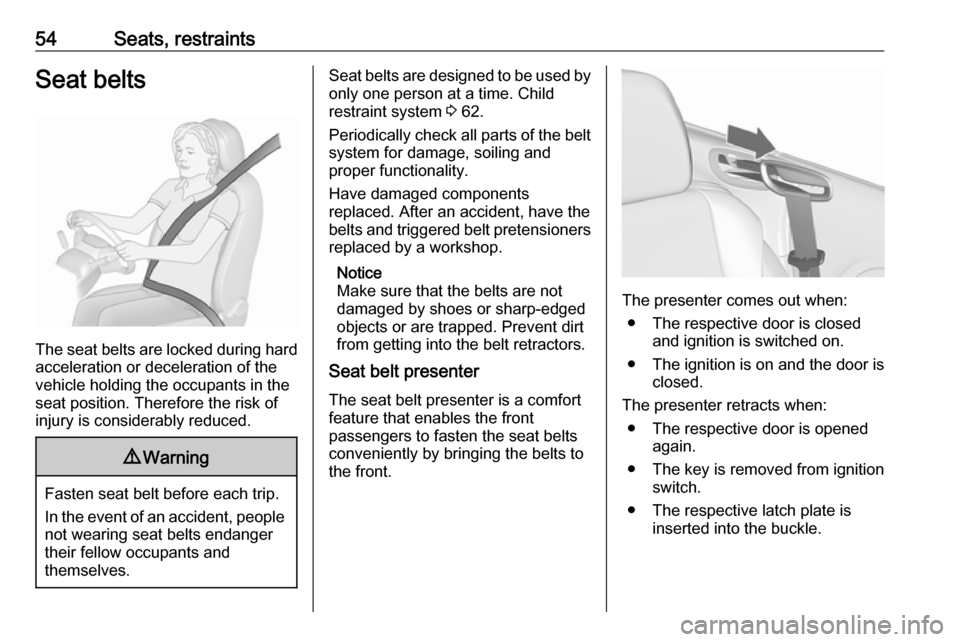
Seat belt presenter
The seat belt presenter is a comfort
feature that enables the front
passengers to fasten the seat belts
conveniently by bringing the belts to
the front.
The presenter comes out when:
● The respective door is closed and ignition is switched on.
● The ignition is on and the door is closed.
The presenter retracts when: ● The respective door is opened again.
● The key is removed from ignition switch.
● The respective latch plate is inserted into the buckle.
Page 78 of 263

76Instruments and controlsInstruments and
controlsControls ....................................... 77
Steering wheel adjustment ........77
Steering wheel controls .............77
Heated steering wheel ...............77
Horn ........................................... 78
Windscreen wiper/washer .........78
Outside temperature ..................80
Clock ......................................... 80
Power outlets ............................. 82
Cigarette lighter ......................... 82
Ashtrays .................................... 83
Warning lights, gauges and indi‐ cators ........................................... 83
Instrument cluster ......................83
Speedometer ............................. 83
Odometer .................................. 83
Trip odometer ............................ 84
Tachometer ............................... 84
Fuel gauge ................................ 84
Engine coolant temperature gauge ....................................... 85
Service display .......................... 85
Control indicators ......................86
Turn signal ................................. 87Seat belt reminder.....................87
Airbag, belt tensioners and roll bars .......................................... 88
Airbag deactivation ....................88
Charging system .......................88
Malfunction indicator light ..........88
Brake and clutch system ...........89
Operate pedal ............................ 89
Electric parking brake ................89
Electric parking brake fault ........89
Antilock brake system (ABS) .....90
Upshift ....................................... 90
Power steering .......................... 90
Lane departure warning ............90
Electronic Stability Control off ...90
Electronic Stability Control and Traction Control system ...........90
Traction Control system off .......91
Preheating ................................. 91
Diesel particle filter ....................91
AdBlue ....................................... 91
Tyre pressure monitoring system ...................................... 91
Engine oil pressure ....................91
Low fuel ..................................... 92
Immobiliser ................................ 92
Exterior light .............................. 92
High beam ................................. 92
High beam assist .......................92
Adaptive forward lighting ...........92Fog light ..................................... 93
Rear fog light ............................. 93
Cruise control ............................ 93
Vehicle detected ahead .............93
Door open .................................. 93
Information displays .....................93
Driver Information Centre ..........93
Graphic-Info-Display, Colour- Info-Display .............................. 98
Vehicle messages ......................100
Warning chimes .......................100
Battery voltage ........................ 101
Vehicle personalisation ..............101
Telematics service .....................106
OnStar ..................................... 106
Page 89 of 263

Instruments and controls87RBrake and clutch system 3 89-Operate pedal 3 89mElectric parking brake 3 89jElectric parking brake fault
3 89uAntilock brake system (ABS)
3 90RUpshift 3 90cPower steering 3 90)Lane departure warning 3 90aElectronic Stability Control off
3 90bElectronic Stability Control and
Traction Control system 3 90kTraction Control system off
3 91!Preheating 3 91%Diesel particle filter 3 91YAdBlue 3 91wTyre pressure monitoring
system 3 91IEngine oil pressure 3 91iLow fuel 3 92dImmobiliser 3 928Exterior light 3 92CHigh beam 3 92lHigh beam assist 3 92fAdaptive forward lighting 3 92>Fog light 3 93rRear fog light 3 93mCruise control 3 93AVehicle detected ahead 3 93hDoor open 3 93
Turn signal
O illuminates or flashes green.
Illuminates briefly
The parking lights are switched on.
Flashes
A turn signal or the hazard warning flashers are activated.
Rapid flashing: failure of a turn signal light or associated fuse, failure of turn
signal light on trailer.
Bulb replacement 3 194, Fuses
3 202.
Turn signals 3 119.
Seat belt reminder
Seat belt reminder on front seats X for driver's seat illuminates or
flashes red.
k for front passenger seat illuminates
or flashes red, when seat is occupied.
Illuminates
After the ignition has been switched
on until the seat belt has been
fastened.
Flashes
After having started the engine for a
maximum of 100 seconds until the
seat belt has been fastened.