Load compartment VAUXHALL CASCADA 2018.5 Owner's Guide
[x] Cancel search | Manufacturer: VAUXHALL, Model Year: 2018.5, Model line: CASCADA, Model: VAUXHALL CASCADA 2018.5Pages: 265, PDF Size: 7.82 MB
Page 184 of 265

182Driving and operatingVehicles with a selective catalytic
reduction system are equipped with a
misfuel inhibitor.
The misfuel inhibitor ensures that the flap of the fuel filler neck can only be
opened by using a nozzle for diesel
fuel or a funnel for emergency
refilling.
Turn the fuel filler cap slowly
anticlockwise.
The cap can be retained in the
bracket on the fuel filler flap.
Place the nozzle in a straight line to the filler neck and press with slight
force to insert.
In case of an emergency, refill with a
canister. A funnel must be used to
open the cap of the filler neck.
The funnel is located in the load
compartment.
Place the funnel in a straight line to
the filler neck and press with slight
force to insert.
Use the funnel to fill the diesel fuel into the filler neck.
After topping-up, put the funnel into
the plastic bag and stow it in the
storage compartment.
Selective catalytic reduction system
3 143.
Fuel filler cap
Only use genuine fuel filler caps. Diesel-engined vehicles have special fuel filler caps.
Page 186 of 265
184Driving and operatingThe permissible gross train weight
must not be exceeded. This weight is
specified on the identification plate
3 237.
Vertical coupling load The vertical coupling load is the load
exerted by the trailer on the coupling
ball. It can be varied by changing the
weight distribution when loading the
trailer.
The maximum permissible vertical
coupling load (75 kg) is specified on
the towing equipment identification
plate and in the vehicle documents.
Always aim for the maximum load,
especially in the case of heavy
trailers. The vertical coupling load
should never fall below 25 kg.Rear axle load
When the trailer is coupled and the
towing vehicle fully loaded, the
permissible rear axle load (see
identification plate or vehicle
documents) may be exceeded by 100 kg, the gross vehicle weight
rating may be exceeded by 100 kg. If
the permissible rear axle load is
exceeded, a maximum speed of
60 mph applies.
Towing equipmentCaution
When operating without a trailer,
remove the coupling ball bar.
Stowage of coupling ball bar
The coupling ball bar is stowed in a
bag and must be secured in the load
compartment.
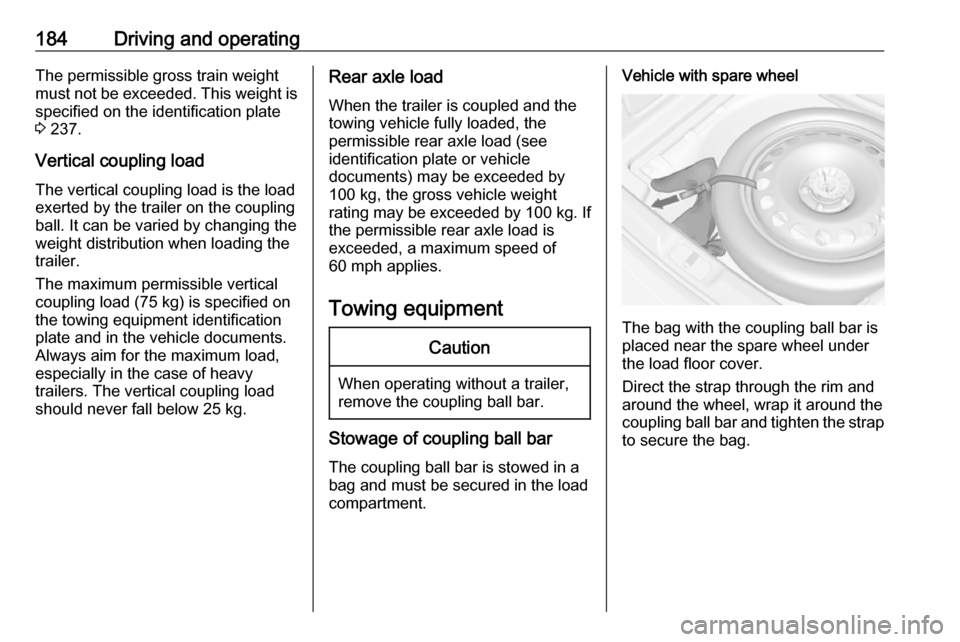
Vehicle with spare wheel
The bag with the coupling ball bar is
placed near the spare wheel under
the load floor cover.
Direct the strap through the rim and around the wheel, wrap it around the
coupling ball bar and tighten the strap
to secure the bag.
Page 187 of 265
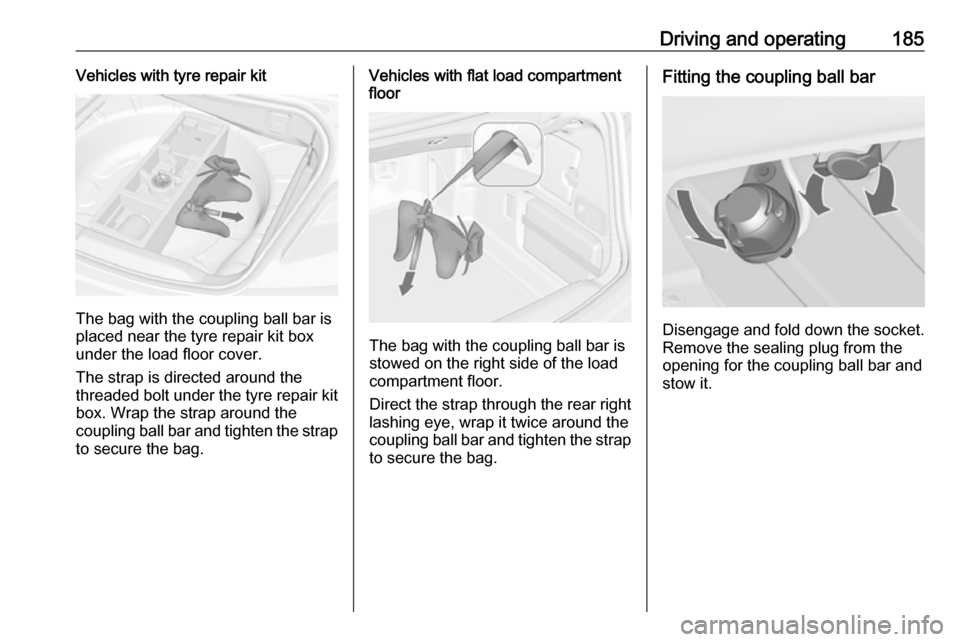
Driving and operating185Vehicles with tyre repair kit
The bag with the coupling ball bar is
placed near the tyre repair kit box
under the load floor cover.
The strap is directed around the
threaded bolt under the tyre repair kit box. Wrap the strap around the
coupling ball bar and tighten the strap
to secure the bag.
Vehicles with flat load compartment
floor
The bag with the coupling ball bar is
stowed on the right side of the load
compartment floor.
Direct the strap through the rear right
lashing eye, wrap it twice around the
coupling ball bar and tighten the strap
to secure the bag.
Fitting the coupling ball bar
Disengage and fold down the socket. Remove the sealing plug from the
opening for the coupling ball bar and
stow it.
Page 190 of 265

188Vehicle careVehicle careGeneral Information...................189
Accessories and vehicle modifications .......................... 189
Vehicle storage ........................189
End-of-life vehicle recovery .....190
Vehicle checks ........................... 190
Performing work ......................190
Bonnet ..................................... 190
Engine oil ................................. 191
Engine coolant ......................... 192
Washer fluid ............................ 193
Brakes ..................................... 193
Brake fluid ............................... 194
Vehicle battery ......................... 194
Diesel fuel system bleeding .....195
Wiper blade replacement ........196
Bulb replacement .......................196
Halogen headlights ..................196
Adaptive forward lighting .........198
Fog lights ................................. 199
Front turn lights .......................200
Tail lights ................................. 201
Side turn lights ......................... 202
Number plate light ...................203Interior lights ............................ 204
Instrument panel illumination ...204
Electrical system ........................204
Fuses ....................................... 204
Engine compartment fuse box . 205
Instrument panel fuse box .......207
Load compartment fuse box ....208
Vehicle tools .............................. 210
Tools ........................................ 210
Wheels and tyres .......................211
Winter tyres ............................. 211
Tyre designations ....................211
Tyre pressure monitoring
system .................................... 211
Tyre pressure .......................... 215
Tread depth ............................. 216
Changing tyre and wheel size . 216
Wheel covers ........................... 217
Tyre chains .............................. 217
Tyre repair kit .......................... 217
Wheel changing .......................220
Spare wheel ............................ 223
Jump starting ............................. 226
Towing ....................................... 228
Towing the vehicle ...................228
Towing another vehicle ...........229Appearance care .......................230
Exterior care ............................ 230
Interior care ............................. 232
Page 191 of 265

Vehicle care189General Information
Accessories and vehicle modifications
We recommend the use of genuine
parts and accessories and factory
approved parts specific for your
vehicle type. We cannot assess or guarantee reliability of other products
- even if they have a regulatory or
otherwise granted approval.
Any modification, conversion or other changes made to standard vehicle
specifications (including, without
limitation, software modifications,
modifications of the electronic control
units) may invalidate the warranty
offered by Vauxhall. Furthermore,
such changes may affect driver
assistance systems, may impact fuel
consumption, CO 2 emissions and
other emissions of the vehicle and
cause the vehicle to no longer
conform to the operating permit,
impacting the validity of your vehicle
registration.Caution
When transporting the vehicle on
a train or on a recovery vehicle, the
mud flaps may be damaged.
Vehicle storage
Storage for a long period of time
If the vehicle is to be stored for several months:
● Wash the vehicle. Wax painted parts of the vehicle. Exterior care
3 230.
● Have the wax in the engine compartment and underbody
checked.
● Clean and preserve the rubber seals.
● Fill up fuel tank completely.
● Change the engine oil.
● Drain the washer fluid reservoir.
● Check the coolant antifreeze and
corrosion protection.
● Adjust tyre pressure to the value specified for full load.
● Park the vehicle in a dry, well ventilated place. Engage first or
reverse gear or set selector lever
to P. Prevent the vehicle from
rolling.
● Do not apply the parking brake.
● Open the bonnet, close all doors and lock the vehicle.
● Close the soft top.
● Cover the soft top to reduce environmental influences.
● Disconnect the clamp from the negative terminal of the vehicle
battery. Beware that all systems
are not functional, e.g. anti-theft
alarm system.
Putting back into operation When the vehicle is to be put back into
operation:
● Connect the clamp to the negative terminal of the vehicle
battery. Activate the electronics
of the power windows.
● Check tyre pressure.
● Fill up the washer fluid reservoir.
● Check the engine oil level.
Page 206 of 265

204Vehicle care5. Insert bulb holder into lamphousing and turn clockwise.
6. Insert lamp into bumper and let engage.
Interior lights Courtesy light, reading lights
Have bulbs replaced by a workshop.
Load compartment light
Have bulbs replaced by a workshop.
Instrument panel illumination
Have bulbs replaced by a workshop.Electrical system
Fuses Data on the replacement fuse mustmatch the data on the defective fuse.
There are three fuse boxes in the vehicle:
● In the front left of the engine compartment,
● In left-hand drive vehicles, in the interior behind the storage
compartment, or, in right-hand
drive vehicles, behind the
glovebox,
● Behind a cover on the left side of
the load compartment.
Before replacing a fuse, turn off the
respective switch and the ignition.
A blown fuse can be recognized by its melted wire. Do not replace the fuse
until the cause of the fault has been
remedied.
Some functions are protected by
several fuses.
Fuses may also be inserted without existence of a function.
Fuse extractor
A fuse extractor may be located in the
fuse box in the engine compartment.
Page 210 of 265

208Vehicle careNo.Circuit1Displays2Body control unit, exterior lights3Body control unit, exterior lights4Infotainment system5Infotainment system, instru‐
ment6Power outlet, cigarette lighter7Power outlet8Body control module, left low
beam9Body control module, right low
beam10Body control module, door locks11Interior fan12Driver power seat13Passenger power seat14Diagnostic connector15Airbag16Boot lid relayNo.Circuit17Air conditioning system18Service diagnose19Body control module, brake
lights, tail lights, interior lights20-21Instrument panel22Ignition system23Body control module24Body control module25–26Trunk power outlet accessory
Load compartment fuse box
The fuse box is on the left side of the
load compartment behind a cover.
Remove the cover.
Fuse assignments
Page 212 of 265

210Vehicle careVehicle tools
Tools
Vehicles with spare wheel
Open the load floor cover. The jack,
the tools and a strap for securing a
damaged wheel are in the tool box
below the spare wheel in the load
compartment.
The wheel wrench and the towing eye
are in the tool bag located in the spare wheel well near the tool box. The toolbag is fixated with a tether to the stow
rod. Remove tool box and tool bag
tether from the stow rod to access the
tools in the bag.
Spare wheel 3 223.
Vehicles without spare wheel
Some tools and the towing eye are
located in a tool box in the load
compartment below the floor cover.
Vehicles without spare wheel and
flat load compartment floor
Some tools and the towing eye are
located in a bag, which is fixed at the
front left lashing eye in the load
compartment.
Page 220 of 265

218Vehicle care
The tyre repair kit is in a box under the
floor cover in the load compartment.
On another version, a bag with the
tyre repair kit is fixed at the left rear
lashing eye in the load compartment.
1. Take the tyre repair kit from the load compartment.
2. Remove the compressor.
3. Remove the electrical connection cable and air hose from the
stowage compartments on the
underside of the compressor.
4. Screw the compressor air hose to
the connection on the sealant
bottle.
5. Fit the sealant bottle into the retainer on the compressor.
Set the compressor near the tyre
in such a way that the sealant
bottle is upright.
Page 222 of 265
220Vehicle care14. Detach the tyre repair kit. Pushcatch on bracket to remove
sealant bottle from bracket. Screw the tyre inflation hose to the free
connection of the sealant bottle.
This prevents sealant from
escaping. Stow tyre repair kit in
load compartment.
15. Remove any excess sealant using a cloth.
16. Take the label indicating maximum permitted speed from
the sealant bottle and affix in the
driver's field of view.
17. Continue driving immediately so that sealant is evenly distributed
in the tyre. After driving approx.
6 miles (but no more than
10 minutes), stop and check tyre
pressure. Screw compressor air
hose directly onto tyre valve and
compressor when doing this.
If tyre pressure is more than
1.3 bar , set it to the correct value.
Repeat the procedure until there
is no more loss of pressure.
If the tyre pressure has fallen
below 1.3 bar, the vehicle must
not be used. Seek the assistance
of a workshop.
18. Stow away the tyre repair kit in the
load compartment.
Notice
The driving characteristics of the repaired tyre are severely affected,
therefore have this tyre replaced.
If unusual noise is heard or the
compressor becomes hot, turn
compressor off for at least
30 minutes.
The built-in safety valve opens at a
pressure of 102 psi.
Note the expiry date of the kit. After
this date its sealing capability is no
longer guaranteed. Pay attention to
storage information on sealant
bottle.
Replace the used sealant bottle. Dispose of the bottle as prescribed
by applicable laws.
The compressor and sealant can be used from approx. -30 °C.
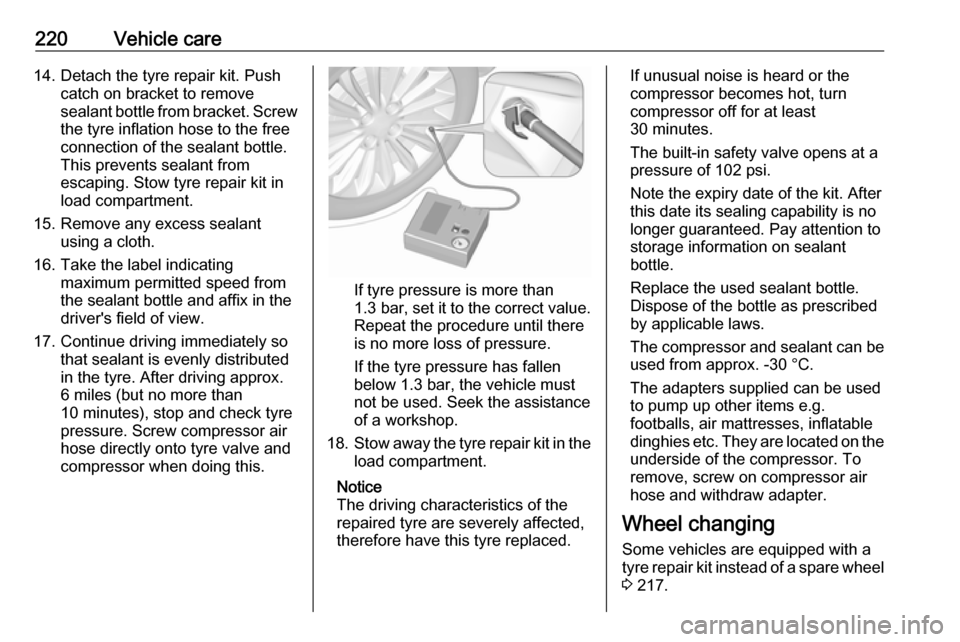
The adapters supplied can be used
to pump up other items e.g.
footballs, air mattresses, inflatable
dinghies etc. They are located on the underside of the compressor. To
remove, screw on compressor air
hose and withdraw adapter.
Wheel changing
Some vehicles are equipped with a
tyre repair kit instead of a spare wheel
3 217.