tow VAUXHALL CASCADA 2018 Owner's Guide
[x] Cancel search | Manufacturer: VAUXHALL, Model Year: 2018, Model line: CASCADA, Model: VAUXHALL CASCADA 2018Pages: 265, PDF Size: 7.81 MB
Page 188 of 265

186Vehicle careVehicle careGeneral Information...................187
Accessories and vehicle modifications .......................... 187
Vehicle storage ........................187
End-of-life vehicle recovery .....188
Vehicle checks ........................... 188
Performing work ......................188
Bonnet ..................................... 188
Engine oil ................................. 189
Engine coolant ......................... 190
Washer fluid ............................ 191
Brakes ..................................... 191
Brake fluid ............................... 192
Vehicle battery ......................... 192
Diesel fuel system bleeding .....193
Wiper blade replacement ........194
Bulb replacement .......................194
Halogen headlights ..................194
Adaptive forward lighting .........196
Fog lights ................................. 197
Front turn signal lights .............198
Tail lights ................................. 199
Side turn signal lights ..............200
Number plate light ...................201Interior lights ............................ 202
Instrument panel illumination ...202
Electrical system ........................202
Fuses ....................................... 202
Engine compartment fuse box . 203
Instrument panel fuse box .......205
Load compartment fuse box ....206
Vehicle tools .............................. 208
Tools ........................................ 208
Wheels and tyres .......................209
Winter tyres ............................. 209
Tyre designations ....................209
Tyre pressure monitoring
system .................................... 209
Tyre pressure .......................... 213
Tread depth ............................. 214
Changing tyre and wheel size . 214
Wheel covers ........................... 215
Tyre chains .............................. 215
Tyre repair kit .......................... 215
Wheel changing .......................218
Spare wheel ............................ 221
Jump starting ............................. 224
Towing ....................................... 226
Towing the vehicle ...................226
Towing another vehicle ...........227Appearance care .......................228
Exterior care ............................ 228
Interior care ............................. 230
Page 210 of 265
208Vehicle careVehicle tools
Tools
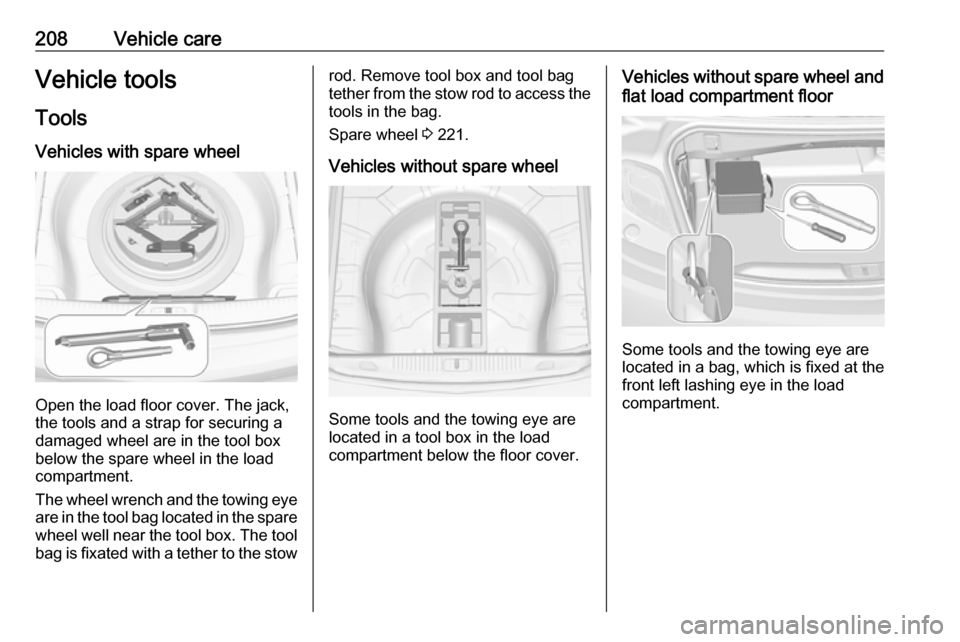
Vehicles with spare wheel
Open the load floor cover. The jack,
the tools and a strap for securing a
damaged wheel are in the tool box
below the spare wheel in the load
compartment.
The wheel wrench and the towing eye
are in the tool bag located in the spare wheel well near the tool box. The toolbag is fixated with a tether to the stow
rod. Remove tool box and tool bag
tether from the stow rod to access the
tools in the bag.
Spare wheel 3 221.
Vehicles without spare wheel
Some tools and the towing eye are
located in a tool box in the load
compartment below the floor cover.
Vehicles without spare wheel and
flat load compartment floor
Some tools and the towing eye are
located in a bag, which is fixed at the
front left lashing eye in the load
compartment.
Page 218 of 265
216Vehicle care
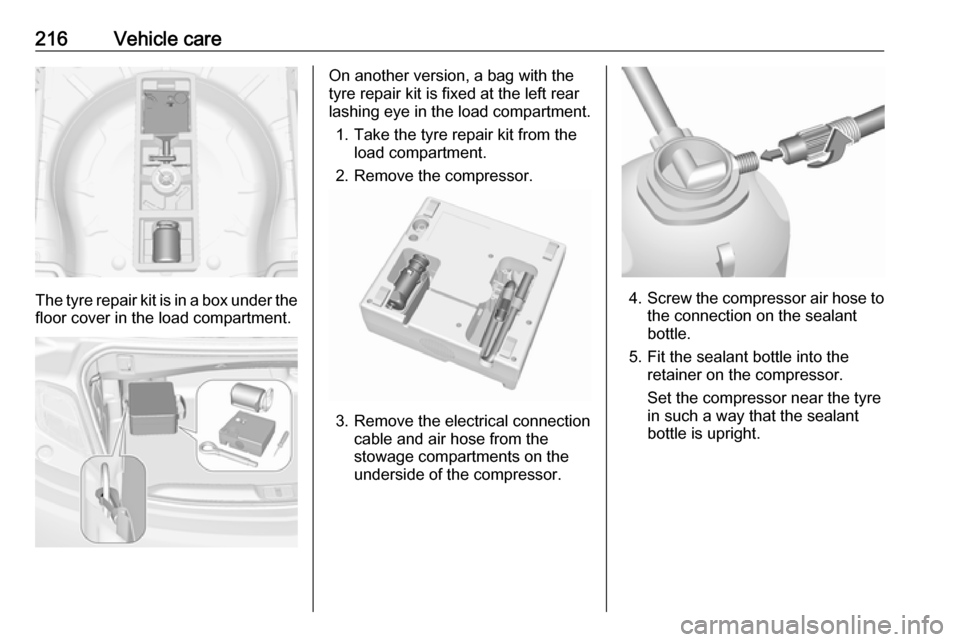
The tyre repair kit is in a box under the
floor cover in the load compartment.
On another version, a bag with the
tyre repair kit is fixed at the left rear
lashing eye in the load compartment.
1. Take the tyre repair kit from the load compartment.
2. Remove the compressor.
3. Remove the electrical connection cable and air hose from the
stowage compartments on the
underside of the compressor.
4. Screw the compressor air hose to
the connection on the sealant
bottle.
5. Fit the sealant bottle into the retainer on the compressor.
Set the compressor near the tyre
in such a way that the sealant
bottle is upright.
Page 220 of 265
218Vehicle care14. Detach the tyre repair kit. Pushcatch on bracket to remove
sealant bottle from bracket. Screw the tyre inflation hose to the free
connection of the sealant bottle.
This prevents sealant from
escaping. Stow tyre repair kit in
load compartment.
15. Remove any excess sealant using a cloth.
16. Take the label indicating maximum permitted speed from
the sealant bottle and affix in the
driver's field of view.
17. Continue driving immediately so that sealant is evenly distributed
in the tyre. After driving approx.
6 miles (but no more than
10 minutes), stop and check tyre
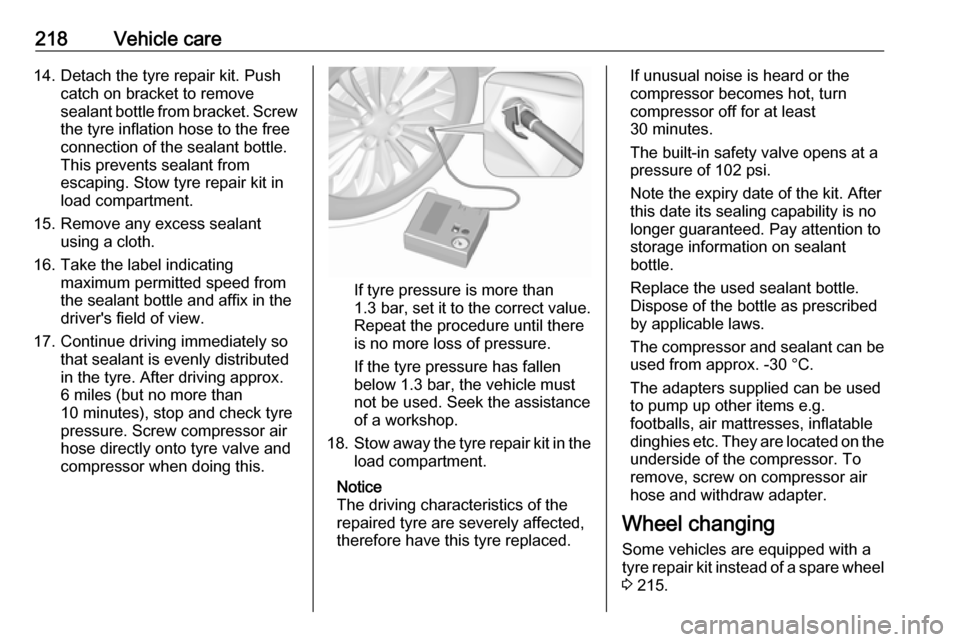
pressure. Screw compressor air
hose directly onto tyre valve and
compressor when doing this.
If tyre pressure is more than
1.3 bar , set it to the correct value.
Repeat the procedure until there
is no more loss of pressure.
If the tyre pressure has fallen
below 1.3 bar, the vehicle must
not be used. Seek the assistance
of a workshop.
18. Stow away the tyre repair kit in the
load compartment.
Notice
The driving characteristics of the repaired tyre are severely affected,
therefore have this tyre replaced.
If unusual noise is heard or the
compressor becomes hot, turn
compressor off for at least
30 minutes.
The built-in safety valve opens at a
pressure of 102 psi.
Note the expiry date of the kit. After
this date its sealing capability is no
longer guaranteed. Pay attention to
storage information on sealant
bottle.
Replace the used sealant bottle. Dispose of the bottle as prescribed
by applicable laws.
The compressor and sealant can be used from approx. -30 °C.
The adapters supplied can be used
to pump up other items e.g.
footballs, air mattresses, inflatable
dinghies etc. They are located on the underside of the compressor. To
remove, screw on compressor air
hose and withdraw adapter.
Wheel changing
Some vehicles are equipped with a
tyre repair kit instead of a spare wheel
3 215.
Page 222 of 265
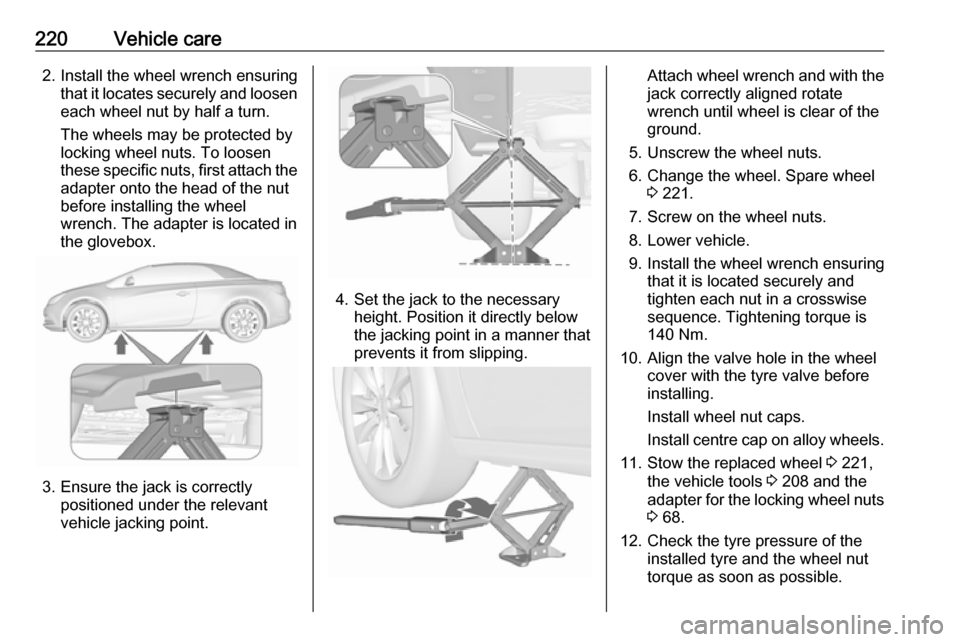
220Vehicle care2. Install the wheel wrench ensuringthat it locates securely and loosen
each wheel nut by half a turn.
The wheels may be protected by
locking wheel nuts. To loosen
these specific nuts, first attach the adapter onto the head of the nut
before installing the wheel
wrench. The adapter is located in
the glovebox.
3. Ensure the jack is correctly positioned under the relevant
vehicle jacking point.
4. Set the jack to the necessary height. Position it directly below
the jacking point in a manner that
prevents it from slipping.
Attach wheel wrench and with the
jack correctly aligned rotate
wrench until wheel is clear of the
ground.
5. Unscrew the wheel nuts. 6. Change the wheel. Spare wheel 3 221.
7. Screw on the wheel nuts.
8. Lower vehicle.
9. Install the wheel wrench ensuring that it is located securely and
tighten each nut in a crosswise
sequence. Tightening torque is
140 Nm.
10. Align the valve hole in the wheel cover with the tyre valve before
installing.
Install wheel nut caps.
Install centre cap on alloy wheels.
11. Stow the replaced wheel 3 221,
the vehicle tools 3 208 and the
adapter for the locking wheel nuts
3 68.
12. Check the tyre pressure of the installed tyre and the wheel nut
torque as soon as possible.
Page 223 of 265

Vehicle care221Have the defective tyre renewed or
repaired as soon as possible.
Jacking position for lifting platform
Rear arm position of the lifting
platform centrically under the recess
of the sill.
Front arm position of the lifting
platform at the underbody.
Spare wheel If mounting a spare wheel which is
different from the other wheels, this
wheel might be classified as a
temporary spare wheel and the
corresponding speed limits apply,
even though no label indicates this.
Seek the assistance of a workshop to
check the applicable speed limit.
The spare wheel has a steel rim.
Caution
The use of a spare wheel that is smaller than the other wheels or
used in combination with winter
tyres could affect driveability.
Have the defective tyre replaced
as soon as possible.
Removing the spare wheel and
stowing a damaged wheel in the
load compartment
The spare wheel is located in the
spare wheel well beneath the floor
cover.
The spare wheel well is not designed for other tyre sizes than the spare
wheel.
To remove: 1. Close the soft top and fold in the load compartment partition by
pushing upwards at the loop area towards the inside 3 71.
Page 224 of 265
222Vehicle care
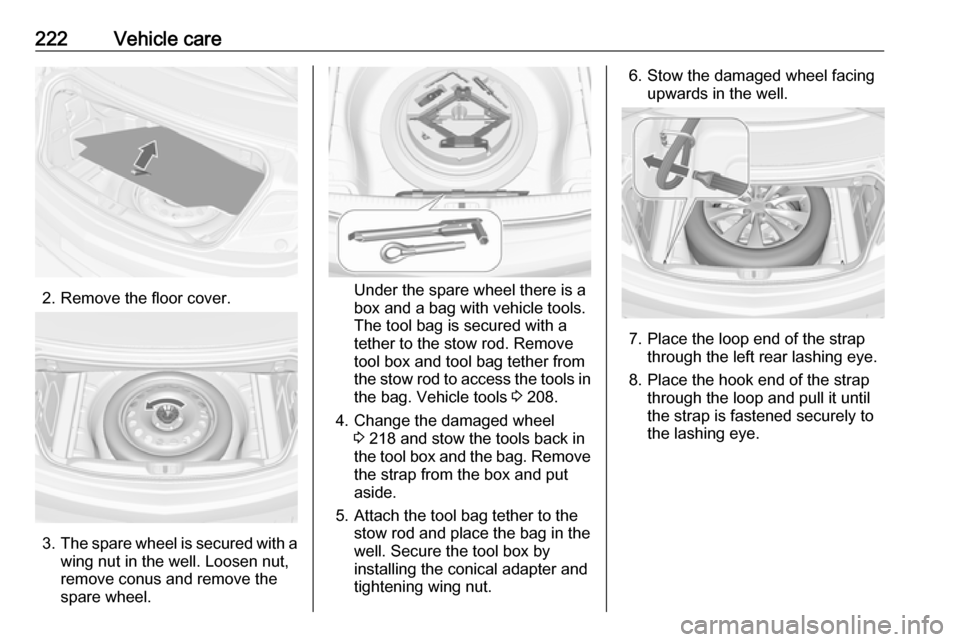
2. Remove the floor cover.
3.The spare wheel is secured with a
wing nut in the well. Loosen nut, remove conus and remove the
spare wheel.
Under the spare wheel there is a box and a bag with vehicle tools.
The tool bag is secured with a
tether to the stow rod. Remove
tool box and tool bag tether from
the stow rod to access the tools in the bag. Vehicle tools 3 208.
4. Change the damaged wheel 3 218 and stow the tools back in
the tool box and the bag. Remove
the strap from the box and put
aside.
5. Attach the tool bag tether to the stow rod and place the bag in the
well. Secure the tool box by
installing the conical adapter and
tightening wing nut.
6. Stow the damaged wheel facing upwards in the well.
7. Place the loop end of the strap through the left rear lashing eye.
8. Place the hook end of the strap through the loop and pull it until
the strap is fastened securely to
the lashing eye.
Page 225 of 265

Vehicle care223
9. Insert the strap through thespokes of the wheel as shown in
the illustration.
10. Mount the hook to the right rear lashing eye.
11. Tighten the strap and secure it using the buckle.
12. Place the floor cover over the damaged wheel.
13. If equipped, secure coupling ball bar in the bag to a lashing eye in
the load compartment.
14. Fold out the load compartment partition before opening the soft
top.
Stowing the spare wheel back in
the well after replacing the
damaged wheel
1. Close the soft top and fold in the load compartment partition.
2. Remove floor cover, loosen and remove wing nut and conus.
3. Stow the tools in the tool box and the bag.
4. Place spare wheel facing upwards in the well.
5. Insert and turn the excentric conus in the recess of the spare
wheel so that the wheel is
positioned as far as possible
towards the front. Secure the
wheel by turning the wing nut
clockwise.
6. Insert and close floor cover.9 Warning
Storing a jack, a wheel or other
equipment in the load
compartment could cause injury if they are not secured properly.
During a sudden stop or a
collision, loose equipment could cause personal injury or damage
to the load or vehicle.
Always store jack and tools in the
respective storage compartments
and secure them by fixing.
Damaged wheel placed in the load compartment must always be
secured with the strap.
Page 226 of 265

224Vehicle careTemporary spare wheelCaution
The use of a spare wheel that issmaller than the other wheels or in combination with winter tyres
could affect driveability. Have the defective tyre replaced as soon as
possible.
Only mount one temporary spare
wheel. Do not drive faster than
50 mph. Take curves slowly. Do not
use for a long period of time.
If your vehicle gets a flat tyre on the
rear while towing another vehicle,
mount the temporary spare wheel at
the front and the full size tyre at the
rear.
Tyre chains 3 215.
Spare wheel with directional tyre
Fit directional tyres such that they roll in the direction of travel. The rolling
direction is indicated by a symbol
(e.g. an arrow) on the sidewall.
The following applies to tyres fitted
opposing the rolling direction:
● Driveability may be affected. Have the defective tyre renewed
or repaired as soon as possible
and fit it instead of the spare
wheel.
● Drive particularly carefully on wet
and snow-covered road
surfaces.Jump starting
Do not start with quick charger.
A vehicle with a discharged vehicle
battery can be started using jump
leads and the vehicle battery of
another vehicle.9 Warning
Be extremely careful when starting
with jump leads. Any deviation
from the following instructions can
lead to injuries or damage caused
by battery explosion or damage to the electrical systems of both
vehicles.
9 Warning
Avoid contact of the battery with
eyes, skin, fabrics and painted
surfaces. The fluid contains
sulphuric acid which can cause
injuries and damage in the event
of direct contact.
● Never expose the battery to naked flames or sparks.
Page 228 of 265
226Vehicle care4. Switch on electrical consumers(e.g. headlights, heated rear
window) of the vehicle receiving
the jump start.
5. Reverse above sequence exactly when removing leads.Towing
Towing the vehicle
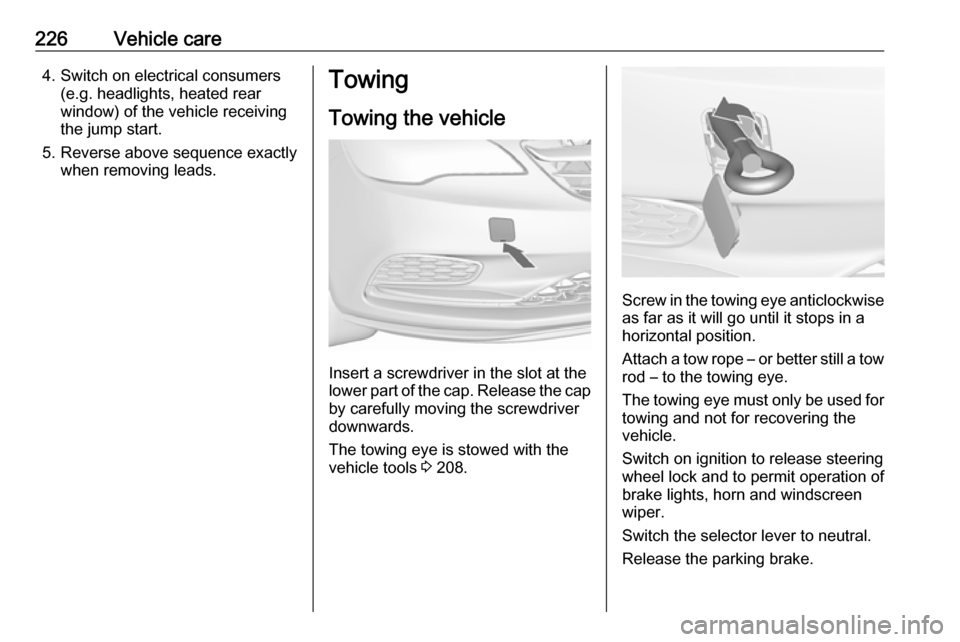
Insert a screwdriver in the slot at the
lower part of the cap. Release the cap
by carefully moving the screwdriver
downwards.
The towing eye is stowed with the
vehicle tools 3 208.
Screw in the towing eye anticlockwise
as far as it will go until it stops in a
horizontal position.
Attach a tow rope – or better still a tow rod – to the towing eye.
The towing eye must only be used for
towing and not for recovering the
vehicle.
Switch on ignition to release steering
wheel lock and to permit operation of
brake lights, horn and windscreen
wiper.
Switch the selector lever to neutral.
Release the parking brake.