door lock VAUXHALL COMBO 2014 User Guide
[x] Cancel search | Manufacturer: VAUXHALL, Model Year: 2014, Model line: COMBO, Model: VAUXHALL COMBO 2014Pages: 187, PDF Size: 4.15 MB
Page 32 of 187

30Keys, doors and windows
OverloadIf the windows are repeatedly
operated within short intervals, the
window operation is disabled for
some time.
Initialising the power windows
If the windows cannot be closed
automatically (e.g. after
disconnecting the vehicle battery),
activate the window electronics as
follows:
1. Close doors.
2. Switch on ignition.
3. Pull switch until the window is closed and keep pulling for an
additional 5 seconds.
4. Repeat for each window.Child safety system for rear windows
Press switch , to deactivate rear
door power windows.
To activate, press , again.
Operating windows from outside
The windows can be operated
remotely from outside the vehicle
when locking or unlocking the vehicle.
Central locking system 3 21.
Press and hold the Ä button to open
windows.
Press and hold the e button to close
windows.
Release button to stop window
movement.
Page 85 of 187

Instruments and controls83
Press the SETq button when
activated ( On) to access the current
set speed. Adjust as required and
confirm.
Warning chimes 3 85.
TRIP B DATA
Activate or deactivate the second trip
computer (set to On or Off).
Trip B records average consumption, distance travelled, average speed
and travel time (driving time). The
measurement can be restarted at any
time. Trip computer 3 86.
SET TIME (Setting the clock and
clock mode)
After accessing this menu option, it is possible to either set the time or
change the clock mode between 12
hour and 24 hour clock.
Select Time and confirm. Adjust the
hours setting (flashing value) and
confirm. Adjust minutes setting
(flashing value) and confirm.
Select Mode and confirm. Select
12h or 24h and confirm.
Clock 3 63.SET DATE
Adjust the year setting (flashing
value) and confirm. Adjust month
setting (flashing value) and confirm.
Adjust the day setting (flashing value)
and confirm.
RADIO INFO (Display audio and
radio information)
Activate radio info (set to On) to
display audio and radio information (e.g. station frequency, RDS
messages, track number). Deactivate
when not required (set to Off).
AUTOCLOSE (Automatic central
locking when driving)
Activate the autoclose feature (set to
On ) to automatically lock the doors
when vehicle speed exceeds
12 mph. Deactivate when not
required (set to Off).
UNIT OF MEASUREMENT (for
Distance, Fuel consumption and
Temperature)
After accessing this menu option, it is possible to set the unit of
measurement for distance, fuel
consumption and temperature.Select Distance and confirm. Set the
unit of measurement to km or mi
(miles) and confirm.
Select Consumption and confirm.
When the Distance unit is set to km, it
is possible to set the unit of
measurement for fuel consumption to either l/100km or km/l . When the
Distance unit is set to mi (miles), fuel
consumption is shown in mpg.
Select Temperature and confirm. Set
the unit of measurement to °C or °F
and confirm.
LANGUAGE (for Display messages) Display messages can be shown in
different languages, including:
English, German, French, Italian,
Portuguese, Spanish, Dutch, Polish and Turkish. Select desired language
and confirm.
WARNING VOLUME (Warning chime volume)
Adjust the volume of warning chimes and confirm. 8 volume levels are
available.
Warning chimes 3 85.
Page 107 of 187

Driving and operating105
■ the ambient temperature is not toolow
■ the climate control system allows an Autostop
■ the self-cleaning function of the diesel particle filter is not active
■ the vehicle has moved since the last Autostop
■ the brake vacuum is sufficient
■ the windscreen wipers are not operating at fast speed
■ reverse gear is not selected
■ heated rear window is not operating
Ambient temperature near to the
freezing point can inhibit an Autostop.
For manual transmission automated
vehicles, an Autostop may be
inhibited until a speed of approx.
6 mph is reached.
New vehicle running-in 3 101.
Battery discharge protection
To ensure reliable engine restarts, several battery discharge protection
features are implemented as part of
the stop-start system.Restart the engine
Manual transmission
The selector lever must be in neutral to enable an automatic restart.
Depress the clutch pedal to restart the
engine.
Manual transmission automated
If the lever is in position N, select
another gear, otherwise release the brake pedal or move the lever to +, –
or R to enable an automatic restart.
When one of the following conditions
occurs during an Autostop, the
engine will need to be restarted
manually using the key.
■ the driver's seat belt is unfastened and the driver's door is opened
■ three minutes have elapsed since the engine was switched off
If an electrical accessory, e.g. a
portable CD player, is connected to
the power outlet, a brief power drop
during the restart may be noticeable.Parking
■ Do not park the vehicle on an easily
ignitable surface. The high
temperature of the exhaust system
could ignite the surface.
■ Always apply parking brake. Apply manual parking brake without
pressing release button. Apply as
firmly as possible on downhill or uphill slopes. Depress the foot
brake at the same time to reduce
operating force.
■ Switch off the engine and ignition. Turn the steering wheel until the
steering wheel lock engages.
■ If the vehicle is on a level surface or
uphill slope, engage first gear. On
an uphill slope, turn the front
wheels away from the kerb.
If the vehicle is on a downhill slope, engage reverse gear. Turn the front
wheels towards the kerb.
■ Lock the vehicle.
Page 122 of 187

120Driving and operating
indicator Y illuminates in the Driver
Information Centre 3 79 until the
ignition is switched off.
A slight loss of power and torque can be expected in petrol operation. You
must therefore adapt your driving style (e.g. during overtaking
manoeuvres) and vehicle loads (e.g.
towing loads) accordingly.
Every six months run the petrol tank
down until control indicator §
illuminates and then refuel. This is
necessary to maintain fuel quality as
well as system function necessary for
petrol operation.
Fill the tank completely at regular
intervals to prevent corrosion in the
tank.
Refuelling
Fuel filler flap is located at left rear
side of vehicle.9 Danger
Before refuelling, switch off engine
and any external heaters with
combustion chambers. Switch off
any mobile phones.
Follow the operating and safety
instructions of the filling station
when refuelling.
9 Danger
Fuel is flammable and explosive.
No smoking. No naked flames or
sparks.
If you can smell fuel in your
vehicle, have the cause of this
remedied immediately by a
workshop.
Caution
In case of misfuelling, do not
switch on ignition.
Release the fuel filler flap by pulling
the flap by hand.
Insert key into fuel filler cap and turn
anticlockwise to unlock.
To remove fuel filler cap, rotate
anticlockwise.Caution
To avoid damage, do not attempt
to operate the sliding side door
when the fuel filler flap is open.
Notice
Depending on model, the sliding
side door may be fitted with a safety system that prevents the door from
being opened fully when the fuel
filler flap is open.
Sliding side door 3 23.
Page 128 of 187
126Vehicle care
■ Open the bonnet, close all doorsand lock the vehicle.
■ Disconnect the clamp from the negative terminal of the vehicle
battery. Beware that all systems are not functional, e.g. anti-theft lockingsystem.
Putting back into operation When the vehicle is to be put back into
operation:
■ Connect the clamp to the negative terminal of the vehicle battery.
Activate the electronics of the
power windows.
■ Check tyre pressure.
■ Fill up the washer fluid reservoir.
■ Check the engine oil level.
■ Check the coolant level.
■ Fit the number plates if necessary.End-of-life vehicle
recovery
Information on end-of-life vehicle
recovery centres and the recycling of
end-of-life vehicles is available on our website. Only entrust this work to an
authorised recycling centre.
Natural gas vehicles must be recycled by a service centre authorised for
natural gas vehicles.Vehicle checks
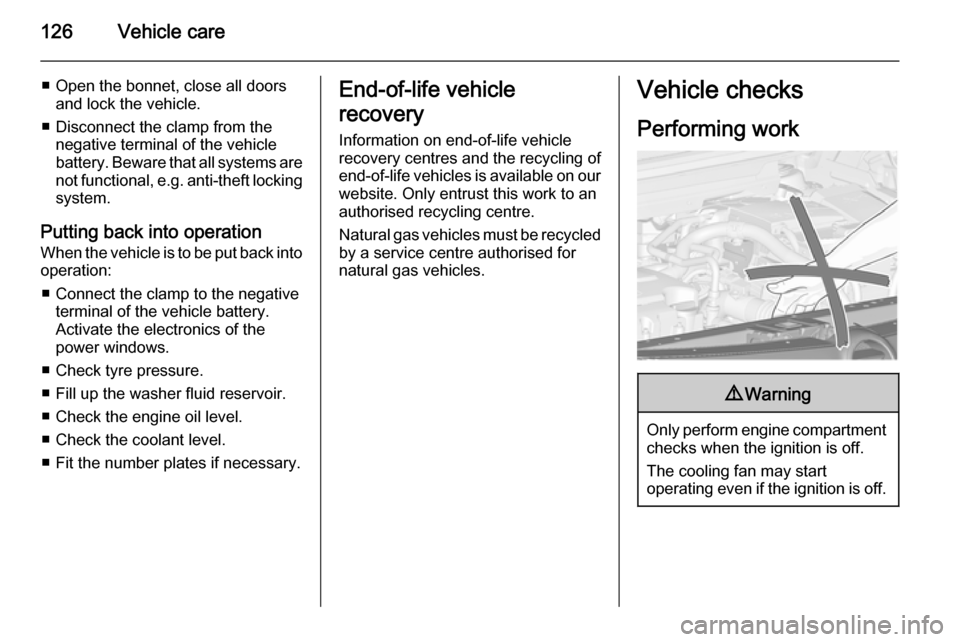
Performing work9 Warning
Only perform engine compartment
checks when the ignition is off.
The cooling fan may start
operating even if the ignition is off.
Page 138 of 187
136Vehicle careNumber plate lightTailgate
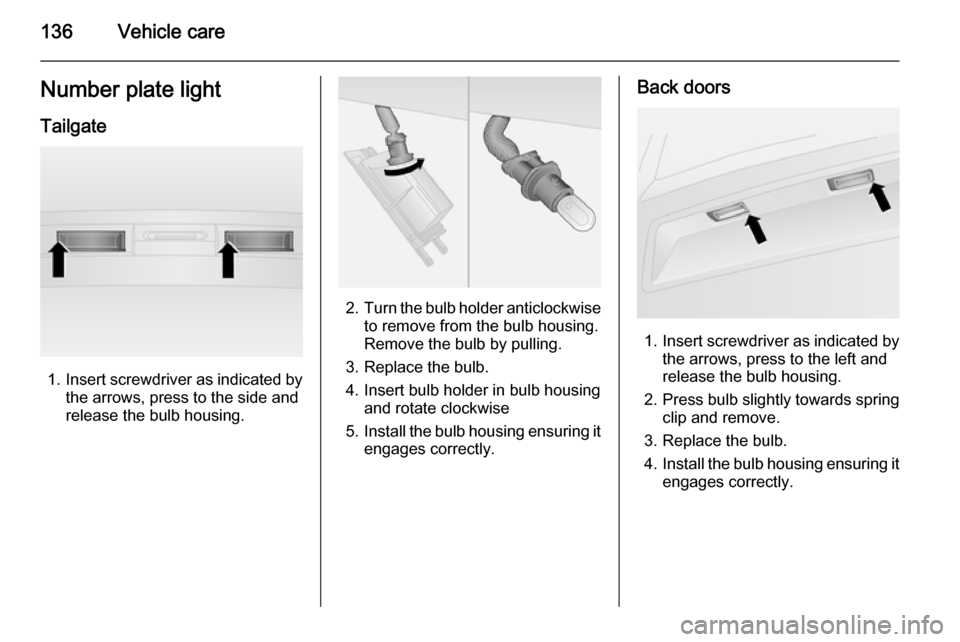
1. Insert screwdriver as indicated by
the arrows, press to the side and
release the bulb housing.
2. Turn the bulb holder anticlockwise
to remove from the bulb housing.
Remove the bulb by pulling.
3. Replace the bulb.
4. Insert bulb holder in bulb housing and rotate clockwise
5. Install the bulb housing ensuring it
engages correctly.
Back doors
1. Insert screwdriver as indicated by
the arrows, press to the left and
release the bulb housing.
2. Press bulb slightly towards spring
clip and remove.
3. Replace the bulb.
4. Install the bulb housing ensuring it
engages correctly.
Page 157 of 187

Vehicle care155Appearance care
Exterior care
Locks The locks are lubricated at the factoryusing a high quality lock cylinder
grease. Use de-icing agent only when
absolutely necessary, as this has a
degreasing effect and impairs lock function. After using de-icing agent,
have the locks regreased by a
workshop.
Washing The paintwork of your vehicle is
exposed to environmental influences.
Wash and wax your vehicle regularly.
When using automatic vehicle
washes, select a programme that
includes waxing.
Bird droppings, dead insects, resin,
pollen and the like should be cleaned off immediately, as they contain
aggressive constituents which can
cause paint damage.If using a vehicle wash, comply with
the vehicle wash manufacturer's
instructions. The windscreen wiper
and rear window wiper must be
switched off. Remove antenna and
external accessories such as roof
racks etc.
If you wash your vehicle by hand,
make sure that the insides of the
wheel housings are also thoroughly
rinsed out.
Clean edges and folds on opened
doors and the bonnet as well as the
areas they cover.Caution
Always use a cleaning agent with
a pH value of 4 to 9.
Do not use cleaning agents on hot surfaces.
Have the door hinges of all doors
greased by a workshop.
Do not clean the engine compartment with a steam-jet or high-pressure jet
cleaner.
Thoroughly rinse and leather-off the vehicle. Rinse leather frequently. Use
separate leathers for painted and
glass surfaces: remnants of wax on
the windows will impair vision.
Exterior lights
Headlight and other light covers are
made of plastic. Do not use any
abrasive or caustic agents, do not use an ice scraper, and do not clean them
dry.
Polishing and waxing Wax the vehicle regularly (at the
latest when water no longer beads).
Otherwise, the paintwork will dry out.
Polishing is necessary only if the paint
has become dull or if solid deposits
have become attached to it.
Paintwork polish with silicone forms a
protective film, making waxing
unnecessary.
Plastic body parts must not be treated with wax or polishing agents.
Page 180 of 187

178Customer information
When using the vehicle, situations
may occur in which technical data
related to other information (accident report, damages on the vehicle,
witness statements etc.) may be
associated with a specific person -
possibly, with the assistance of an
expert.
Additional functions contractually
agreed upon with the client (e.g.
vehicle location in emergency cases)
allow the transmission of particular vehicle data from the vehicle.
Radio Frequency
Identification (RFID)
RFID technology is used in some
vehicles for functions such as ignition system security. It is also used in
connection with conveniences such
as radio remote controls for door
locking/unlocking and starting, and in- vehicle transmitters for garage door
openers. RFID technology in
Vauxhall vehicles does not use or
record personal information or link
with any other Vauxhall system
containing personal information.
Page 183 of 187

181
Child safety system for rearwindows .................................... 29
Chimes ......................................... 85
Cigarette lighter ........................... 66
Climate control ............................. 14
Climate control systems ...............95
Clock....................................... 63, 79
Control indicators.......................... 70
Control of the vehicle .................101
Controls ........................................ 61
Convex shape .............................. 27
Coolant and antifreeze ...............159
Cruise control ...................... 79, 115
Cupholders .................................. 54
D
Danger, Warnings and Cautions ...3
Date .............................................. 79
Daytime running lights ............79, 89
Diesel particle filter ...............76, 106
Distance to next service ...............79
Door open .................................... 79
Doors ...................................... 23, 25
Drain fuel filter ............................. 78
Driver Information Centre .............79
Driving characteristics and towing tips .............................. 123
Driving hints ................................ 101E
Eco mode (E).............................. 111
Electric adjustment ......................27
Electrical system......................... 138
Electronic climate control system 97
Electronic driving programmes ..111
Electronic Stability Program 76, 114
End-of-life vehicle recovery .......126
Engine compartment fuse box ...139
Engine coolant ........................... 128
Engine coolant temperature ........76
Engine coolant temperature gauge ....................................... 69
Engine data ............................... 164
Engine exhaust .......................... 106
Engine oil ................... 127, 159, 162
Engine oil pressure ......................77
ESP (Electronic Stability Program) ................................. 114
Event data recorders ..................177
Extendable load compartment cover ................................... 55, 59
Exterior care .............................. 155
Exterior light ................................. 78
Exterior lighting ......................11, 88
Exterior mirrors ............................. 27F
Fault ........................................... 111
Fixed air vents ........................... 100
Fog light ....................................... 79
Folding ......................................... 28
Folding seats ................................ 55
Front airbag system .....................44
Front fog lights ............................. 90
Front seats.................................... 33
Front turn signal light ..................132
Fuel............................................. 118
Fuel consumption .........................79
Fuel consumption - CO 2-
Emissions ............................... 122
Fuel cut-off system ...............85, 103
Fuel for diesel engines ..............119
Fuel for natural gas operation ...119
Fuel for petrol engines ...............118
Fuel gauge ................................... 68
Fuel selector ................................ 69
Fuel system messages .................85
Fuses ......................................... 138
G Gauges ......................................... 67
General information ...................123
Generic warning ........................... 73
Glovebox ..................................... 54
Gross Vehicle Weight ...................59