transmission VAUXHALL COMBO 2014 User Guide
[x] Cancel search | Manufacturer: VAUXHALL, Model Year: 2014, Model line: COMBO, Model: VAUXHALL COMBO 2014Pages: 187, PDF Size: 4.15 MB
Page 111 of 187
Driving and operating109Selector lever
Always move the selector lever in the
appropriate direction as far as it will
go.
After selecting A/M, + or - and
releasing the selector lever, the lever
automatically returns to the centre
position.
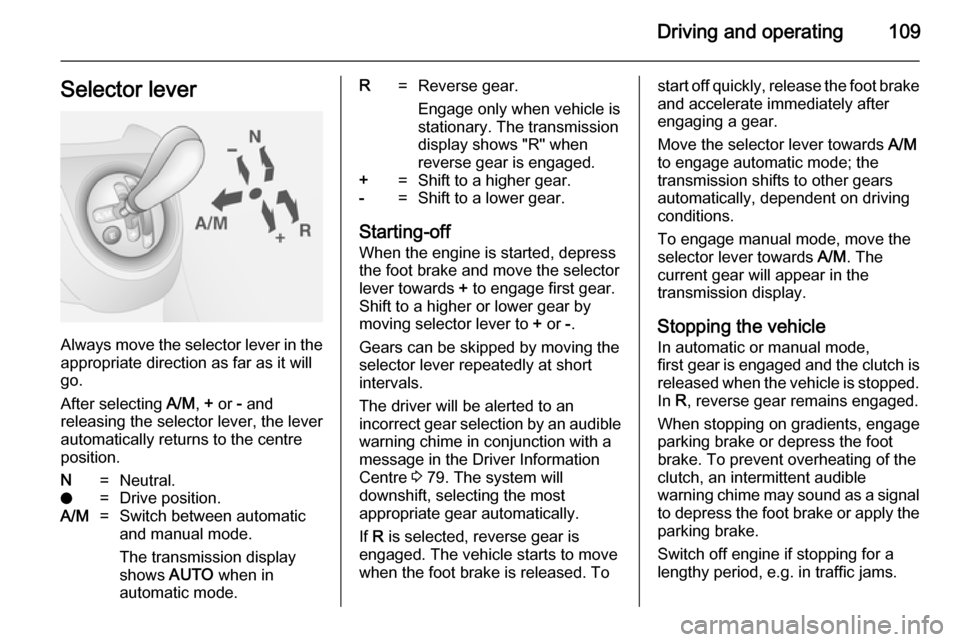
N=Neutral.o=Drive position.A/M=Switch between automatic
and manual mode.
The transmission display
shows AUTO when in
automatic mode.R=Reverse gear.
Engage only when vehicle is
stationary. The transmission
display shows "R" when
reverse gear is engaged.+=Shift to a higher gear.-=Shift to a lower gear.
Starting-off
When the engine is started, depress
the foot brake and move the selector
lever towards + to engage first gear.
Shift to a higher or lower gear by
moving selector lever to + or -.
Gears can be skipped by moving the selector lever repeatedly at short
intervals.
The driver will be alerted to an
incorrect gear selection by an audible warning chime in conjunction with a
message in the Driver Information
Centre 3 79. The system will
downshift, selecting the most
appropriate gear automatically.
If R is selected, reverse gear is
engaged. The vehicle starts to move
when the foot brake is released. To
start off quickly, release the foot brake
and accelerate immediately after
engaging a gear.
Move the selector lever towards A/M
to engage automatic mode; the
transmission shifts to other gears
automatically, dependent on driving
conditions.
To engage manual mode, move the
selector lever towards A/M. The
current gear will appear in the
transmission display.
Stopping the vehicle
In automatic or manual mode,
first gear is engaged and the clutch is
released when the vehicle is stopped. In R, reverse gear remains engaged.
When stopping on gradients, engage parking brake or depress the foot
brake. To prevent overheating of the
clutch, an intermittent audible
warning chime may sound as a signal
to depress the foot brake or apply the
parking brake.
Switch off engine if stopping for a
lengthy period, e.g. in traffic jams.
Page 112 of 187

110Driving and operating
When the vehicle is parked and the
driver's door is opened, a warning
chime will sound if neutral is not
selected or the foot brake has not
been depressed.
Engine braking
Automatic mode
When driving downhill, the manual
transmission automated does not
shift into higher gears until a fairly
high engine speed has been reached. It shifts down in good time when
braking.
Manual mode
To utilise the engine braking effect,
select a lower gear in good time when driving downhill.Rocking the vehicle
Rocking the vehicle is only
permissible if the vehicle is stuck in
sand, mud, snow or a hole. Move the
selector lever between R and A/M (or
between + and -) in a repeat pattern,
while applying light pressure to the
accelerator pedal. Do not race the
engine and avoid sudden
acceleration.
Parking
Apply the parking brake. The most recently engaged gear (see
transmission display) remains
engaged. With N, no gear is engaged.
When the ignition is switched off, the transmission no longer responds to
movement of the selector lever.
If the ignition is not switched off, or the
parking brake has not been applied, a warning chime will sound upon
opening the driver's door.Manual mode
If engine speed is too low, the
transmission automatically shifts to a
lower gear.
In manual mode, no automatic
shifting to a higher gear takes place
at high engine revolutions. If engine
speed is too high, the transmission
only switches to a higher gear via
kickdown.
Kickdown 3 111.
Page 113 of 187

Driving and operating111Electronic driving
programmes
Eco mode E
When automatic mode is engaged,
the Eco mode can be selected to
reduce fuel consumption.
Eco mode selects the most suitable gear depending on the speed of the
vehicle, the engine speed and the
intensity with which the accelerator is pressed.
Activation
Press the E button on the selector
lever housing. Control indicator E is
shown in the transmission display to
indicate activation.
Deactivation
Eco mode is switched off by:
■ pressing the E button again,
■ switching to manual mode.
In order to protect the transmission at
extremely high clutch temperatures,
an intermittent audible warning chime may sound. In such cases, depress
the foot brake, select N and apply the
parking brake to allow the clutch to
cool down.
Kickdown
If the accelerator pedal is pressed
past the pressure point, the
transmission shifts to a lower gear
depending on engine speed. Full
engine power is available for
acceleration.If engine speed is too high the
transmission switches to a higher
gear, even in manual mode. Without
kickdown this automatic shift is not
effected in manual mode.
Fault In the event of a fault, control indicator
Ñ is shown in the transmission
display.
Continued driving is possible,
provided the vehicle is driven with
care and anticipation. A warning
message may appear in the Driver
Information Centre in conjunction with
a warning chime 3 85.
Notice
The volume of the warning chime
can also be adjusted via the Driver
Information Centre 3 79.
Have the cause of the fault remedied
by a workshop.
Page 154 of 187

152Vehicle careJump startingDo not start with quick charger.
A vehicle with a discharged battery
can be started using jump leads and the battery of another vehicle.9 Warning
Be extremely careful when starting
with jump leads. Any deviation
from the following instructions can
lead to injuries or damage caused
by battery explosion or damage to the electrical systems of both
vehicles.
9 Warning
Avoid contact of the battery with
eyes, skin, fabrics and painted
surfaces. The fluid contains
sulphuric acid which can cause
injuries and damage in the event
of direct contact.
■ Never expose the battery to naked flames or sparks.
■ A discharged battery can alreadyfreeze at a temperature of 0 °C.
Defrost the frozen battery before
connecting jump leads.
■ Wear eye protection and protective
clothing when handling a battery.
■ Use a booster battery with the same voltage (12 Volts). Its
capacity (Ah) must not be much less than that of the discharged
battery.
■ Use jump leads with insulated terminals and a cross section of at
least 16 mm 2
(25 mm 2
for diesel
engines).
■ Do not disconnect the discharged battery from the vehicle.
■ Switch off all unnecessary electrical
consumers.
■ Do not lean over the battery during jump starting.
■ Do not allow the terminals of one lead to touch those of the other
lead.■ The vehicles must not come into contact with each other during the
jump starting process.
■ Apply the parking brake, transmission in neutral.
Lead connection order:
1. Connect the red lead to the positive terminal of the booster
battery.
2. Connect the other end of the red lead to the positive terminal of the
discharged battery.
Page 156 of 187
154Vehicle careCaution
The towing eye must only be usedfor towing and not for recovering
the vehicle.
Switch on ignition to release steering
wheel lock and to permit operation of
brake lights, horn and windscreen
wiper.
Transmission in neutral.
Notice
If neutral cannot be selected on
vehicles with manual transmission
automated (MTA), the vehicle must
only be towed with the drive wheels
raised off the ground.
Caution
Drive slowly. Do not drive jerkily.
Excessive tractive force can
damage the vehicle.
When the engine is not running,
considerably more force is needed to
brake and steer.
To prevent the entry of exhaust gases from the towing vehicle, switch on the
air recirculation and close the
windows.
Seek the assistance of a workshop.
After towing, unscrew the towing eye
and replace the cap.
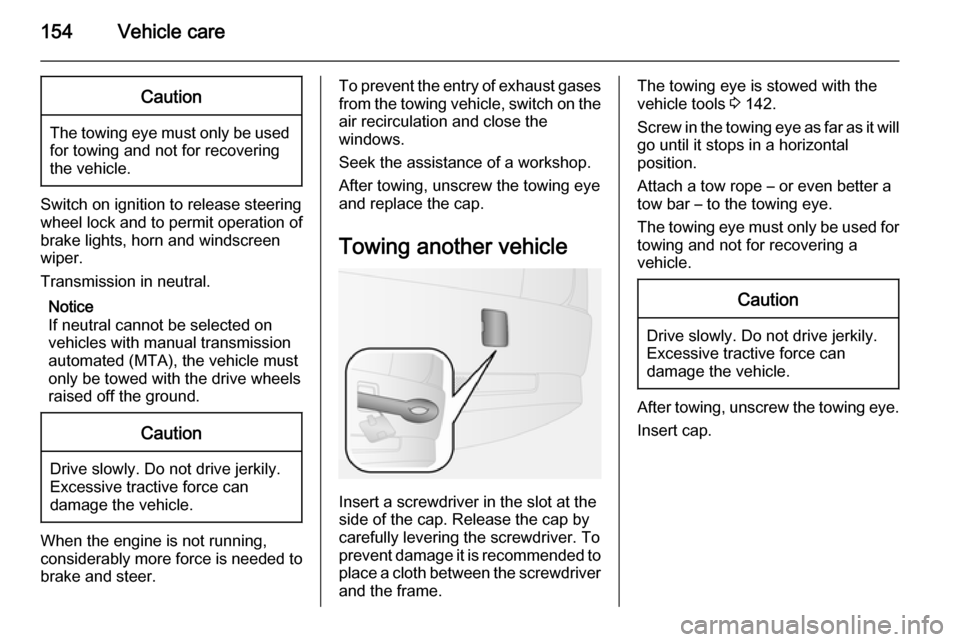
Towing another vehicle
Insert a screwdriver in the slot at the
side of the cap. Release the cap by
carefully levering the screwdriver. To
prevent damage it is recommended to place a cloth between the screwdriver
and the frame.
The towing eye is stowed with the vehicle tools 3 142.
Screw in the towing eye as far as it will
go until it stops in a horizontal
position.
Attach a tow rope – or even better a tow bar – to the towing eye.
The towing eye must only be used for
towing and not for recovering a
vehicle.Caution
Drive slowly. Do not drive jerkily.
Excessive tractive force can
damage the vehicle.
After towing, unscrew the towing eye.
Insert cap.
Page 167 of 187
![VAUXHALL COMBO 2014 User Guide Technical data165
Sales designation1.3 Turbo1.6 Turbo2.0 TurboEngine identifier code1.3CDTI1.6CDTI1)2.0CDTINumber of cylinders444Piston displacement [cm 3
]124815981956Engine power [kW]6666 / 7799at r](/img/38/19395/w960_19395-166.png "VAUXHALL COMBO 2014 User Guide Technical data165
Sales designation1.3 Turbo1.6 Turbo2.0 TurboEngine identifier code1.3CDTI1.6CDTI1)2.0CDTINumber of cylinders444Piston displacement [cm 3
]124815981956Engine power [kW]6666 / 7799at r")
Technical data165
Sales designation1.3 Turbo1.6 Turbo2.0 TurboEngine identifier code1.3CDTI1.6CDTI1)2.0CDTINumber of cylinders444Piston displacement [cm 3
]124815981956Engine power [kW]6666 / 7799at rpm400040003500Torque [Nm]200200 2)
/ 290320at rpm150015001500Fuel typeDieselDieselDieselOil consumption [l/1000 km]0.60.60.61) Low / High output.
2) Vehicles with manual transmission automated (MTA).
Page 168 of 187

166Technical dataPerformance
The maximum speed indicated is achievable at kerb weight (without driver) plus 200 kg payload. Optional equipment could reduce the specified maximum speed of the vehicle.Engine1.4i1.4Turbo1.4CNGMaximum speed [mph]Manual transmission100107107Manual transmission automated–––Engine1.3CDTI1.6CDTI 3)2.0CDTIMaximum speed [mph]Manual transmission98 / 955)102 / 98 4)
/ 95 5)111Manual transmission automated– / –– / 98 4)
/ 95 5)–3)
Low / High output.
5) High roof version.
4) Low roof version.
Page 180 of 187

178Customer information
When using the vehicle, situations
may occur in which technical data
related to other information (accident report, damages on the vehicle,
witness statements etc.) may be
associated with a specific person -
possibly, with the assistance of an
expert.
Additional functions contractually
agreed upon with the client (e.g.
vehicle location in emergency cases)
allow the transmission of particular vehicle data from the vehicle.
Radio Frequency
Identification (RFID)
RFID technology is used in some
vehicles for functions such as ignition system security. It is also used in
connection with conveniences such
as radio remote controls for door
locking/unlocking and starting, and in- vehicle transmitters for garage door
openers. RFID technology in
Vauxhall vehicles does not use or
record personal information or link
with any other Vauxhall system
containing personal information.
Page 184 of 187

182
HHalogen headlights ....................132
Hand brake ................................. 112
Hazard warning flashers ..............90
Headlight flash ............................. 88
Headlight range adjustment ........89
Headlights..................................... 88
Headlights when driving abroad ..89
Head restraint adjustment .............8
Head restraints ............................ 32
Heated mirrors ............................. 28
Heated rear window ..................... 31
Heating ........................................ 35
Heating and ventilation system ...95
High beam ............................. 79, 88
Hill start assist ...................... 75, 113
Horn ....................................... 13, 62
I
Identification plate .....................161
Ignition switch positions .............102
Immobiliser ............................ 26, 78
Indicators ...................................... 67
Information displays...................... 79
Instrument cluster ........................67
Instrument panel fuse box .........140
Instrument panel illumination .....138
Instrument panel illumination control ...................................... 91Instrument panel overview ........... 10
Instrument panel storage ..............53
Interior care ............................... 156
Interior lighting ........................ 79, 91
Interior lights ........................ 92, 137
Interior mirrors .............................. 28
Introduction .................................... 3
ISOFIX child restraint systems ....52
J
Jump starting ............................. 152
K Kerb weight................................... 59Keys ............................................. 19
Keys, locks ................................... 19
L
Language ..................................... 79
Lashing eyes ......................... 58, 59
Light switch .................................. 88
Load compartment ................25, 55
Load compartment cover .............55
Load compartment lighting ...........93
Loading ......................................... 55
Loading information .....................59
Low engine oil level .....................78
Low fuel ....................................... 78M
Malfunction indicator light ............74
Manual adjustment ......................27
Manual anti-dazzle ......................28
Manual mode ............................. 110
Manual transmission .................. 107
Manual transmission automated 108
Manual windows ..........................29
Mirror adjustment ........................... 8
Misted light covers .......................91
Multifunction display .....................79
N New vehicle running-in ..............101
Number plate light .....................136
O Object detection systems ...........116
Odometer ..................................... 67
Oil, engine .......................... 159, 162
Operating windows from outside ..29
Outside temperature ....................63
Overhead console .......................54
Overrun cut-off ........................... 103
P Parking ................................ 17, 105
Parking assist ............................ 116
Parking brake ............................ 112
Particulate filter ........................... 106
Page 185 of 187

183
Payload......................................... 59
Performance .............................. 166
Performing work ........................126
Pollen filter ................................. 100
Power outlets ............................... 65
Power steering fluid ....................129
Power windows ............................ 29
Preheating ................................... 76
Puncture ..................................... 147
R
Radio Frequency Identification (RFID) ..................................... 178
Radio info ..................................... 79
Radio remote control ...................20
Rear doors ................................... 23
Rear fog light ............................... 79
Rear fog lights ............................. 91
Rear parcel shelf .......................... 55
Rear seats ............................. 36, 55
Rear windows .............................. 31
Rear window wiper/washer .......... 63
Recommended fluids and lubricants ........................ 159, 162
Refuelling ................................... 120 Reversing lights ........................... 91
Ride control systems ..........113, 114
Roof load ...................................... 59
Roof rack ..................................... 58
Roof racks .................................... 59S
Safety belts ................................... 38
Seat adjustment ....................... 7, 33
Seat belt ........................................ 8
Seat belt reminder .......................73
Seat belt reminder warning chime 79
Seat belts ..................................... 38
Seat position ................................ 33
Selector lever ............................. 109
Service ............................... 100, 158
Service display ......................70, 79
Service information ....................158
Settings menu............................... 79
Side airbag system ......................45
Sidelights ...................................... 88
Side turn signal lights ................135
Sliding door .................................. 23
Sliding side door ........................... 23
Spare wheel ............................... 149
Speed limit warning chime............ 79
Speedometer ............................... 67
Standard display ........................... 79
Starting and operating ................101
Starting off ................................... 16
Starting the engine ............102, 108
Steering wheel adjustment ......9, 61
Steering wheel controls ...............61
Stop-start system.................. 78, 103
Storage ......................................... 53Storage compartments.................53
Sun visors .................................... 31
Symbols ......................................... 4
T
Tachometer ................................. 68
Tailgate ......................................... 25
Tail lights ................................... 134
Temperature ................................. 79
Three-point seat belt .................... 39 Tools .......................................... 142
Top-tether fastening eyes ............52
Towing ................................ 123, 153
Towing another vehicle .............154
Towing the vehicle .....................153
Traction Control system ............. 113
Trailer coupling ........................... 123
Trailer towing ............................. 123
Transmission ............................... 15
Transmission display .................108
Tread depth ............................... 143
Trip computer ......................... 79, 86
Trip odometer .............................. 67
Turn and lane-change signals .....90
Turn signal ................................... 73
Tyre chains ................................ 144
Tyre designations ......................143
Tyre pressure ............................ 143
Tyre pressures ........................... 174
Tyre repair kit ............................. 145