wheel VAUXHALL COMBO 2014 User Guide
[x] Cancel search | Manufacturer: VAUXHALL, Model Year: 2014, Model line: COMBO, Model: VAUXHALL COMBO 2014Pages: 187, PDF Size: 4.15 MB
Page 63 of 187
Instruments and controls61Instruments and
controlsControls ....................................... 61
Warning lights, gauges and indi‐ cators ........................................... 67
Information displays .....................79
Vehicle messages ........................ 85
Trip computer ............................... 86Controls
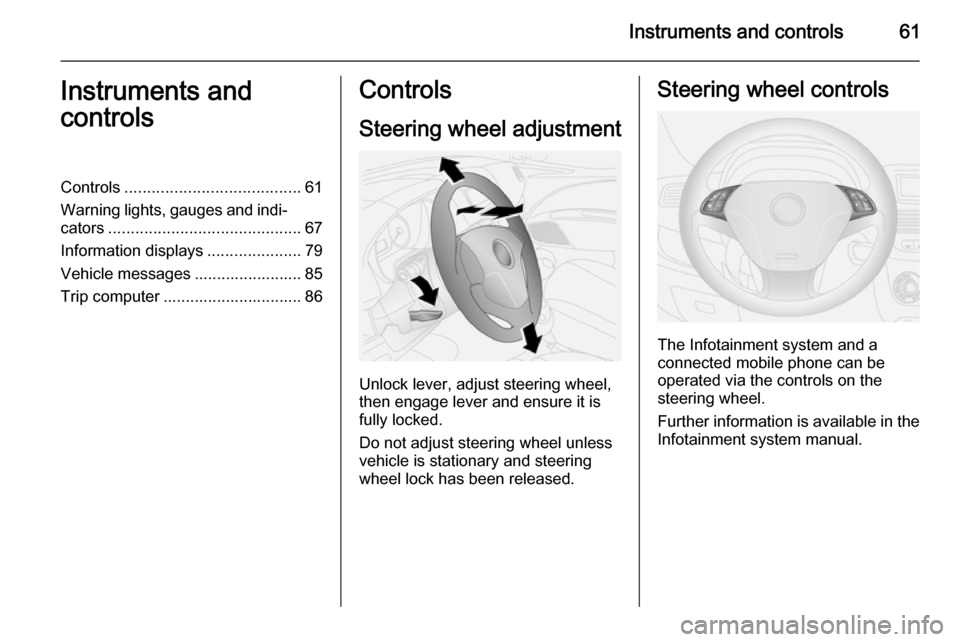
Steering wheel adjustment
Unlock lever, adjust steering wheel,
then engage lever and ensure it is fully locked.
Do not adjust steering wheel unless
vehicle is stationary and steering
wheel lock has been released.
Steering wheel controls
The Infotainment system and a
connected mobile phone can be
operated via the controls on the
steering wheel.
Further information is available in the
Infotainment system manual.
Page 68 of 187
66Instruments and controls
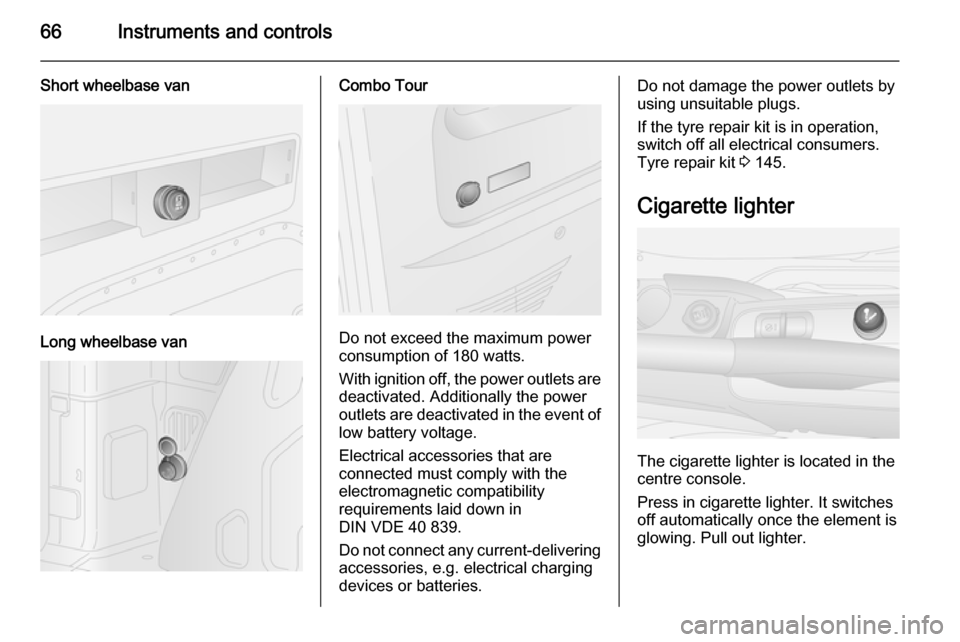
Short wheelbase van
Long wheelbase van
Combo Tour
Do not exceed the maximum power
consumption of 180 watts.
With ignition off, the power outlets are
deactivated. Additionally the power
outlets are deactivated in the event of
low battery voltage.
Electrical accessories that are
connected must comply with the
electromagnetic compatibility
requirements laid down in
DIN VDE 40 839.
Do not connect any current-delivering
accessories, e.g. electrical charging
devices or batteries.
Do not damage the power outlets by
using unsuitable plugs.
If the tyre repair kit is in operation,
switch off all electrical consumers.
Tyre repair kit 3 145.
Cigarette lighter
The cigarette lighter is located in the
centre console.
Press in cigarette lighter. It switches off automatically once the element is
glowing. Pull out lighter.
Page 79 of 187
Instruments and controls77
Continue driving until
[ extinguishes. If possible, do not
allow engine speed to drop below
2000 rpm.
Illuminates The diesel particle filter is full. Start
cleaning process as soon as
possible.
Diesel particle filter 3 106, Stop-start
system 3 103.
Engine oil pressure
I illuminates red.
Illuminates when the ignition is
switched on and extinguishes shortly
after the engine starts.
Illuminates when the engine is runningCaution
Engine lubrication may be
interrupted. This may result in
damage to the engine and/or
locking of the drive wheels.
1. Depress clutch.
2. Select neutral gear (or move selector lever to N).
3. Move out of the flow of traffic as quickly as possible without
impeding other vehicles.
4. Switch off ignition.9 Warning
When the engine is off,
considerably more force is needed
to brake and steer. During an
Autostop the brake servo unit will still be operational.
Do not remove key until vehicle is stationary, otherwise the steeringwheel lock could engage
unexpectedly.
Check oil level before seeking the
assistance of a workshop 3 127.
Change engine oil
Diesel engines with dieselparticle filter
I flashes red.
Illuminates when the ignition is
switched on and extinguishes shortly
after the engine starts.
The engine oil life monitor lets you know when to change the oil. Control
indicator I will flash, together with a
message in the Driver Information
Centre, to indicate that engine oil life
has been diminished and the oil
needs changing.
Based on driving conditions, the
interval at which an oil change will be
indicated can vary considerably.
Depending on model variant, I may
flash in the following ways:
■ for 1 minute every 2 hours, or
■ for 3 minute cycles with I off for
intervals of 5 seconds.
Page 92 of 187

90LightingHazard warning flashers
Operated with the ¨ button.
Turn and lane-change
signalsLever up=right turn signalLever down=left turn signal
If the lever is moved past the
resistance point, the turn signal is
switched on constantly. When the
steering wheel moves back, the turn
signal is automatically deactivated.
For five flashes, e.g. when changing
lanes, press the lever until resistance is felt and then release.
Move the lever to the resistance point
and hold for longer indication.
Switch the indicator off manually by
moving the lever to its original
position.
Front fog lights
Operated by pressing the > button.
Switching on front fog lights will
switch sidelights on automatically.
Press the button again to turn the
front fog lights off.
Page 104 of 187
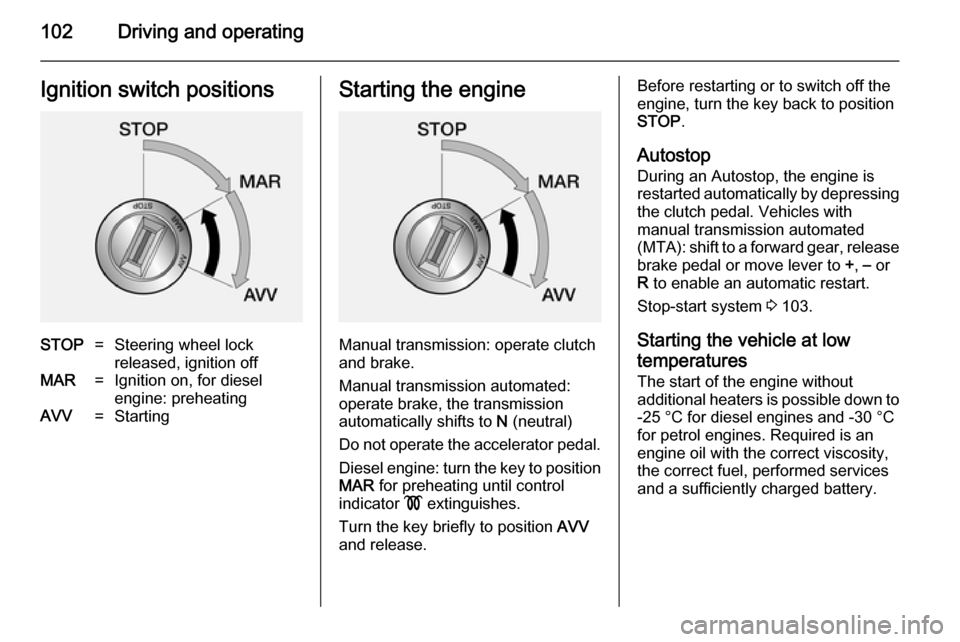
102Driving and operatingIgnition switch positionsSTOP=Steering wheel lock
released, ignition offMAR=Ignition on, for diesel
engine: preheatingAVV=StartingStarting the engine
Manual transmission: operate clutch
and brake.
Manual transmission automated: operate brake, the transmission
automatically shifts to N (neutral)
Do not operate the accelerator pedal. Diesel engine: turn the key to positionMAR for preheating until control
indicator ! extinguishes.
Turn the key briefly to position AVV
and release.
Before restarting or to switch off the
engine, turn the key back to position
STOP .
Autostop
During an Autostop, the engine is
restarted automatically by depressing the clutch pedal. Vehicles with
manual transmission automated
(MTA): shift to a forward gear, release
brake pedal or move lever to +, – or
R to enable an automatic restart.
Stop-start system 3 103.
Starting the vehicle at low
temperatures The start of the engine without
additional heaters is possible down to
-25 °С for diesel engines and -30 °C
for petrol engines. Required is an
engine oil with the correct viscosity,
the correct fuel, performed services
and a sufficiently charged battery.
Page 107 of 187

Driving and operating105
■ the ambient temperature is not toolow
■ the climate control system allows an Autostop
■ the self-cleaning function of the diesel particle filter is not active
■ the vehicle has moved since the last Autostop
■ the brake vacuum is sufficient
■ the windscreen wipers are not operating at fast speed
■ reverse gear is not selected
■ heated rear window is not operating
Ambient temperature near to the
freezing point can inhibit an Autostop.
For manual transmission automated
vehicles, an Autostop may be
inhibited until a speed of approx.
6 mph is reached.
New vehicle running-in 3 101.
Battery discharge protection
To ensure reliable engine restarts, several battery discharge protection
features are implemented as part of
the stop-start system.Restart the engine
Manual transmission
The selector lever must be in neutral to enable an automatic restart.
Depress the clutch pedal to restart the
engine.
Manual transmission automated
If the lever is in position N, select
another gear, otherwise release the brake pedal or move the lever to +, –
or R to enable an automatic restart.
When one of the following conditions
occurs during an Autostop, the
engine will need to be restarted
manually using the key.
■ the driver's seat belt is unfastened and the driver's door is opened
■ three minutes have elapsed since the engine was switched off
If an electrical accessory, e.g. a
portable CD player, is connected to
the power outlet, a brief power drop
during the restart may be noticeable.Parking
■ Do not park the vehicle on an easily
ignitable surface. The high
temperature of the exhaust system
could ignite the surface.
■ Always apply parking brake. Apply manual parking brake without
pressing release button. Apply as
firmly as possible on downhill or uphill slopes. Depress the foot
brake at the same time to reduce
operating force.
■ Switch off the engine and ignition. Turn the steering wheel until the
steering wheel lock engages.
■ If the vehicle is on a level surface or
uphill slope, engage first gear. On
an uphill slope, turn the front
wheels away from the kerb.
If the vehicle is on a downhill slope, engage reverse gear. Turn the front
wheels towards the kerb.
■ Lock the vehicle.
Page 114 of 187
112Driving and operatingBrakes
The brake system comprises two
independent brake circuits.
If a brake circuit fails, the vehicle can
still be braked using the other brake
circuit. However, braking effect is
achieved only when the brake pedal
is depressed firmly. Considerably
more force is needed for this. The
braking distance is extended. Seek the assistance of a workshop before
continuing your journey.
When the engine is not running, the
support of the brake servo unit
disappears once the brake pedal has been depressed once or twice.
Braking effect is not reduced, but
braking requires significantly greater
force. It is especially important to bear this in mind when being towed.
Control indicator R 3 74.
Antilock brake system Antilock brake system (ABS)
prevents the wheels from locking.ABS starts to regulate brake pressure as soon as a wheel shows a tendency
to lock. The vehicle remains
steerable, even during hard braking.
ABS control is made apparent
through a pulse in the brake pedal
and the noise of the regulation
process.
For optimum braking, keep the brake
pedal fully depressed throughout the
braking process, despite the fact that
the pedal is pulsating. Do not reduce
the pressure on the pedal.
After starting off the system performs a self-test which may be audible.
Control indicator u 3 75.
Fault9 Warning
If there is a fault in the ABS, the
wheels may be liable to lock due
to braking that is heavier than
normal. The advantages of ABS are no longer available. During
hard braking, the vehicle can nolonger be steered and may
swerve.
Have the cause of the fault remedied
by a workshop.
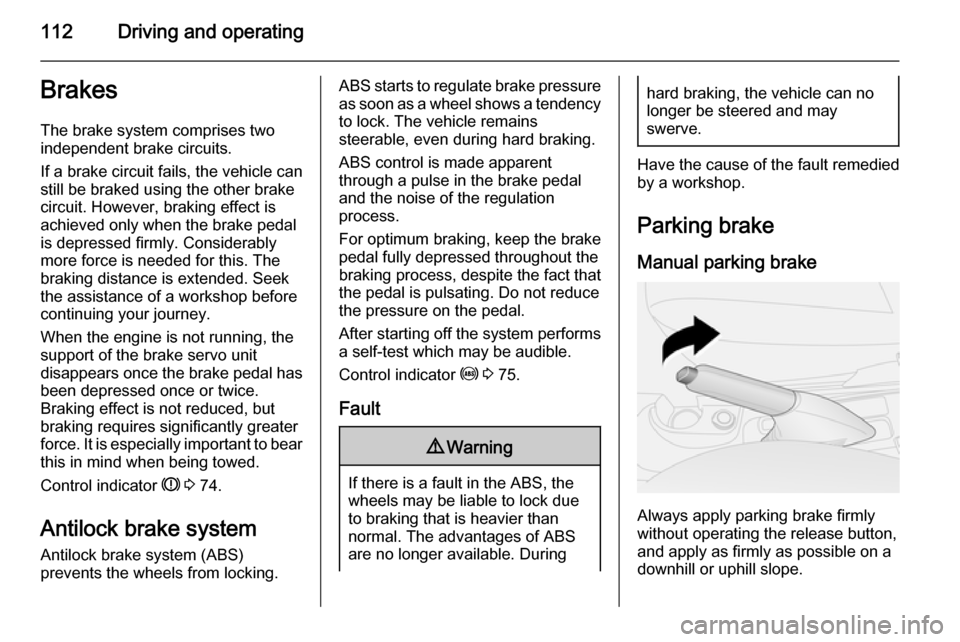
Parking brake Manual parking brake
Always apply parking brake firmly
without operating the release button,
and apply as firmly as possible on a
downhill or uphill slope.
Page 115 of 187

Driving and operating113
To release the parking brake, pull thelever up slightly, press the release
button and fully lower the lever.
To reduce the operating forces of the
parking brake, depress the foot brake
at the same time.
A warning chime will sound if a certain speed is exceeded with the parking
brake applied.
Notice
The volume of the warning chime
can also be adjusted via the Driver
Information Centre 3 79.
Control indicator R 3 74.
Brake assist
If the brake pedal is depressed
quickly and forcefully, maximum
brake force is automatically applied
(full braking).
Maintain steady pressure on the
brake pedal for as long as full braking is required. Maximum brake force is
automatically reduced when the
brake pedal is released.Hill start assist
The system helps prevent unintendedmovement when driving away on
inclines.
When releasing the foot brake after
stopping on an incline, the brakes
remain on for a further two seconds.
The brakes release automatically as
soon as the vehicle begins to
accelerate.
If control indicator Z illuminates
while driving, there is a fault in the Hill
start assist 3 75 . Seek the assistance
of a workshop to have the fault
remedied.
The Hill start assist is not active
during an Autostop.
Stop-start system 3 103.Ride control systems
Traction Control system
The Anti-Slip Regulator (ASR) is a
component of the Electronic Stability
Program (ESP).
ASR improves driving stability when
necessary, regardless of the type of
road surface or tyre grip, by
preventing the drive wheels from
spinning.
As soon as the drive wheels starts to spin, engine output is reduced and
the wheel spinning the most is braked
individually. This considerably
improves the driving stability of the
vehicle on slippery road surfaces.
ASR is operational as soon as the
control indicator x extinguishes.
When ASR is active, control indicator x flashes.
Page 116 of 187

114Driving and operating9Warning
Do not let this special safety
feature tempt you into taking risks
when driving.
Adapt speed to the road
conditions.
Deactivation
ASR can be switched off when
spinning of drive wheels is required:
press button ASR OFF briefly.
LED in button illuminates and a
message appears in the Driver
Information Centre.
ASR is reactivated by pressing the
ASR OFF button again.
ASR is also reactivated the next time
the ignition is switched on.
Fault ASR will switch off automatically in
the event of a fault. Control indicator
x will illuminate in the instrument
cluster in conjunction with a message
in the Driver Information Centre 3 79.
Have the cause of the fault remedied
by a workshop.
Control indicator x 3 76.
Electronic stability
program
Electronic Stability Program (ESP)
improves driving stability when
necessary, regardless of the type of
road surface or tyre grip. It also
prevents the drive wheels from
spinning.
As soon as the vehicle starts to
swerve (understeer/oversteer),
engine output is reduced and the wheels are braked individually. Thisconsiderably improves the driving
stability of the vehicle on slippery road
surfaces.
ESP is operational as soon as control
indicator x extinguishes.
When ESP comes into action, control indicator x flashes.
The ESP system is automatically
activated when the vehicle is started
and cannot be deactivated9 Warning
Do not let this special safety
feature tempt you into taking risks
when driving.
Adapt speed to the road
conditions.
Fault
In the event of a fault, ESP will be
automatically switched off and control
indicator x will illuminate in the
instrument cluster in conjunction with
a message in the Driver Information
Centre 3 79. The LED in the ASR
OFF button will also illuminate.
Page 127 of 187

Vehicle care125Vehicle careGeneral Information...................125
Vehicle checks ........................... 126
Bulb replacement .......................132
Electrical system ........................138
Vehicle tools .............................. 142
Wheels and tyres .......................142
Jump starting ............................. 152
Towing ....................................... 153
Appearance care .......................155General Information
Accessories and vehicle
modifications
We recommend the use of genuine parts and accessories and factory
approved parts specific for your
vehicle type. We cannot assess or
guarantee reliability of other products
- even if they have a regulatory or
otherwise granted approval.
Do not make any modifications to the electrical system, e.g. changes of
electronic control units (chip tuning).Caution
When transporting the vehicle on
a train or on a recovery vehicle, the
mud flaps might be damaged.
Vehicle storage
Storage for a long period of time
If the vehicle is to be stored for several months:
■ Wash and wax the vehicle.
■ Have the wax in the engine compartment and underbody
checked.
■ Clean and preserve the rubber seals.
■ Fill up fuel tank completely.
■ Change the engine oil.
■ Drain the washer fluid reservoir.
■ Check the coolant antifreeze and corrosion protection.
■ Adjust tyre pressure to the value specified for full load.
■ Park the vehicle in a dry, well ventilated place. Engage first orreverse gear to prevent the vehicle
from rolling.
■ Do not apply the parking brake.