tow VAUXHALL COMBO 2015 Owner's Guide
[x] Cancel search | Manufacturer: VAUXHALL, Model Year: 2015, Model line: COMBO, Model: VAUXHALL COMBO 2015Pages: 183, PDF Size: 4.28 MB
Page 140 of 183

138Vehicle care
Back doors
1.Insert screwdriver as indicated by
the arrows, press to the left and
release the bulb housing.
2. Press bulb slightly towards spring
clip and remove.
3. Replace the bulb.
4. Install the bulb housing ensuring it
engages correctly.
Interior lights
Front and rear courtesy light
1. Remove lens using a flat blade screwdriver.
2. Open the rear cover. 3. Renew bulb.
4. Close rear cover.
5. Reinstall lens.
Front courtesy light, reading
lights
1. Remove lens using a flat blade screwdriver.
2. Open the rear cover. 3. Renew bulbs.
4. Close rear cover.
5. Reinstall lens.
Page 151 of 183
Vehicle care149
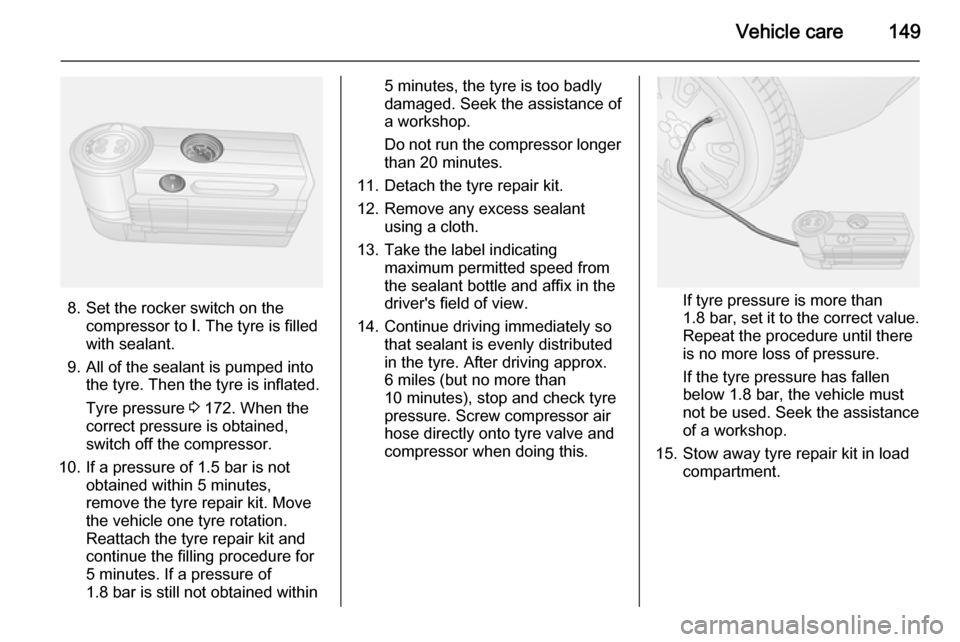
8. Set the rocker switch on thecompressor to I. The tyre is filled
with sealant.
9. All of the sealant is pumped into the tyre. Then the tyre is inflated.
Tyre pressure 3 172. When the
correct pressure is obtained,
switch off the compressor.
10. If a pressure of 1.5 bar is not obtained within 5 minutes,
remove the tyre repair kit. Move
the vehicle one tyre rotation.
Reattach the tyre repair kit and
continue the filling procedure for 5 minutes. If a pressure of
1.8 bar is still not obtained within
5 minutes, the tyre is too badly
damaged. Seek the assistance of
a workshop.
Do not run the compressor longer
than 20 minutes.
11. Detach the tyre repair kit.
12. Remove any excess sealant using a cloth.
13. Take the label indicating maximum permitted speed from
the sealant bottle and affix in the
driver's field of view.
14. Continue driving immediately so that sealant is evenly distributed
in the tyre. After driving approx.
6 miles (but no more than 10 minutes), stop and check tyre
pressure. Screw compressor air
hose directly onto tyre valve and
compressor when doing this.
If tyre pressure is more than 1.8 bar , set it to the correct value.
Repeat the procedure until there
is no more loss of pressure.
If the tyre pressure has fallen
below 1.8 bar, the vehicle must
not be used. Seek the assistance
of a workshop.
15. Stow away tyre repair kit in load compartment.
Page 154 of 183

152Vehicle care
With the jack correctly aligned,
rotate until wheel is clear of the
ground.
5. Unscrew the wheel nuts. 6. Change the wheel. Spare wheel 3 152.
7. Screw on the wheel nuts.
8. Lower vehicle.
9. Install the wheel wrench ensuring that it locates securely and tighten
each nut in a crosswise
sequence. Tightening torque is
85 Nm (steel wheel) or 120 Nm
(alloy wheel).
10. Align the valve hole in the wheel cover with the tyre valve before
installing.
Install wheel nut caps.
11. Stow the replaced wheel 3 152
and the vehicle tools 3 143.
12. Check the tyre pressure of the installed tyre and the wheel nut
torque as soon as possible.
Have the defective tyre renewed or
repaired as soon as possible.Spare wheel
Some vehicles are equipped with a tyre repair kit 3 148 instead of a spare
wheel.
The spare wheel can be classified as a temporary spare wheel depending
on the size compared to the other
mounted wheels and country
regulations.Caution
The use of a spare wheel that is smaller than the other wheels or in combination with winter tyres
could affect driveability. Have the defective tyre replaced as soon as
possible.Depending on model variant, the
spare wheel is stored beneath the
floor or in the load compartment.
1. Attach the extension bar 2 to the
wheel wrench 1. Vehicle tools
3 143.
Page 158 of 183

156Vehicle care
3. Connect the black lead to thenegative terminal of the booster
battery.
4. Connect the other end of the black
lead to a vehicle grounding point,
such as the engine block or an
engine mounting bolt. Connect as far away from the discharged
battery as possible, however at
least 60 cm.
Route the leads so that they cannot
catch on rotating parts in the engine
compartment.
To start the engine: 1. Start the engine of the vehicle providing the jump.
2. After 5 minutes, start the other engine. Start attempts should be
made for no longer than
15 seconds at an interval of 1 minute.
3. Allow both engines to idle for approx. 3 minutes with the leads
connected.4. Switch on electrical consumers (e.g. headlights, heated rear
window) of the vehicle receiving
the jump start.
5. Reverse above sequence exactly when removing leads.Towing
Towing the vehicle
Release the cap by carefully lifting
with a screwdriver. To prevent
damage, it is recommended to place
a cloth between the screwdriver and
the frame.
The towing eye is stowed with the vehicle tools 3 143.
Screw in the towing eye as far as it will
go until it stops in a horizontal
position.
Attach a tow rope – or better still a tow
rod – to the towing eye.
Page 159 of 183

Vehicle care157Caution
The towing eye must only be usedfor towing and not for recovering
the vehicle.
Switch on ignition to release steering
wheel lock and to permit operation of
brake lights, horn and windscreen
wiper.
Transmission in neutral.
Notice
If neutral cannot be selected on
vehicles with manual transmission
automated (MTA), the vehicle must
only be towed with the drive wheels
raised off the ground.
Caution
Drive slowly. Do not drive jerkily.
Excessive tractive force can
damage the vehicle.
When the engine is not running,
considerably more force is needed to
brake and steer.
To prevent the entry of exhaust gases from the towing vehicle, switch on the
air recirculation and close the
windows.
Seek the assistance of a workshop.
After towing, unscrew the towing eye
and replace the cap.
Towing another vehicle
Insert a screwdriver in the slot at the
side of the cap. Release the cap by
carefully levering the screwdriver. To
prevent damage it is recommended to place a cloth between the screwdriver
and the frame.
The towing eye is stowed with the vehicle tools 3 143.
Screw in the towing eye as far as it will
go until it stops in a horizontal
position.
Attach a tow rope – or even better a tow bar – to the towing eye.
The towing eye must only be used for
towing and not for recovering a
vehicle.Caution
Drive slowly. Do not drive jerkily.
Excessive tractive force can
damage the vehicle.
After towing, unscrew the towing eye.
Insert cap.
Page 161 of 183

Vehicle care159
Windows and windscreen wiperblades
Use a soft lint-free cloth or chamois
leather together with window cleaner
and insect remover.
When cleaning the rear window from
inside, always wipe in parallel to the
heating element to prevent damage.
For mechanical removal of ice, use a
sharp-edged ice scraper. Press the
scraper firmly against the glass so
that no dirt can get under it and
scratch the glass.
Clean smearing wiper blades with a
soft cloth and window cleaner.
Glass panel
Never clean with solvents or abrasive
agents, fuels, aggressive media (e.g.
paint cleaner, acetone-containing
solutions etc.), acidic or highly
alkaline media or abrasive pads. Do
not apply wax or polishing agents to
the glass panel.
Wheels and tyres Do not use high-pressure jet
cleaners.Clean rims with a pH-neutral wheel
cleaner.
Rims are painted and can be treated
with the same agents as the body.
Paintwork damage Rectify minor paintwork damage with
a touch-up pen before rust forms.
Have more extensive damage or rust
areas repaired by a workshop.
Underbody
Some areas of the vehicle underbody
have a PVC undercoating while other critical areas have a durable
protective wax coating.
After the underbody is washed, check
the underbody and have it waxed if
necessary.
Bitumen/rubber materials could
damage the PVC coating. Have
underbody work carried out by a
workshop.
Before and after winter, wash the
underbody and have the protective
wax coating checked.Natural gas system
Do not direct the steam jet or high-
pressure jet towards natural gas
system components. It is particularly
important to protect the natural gas
tank and the pressure valves on the
vehicle underbody and the bulkhead
in the engine compartment.
These components must not be
treated using chemical cleaners or
preservatives.
Have components of the natural gas
system cleaned by a workshop
authorised to carry out maintenance
of natural gas vehicles.
Towing equipment Do not clean the coupling ball bar with
a steam-jet or high-pressure jet
cleaner.
Interior care Interior and upholsteryOnly clean the vehicle interior,
including the instrument panel fascia
and panelling, with a dry cloth or
interior cleaner.
Page 179 of 183

177
Chimes......................................... 86
Cigarette lighter ........................... 67
Climate control ............................. 15
Climate control systems ...............96
Clock....................................... 64, 80
Control indicators.......................... 71
Control of the vehicle .................102
Controls ........................................ 62
Convex shape .............................. 27
Coolant and antifreeze ...............162
Cruise control ...................... 80, 117
Cupholders .................................. 54
D
Danger, Warnings and Cautions ...4
Date .............................................. 80
Daytime running lights ............80, 90
Declaration of conformity ............173
Diesel particle filter ...............77, 108
Distance to next service ...............80
Door locks..................................... 21
Door open .................................... 80
Doors ...................................... 23, 25
Drain fuel filter ............................. 79
Driver assistance systems ..........117
Driver Information Centre .............80
Driving characteristics and towing tips .............................. 124
Driving hints ................................ 102E
Eco mode (E).............................. 112
Electric adjustment ......................27
Electrical system......................... 139
Electronic climate control system 98
Electronic driving programmes ..112
Electronic Stability Program 76, 116
End-of-life vehicle recovery .......127
Engine compartment fuse box ...141
Engine coolant ........................... 129
Engine coolant temperature ........77
Engine coolant temperature gauge ....................................... 70
Engine data ............................... 166
Engine exhaust .......................... 108
Engine identification ...................165
Engine oil ................... 128, 162, 165
Engine oil pressure ......................78
ESP (Electronic Stability Program) ................................. 116
Event data recorders ..................173
Extendable load compartment cover ................................... 56, 60
Exterior care .............................. 158
Exterior light ................................. 80
Exterior lighting ......................12, 89
Exterior mirrors ............................. 27F
Fault ........................................... 113
Fixed air vents ........................... 101
Fog light ....................................... 80
Folding ......................................... 28
Folding seats ................................ 55
Front airbag system .....................44
Front fog lights ............................. 91
Front seats.................................... 33
Front turn signal light ..................134
Fuel............................................. 120
Fuel consumption .........................80
Fuel consumption - CO 2-
Emissions ............................... 123
Fuel cut-off system ...............86, 104
Fuel for diesel engines ..............120
Fuel for natural gas operation ...120
Fuel for petrol engines ...............120
Fuel gauge ................................... 68
Fuel selector ................................ 69
Fuel system messages .................86
Fuses ......................................... 139
G
Gauges ......................................... 67
General information ...................124
Generic warning ........................... 73
Glovebox ..................................... 54
Gross Vehicle Weight ...................60
Page 181 of 183

179
Payload......................................... 60
Performance .............................. 168
Performing work ........................127
Pollen filter ................................. 101
Power outlets ............................... 66
Power steering fluid ....................130
Power windows ............................ 29
Preheating ................................... 77
Puncture ..................................... 150
R
Radio Frequency Identification (RFID) ..................................... 174
Radio info ..................................... 80
Radio remote control ...................20
Rear doors ................................... 23
Rear fog light ............................... 80
Rear fog lights ............................. 92
Rear parcel shelf .......................... 56
Rear seats ............................. 36, 55
Rear storage ................................. 55
Rear windows .............................. 31
Rear window wiper/washer .......... 64
Recommended fluids and lubricants ........................ 162, 165
Refuelling ................................... 121
Reversing lights ........................... 92
Ride control systems ..........115, 116
Roof bars ...................................... 55
Roof load ...................................... 60Roof rack ..................................... 59
Roof racks .................................... 60
S Safety belts ................................... 38
Seat adjustment ....................... 7, 33
Seat belt ........................................ 8
Seat belt reminder .......................73
Seat belt reminder warning chime 80
Seat belts ..................................... 38
Seat position ................................ 33
Selector lever ............................. 110
Service ............................... 101, 161
Service display ......................70, 80
Service information ....................161
Settings menu............................... 80
Side airbag system ......................45
Sidelights ...................................... 89
Side turn signal lights ................137
Sliding door .................................. 23
Sliding side door ........................... 23
Spare wheel ............................... 152
Speed limit warning chime............ 80
Speedometer ............................... 67
Standard display ........................... 80
Starting and operating ................103
Starting off ................................... 16
Starting the engine ............103, 110
Steering ...................................... 102
Steering wheel adjustment ......9, 62Steering wheel controls ...............62
Stop-start system.................. 79, 105
Storage ......................................... 53
Storage compartments .................53
Sun visors .................................... 31
Symbols ......................................... 4
T
Tachometer ................................. 68
Tailgate ......................................... 25
Tail lights ................................... 136
Temperature ................................. 80
Three-point seat belt .................... 39 Tools .......................................... 143
Top-tether fastening eyes ............52
Towing ................................ 124, 156
Towing another vehicle .............157
Towing the vehicle .....................156
Traction Control system ............. 115
Trailer coupling ........................... 124
Trailer towing ............................. 124
Transmission ......................... 16, 76
Transmission display ...........71, 110
Tread depth ............................... 146
Trip computer ......................... 80, 87
Trip odometer .............................. 68
Turn and lane-change signals .....91
Turn signal ................................... 73
Tyre chains ................................ 147
Tyre designations ......................144