height VAUXHALL COMBO 2015 Owner's Manual
[x] Cancel search | Manufacturer: VAUXHALL, Model Year: 2015, Model line: COMBO, Model: VAUXHALL COMBO 2015Pages: 183, PDF Size: 4.28 MB
Page 9 of 183
In brief7Seat adjustmentSeat positioning
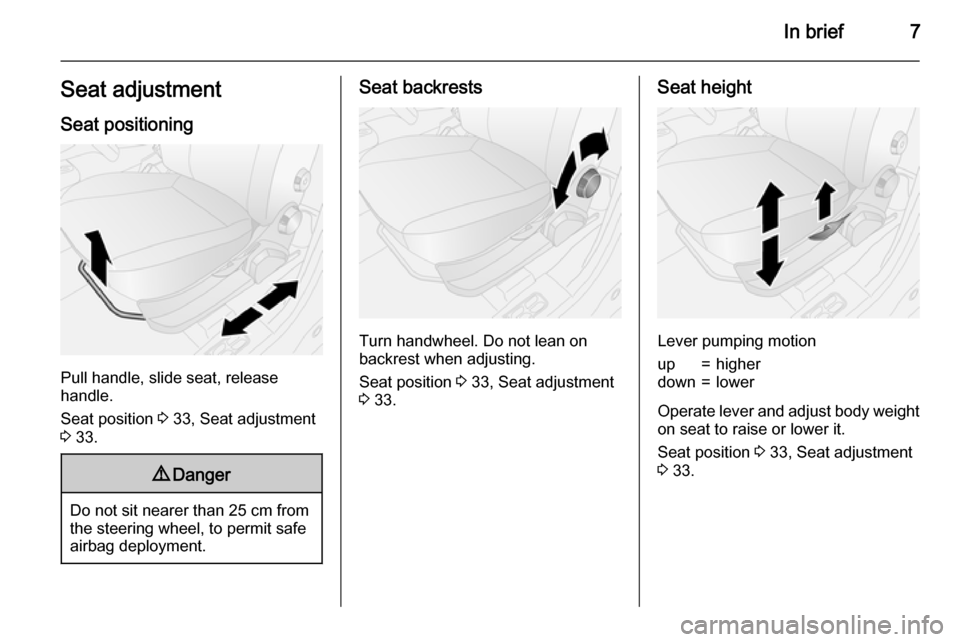
Pull handle, slide seat, release
handle.
Seat position 3 33, Seat adjustment
3 33.
9 Danger
Do not sit nearer than 25 cm from
the steering wheel, to permit safe
airbag deployment.
Seat backrests
Turn handwheel. Do not lean on
backrest when adjusting.
Seat position 3 33, Seat adjustment
3 33.
Seat height
Lever pumping motion
up=higherdown=lower
Operate lever and adjust body weight
on seat to raise or lower it.
Seat position 3 33, Seat adjustment
3 33.
Page 10 of 183
8In briefHead restraint adjustment
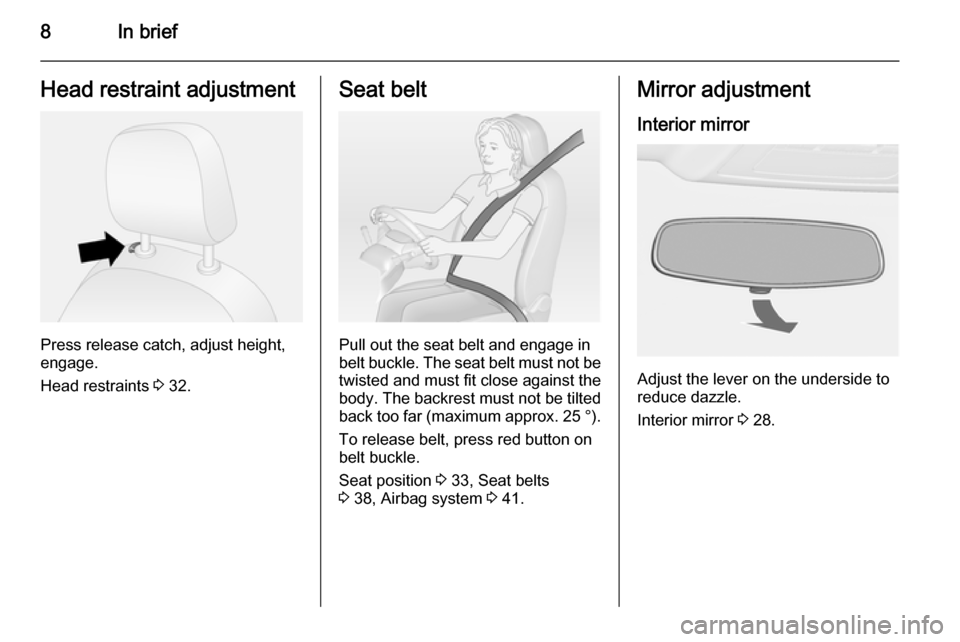
Press release catch, adjust height,
engage.
Head restraints 3 32.
Seat belt
Pull out the seat belt and engage in
belt buckle. The seat belt must not be twisted and must fit close against the
body. The backrest must not be tilted
back too far (maximum approx. 25 ° ).
To release belt, press red button on belt buckle.
Seat position 3 33, Seat belts
3 38, Airbag system 3 41.
Mirror adjustment
Interior mirror
Adjust the lever on the underside to
reduce dazzle.
Interior mirror 3 28.
Page 34 of 183

32Seats, restraintsSeats, restraintsHead restraints............................ 32
Front seats ................................... 33
Rear seats ................................... 36
Seat belts ..................................... 38
Airbag system .............................. 41
Child restraints ............................. 47Head restraints
Position9 Warning
Only drive with the head restraint
set to the proper position.
The upper edge of the head restraint
should be at upper head level. If this
is not possible for extremely tall
people, set to highest position, and
set to lowest position for small people.
Adjustment
Front head restraints, height
adjustment
Press the button, adjust height and
engage.
Page 35 of 183

Seats, restraints33
Rear head restraints, heightadjustment
Pull the head restraint upwards or
press the catch to release and push the head restraint downwards.
Removal
Rear head restraints, removal
Press both catches, pull the head restraint upwards and remove.
Secure the removed head restraint in the load compartment.
Notice
Approved accessories may only be
attached if the seat is not in use.
Front seats
Seat position9 Warning
Only drive with the seat correctly
adjusted.
■ Sit with buttocks as far back against
the backrest as possible. Adjust the distance between the seat and the
pedals so that legs are slightly
angled when pressing the pedals.
Slide the front passenger seat as
far back as possible.
■ Sit with shoulders as far back against the backrest as possible.
Set the backrest to an angle so that it is possible to reach the steering
wheel with arms slightly bent.
Maintain contact between
shoulders and the backrest when
turning the steering wheel. Do not
tilt the backrest too far back. We
recommend a maximum angle of
approx. 25°.
■ Adjust the steering wheel 3 62.
■ Set the seat high enough to have a
clear field of vision on all sides and
on all display instruments. There
should be at least one hand of
clearance between head and the
roof frame. Thighs should rest
lightly on the seat without pressing
into it.
■ Adjust the head restraint 3 32.
■ Adjust the height of the seat belt 3 39.
Seat adjustment Drive only with seats and backrests
properly engaged.
Page 37 of 183
Seats, restraints35
Seat height
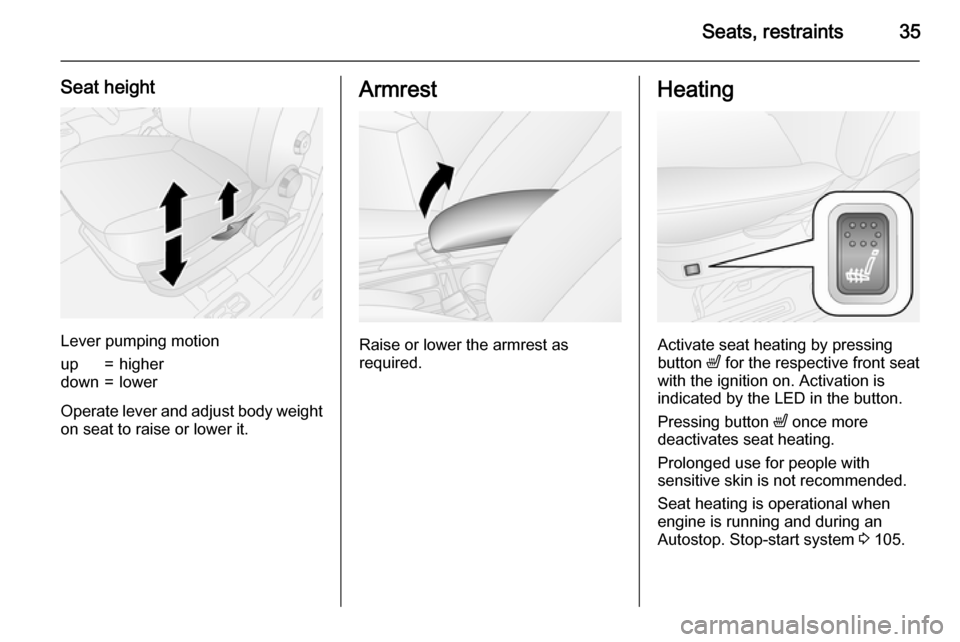
Lever pumping motion
up=higherdown=lower
Operate lever and adjust body weight
on seat to raise or lower it.
Armrest
Raise or lower the armrest as
required.
Heating
Activate seat heating by pressing
button ß for the respective front seat
with the ignition on. Activation is
indicated by the LED in the button.
Pressing button ß once more
deactivates seat heating.
Prolonged use for people with
sensitive skin is not recommended.
Seat heating is operational when
engine is running and during an
Autostop. Stop-start system 3 105.
Page 41 of 183
Seats, restraints39Three-point seat belt
Fastening
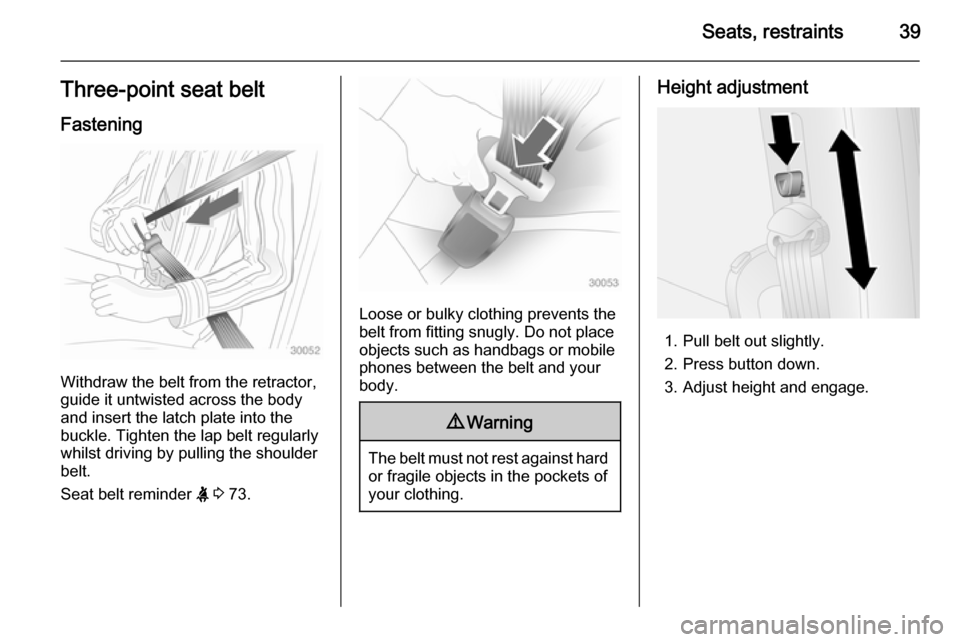
Withdraw the belt from the retractor,
guide it untwisted across the body
and insert the latch plate into the
buckle. Tighten the lap belt regularly
whilst driving by pulling the shoulder
belt.
Seat belt reminder X 3 73.
Loose or bulky clothing prevents the
belt from fitting snugly. Do not place
objects such as handbags or mobile
phones between the belt and your body.
9 Warning
The belt must not rest against hard
or fragile objects in the pockets of
your clothing.
Height adjustment
1. Pull belt out slightly.
2. Press button down.
3. Adjust height and engage.
Page 42 of 183

40Seats, restraints
Adjust the height so that the belt lies
across the shoulder. It must not lie across the throat or upper arm.
Do not adjust while driving.
Removing
To release belt, press red button on
belt buckle.
Seat belts on the rear seats
The seat belt for the rear centre seat
can only be withdrawn from the
retractor if the backrest is in the rear
position.
Using the seat belt while
pregnant9 Warning
The lap belt must be positioned as
low as possible across the pelvis
to prevent pressure on the
abdomen.
Page 51 of 183

Seats, restraints49Child restraint installation locationsPermissible options for fitting a child restraint system
Weight and age class
Front passenger seatSecond rowThird rowactivated airbagdeactivated airbagoutboard seatcentre seatGroup 0: up to 10 kg
or approx. 10 monthsXU 1U,
or approx. 6 to 12 yearsXXUUX1=Only if front airbag system is deactivated. When securing with a three-point seat belt, move seat height adjustment to uppermost position and ensure that the seat belt runs forwards from the upper anchorage point. Adjust seat backrest
inclination as far as necessary to a vertical position to ensure that the belt is tight on the buckle side.<=Vehicle seat available with ISOFIX attachments. When attaching using ISOFIX, only the ISOFIX child restraint systems
permitted for the vehicle may be used.U=Universal suitability in conjunction with three-point seat belt.X=No child restraint system permitted in this weight class.
Page 146 of 183

144Vehicle careWheels and tyres
Tyre condition, wheel condition
Drive over edges slowly and at right
angles if possible. Driving over sharp
edges can cause tyre and wheel
damage. Do not trap tyres on the kerb when parking.
Regularly check the wheels for
damage. Seek the assistance of a
workshop in the event of damage or
unusual wear.
Winter tyres Winter tyres improve driving safety at
temperatures below 7 °C and should
therefore be fitted on all wheels.
Tyres of size 185/65 R15,
195/65 R15 and 195/60 R16 C are
permitted as winter tyres.
In accordance with country-specific
regulations, affix the speed sticker in
the driver's field of view.Tyre designations
E.g. 215/60 R 16 95 H215=Tyre width, mm60=Cross-section ratio (tyre height
to tyre width), %R=Belt type: RadialRF=Type: RunFlatC=Cargo or commercial use16=Wheel diameter, inches95=Load index e.g. 95 is
equivalent to 690 kgH=Speed code letter
Speed code letter:
Q=up to 100 mphS=up to 112 mphT=up to 118 mphH=up to 130 mphV=up to 150 mphW=up to 168 mph
Directional tyres
Fit directional tyres such that they roll in the direction of travel. The rolling
direction is indicated by a symbol
(e.g. an arrow) on the sidewall.
Tyre pressure
Check the pressure of cold tyres atleast every 14 days and before any
long journey. Do not forget the spare
wheel.
Unscrew the valve cap.
Tyre pressure 3 172.
The tyre pressure data refers to cold
tyres. It applies to summer and winter tyres.
Always inflate the spare tyre to the
pressure specified for full load.
Incorrect tyre pressures will impair
safety, vehicle handling, comfort and
fuel economy and will increase tyre
wear.
Tyre pressures differ depending on
various options. For the correct tyre
pressure value, follow the procedure
below:
1. Identify the engine identifier code.
Engine data 3 166.
2. Identify the respective tyre.
The tyre pressure tables show all
possible tyre combinations 3 172.
Page 153 of 183

Vehicle care151
■ Do not start the vehicle when it israised on the jack.
■ Clean wheel nuts and thread with a
clean cloth before mounting the
wheel.9 Warning
Do not grease wheel bolt, wheel
nut and wheel nut cone.
1. Disengage wheel nut caps with a screwdriver and remove. Pull off
the wheel cover using a suitable
tool.
2. Attach wheel wrench securely and loosen each wheel nut by halfa turn.
3. Vehicle jacking points are located
at the front and rear.
4. Set the jack to the necessary height. Position it directly below
the jacking point in a manner that prevents it from slipping.