battery VAUXHALL COMBO 2016 User Guide
[x] Cancel search | Manufacturer: VAUXHALL, Model Year: 2016, Model line: COMBO, Model: VAUXHALL COMBO 2016Pages: 189, PDF Size: 4.47 MB
Page 111 of 189
Driving and operating109Starting the engine
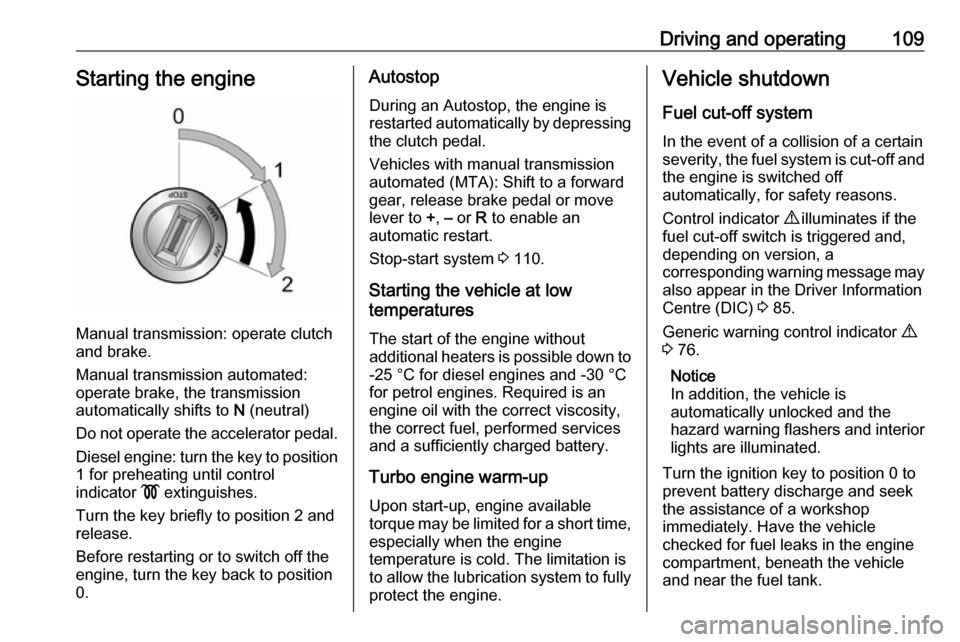
Manual transmission: operate clutch
and brake.
Manual transmission automated: operate brake, the transmission
automatically shifts to N (neutral)
Do not operate the accelerator pedal. Diesel engine: turn the key to position1 for preheating until control
indicator ! extinguishes.
Turn the key briefly to position 2 and release.
Before restarting or to switch off the engine, turn the key back to position
0.
Autostop
During an Autostop, the engine is
restarted automatically by depressing
the clutch pedal.
Vehicles with manual transmission
automated (MTA): Shift to a forward
gear, release brake pedal or move
lever to +, – or R to enable an
automatic restart.
Stop-start system 3 110.
Starting the vehicle at low
temperatures
The start of the engine without
additional heaters is possible down to -25 °С for diesel engines and -30 °C
for petrol engines. Required is an engine oil with the correct viscosity,
the correct fuel, performed services
and a sufficiently charged battery.
Turbo engine warm-up
Upon start-up, engine available
torque may be limited for a short time, especially when the engine
temperature is cold. The limitation is
to allow the lubrication system to fully protect the engine.Vehicle shutdown
Fuel cut-off system In the event of a collision of a certain
severity, the fuel system is cut-off and
the engine is switched off
automatically, for safety reasons.
Control indicator 9 illuminates if the
fuel cut-off switch is triggered and, depending on version, a
corresponding warning message may
also appear in the Driver Information
Centre (DIC) 3 85.
Generic warning control indicator 9
3 76.
Notice
In addition, the vehicle is
automatically unlocked and the
hazard warning flashers and interior lights are illuminated.
Turn the ignition key to position 0 to
prevent battery discharge and seek
the assistance of a workshop
immediately. Have the vehicle
checked for fuel leaks in the engine
compartment, beneath the vehicle
and near the fuel tank.
Page 112 of 189
110Driving and operatingTo reset the fuel cut-off system and
enable the vehicle to be driven:
1. Turn the ignition key to position 1 3 108.
2. Fully actuate the right turn signal light 3 96.
3. Deactivate the right turn signal light.
4. Fully actuate the left turn signal light.
5. Deactivate the left turn signal light.
6. Repeat steps 2, 3, 4 and 5.
7. Turn the ignition key to position 0.9Danger
If you can smell fuel in the vehicle,
or a fuel leak is present, have thecause of this remedied
immediately by a workshop. Do
not reset the fuel cut-off system, to avoid the risk of fire.
Fuel system messages 3 91.
Overrun cut-off
The fuel supply is automatically cut-
off during overrun, i.e. when the
vehicle is driven with a gear engaged
but accelerator is released.
Stop-start system The stop-start system helps to save
fuel and to reduce exhaust emissions. When conditions allow, it switches off
the engine as soon as the vehicle is
at a low speed or at a standstill, e.g.
at a traffic light or in a traffic jam. It
starts the engine automatically as
soon as the clutch is depressed.
A battery sensor ensures that an
Autostop is only performed if the
battery is sufficiently charged for a
restart.
Activation
The stop-start system is available as
soon as the engine is started, the
vehicle starts-off and the conditions
as stated below in this section are
fulfilled.Deactivation
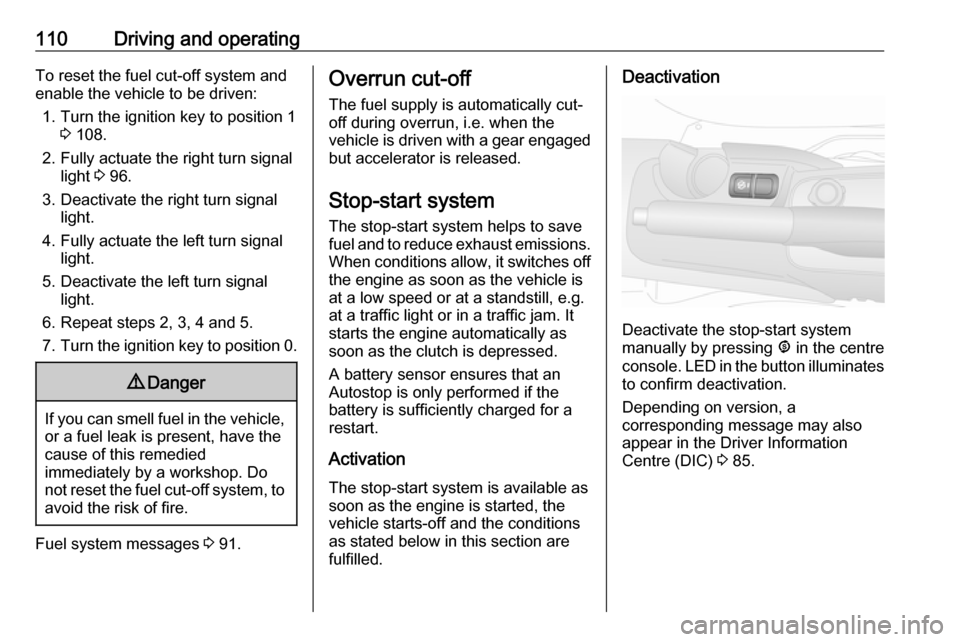
Deactivate the stop-start system
manually by pressing ^ in the centre
console. LED in the button illuminates
to confirm deactivation.
Depending on version, a
corresponding message may also
appear in the Driver Information
Centre (DIC) 3 85.
Page 113 of 189
Driving and operating111AutostopIf the vehicle is at a low speed or at a
standstill, activate an Autostop as
follows:
● depress the clutch pedal
● set the lever to neutral
● release the clutch pedal
The engine will be switched off while
the ignition stays on.
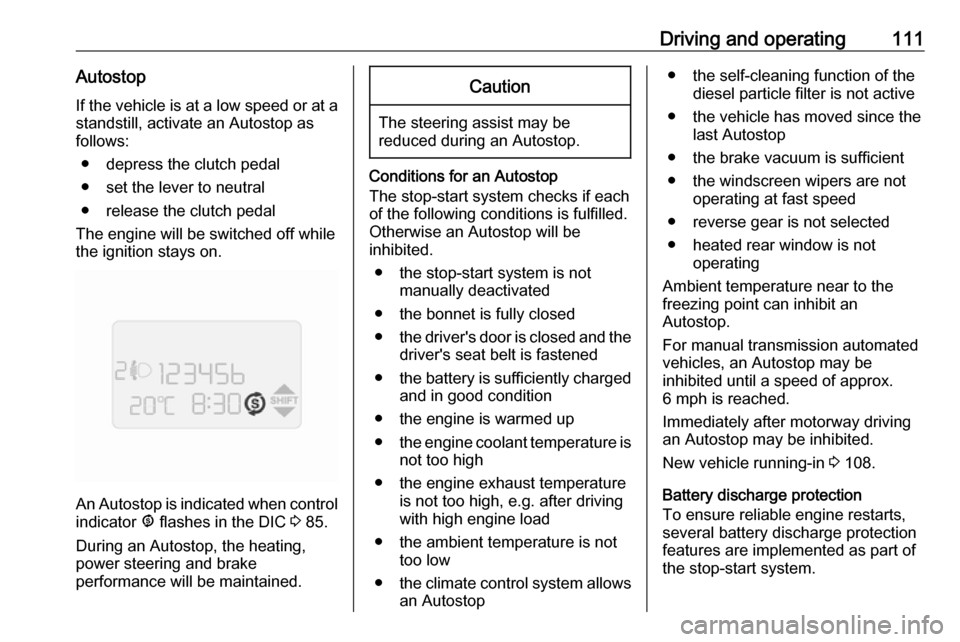
An Autostop is indicated when control
indicator ^ flashes in the DIC 3 85.
During an Autostop, the heating,
power steering and brake
performance will be maintained.
Caution
The steering assist may be
reduced during an Autostop.
Conditions for an Autostop
The stop-start system checks if each
of the following conditions is fulfilled.
Otherwise an Autostop will be
inhibited.
● the stop-start system is not manually deactivated
● the bonnet is fully closed
● the driver's door is closed and the
driver's seat belt is fastened
● the battery is sufficiently charged
and in good condition
● the engine is warmed up
● the engine coolant temperature is
not too high
● the engine exhaust temperature is not too high, e.g. after driving
with high engine load
● the ambient temperature is not too low
● the climate control system allows
an Autostop
● the self-cleaning function of the diesel particle filter is not active
● the vehicle has moved since the last Autostop
● the brake vacuum is sufficient ● the windscreen wipers are not operating at fast speed
● reverse gear is not selected
● heated rear window is not operating
Ambient temperature near to the
freezing point can inhibit an
Autostop.
For manual transmission automated vehicles, an Autostop may be
inhibited until a speed of approx.
6 mph is reached.
Immediately after motorway driving
an Autostop may be inhibited.
New vehicle running-in 3 108.
Battery discharge protection
To ensure reliable engine restarts,
several battery discharge protection
features are implemented as part of
the stop-start system.
Page 134 of 189
132Vehicle careVehicle careGeneral Information...................132
Accessories and vehicle modifications .......................... 132
Vehicle storage ........................133
End-of-life vehicle recovery .....133
Vehicle checks ........................... 134
Performing work ......................134
Bonnet ..................................... 134
Engine oil ................................. 135
Engine coolant ......................... 136
Power steering fluid .................136
Washer fluid ............................ 137
Brakes ..................................... 137
Brake fluid ............................... 137
Vehicle battery ......................... 137
Wiper blade replacement ........139
Bulb replacement .......................140
Halogen headlights ..................140
Fog lights ................................. 142
Tail lights ................................. 142
Side turn signal lights ..............143
Centre high-mounted brake light ......................................... 143
Number plate light ...................143Interior lights ............................ 144
Instrument panel illumination ...145
Electrical system ........................146
Fuses ....................................... 146
Engine compartment fuse box . 147
Instrument panel fuse box .......148
Vehicle tools .............................. 149
Tools ........................................ 149
Wheels and tyres .......................150
Winter tyres ............................. 150
Tyre designations ....................150
Tyre pressure .......................... 151
Tyre pressure monitoring
system .................................... 151
Tread depth ............................. 153
Changing tyre and wheel size . 153 Wheel covers ........................... 154
Tyre chains .............................. 154
Tyre repair kit .......................... 154
Wheel changing .......................157
Spare wheel ............................ 158
Jump starting ............................. 161
Towing ....................................... 162
Towing the vehicle ...................162
Towing another vehicle ...........163
Appearance care .......................164
Exterior care ............................ 164
Interior care ............................. 166General Information
Accessories and vehiclemodifications
We recommend the use of genuine
parts and accessories and factory
approved parts specific for your
vehicle type. We cannot assess or guarantee reliability of other products
- even if they have a regulatory or
otherwise granted approval.
Do not make any modifications to the
electrical system, e.g. changes of
electronic control units (chip tuning).Caution
When transporting the vehicle on
a train or on a recovery vehicle, the
mud flaps might be damaged.
Page 135 of 189

Vehicle care133Vehicle storageStorage for a long period of time
If the vehicle is to be stored for several months:
● Wash and wax the vehicle.
● Have the wax in the engine compartment and underbody
checked.
● Clean and preserve the rubber seals.
● Fill up fuel tank completely.
● Change the engine oil.
● Drain the washer fluid reservoir.
● Check the coolant antifreeze and
corrosion protection.
● Adjust tyre pressure to the value specified for full load.
● Park the vehicle in a dry, well ventilated place. Engage first or
reverse gear to prevent the
vehicle from rolling.
● Do not apply the parking brake.● Open the bonnet, close all doors and lock the vehicle.
● Disconnect the clamp from the negative terminal of the vehicle
battery. Beware that all systems
are not functional, e.g. anti-theft
locking system.
Putting back into operation
When the vehicle is to be put back into
operation:
● Connect the clamp to the negative terminal of the vehicle
battery. Activate the electronics
of the power windows.
● Check tyre pressure.
● Fill up the washer fluid reservoir.
● Check the engine oil level.
● Check the coolant level.
● Fit the number plates if necessary.End-of-life vehicle recovery
Information on end-of-life vehicle
recovery centres and the recycling of
end-of-life vehicles is available on our website. Only entrust this work to an
authorised recycling centre.
Natural gas vehicles must be recycled by a service centre authorised for
natural gas vehicles.
Page 139 of 189

Vehicle care137Washer fluid
Fill with clean water mixed with a
suitable quantity of windscreen
washer fluid which contains
antifreeze.
Caution
Only washer fluid with a sufficient
antifreeze concentration provides
protection at low temperatures or
a sudden drop in temperature.
Use of washer fluid containing
isopropanol can damage exterior
lamps.
Brakes
A squealing noise, or illumination ofbrake pad wear control indicator F
indicates that the brake lining is at its
minimum thickness.
Continued driving is possible but
have the brake linings replaced as
soon as possible.
Once new brake linings are installed,
do not brake unnecessarily hard for
the first few journeys.
Brake pad wear indicator F 3 79.
Brake fluid9 Warning
Brake fluid is poisonous and
corrosive. Avoid contact with eyes, skin, fabrics and painted surfaces.
The brake fluid level must be betweenthe MIN and MAX marks.
When topping up, ensure maximum cleanliness as contamination of the
brake fluid can lead to brake system
malfunctions. Have the cause of the
loss of brake fluid remedied by a
workshop.
Only use high-performance brake
fluid approved for the vehicle.
Brake and clutch fluid 3 168.
Vehicle battery
The vehicle battery is maintenance-
free provided that the driving profile
allows sufficient charging of the
Page 140 of 189
138Vehicle carebattery. Short-distance-driving and
frequent engine starts can discharge
the battery. Avoid the use of
unnecessary electrical consumers.
Batteries do not belong in household
waste. They must be disposed of at
an appropriate recycling collection
point.
Laying up the vehicle for more than
4 weeks can lead to battery
discharge. Disconnect the clamp from the negative terminal of the vehicle
battery.
Ensure the ignition is switched off
before connecting or disconnecting
the vehicle battery.
The anti-theft alarm siren must be
deactivated as follows: Switch the ignition on then off, disconnect the
vehicle's battery within 15 seconds.
Vehicle battery discharge protection
3 100.
Replacing the vehicle battery
Notice
Any deviation from the instructions
given in this paragraph may lead to
a temporary deactivation of the stop-
start system.
In vehicles with stop-start system,
ensure the correct battery is used
when replacing the battery. We
recommend that you have the battery
replaced by a workshop.
Stop-start system 3 110.
Charging the vehicle battery9 Warning
On vehicles with stop-start
system, ensure that the charging potential does not exceed 14.6
volts when using a battery
charger. Otherwise the battery
might be damaged.
Jump starting 3 161.
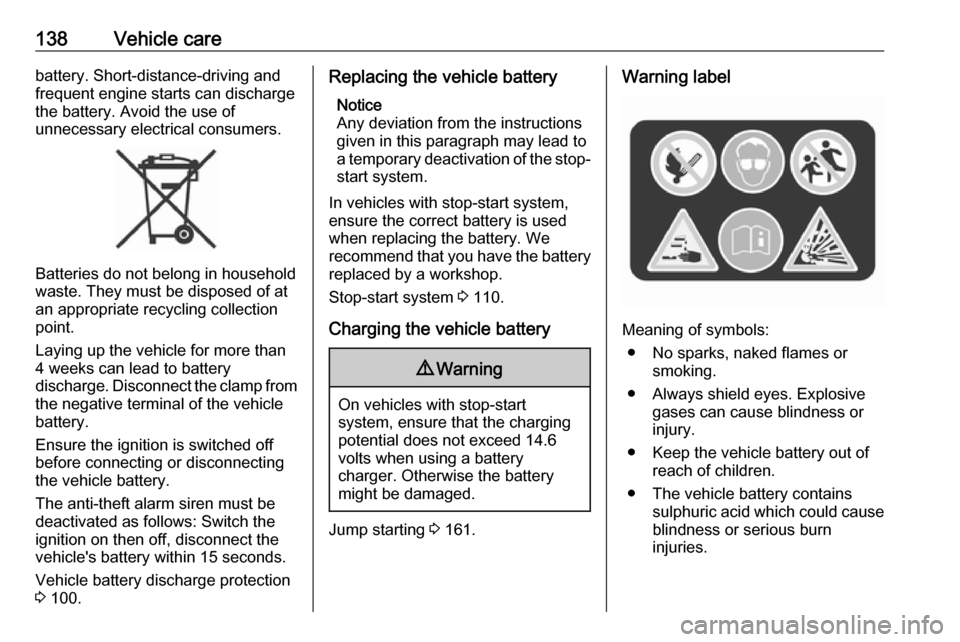
Warning label
Meaning of symbols:
● No sparks, naked flames or smoking.
● Always shield eyes. Explosive gases can cause blindness or
injury.
● Keep the vehicle battery out of reach of children.
● The vehicle battery contains sulphuric acid which could cause
blindness or serious burn
injuries.
Page 141 of 189

Vehicle care139● See the Owner's Manual forfurther information.
● Explosive gas may be present in the vicinity of the vehicle battery.
Wiper blade replacement
Lift the wiper arm until it stays in the
raised position, press button to
disengage the wiper blade and
remove.
Attach the wiper blade slightly angled
to the wiper arm and push until it
engages.
Lower wiper arm carefully.
Wiper blade on rear swing door
Lift wiper arm, press and hold
retaining clip and detach wiper blade.
Attach the wiper blade slightly angled
to the wiper arm and push until it
engages.
Lower wiper arm carefully.
Wiper blade on tailgate
Lift wiper arm, press retaining clips to
detach wiper blade.
Attach the wiper blade to the wiper
arm and push until it engages.
Lower wiper arm carefully.
Page 148 of 189
146Vehicle careElectrical systemFuses
Data on the replacement fuse must
match the data on the defective fuse.
There are two fuse boxes in the
vehicle:
● on the right of the engine compartment, next to the battery
● behind a cover on the lower part of the instrument panel, on the
driver's side
Before replacing a fuse, turn off the
respective switch and the ignition.
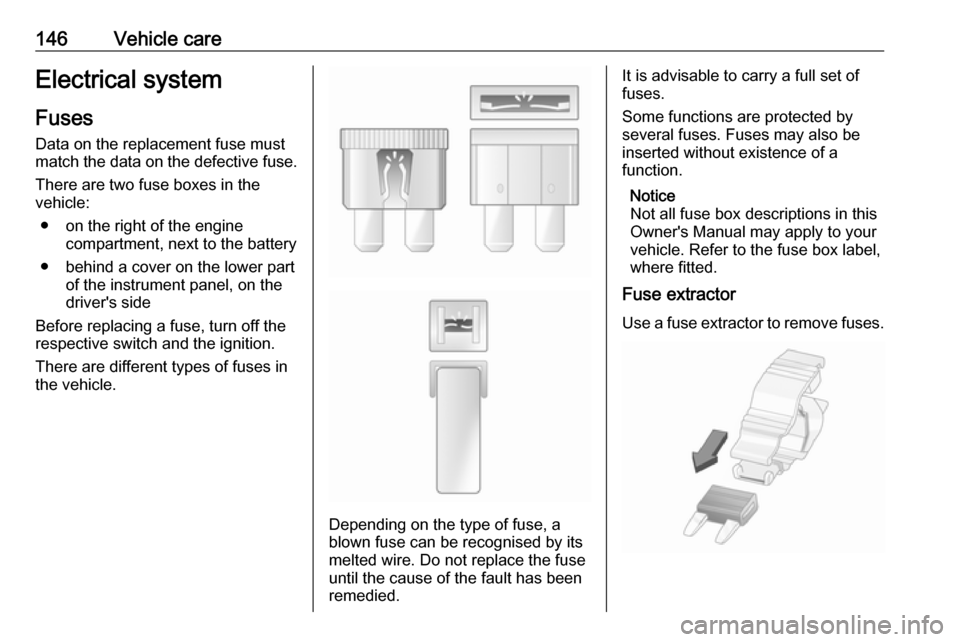
There are different types of fuses in
the vehicle.
Depending on the type of fuse, a
blown fuse can be recognised by its
melted wire. Do not replace the fuse until the cause of the fault has been
remedied.
It is advisable to carry a full set of
fuses.
Some functions are protected by
several fuses. Fuses may also be
inserted without existence of a
function.
Notice
Not all fuse box descriptions in this
Owner's Manual may apply to your
vehicle. Refer to the fuse box label,
where fitted.
Fuse extractor
Use a fuse extractor to remove fuses.
Page 149 of 189
Vehicle care147
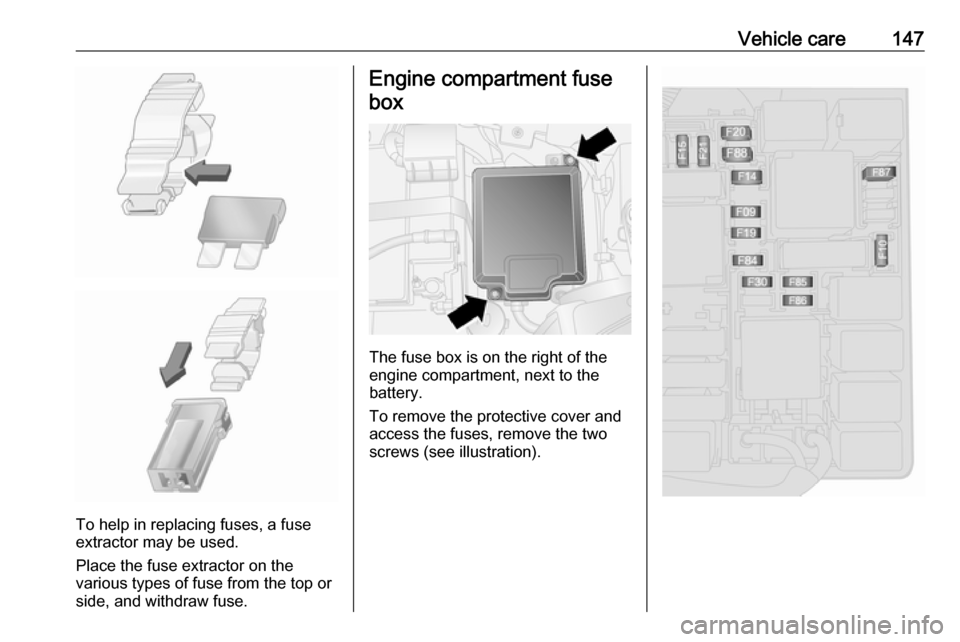
To help in replacing fuses, a fuse
extractor may be used.
Place the fuse extractor on the
various types of fuse from the top or
side, and withdraw fuse.
Engine compartment fuse
box
The fuse box is on the right of the
engine compartment, next to the
battery.
To remove the protective cover and
access the fuses, remove the two
screws (see illustration).