parking brake VAUXHALL COMBO 2016 User Guide
[x] Cancel search | Manufacturer: VAUXHALL, Model Year: 2016, Model line: COMBO, Model: VAUXHALL COMBO 2016Pages: 189, PDF Size: 4.47 MB
Page 120 of 189

118Driving and operatingElectronic drivingprogrammes
Eco mode E
When automatic mode is engaged,
the Eco mode can be selected to
reduce fuel consumption.
Eco mode selects the most suitable gear depending on the speed of the
vehicle, the engine speed and the
intensity with which the accelerator is pressed.
Activation
Press E on the selector lever housing.
Control indicator E is shown in the
transmission display to indicate
activation.
Deactivation
Eco mode is switched off by:
● pressing E again
● switching to manual mode
In order to protect the transmission at extremely high clutch temperatures,
an intermittent audible warning chime
may sound. In such cases, depress
the brake pedal, select N and apply
the parking brake to allow the clutch
to cool down.
Kickdown If the accelerator pedal is pressed
past the pressure point, the
transmission shifts to a lower gear
depending on engine speed. Full
engine power is available for
acceleration.If engine speed is too high the
transmission switches to a higher
gear, even in manual mode. Without
kickdown this automatic shift is not
effected in manual mode.
Fault
In the event of a fault, control indicator s is shown in the transmission
display.
Continued driving is possible,
provided the vehicle is driven with
care and anticipation. A warning
message may appear in the Driver
Information Centre (DIC) in
conjunction with a warning chime
3 90.
Notice
The volume of the warning chime can also be adjusted via the Driver
Information Centre (DIC) 3 85.
Have the cause of the fault remedied by a workshop.
Page 121 of 189

Driving and operating119Brakes
The brake system comprises two
independent brake circuits.
If a brake circuit fails, the vehicle can
still be braked using the other brake
circuit. However, braking effect is
achieved only when the brake pedal
is depressed firmly. Considerably
more force is needed for this. The
braking distance is extended. Seek the assistance of a workshop before
continuing your journey.
When the engine is not running, the
support of the brake servo unit
disappears once the brake pedal has
been depressed once or twice.
Braking effect is not reduced, but
braking requires significantly greater
force. It is especially important to bear this in mind when being towed.
Control indicator R 3 79.
Antilock brake system
Antilock brake system (ABS)
prevents the wheels from locking.ABS starts to regulate brake pressure as soon as a wheel shows a tendency to lock. The vehicle remains
steerable, even during hard braking.
ABS control is made apparent
through a pulse in the brake pedal
and the noise of the regulation
process.
For optimum braking, keep the brake
pedal fully depressed throughout the
braking process, despite the fact that
the pedal is pulsating. Do not reduce
the pressure on the pedal.
After starting off the system performs
a self-test which may be audible.
Control indicator u 3 79.
Fault9 Warning
If there is a fault in the ABS, the
wheels may be liable to lock due
to braking that is heavier than
normal. The advantages of ABS
are no longer available. During
hard braking, the vehicle can nolonger be steered and may
swerve.
Have the cause of the fault remedied
by a workshop.
Parking brake
Manual parking brake
Page 122 of 189

120Driving and operating9Warning
Always apply parking brake firmly
without operating the release
button, and apply as firmly as
possible on a downhill or uphill
slope.
To release the parking brake, pull
the lever up slightly, press the
release button and fully lower the
lever.
To reduce the operating forces of
the parking brake, depress the
brake pedal at the same time.
A warning chime will sound if a certain
speed is exceeded with the parking
brake applied.
Notice
The volume of the warning chime
can also be adjusted via the Driver
Information Centre (DIC) 3 85.
Control indicator R 3 79.
Brake assist
If the brake pedal is depressed
quickly and forcefully, maximum
brake force is automatically applied
(full braking).
Maintain steady pressure on the brake pedal for as long as full braking
is required. Maximum brake force is
automatically reduced when the
brake pedal is released.
Hill start assist
The system helps prevent unintended movement when driving away on
inclines.
When releasing the brake pedal after
stopping on an incline, the brakes
remain on for a further two seconds.
The brakes release automatically as
soon as the vehicle begins to
accelerate.
If control indicator Z illuminates
while driving, there is a fault in the Hill
start assist 3 80 . Seek the assistance
of a workshop to have the fault remedied.The Hill start assist is not active
during an Autostop.
Stop-start system 3 110.
Page 135 of 189

Vehicle care133Vehicle storageStorage for a long period of time
If the vehicle is to be stored for several months:
● Wash and wax the vehicle.
● Have the wax in the engine compartment and underbody
checked.
● Clean and preserve the rubber seals.
● Fill up fuel tank completely.
● Change the engine oil.
● Drain the washer fluid reservoir.
● Check the coolant antifreeze and
corrosion protection.
● Adjust tyre pressure to the value specified for full load.
● Park the vehicle in a dry, well ventilated place. Engage first or
reverse gear to prevent the
vehicle from rolling.
● Do not apply the parking brake.● Open the bonnet, close all doors and lock the vehicle.
● Disconnect the clamp from the negative terminal of the vehicle
battery. Beware that all systems
are not functional, e.g. anti-theft
locking system.
Putting back into operation
When the vehicle is to be put back into
operation:
● Connect the clamp to the negative terminal of the vehicle
battery. Activate the electronics
of the power windows.
● Check tyre pressure.
● Fill up the washer fluid reservoir.
● Check the engine oil level.
● Check the coolant level.
● Fit the number plates if necessary.End-of-life vehicle recovery
Information on end-of-life vehicle
recovery centres and the recycling of
end-of-life vehicles is available on our website. Only entrust this work to an
authorised recycling centre.
Natural gas vehicles must be recycled by a service centre authorised for
natural gas vehicles.
Page 156 of 189

154Vehicle care9Warning
Use of unsuitable tyres or wheels
may lead to accidents and will
invalidate the vehicle type
approval.
Wheel covers
Wheel covers and tyres that are
factory approved for the respective
vehicle and comply with all of the
relevant wheel and tyre combination
requirements must be used.
If the wheel covers and tyres used are
not factory approved, the tyres must
not have a rim protection ridge.
Wheel covers must not impair brake
cooling.
9 Warning
Use of unsuitable tyres or wheel
covers could lead to sudden
pressure loss and thereby
accidents.
Tyre chains
Tyre chains are only permitted on the
front wheels.
Always use fine mesh chains that add no more than 10 mm to the tyre tread
and the inboard sides (including chain lock).
Do not exceed 30 mph when tyre
chains are fitted.
9 Warning
Damage may lead to tyre blowout.
Tyre repair kit
Minor damage to the tyre tread can be
repaired with the tyre repair kit.
Do not remove foreign bodies from
the tyres.
Tyre damage exceeding 4 mm or that is at tyre's sidewall cannot be repairedwith the tyre repair kit.9 Warning
Do not drive faster than 50 mph.
Do not use for a lengthy period.
Steering and handling may be
affected.
If you have a flat tyre:
Apply the parking brake and engage
first or reverse gear.
The tyre repair kit may be located
under the front seat, in the glovebox,
or on the right side of the load
compartment behind a cover.
Page 159 of 189

Vehicle care1572. Turn the canister anticlockwise tolift it out.
3. Insert the new canister and turn it clockwise.
4. Connect the compressor air hose to the canister and fit the flexible
filler tube into its allocated space.
Wheel changing Some vehicles are equipped with a
tyre repair kit instead of a spare wheel
3 154.
Make the following preparations and
observe the following information:
● Park the vehicle on a level, firm and non-skid surface. The front
wheels must be in the straight-
ahead position.
● Apply the parking brake and engage first or reverse gear.
● Remove the spare wheel 3 158.
● Never change more than one wheel at once.
● Use the jack only to change wheels in case of puncture, not
for seasonal winter or summer
tyre change.● The jack is maintenance-free.
● If the ground on which the vehicle
is standing is soft, a solid board
(max. 1 cm thick) should be
placed under the jack.
● No people or animals may be in the vehicle when it is jacked-up.
● Never crawl under a jacked-up vehicle.
● Do not start the vehicle when it is
raised on the jack.
● Clean wheel nuts and thread with
a clean cloth before mounting the
wheel.9 Warning
Do not grease wheel bolt, wheel
nut and wheel nut cone.
1. Disengage wheel nut caps with a screwdriver and remove. Pull off
the wheel cover using a suitable
tool.
2. Attach wheel wrench securely and loosen each wheel nut by halfa turn.
Page 163 of 189
Vehicle care161Jump starting
Do not start with quick charger.
A vehicle with a discharged battery
can be started using jump leads and
the battery of another vehicle.9 Warning
Be extremely careful when starting
with jump leads. Any deviation
from the following instructions can
lead to injuries or damage caused
by battery explosion or damage to the electrical systems of both
vehicles.
9 Warning
Avoid contact of the battery with
eyes, skin, fabrics and painted
surfaces. The fluid contains
sulphuric acid which can cause
injuries and damage in the event
of direct contact.
● Never expose the battery to naked flames or sparks.
●A discharged battery can already
freeze at a temperature of 0 °C.
Defrost the frozen battery before
connecting jump leads.
● Wear eye protection and protective clothing when
handling a battery.
● Use a booster battery with the same voltage (12 Volts). Its
capacity (Ah) must not be much less than that of the discharged
battery.
● Use jump leads with insulated terminals and a cross section of
at least 16 mm 2
(25 mm 2
for
diesel engines).
● Do not disconnect the discharged
battery from the vehicle.
● Switch off all unnecessary electrical consumers.
● Do not lean over the battery during jump starting.
● Do not allow the terminals of one
lead to touch those of the other
lead.● The vehicles must not come into contact with each other during
the jump starting process.
● Apply the parking brake, transmission in neutral.
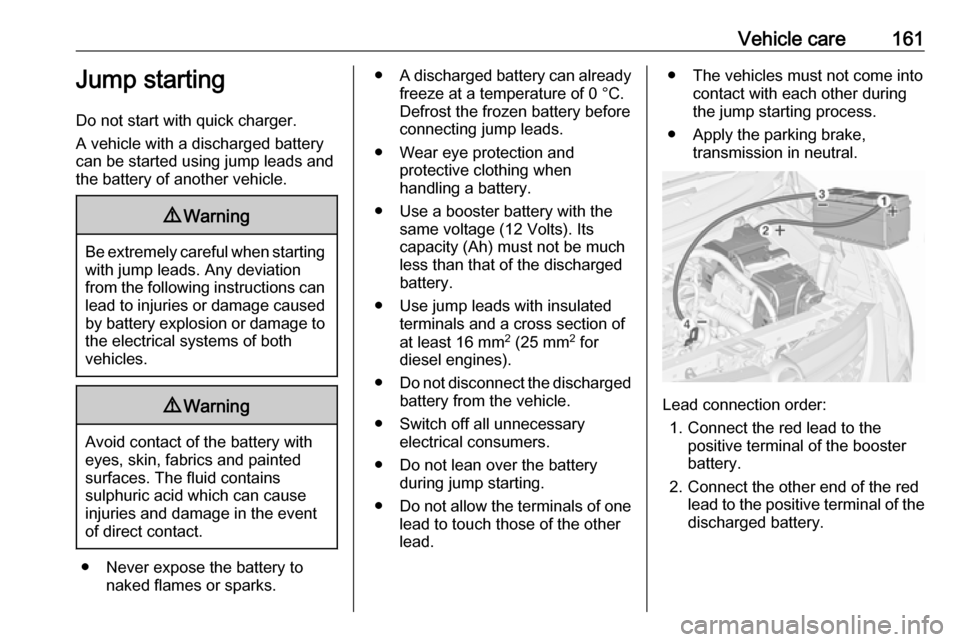
Lead connection order:
1. Connect the red lead to the positive terminal of the booster
battery.
2. Connect the other end of the red lead to the positive terminal of the
discharged battery.
Page 187 of 189

185Operating windows from outside..29
Outside temperature ....................67
Overhead console .......................57
Overrun cut-off ........................... 110
P Parking ................................ 17, 112
Parking assist ............................ 124
Parking brake ............................ 119
Particulate filter ........................... 113
Payload......................................... 62
Pedals......................................... 107
Performance .............................. 175
Performing work ........................134
Pollen filter ................................. 106
Power outlets ............................... 68
Power steering fluid ....................136
Power windows ............................ 29
Preheating ................................... 81
Puncture ..................................... 157
R Radio Frequency Identification (RFID) ..................................... 181
Radio info ..................................... 85
Radio remote control ...................20
Rear doors ................................... 24
Rear fog light ............................... 84
Rear fog lights ............................. 96
Rear parcel shelf .......................... 58
Rear seats .................................... 37Rear storage................................. 58
Rear windows .............................. 31
Rear window wiper/washer .......... 66
Recommended fluids and lubricants ........................ 168, 171
Refuelling ................................... 127 Removing seats ............................ 39
Reversing lights ........................... 96
Ride control systems ..................121
Roof bars ...................................... 58
Roof load ...................................... 62
Roof rack ..................................... 62
Roof racks .................................... 62
S Safety belts ................................... 41
Seat adjustment ....................... 7, 34
Seat belt ........................................ 8
Seat belt reminder .......................77
Seat belt reminder warning chime 85
Seat belts ..................................... 41
Seat folding .................................. 35
Seat heating ................................. 37
Seat position ................................ 33
Second row seats ........................37
Selector lever ............................. 116
Service ............................... 106, 167
Service display ......................73, 85
Service information ....................167
Settings menu............................... 85Side airbag system ......................49
Sidelights ...................................... 94
Side turn signal lights ................143
Sliding door .................................. 23
Sliding side door ........................... 23
Spare wheel ............................... 158
Speed limit warning chime............ 85
Speedometer ............................... 70
Standard display ........................... 85
Starting and operating ................108
Starting off ................................... 16
Starting the engine ............109, 115
Steering ...................................... 107
Steering wheel adjustment ......9, 65
Steering wheel controls ...............65
Stop engine .................................. 76
Stop-start system.................. 84, 110
Storage ......................................... 56
Storage compartments .................56
Sun visors .................................... 31
Symbols ......................................... 4
T
Tachometer ................................. 71
Tailgate ......................................... 25
Tail lights ................................... 142
Temperature ................................. 85
Third row seats ............................ 39
Three-point seat belt .................... 42
Tools .......................................... 149