brake VAUXHALL COMBO 2016 Owner's Guide
[x] Cancel search | Manufacturer: VAUXHALL, Model Year: 2016, Model line: COMBO, Model: VAUXHALL COMBO 2016Pages: 189, PDF Size: 4.47 MB
Page 122 of 189

120Driving and operating9Warning
Always apply parking brake firmly
without operating the release
button, and apply as firmly as
possible on a downhill or uphill
slope.
To release the parking brake, pull
the lever up slightly, press the
release button and fully lower the
lever.
To reduce the operating forces of
the parking brake, depress the
brake pedal at the same time.
A warning chime will sound if a certain
speed is exceeded with the parking
brake applied.
Notice
The volume of the warning chime
can also be adjusted via the Driver
Information Centre (DIC) 3 85.
Control indicator R 3 79.
Brake assist
If the brake pedal is depressed
quickly and forcefully, maximum
brake force is automatically applied
(full braking).
Maintain steady pressure on the brake pedal for as long as full braking
is required. Maximum brake force is
automatically reduced when the
brake pedal is released.
Hill start assist
The system helps prevent unintended movement when driving away on
inclines.
When releasing the brake pedal after
stopping on an incline, the brakes
remain on for a further two seconds.
The brakes release automatically as
soon as the vehicle begins to
accelerate.
If control indicator Z illuminates
while driving, there is a fault in the Hill
start assist 3 80 . Seek the assistance
of a workshop to have the fault remedied.The Hill start assist is not active
during an Autostop.
Stop-start system 3 110.
Page 123 of 189

Driving and operating121Ride control systems
Traction Control system The Anti-Slip Regulator (ASR) is a
component of the Electronic Stability
Control (ESC).
ASR improves driving stability when
necessary, regardless of the type of
road surface or tyre grip, by
preventing the drive wheels from
spinning.
As soon as the drive wheels starts to spin, engine output is reduced and
the wheel spinning the most is braked
individually. This considerably
improves the driving stability of the
vehicle on slippery road surfaces.
ASR is operational as soon as the
control indicator R extinguishes.
When ASR is active, control indicator
R flashes.9 Warning
Do not let this special safety
feature tempt you into taking risks
when driving.
Adapt speed to the road
conditions.
Deactivation
ASR can be switched off when
spinning of drive wheels is required:
press ASR OFF briefly.
LED in button illuminates and,
depending on version, a message may also appear in the Driver
Information Centre (DIC) 3 85.
ASR is reactivated by pressing
ASR OFF again.
ASR is also reactivated the next time
the ignition is switched on.
Fault
ASR will switch off automatically in
the event of a fault. Control indicator R will illuminate in the instrument
cluster. Depending on version, a
message may also appear in the DIC 3 85.
Have the cause of the fault remedied
by a workshop.
Control indicator R 3 80.
Electronic Stability Control Electronic Stability Control (ESC)
improves driving stability when
necessary, regardless of the type of
road surface or tyre grip. It also
prevents the drive wheels from
spinning.
As soon as the vehicle starts to
swerve (understeer/oversteer),
engine output is reduced and the wheels are braked individually. This
Page 125 of 189
Driving and operating123
Do not use the cruise control if it is notadvisable to maintain a constant
speed.
Control indicator m 3 84.
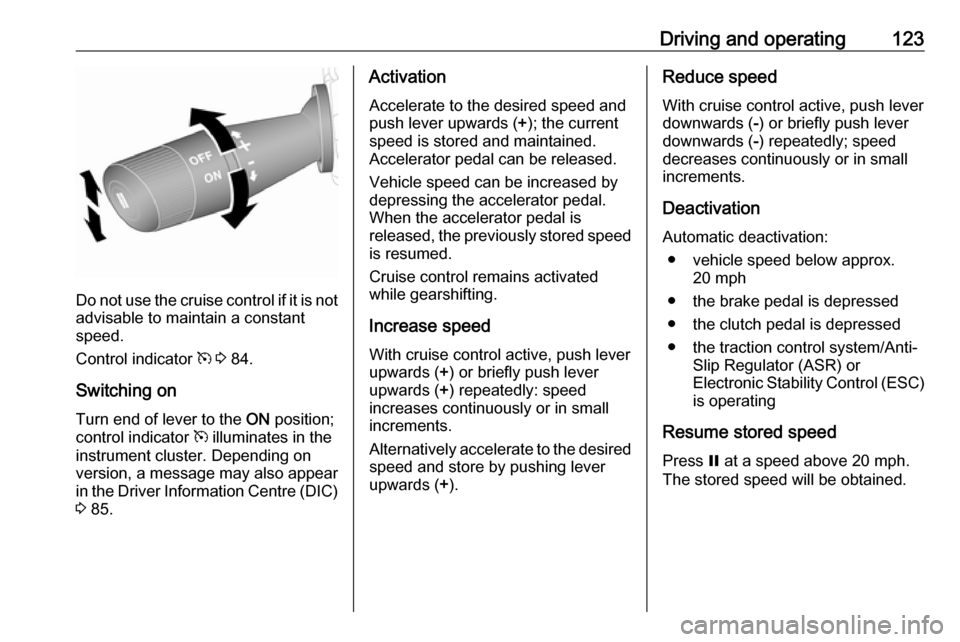
Switching on
Turn end of lever to the ON position;
control indicator m illuminates in the
instrument cluster. Depending on version, a message may also appear
in the Driver Information Centre (DIC)
3 85.
Activation
Accelerate to the desired speed and
push lever upwards ( +); the current
speed is stored and maintained.
Accelerator pedal can be released.
Vehicle speed can be increased by
depressing the accelerator pedal.
When the accelerator pedal is
released, the previously stored speed
is resumed.
Cruise control remains activated
while gearshifting.
Increase speed With cruise control active, push lever
upwards ( +) or briefly push lever
upwards ( +) repeatedly: speed
increases continuously or in small
increments.
Alternatively accelerate to the desired speed and store by pushing lever
upwards ( +).Reduce speed
With cruise control active, push lever
downwards ( -) or briefly push lever
downwards ( -) repeatedly; speed
decreases continuously or in small
increments.
Deactivation
Automatic deactivation: ● vehicle speed below approx. 20 mph
● the brake pedal is depressed
● the clutch pedal is depressed
● the traction control system/Anti- Slip Regulator (ASR) or
Electronic Stability Control (ESC)
is operating
Resume stored speed
Press = at a speed above 20 mph.
The stored speed will be obtained.
Page 132 of 189

130Driving and operatingTrailer hitch
General information
Only use towing equipment that has
been approved for your vehicle.
Vehicles with natural gas engine may
require special towing equipment.
Entrust retrofitting of towing
equipment to a workshop. It may be
necessary to make changes that
affect the cooling system, heat
shields or other equipment.
Fitting of towing equipment could
cover the opening of the towing eye.
If this is the case use the coupling ball bar for towing. Always keep the
coupling ball bar in the vehicle.
Driving characteristics and towing tips
Before attaching a trailer, lubricate the coupling ball. However, do not do so if a stabiliser, which acts on the
coupling ball, is being used to reduce
snaking movements.For trailers with low driving stability
and caravan trailers with a permitted
gross vehicle weight of more than
1300 kg the use of a stabiliser is
strongly recommended when driving
above 50 mph.
If the trailer starts snaking, drive more slowly, do not attempt to correct the
steering and brake sharply if
necessary.
When driving downhill, drive in the
same gear as if driving uphill and
drive at a similar speed.
Adjust tyre pressure to the value
specified for full load 3 179.
Trailer towing
Trailer loads The permissible trailer loads are
vehicle and engine-dependent
maximum values which must not be
exceeded. The actual trailer load is the difference between the actual
gross weight of the trailer and the
actual coupling socket load with the
trailer coupled.The permissible trailer loads are
specified in the vehicle documents. In general, they are valid for gradients
up to max. 12%.
The permitted trailer load applies up
to the specified incline and up to an
altitude of 1000 metres above sea
level. Since engine power decreases
as altitude increases due to the air
becoming thinner, therefore reducing
climbing ability, the permissible gross
train weight also decreases by 10% for every 1000 metres of additional
altitude. The gross train weight does
not have to be reduced when driving
on roads with slight inclines (less than
8%, e.g. motorways).
The permissible gross train weight
must not be exceeded. This weight is specified on the identification plate
3 170.
Vertical coupling load
The vertical coupling load is the load
exerted by the trailer on the coupling
ball. It can be varied by changing the
weight distribution when loading the
trailer.
Page 134 of 189

132Vehicle careVehicle careGeneral Information...................132
Accessories and vehicle modifications .......................... 132
Vehicle storage ........................133
End-of-life vehicle recovery .....133
Vehicle checks ........................... 134
Performing work ......................134
Bonnet ..................................... 134
Engine oil ................................. 135
Engine coolant ......................... 136
Power steering fluid .................136
Washer fluid ............................ 137
Brakes ..................................... 137
Brake fluid ............................... 137
Vehicle battery ......................... 137
Wiper blade replacement ........139
Bulb replacement .......................140
Halogen headlights ..................140
Fog lights ................................. 142
Tail lights ................................. 142
Side turn signal lights ..............143
Centre high-mounted brake light ......................................... 143
Number plate light ...................143Interior lights ............................ 144
Instrument panel illumination ...145
Electrical system ........................146
Fuses ....................................... 146
Engine compartment fuse box . 147
Instrument panel fuse box .......148
Vehicle tools .............................. 149
Tools ........................................ 149
Wheels and tyres .......................150
Winter tyres ............................. 150
Tyre designations ....................150
Tyre pressure .......................... 151
Tyre pressure monitoring
system .................................... 151
Tread depth ............................. 153
Changing tyre and wheel size . 153 Wheel covers ........................... 154
Tyre chains .............................. 154
Tyre repair kit .......................... 154
Wheel changing .......................157
Spare wheel ............................ 158
Jump starting ............................. 161
Towing ....................................... 162
Towing the vehicle ...................162
Towing another vehicle ...........163
Appearance care .......................164
Exterior care ............................ 164
Interior care ............................. 166General Information
Accessories and vehiclemodifications
We recommend the use of genuine
parts and accessories and factory
approved parts specific for your
vehicle type. We cannot assess or guarantee reliability of other products
- even if they have a regulatory or
otherwise granted approval.
Do not make any modifications to the
electrical system, e.g. changes of
electronic control units (chip tuning).Caution
When transporting the vehicle on
a train or on a recovery vehicle, the
mud flaps might be damaged.
Page 135 of 189

Vehicle care133Vehicle storageStorage for a long period of time
If the vehicle is to be stored for several months:
● Wash and wax the vehicle.
● Have the wax in the engine compartment and underbody
checked.
● Clean and preserve the rubber seals.
● Fill up fuel tank completely.
● Change the engine oil.
● Drain the washer fluid reservoir.
● Check the coolant antifreeze and
corrosion protection.
● Adjust tyre pressure to the value specified for full load.
● Park the vehicle in a dry, well ventilated place. Engage first or
reverse gear to prevent the
vehicle from rolling.
● Do not apply the parking brake.● Open the bonnet, close all doors and lock the vehicle.
● Disconnect the clamp from the negative terminal of the vehicle
battery. Beware that all systems
are not functional, e.g. anti-theft
locking system.
Putting back into operation
When the vehicle is to be put back into
operation:
● Connect the clamp to the negative terminal of the vehicle
battery. Activate the electronics
of the power windows.
● Check tyre pressure.
● Fill up the washer fluid reservoir.
● Check the engine oil level.
● Check the coolant level.
● Fit the number plates if necessary.End-of-life vehicle recovery
Information on end-of-life vehicle
recovery centres and the recycling of
end-of-life vehicles is available on our website. Only entrust this work to an
authorised recycling centre.
Natural gas vehicles must be recycled by a service centre authorised for
natural gas vehicles.
Page 139 of 189

Vehicle care137Washer fluid
Fill with clean water mixed with a
suitable quantity of windscreen
washer fluid which contains
antifreeze.
Caution
Only washer fluid with a sufficient
antifreeze concentration provides
protection at low temperatures or
a sudden drop in temperature.
Use of washer fluid containing
isopropanol can damage exterior
lamps.
Brakes
A squealing noise, or illumination ofbrake pad wear control indicator F
indicates that the brake lining is at its
minimum thickness.
Continued driving is possible but
have the brake linings replaced as
soon as possible.
Once new brake linings are installed,
do not brake unnecessarily hard for
the first few journeys.
Brake pad wear indicator F 3 79.
Brake fluid9 Warning
Brake fluid is poisonous and
corrosive. Avoid contact with eyes, skin, fabrics and painted surfaces.
The brake fluid level must be betweenthe MIN and MAX marks.
When topping up, ensure maximum cleanliness as contamination of the
brake fluid can lead to brake system
malfunctions. Have the cause of the
loss of brake fluid remedied by a
workshop.
Only use high-performance brake
fluid approved for the vehicle.
Brake and clutch fluid 3 168.
Vehicle battery
The vehicle battery is maintenance-
free provided that the driving profile
allows sufficient charging of the
Page 145 of 189
Vehicle care143
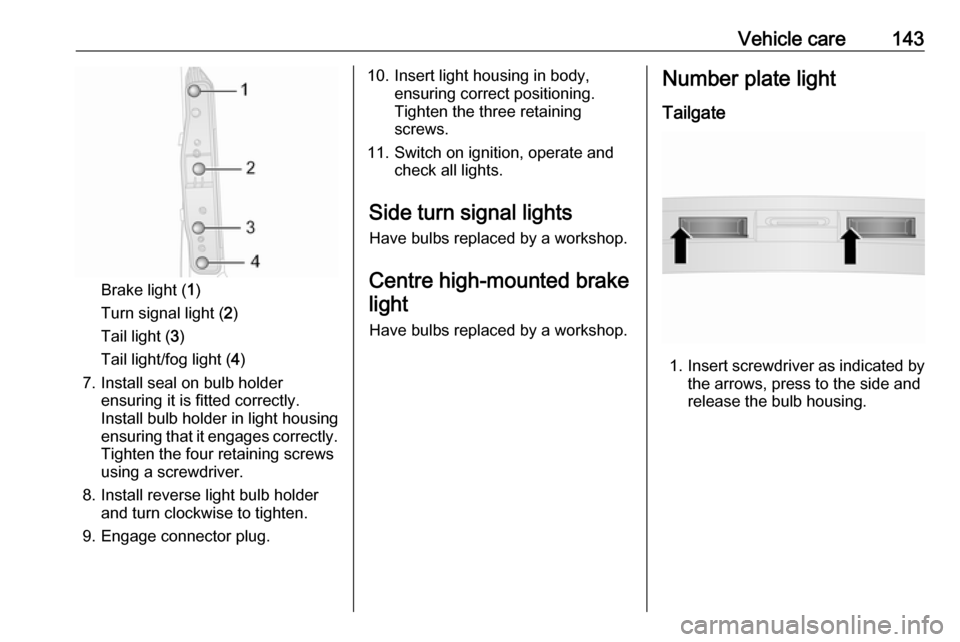
Brake light (1)
Turn signal light ( 2)
Tail light ( 3)
Tail light/fog light ( 4)
7. Install seal on bulb holder ensuring it is fitted correctly.
Install bulb holder in light housing
ensuring that it engages correctly.
Tighten the four retaining screws
using a screwdriver.
8. Install reverse light bulb holder and turn clockwise to tighten.
9. Engage connector plug.
10. Insert light housing in body, ensuring correct positioning.
Tighten the three retaining
screws.
11. Switch on ignition, operate and check all lights.
Side turn signal lights
Have bulbs replaced by a workshop.
Centre high-mounted brake light
Have bulbs replaced by a workshop.Number plate light
Tailgate
1. Insert screwdriver as indicated by
the arrows, press to the side and
release the bulb housing.
Page 156 of 189

154Vehicle care9Warning
Use of unsuitable tyres or wheels
may lead to accidents and will
invalidate the vehicle type
approval.
Wheel covers
Wheel covers and tyres that are
factory approved for the respective
vehicle and comply with all of the
relevant wheel and tyre combination
requirements must be used.
If the wheel covers and tyres used are
not factory approved, the tyres must
not have a rim protection ridge.
Wheel covers must not impair brake
cooling.
9 Warning
Use of unsuitable tyres or wheel
covers could lead to sudden
pressure loss and thereby
accidents.
Tyre chains
Tyre chains are only permitted on the
front wheels.
Always use fine mesh chains that add no more than 10 mm to the tyre tread
and the inboard sides (including chain lock).
Do not exceed 30 mph when tyre
chains are fitted.
9 Warning
Damage may lead to tyre blowout.
Tyre repair kit
Minor damage to the tyre tread can be
repaired with the tyre repair kit.
Do not remove foreign bodies from
the tyres.
Tyre damage exceeding 4 mm or that is at tyre's sidewall cannot be repairedwith the tyre repair kit.9 Warning
Do not drive faster than 50 mph.
Do not use for a lengthy period.
Steering and handling may be
affected.
If you have a flat tyre:
Apply the parking brake and engage
first or reverse gear.
The tyre repair kit may be located
under the front seat, in the glovebox,
or on the right side of the load
compartment behind a cover.
Page 159 of 189

Vehicle care1572. Turn the canister anticlockwise tolift it out.
3. Insert the new canister and turn it clockwise.
4. Connect the compressor air hose to the canister and fit the flexible
filler tube into its allocated space.
Wheel changing Some vehicles are equipped with a
tyre repair kit instead of a spare wheel
3 154.
Make the following preparations and
observe the following information:
● Park the vehicle on a level, firm and non-skid surface. The front
wheels must be in the straight-
ahead position.
● Apply the parking brake and engage first or reverse gear.
● Remove the spare wheel 3 158.
● Never change more than one wheel at once.
● Use the jack only to change wheels in case of puncture, not
for seasonal winter or summer
tyre change.● The jack is maintenance-free.
● If the ground on which the vehicle
is standing is soft, a solid board
(max. 1 cm thick) should be
placed under the jack.
● No people or animals may be in the vehicle when it is jacked-up.
● Never crawl under a jacked-up vehicle.
● Do not start the vehicle when it is
raised on the jack.
● Clean wheel nuts and thread with
a clean cloth before mounting the
wheel.9 Warning
Do not grease wheel bolt, wheel
nut and wheel nut cone.
1. Disengage wheel nut caps with a screwdriver and remove. Pull off
the wheel cover using a suitable
tool.
2. Attach wheel wrench securely and loosen each wheel nut by halfa turn.