remove engine cover VAUXHALL COMBO 2016 Owner's Manual
[x] Cancel search | Manufacturer: VAUXHALL, Model Year: 2016, Model line: COMBO, Model: VAUXHALL COMBO 2016Pages: 189, PDF Size: 4.47 MB
Page 82 of 189

80Instruments and controlsA warning message may also appear
in the Driver Information Centre (DIC)
3 85 in conjunction with a warning
chime.
Continued driving is possible,
provided the vehicle is driven with
care and anticipation.
Have the cause of the fault remedied
by a workshop as soon as possible.
Manual transmission automated
3 115.
Upshift
[ or Ò illuminates green in the
Driver Information Centre (DIC)
3 85 when gearshifting is
recommended to improve fuel
economy.
Hill start assistZ illuminates yellow.
Illuminates for a few seconds after the ignition is switched on.
If the control indicator does not
extinguish after a few seconds, or if it
illuminates while driving, there is afault in the Hill start assist. Seek the
assistance of a workshop to have the
fault remedied.
The Electronic Stability Control (ESC) control indicator R may also
illuminate 3 80 in conjunction with
Z .
Depending on version, 9 may
illuminate as an alternative if control
indicator Z is not present, in
conjunction with a warning message
in the Driver Information Centre (DIC)
3 85.
Generic warning 9 3 76.
Hill start assist 3 120.
Ultrasonic parking assist r illuminates yellow.
Fault in system
or
Fault due to sensors that are dirty or
covered by ice or snow
orInterference due to external sources
of ultrasound. Once the source of
interference is removed, the system
will operate normally.
Have the cause of the fault in the
system remedied by a workshop.
Control indicator 9 will illuminate as
an alternative if control indicator r
is not present. Depending on version,
a warning message may also be
displayed in the Driver Information
Centre (DIC) 3 85.
Generic warning 9 3 76.
Ultrasonic parking assist 3 124.
Electronic Stability Control
R illuminates or flashes yellow.
Illuminates for a few seconds after the
ignition is switched on. The system is ready for operation when the control
indicator extinguishes.
Flashes during driving
The system is actively engaged.
Engine output may be reduced and the vehicle may be braked
automatically to a small degree.
Page 142 of 189
140Vehicle careBulb replacement
Switch off the ignition and switch off
the relevant switch or close the doors.
Only hold a new bulb at the base! Do not touch the bulb glass with bare
hands.
Use only the same bulb type for
replacement.
Replace headlight bulbs from within
the engine compartment.
Bulb check After a bulb replacement, switch on
the ignition, operate and check the
lights.Halogen headlights
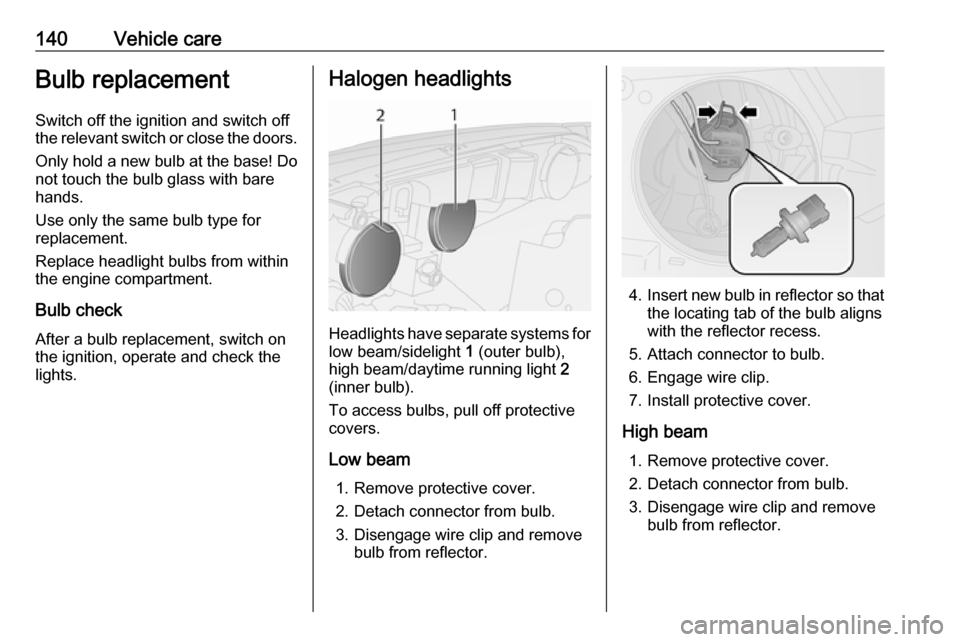
Headlights have separate systems for low beam/sidelight 1 (outer bulb),
high beam/daytime running light 2
(inner bulb).
To access bulbs, pull off protective
covers.
Low beam 1. Remove protective cover.
2. Detach connector from bulb.
3. Disengage wire clip and remove bulb from reflector.
4.Insert new bulb in reflector so that
the locating tab of the bulb aligns
with the reflector recess.
5. Attach connector to bulb.
6. Engage wire clip.
7. Install protective cover.
High beam 1. Remove protective cover.
2. Detach connector from bulb.
3. Disengage wire clip and remove bulb from reflector.
Page 148 of 189
146Vehicle careElectrical systemFuses
Data on the replacement fuse must
match the data on the defective fuse.
There are two fuse boxes in the
vehicle:
● on the right of the engine compartment, next to the battery
● behind a cover on the lower part of the instrument panel, on the
driver's side
Before replacing a fuse, turn off the
respective switch and the ignition.
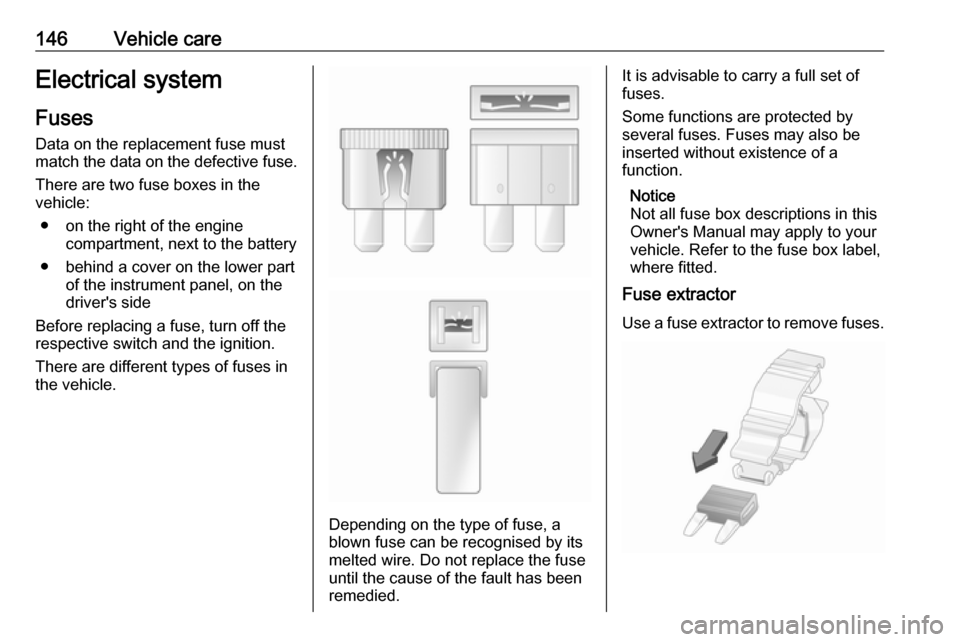
There are different types of fuses in
the vehicle.
Depending on the type of fuse, a
blown fuse can be recognised by its
melted wire. Do not replace the fuse until the cause of the fault has been
remedied.
It is advisable to carry a full set of
fuses.
Some functions are protected by
several fuses. Fuses may also be
inserted without existence of a
function.
Notice
Not all fuse box descriptions in this
Owner's Manual may apply to your
vehicle. Refer to the fuse box label,
where fitted.
Fuse extractor
Use a fuse extractor to remove fuses.
Page 149 of 189
Vehicle care147
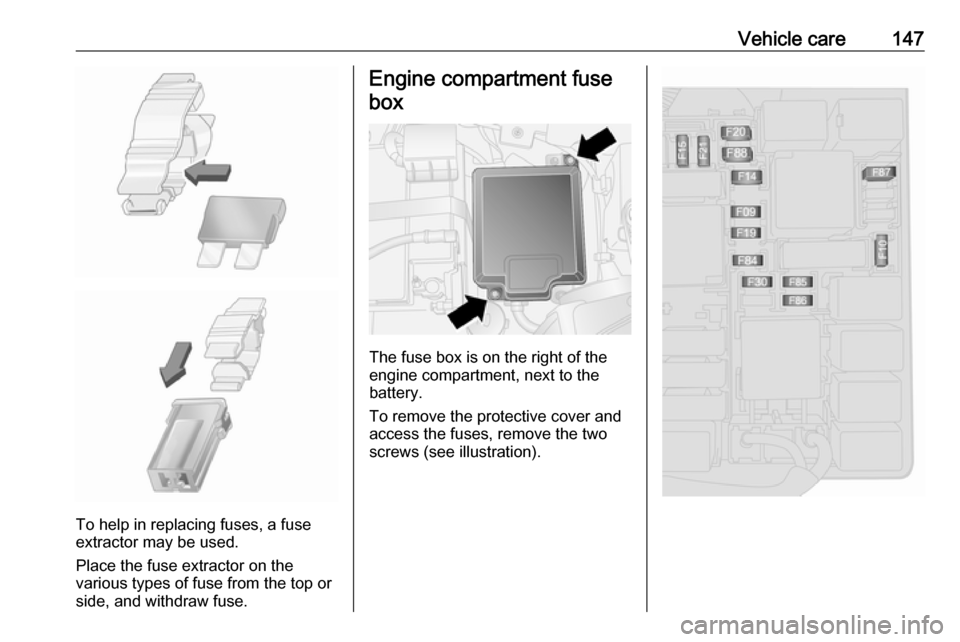
To help in replacing fuses, a fuse
extractor may be used.
Place the fuse extractor on the
various types of fuse from the top or
side, and withdraw fuse.
Engine compartment fuse
box
The fuse box is on the right of the
engine compartment, next to the
battery.
To remove the protective cover and
access the fuses, remove the two
screws (see illustration).
Page 166 of 189

164Vehicle careAppearance careExterior care
Locks The locks are lubricated at the factoryusing a high quality lock cylinder
grease. Use de-icing agent only when
absolutely necessary, as this has a
degreasing effect and impairs lock function. After using a de-icing agent, have the locks regreased by a
workshop.
Washing The paintwork of your vehicle is
exposed to environmental influences. Wash and wax your vehicle regularly.
When using automatic vehicle
washes, select a programme that
includes waxing.
Bird droppings, dead insects, resin,
pollen and the like should be cleaned
off immediately, as they contain
aggressive constituents which can
cause paint damage.If using a vehicle wash, comply with
the vehicle wash manufacturer's
instructions. The windscreen wiper and rear window wiper must be
switched off. Remove antenna and
external accessories such as roof
racks etc.
If you wash your vehicle by hand,
make sure that the insides of the
wheel housings are also thoroughly
rinsed out.
Clean edges and folds on opened
doors and the bonnet as well as the
areas they cover.Caution
Always use a cleaning agent with
a pH value of 4 to 9.
Do not use cleaning agents on hot surfaces.
Have the door hinges of all doors
greased by a workshop.
Do not clean the engine compartment with a steam-jet or high-pressure jet
cleaner.
Thoroughly rinse and leather-off the vehicle. Rinse leather frequently. Use
separate leathers for painted and
glass surfaces: remnants of wax on
the windows will impair vision.
Exterior lights
Headlight and other light covers are
made of plastic. Do not use any
abrasive or caustic agents, do not use
an ice scraper, and do not clean them
dry.
Polishing and waxing
Wax the vehicle regularly (at the
latest when water no longer beads).
Otherwise, the paintwork will dry out.
Polishing is necessary only if the paint
has become dull or if solid deposits
have become attached to it.
Paintwork polish with silicone forms a protective film, making waxing
unnecessary.
Plastic body parts must not be treated
with wax or polishing agents.