fuel VAUXHALL COMBO D 2017.5 Owner's Guide
[x] Cancel search | Manufacturer: VAUXHALL, Model Year: 2017.5, Model line: COMBO D, Model: VAUXHALL COMBO D 2017.5Pages: 201, PDF Size: 4.7 MB
Page 141 of 201

Vehicle care139Vehicle careGeneral Information...................139
Accessories and vehicle modifications .......................... 139
Vehicle storage ........................140
End-of-life vehicle recovery .....140
Vehicle checks ........................... 141
Performing work ......................141
Bonnet ..................................... 141
Engine oil ................................. 142
Engine coolant ......................... 143
Power steering fluid .................144
Washer fluid ............................ 144
Brakes ..................................... 144
Brake fluid ............................... 145
Vehicle battery ......................... 145
Wiper blade replacement ........147
Bulb replacement .......................148
Halogen headlights ..................148
Fog lights ................................. 150
Tail lights ................................. 150
Side turn signal lights ..............151
Centre high-mounted brake light ......................................... 151
Number plate light ...................151Interior lights ............................ 152
Instrument panel illumination ...153
Electrical system ........................154
Fuses ....................................... 154
Engine compartment fuse box . 155
Instrument panel fuse box .......156
Vehicle tools .............................. 158
Tools ........................................ 158
Wheels and tyres .......................158
Winter tyres ............................. 158
Tyre designations ....................159
Tyre pressure .......................... 159
Tyre pressure monitoring
system .................................... 160
Tread depth ............................. 161
Changing tyre and wheel size . 162 Wheel covers ........................... 162
Tyre chains .............................. 162
Tyre repair kit .......................... 163
Wheel changing .......................165
Spare wheel ............................ 167
Jump starting ............................. 169
Towing ....................................... 171
Towing the vehicle ...................171
Towing another vehicle ...........171
Appearance care .......................172
Exterior care ............................ 172
Interior care ............................. 174General Information
Accessories and vehiclemodifications
We recommend the use of genuine
parts and accessories and factory
approved parts specific for your
vehicle type. We cannot assess or guarantee reliability of other products
- even if they have a regulatory or
otherwise granted approval.
Any modification, conversion or other
changes made to standard vehicle
specifications (including, without
limitation, software modifications,
modifications of the electronic control units) may invalidate the warrantyoffered by Vauxhall. Furthermore,
such changes may impact fuel
consumption, CO 2 emissions and
other emissions of the vehicle and
cause the vehicle to no longer
conform to the type approval,
impacting the validity of your vehicle
registration.
Page 142 of 201

140Vehicle careCaution
When transporting the vehicle on
a train or on a recovery vehicle, the
mud flaps might be damaged.
Vehicle storage
Storage for a long period of time
If the vehicle is to be stored for several months:
● Wash and wax the vehicle.
● Have the wax in the engine compartment and underbody
checked.
● Clean and preserve the rubber seals.
● Fill up fuel tank completely.
● Change the engine oil.
● Drain the washer fluid reservoir.
● Check the coolant antifreeze and
corrosion protection.
● Adjust tyre pressure to the value specified for full load.
● Park the vehicle in a dry, wellventilated place. Engage first or
reverse gear to prevent the
vehicle from rolling.
● Do not apply the parking brake.
● Open the bonnet, close all doors and lock the vehicle.
● Disconnect the clamp from the negative terminal of the vehicle
battery. Beware that all systems
are not functional, e.g. anti-theft
locking system.
Putting back into operation
When the vehicle is to be put back into operation:
● Connect the clamp to the negative terminal of the vehicle
battery. Activate the electronics
of the power windows.
● Check tyre pressure.
● Fill up the washer fluid reservoir.
● Check the engine oil level.
● Check the coolant level.
● Fit the number plates if necessary.End-of-life vehicle recovery
Information on end-of-life vehicle
recovery centres and the recycling of
end-of-life vehicles is available on our website. Only entrust this work to an
authorised recycling centre.
Natural gas vehicles must be recycled by a service centre authorised for
natural gas vehicles.
Page 158 of 201
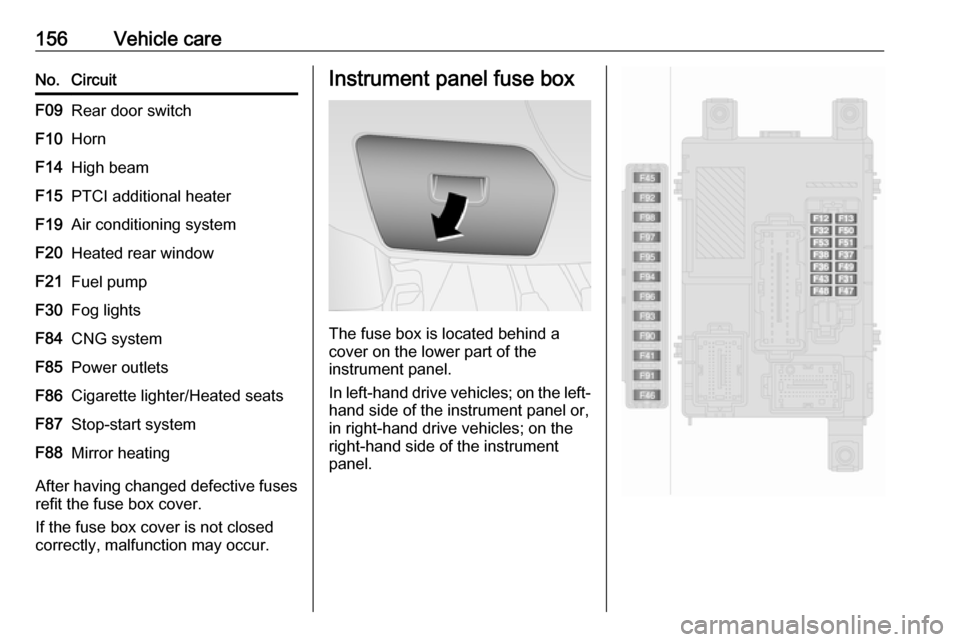
156Vehicle careNo.CircuitF09Rear door switchF10HornF14High beamF15PTCI additional heaterF19Air conditioning systemF20Heated rear windowF21Fuel pumpF30Fog lightsF84CNG systemF85Power outletsF86Cigarette lighter/Heated seatsF87Stop-start systemF88Mirror heating
After having changed defective fuses
refit the fuse box cover.
If the fuse box cover is not closed
correctly, malfunction may occur.
Instrument panel fuse box
The fuse box is located behind a
cover on the lower part of the
instrument panel.
In left-hand drive vehicles; on the left-
hand side of the instrument panel or,
in right-hand drive vehicles; on the
right-hand side of the instrument
panel.
Page 161 of 201

Vehicle care159Tyre designations
E.g. 215/60 R 16 95 H215:tyre width, mm60:cross-section ratio (tyre height
to tyre width), %R:belt type: RadialRF:type: RunFlatC:cargo or commercial use16:wheel diameter, inches95:load index e.g. 95 is equivalent to 690 kgH:speed code letter
Speed code letter:
Q:up to 100 mphS:up to 112 mphT:up to 118 mphH:up to 130 mphV:up to 150 mphW:up to 168 mph
Choose a tyre appropriate for the
maximum speed of your vehicle.
The maximum speed is achievable at
kerb weight with driver (75 kg) plus
125 kg payload. Optional equipment
could reduce the maximum speed of
the vehicle.
Performance 3 185.
Directional tyres
Directional tyres must be mounted so
that they rotate in the correct
direction. The proper rotation
direction is indicated by a symbol
(e.g. an arrow) on the sidewall.
Tyre pressure
Check the pressure of cold tyres at least every 14 days and before any
long journey. Do not forget the spare
wheel. This also applies to vehicles
with tyre pressure monitoring system.
Unscrew the valve cap.
Tyre pressure 3 190.
The tyre pressure information label
on the door frame (if fitted) indicates the original equipment tyres and the
correspondent tyre pressures.
Always inflate tyres to the pressures
shown on the label.
The tyre pressure data refers to cold
tyres. It applies to summer and winter
tyres.Incorrect tyre pressures will impair
safety, vehicle handling, comfort and
fuel economy and will increase tyre
wear.
Tyre pressures differ depending on
various options. For the correct tyre
pressure value, follow the procedure
below:
1. Identify the engine identifier code.
Engine data 3 182.
2. Identify the respective tyre.
The tyre pressure tables show all
possible tyre combinations 3 190.
For the tyres approved for your
vehicle, refer to the EEC Certificate of Conformity provided with your vehicle
or other national registration
documents.
The driver is responsible for correct
adjustment of tyre pressures.9 Warning
If the pressure is too low, this can
result in considerable tyre warm-
up and internal damage, leading to tread separation and even to tyre
blow-out at high speeds.
Page 175 of 201

Vehicle care173Do not clean the engine compartment
with a steam-jet or high-pressure jet
cleaner.
Thoroughly rinse and leather-off the
vehicle. Rinse leather frequently. Use
separate leathers for painted and
glass surfaces: remnants of wax on
the windows will impair vision.
Exterior lights
Headlight and other light covers are
made of plastic. Do not use any
abrasive or caustic agents, do not use
an ice scraper, and do not clean them
dry.
Polishing and waxing
Wax the vehicle regularly (at the
latest when water no longer beads).
Otherwise, the paintwork will dry out.
Polishing is necessary only if the paint
has become dull or if solid deposits
have become attached to it.
Paintwork polish with silicone forms a
protective film, making waxing
unnecessary.Unpainted plastic body parts must not be treated with wax or polishing
agents.
Matt filmed body parts or decor tapes must not be polished, to avoid
gleaming. Do not use hot wax
programmes in automatic car washes if the vehicle is equipped with these
parts.
Matt painted decor parts, e.g. mirror
housing cover, must not be polished. Otherwise these parts would become
agleam or the colour would be
dissolved.
Windows and windscreen wiper
blades
Use a soft lint-free cloth or chamois
leather together with window cleaner
and insect remover.
When cleaning the rear window from
inside, always wipe in parallel to the
heating element to prevent damage.
For mechanical removal of ice, use a
sharp-edged ice scraper. Press the
scraper firmly against the glass so
that no dirt can get under it and
scratch the glass.Clean smearing wiper blades with a
soft cloth and window cleaner.
Remove dirt residues from smearing
wiper blades by using a soft cloth and
window cleaner. Also make sure to
remove any residues such as wax,
insect residues and similar from the
window.
Ice residues, pollution and continuous wiping on dry windows will damage or
even destroy the wiper blades.
Glass panel
Never clean with solvents or abrasive agents, fuels, aggressive media (e.g.
paint cleaner, acetone-containing
solutions etc.), acidic or highly
alkaline media or abrasive pads. Do
not apply wax or polishing agents to
the glass panel.
Wheels and tyres Do not use high-pressure jet
cleaners.
Clean rims with a pH-neutral wheel
cleaner.
Rims are painted and can be treated
with the same agents as the body.
Page 179 of 201

Service and maintenance177Depending on version, a message
may also appear in the Driver
Information Centre 3 89.
Service display 3 77.Recommended fluids,
lubricants and parts
Recommended fluids andlubricants
Only use products that meet the
recommended specifications.9 Warning
Operating materials are
hazardous and could be
poisonous. Handle with care. Pay
attention to information given on
the containers.
Engine oil
Engine oil is identified by its quality
and its viscosity. Quality is more
important than viscosity when
selecting which engine oil to use. The oil quality ensures e.g. engine
cleanliness, wear protection and oil
ageing control, whereas viscosity
grade gives information on the oil's
thickness over a temperature range.
Dexos is the newest engine oil quality
that provides optimum protection for
petrol and diesel engines. If it is
unavailable, engine oils of other listed qualities must be used.
Recommendations for petrol engines
are also valid for Compressed Natural
Gas (CNG) fuelled engines.
Select the appropriate engine oil
based on its quality and on the
minimum ambient temperature
3 181.
Topping up engine oil
Engine oils of different manufacturers
and brands can be mixed as long as
they comply with the required engine
oil quality and viscosity.
Use of engine oil with only
ACEA A1/B1 or only A5/B5 quality is prohibited, since it can cause long-
term engine damage under certain
operating conditions.
Select the appropriate engine oil
based on its quality and on the
minimum ambient temperature
3 181.
Page 184 of 201
![VAUXHALL COMBO D 2017.5 Owners Guide 182Technical dataEngine dataSales designation1.41.41.4Engine identifier code1.4i1.4 Turbo1.4 CNGPiston displacement [cm3
]136813681368Engine power [kW]708888at rpm600050005000Torque [Nm]127206206at rp](/img/38/19404/w960_19404-183.png "VAUXHALL COMBO D 2017.5 Owners Guide 182Technical dataEngine dataSales designation1.41.41.4Engine identifier code1.4i1.4 Turbo1.4 CNGPiston displacement [cm3
]136813681368Engine power [kW]708888at rpm600050005000Torque [Nm]127206206at rp")
182Technical dataEngine dataSales designation1.41.41.4Engine identifier code1.4i1.4 Turbo1.4 CNGPiston displacement [cm3
]136813681368Engine power [kW]708888at rpm600050005000Torque [Nm]127206206at rpm450030003000Fuel typePetrolPetrolCompressed Natural Gas/PetrolOctane rating RON 1)recommended959595possible989898Gas––CNG1)
A country-specific label at the fuel filler flap can supersede the engine specific requirement.
Page 185 of 201
![VAUXHALL COMBO D 2017.5 Owners Guide Technical data183Sales designation1.3 Turbo2)1.3 Turbo3)1.6 Turbo 2)1.6 Turbo2)Engine identifier code1.3 CDTI1.3 CDTI1.6 CDTI1.6 CDTIPiston displacement [cm 3
]1248124815981598Engine power [kW]6670667](/img/38/19404/w960_19404-184.png "VAUXHALL COMBO D 2017.5 Owners Guide Technical data183Sales designation1.3 Turbo2)1.3 Turbo3)1.6 Turbo 2)1.6 Turbo2)Engine identifier code1.3 CDTI1.3 CDTI1.6 CDTI1.6 CDTIPiston displacement [cm 3
]1248124815981598Engine power [kW]6670667")
Technical data183Sales designation1.3 Turbo2)1.3 Turbo3)1.6 Turbo 2)1.6 Turbo2)Engine identifier code1.3 CDTI1.3 CDTI1.6 CDTI1.6 CDTIPiston displacement [cm 3
]1248124815981598Engine power [kW]66706677at rpm4000350040004000Torque [Nm]200200290 / 200 4)290at rpm1500150015001500Fuel typeDieselDieselDieselDiesel2)
Euro 5+.
3) Euro 6.
4) Manual transmission / Manual transmission automated.Sales designation1.6 Turbo 5)2.0 TurboEngine identifier code1.6 CDTI2.0 CDTIPiston displacement [cm 3
]15981956Engine power [kW]70/74/77/88 6)99at rpm3500 - 40003500
Page 186 of 201
![VAUXHALL COMBO D 2017.5 Owners Guide 184Technical dataSales designation1.6 Turbo5)2.0 TurboEngine identifier code1.6 CDTI2.0 CDTITorque [Nm]280 - 320320at rpm1500 - 17501500Fuel typeDieselDiesel5)
Euro 6.
6) Depending on output code.](/img/38/19404/w960_19404-185.png "VAUXHALL COMBO D 2017.5 Owners Guide 184Technical dataSales designation1.6 Turbo5)2.0 TurboEngine identifier code1.6 CDTI2.0 CDTITorque [Nm]280 - 320320at rpm1500 - 17501500Fuel typeDieselDiesel5)
Euro 6.
6) Depending on output code.")
184Technical dataSales designation1.6 Turbo5)2.0 TurboEngine identifier code1.6 CDTI2.0 CDTITorque [Nm]280 - 320320at rpm1500 - 17501500Fuel typeDieselDiesel5)
Euro 6.
6) Depending on output code.
Page 191 of 201
![VAUXHALL COMBO D 2017.5 Owners Guide Technical data189Capacities
Engine oilEngine1.4i1.4Turbo1.4CNG1.3CDTI1.6CDTI2.0CDTIincluding Filter [l]3.02.92.93.2 / 3.9 17)4.94.9between MIN and MAX [l]1.01.01.01.01.01.017)
Euro 5+ / Euro 6.
Fuel t](/img/38/19404/w960_19404-190.png "VAUXHALL COMBO D 2017.5 Owners Guide Technical data189Capacities
Engine oilEngine1.4i1.4Turbo1.4CNG1.3CDTI1.6CDTI2.0CDTIincluding Filter [l]3.02.92.93.2 / 3.9 17)4.94.9between MIN and MAX [l]1.01.01.01.01.01.017)
Euro 5+ / Euro 6.
Fuel t")
Technical data189Capacities
Engine oilEngine1.4i1.4Turbo1.4CNG1.3CDTI1.6CDTI2.0CDTIincluding Filter [l]3.02.92.93.2 / 3.9 17)4.94.9between MIN and MAX [l]1.01.01.01.01.01.017)
Euro 5+ / Euro 6.
Fuel tank
Petrol/diesel, nominal capacity [l]60Natural gas CNG, nominal capacity [kg]
Petrol, nominal capacity [l]16.15 / 22.1 18)
2218) L1 / L2.