roof VAUXHALL COMBO D 2017 Owner's Manual
[x] Cancel search | Manufacturer: VAUXHALL, Model Year: 2017, Model line: COMBO D, Model: VAUXHALL COMBO D 2017Pages: 195, PDF Size: 4.64 MB
Page 37 of 195

Seats, restraints35Rear head restraints, height
adjustment
Pull the head restraint upwards or
press the release buttons and push
the head restraint downwards.
Removal
Rear head restraints, removal
Press both release buttons, pull the
head restraint upwards and remove.
Secure the removed head restraint in the load compartment.
Notice
Approved accessories may only be
attached if the seat is not in use.
Front seats
Seat position9 Warning
Only drive with the seat correctly
adjusted.
9 Danger
Do not sit nearer than 25 cm from
the steering wheel, to permit safe
airbag deployment.
9 Warning
Never adjust seats while driving as
they could move uncontrollably.
9 Warning
Never store any objects under the
seats except in the underseat
storage compartment 3 60.
● Sit with buttocks as far back
against the backrest as possible.
Adjust the distance between the
seat and the pedals so that legs
are slightly angled when pressing the pedals. Slide the front
passenger seat as far back as
possible.
● Set the seat height high enough to have a clear field of vision on
all sides and on all display
instruments. There should be at
least one hand of clearance
between head and the roof
frame. Your thighs should rest
lightly on the seat without
pressing into it.
Page 54 of 195

52Seats, restraints4.Press R or S to switch from Pass
bag On to Pass bag off (Standard
version)
- or -
from Passenger bag On to
Passenger bag Off (Multifunction
version).
5. Press SETq to confirm selection.
Depending on version, a
message requesting confirmation
also appears in the display.
6. Press R or S to select Yes.
7. Press SETq briefly to confirm
deactivation and automatically
return to the previous display
screen.Front passenger seat airbags are
deactivated and will not inflate in the event of a collision. Control indicator
* illuminates continuously in the roof
console. A child restraint system can
be installed in accordance with the
chart Child restraint installation
locations 3 54.9 Danger
Risk of fatal injury for a child using
a child restraint system on a seat
with activated front passenger
airbag.
Risk of fatal injury for an adult
person on a seat with deactivated
front passenger airbag.
As long as the control indicator * is
not illuminated, the front passenger
airbag system will inflate in the event
of a collision.
If control indicators * and v are
illuminated at the same time, there is
a system failure. The status of the system is not discernible, therefore
no person is allowed to occupy the
front passenger seat. Contact a
workshop immediately.
Change status only when the vehicle
is stationary with the ignition off. The
status remains until the next change.
Control indicator v for airbag and belt
tensioners 3 80.
Control indicator * for airbag
deactivation 3 81.
Reactivating front passenger airbag
system - see Driver Information
Centre 3 88.
Page 60 of 195

58StorageStorageStorage compartments................58
Instrument panel storage ...........58
Glovebox ................................... 59
Cupholders ................................ 59
Front storage ............................. 59
Overhead console .....................59
Underseat storage .....................60
Load compartment .......................60
Rear storage .............................. 60
Load compartment cover ...........61
Lashing eyes ............................. 63
Load compartment grille ............63
Roof rack system .........................64
Roof rack ................................... 64
Loading information .....................65Storage compartments9Warning
Do not store heavy or sharp
objects in the storage
compartments. Otherwise vehicle
occupants could be injured by
objects being thrown around in the
event of hard braking, a sudden
change in direction or an accident.
Instrument panel storage
Storage compartments are located on both sides of the instrument panel.
Document holder
Pull the rear of the document holder
upwards from the instrument panel
and rest in tilted position.
To fold away, lower the document holder back into the instrument panel, pressing down until it engages
audibly.
Page 62 of 195

60StorageUnderseat storage
Pull the loop on the seat cushion to
gain access to the storage area.
Load compartment
Rear storage
Storage compartments are located in
the rear door pockets and in the load
compartment sidewalls.
Roof bars
Do not exceed the maximum load
(which includes the weight of the bars) of 25 kg. Always distribute the
load evenly on the roof bars. The load must not obstruct complete closure ofthe doors.
Retighten the fastening screws on the
four brackets periodically.Caution
Do not use elastic lashings, e.g.
bungee cord. We recommend the
use of webbing straps.
Roof bars are designed to be fitted in
a specific position. Proper fastening
of the roof bars cannot be guaranteed if refitted in another position.
No materials (e.g. rubber, plastic)
should be placed between the feet of
the bars and the vehicle body, to
ensure proper fastening.9 Warning
The use of roof bars may affect
steering and vehicle handling.
Removal
To remove the roof bars when not in use:
Page 63 of 195

Storage611. On one side of the vehicle, rotatehandle below first roof bar
(located beneath the bracket) to
loosen, then slide handle inwards
towards centre of vehicle.
2. Repeat above step for the other side of the vehicle.
3. Push up roof bar to release from bracket on both sides and remove
roof bar completely.
4. Repeat above steps for the second roof bar.
5. Unfasten screws on the four brackets to remove the brackets
from the vehicle body.
Load compartment cover
Extendable load compartment
cover
Do not place any heavy or sharp-
edged objects on the extendable load
compartment cover.
Closing
Pull the cover towards the rear using
the handle and engage it in the
retainers at the sides.
Opening
Remove load compartment cover
from the retainers at the sides. Hold
the cover and guide it until it is fully
rolled up.
Page 66 of 195

64Storage● From inside the loadcompartment, release the pin (1)
on the rear of the partition to
unlock, then swing open the
partition door over the folded
front passenger seat.
● Insert the pin in the slot (2) on the
backrest of the folded front
passenger seat to lock in
position.
9 Warning
The load compartment partition
must always be locked in either
position during driving. Otherwise
vehicle occupants could be injured by the partition in the event of hardbraking, a sudden change in
direction or an accident.
Ladder bulkhead
Depending on version, a ladder
bulkhead is fixed behind the driver's
seat or behind the rear seats to
protect seat occupants from
unsecured objects in the load
compartment.
Roof rack system
Roof rack
For safety reasons and to avoid
damage to the roof, the vehicle
approved roof rack system is
recommended. Contact a workshop
for further information.
Follow the installation instructions
and remove the roof rack when not in use.
Mounting roof rack
To fasten a roof rack, insert the
mounting bolts in the holes indicated
in the illustration.
Page 67 of 195

Storage65Notice
Roof racks are not permitted on high
roof variants (H2).
Vehicle dimensions 3 183.Loading information
● Heavy objects in the load compartment should be evenly
distributed and placed as far
forward as possible. If objects
can be stacked, the heavier
objects should be placed at the
bottom.
● Secure objects with lashing straps attached to lashing eyes
3 63.
● Secure loose objects in load compartment to prevent them
from sliding.
● When transporting objects in the load compartment, the backrestsof the rear seats must not be tiltedforwards or folded down.
● Do not allow the load to protrude above the upper edge of the
backrests.
● Do not place any objects on the extendable load compartment
cover 3 61 or the instrument
panel, and do not cover the
sensor on top of the instrument panel 3 106.● The load must not obstruct the
operation of the pedals, parking
brake and gear selector lever, or
hinder the freedom of movement of the driver. Do not place any
unsecured objects in the interior.
● Do not drive with an open load compartment.9Warning
Always make sure that the load in
the vehicle is securely stowed.
Otherwise objects can be thrown
around inside the vehicle and
cause personal injury or damage
to the load or vehicle.
● The payload is the difference between the permitted gross
vehicle weight (see identification
plate 3 175) and the EC kerb
weight.
To calculate the payload, enter
the data for your vehicle in the
weights table at the front of this
manual.
The EC kerb weight includes
weights for the driver (68 kg),
Page 68 of 195

66Storageluggage (7 kg) and all fluids (fuel
tank 90% full).
Optional equipment and
accessories increase the kerb
weight.
● Driving with a roof load increases
the sensitivity of the vehicle to
cross-winds and has a
detrimental effect on vehicle
handling due to the vehicle's
higher centre of gravity.
Distribute the load evenly and secure it properly with retaining
straps. Adjust the tyre pressure
and vehicle speed according to
the load conditions. Check and
retighten the straps frequently.
Do not drive faster than 75 mph.
The permissible roof load (which
includes the weight of the roof
rack) is 100 kg. The roof load is
the combined weight of the roof
rack and the load.
Page 81 of 195
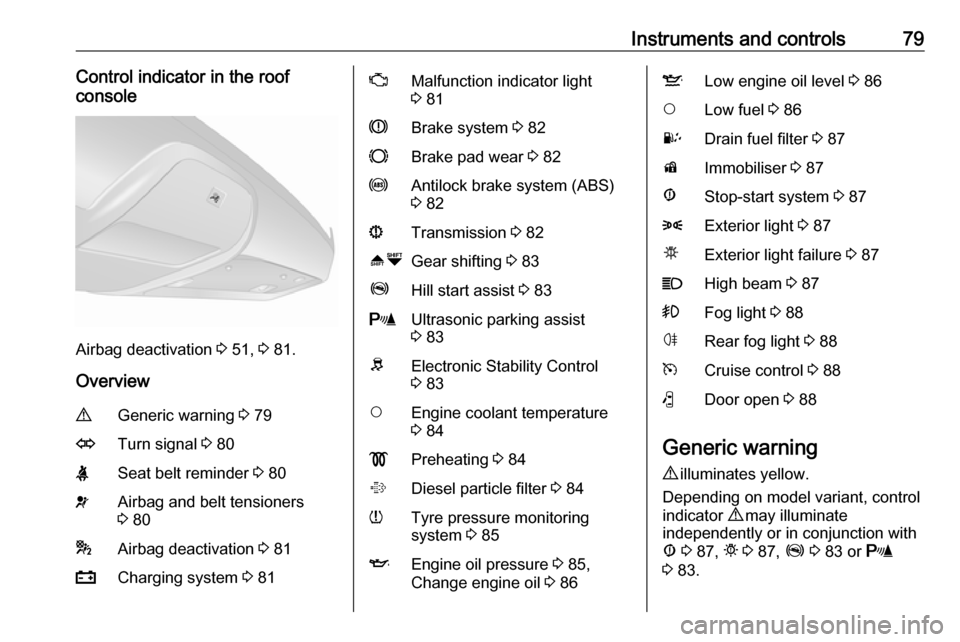
Instruments and controls79Control indicator in the roof
console
Airbag deactivation 3 51, 3 81.
Overview
9Generic warning 3 79OTurn signal 3 80XSeat belt reminder 3 80vAirbag and belt tensioners
3 80*Airbag deactivation 3 81pCharging system 3 81ZMalfunction indicator light
3 81RBrake system 3 82FBrake pad wear 3 82uAntilock brake system (ABS)
3 82sTransmission 3 82[ ÒGear shifting 3 83ZHill start assist 3 83rUltrasonic parking assist
3 83RElectronic Stability Control
3 83$Engine coolant temperature
3 84!Preheating 3 84%Diesel particle filter 3 84wTyre pressure monitoring
system 3 85IEngine oil pressure 3 85,
Change engine oil 3 86SLow engine oil level 3 86$Low fuel 3 86UDrain fuel filter 3 87dImmobiliser 3 87ÆStop-start system 3 878Exterior light 3 87µExterior light failure 3 87CHigh beam 3 87>Fog light 3 88øRear fog light 3 88mCruise control 3 88(Door open 3 88
Generic warning
9 illuminates yellow.
Depending on model variant, control
indicator 9 may illuminate
independently or in conjunction with
Æ 3 87, t 3 87, Z 3 83 or r
3 83.
Page 171 of 195

Vehicle care169If using a vehicle wash, comply with
the vehicle wash manufacturer's
instructions. The windscreen wiper and rear window wiper must be
switched off. Remove antenna and
external accessories such as roof
racks etc.
If you wash your vehicle by hand,
make sure that the insides of the
wheel housings are also thoroughly
rinsed out.
Clean edges and folds on opened
doors and the bonnet as well as the
areas they cover.Caution
Always use a cleaning agent with
a pH value of four to nine.
Do not use cleaning agents on hot surfaces.
Do not clean the engine compartmentwith a steam-jet or high-pressure jet
cleaner.
Thoroughly rinse and leather-off the vehicle. Rinse leather frequently. Use
separate leathers for painted and
glass surfaces: remnants of wax on
the windows will impair vision.
Have the door hinges of all doors
greased by a workshop.
Exterior lights
Headlight and other light covers are
made of plastic. Do not use any
abrasive or caustic agents, do not use an ice scraper, and do not clean them
dry.
Polishing and waxing
Wax the vehicle regularly (at the
latest when water no longer beads).
Otherwise, the paintwork will dry out.
Polishing is necessary only if the paint
has become dull or if solid deposits
have become attached to it.
Paintwork polish with silicone forms a
protective film, making waxing
unnecessary.
Plastic body parts must not be treated with wax or polishing agents.Windows and windscreen wiper
blades
Use a soft lint-free cloth or chamois
leather together with window cleaner
and insect remover.
When cleaning the rear window from
inside, always wipe in parallel to the
heating element to prevent damage.
For mechanical removal of ice, use a
sharp-edged ice scraper. Press the
scraper firmly against the glass so
that no dirt can get under it and
scratch the glass.
Clean smearing wiper blades with a
soft cloth and window cleaner.
Remove dirt residues from smearing
wiper blades by using a soft cloth and window cleaner. Also make sure to
remove any residues such as wax,
insect residues and similar from the
window.
Ice residues, pollution and continuous
wiping on dry windows will damage or
even destroy the wiper blades.