engine oil VAUXHALL COMBO D 2018 User Guide
[x] Cancel search | Manufacturer: VAUXHALL, Model Year: 2018, Model line: COMBO D, Model: VAUXHALL COMBO D 2018Pages: 203, PDF Size: 4.76 MB
Page 145 of 203
Vehicle care143If the bonnet is opened during an
Autostop, the engine will be restarted
automatically for safety reasons.
Stop-start system 3 116.
Closing Before closing the bonnet, press the
support into the holder.
Lower the bonnet and allow it to fall
into the latch from a low height
(20-25 cm). Check that the bonnet is
engaged.Caution
Do not press the bonnet into the
latch, to avoid dents.
Engine oil
Check the engine oil level manually
on a regular basis to prevent damage
to the engine. Ensure that the correct specification of oil is used.
Recommended fluids and lubricants
3 178.
Low engine oil level control indicator
S 3 88.
The maximum engine oil
consumption is 0.6 litres per
600 miles.
Check with the vehicle on a level
surface. The engine must be at
operating temperature and switched
off for at least five minutes.Caution
It is the owner's responsibility to
maintain the proper level of an
appropriate quality oil in the
engine.
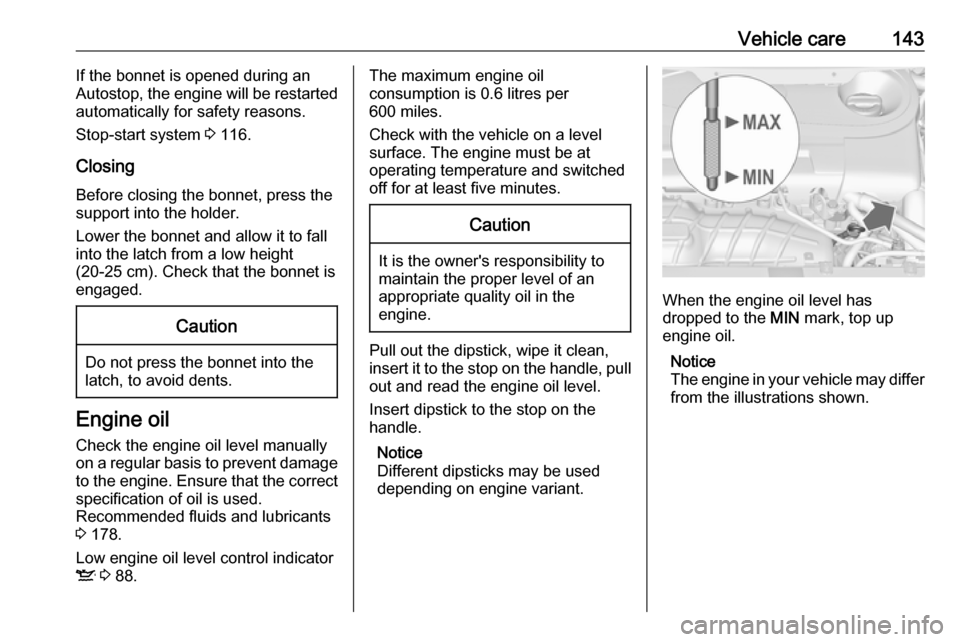
Pull out the dipstick, wipe it clean,
insert it to the stop on the handle, pull
out and read the engine oil level.
Insert dipstick to the stop on the
handle.
Notice
Different dipsticks may be used
depending on engine variant.
When the engine oil level has
dropped to the MIN mark, top up
engine oil.
Notice
The engine in your vehicle may differ from the illustrations shown.
Page 146 of 203
144Vehicle care
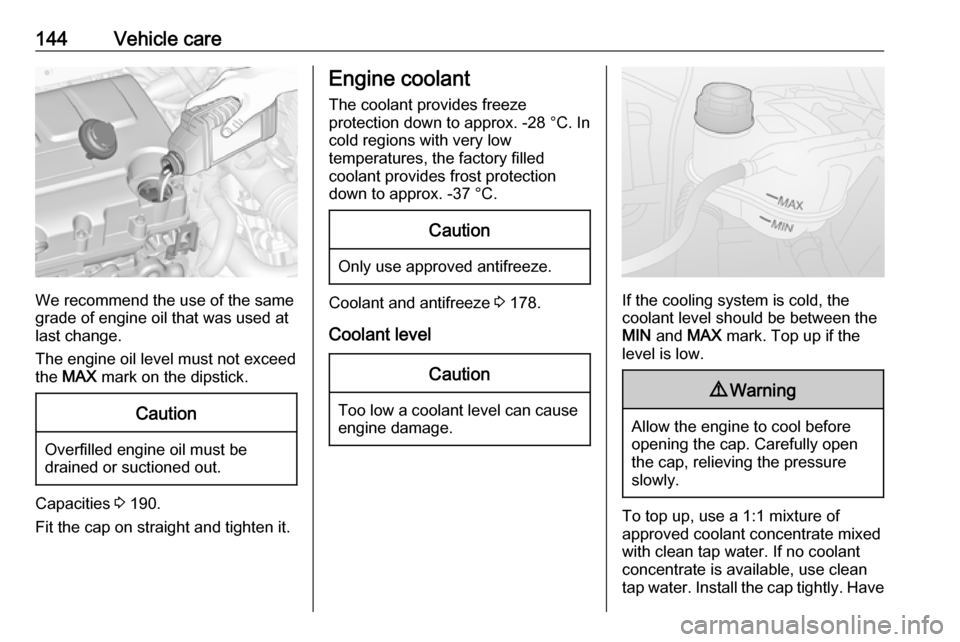
We recommend the use of the same
grade of engine oil that was used at
last change.
The engine oil level must not exceed
the MAX mark on the dipstick.
Caution
Overfilled engine oil must be
drained or suctioned out.
Capacities 3 190.
Fit the cap on straight and tighten it.
Engine coolant
The coolant provides freeze
protection down to approx. -28 °C. In
cold regions with very low
temperatures, the factory filled
coolant provides frost protection
down to approx. -37 °C.Caution
Only use approved antifreeze.
Coolant and antifreeze 3 178.
Coolant level
Caution
Too low a coolant level can cause engine damage.
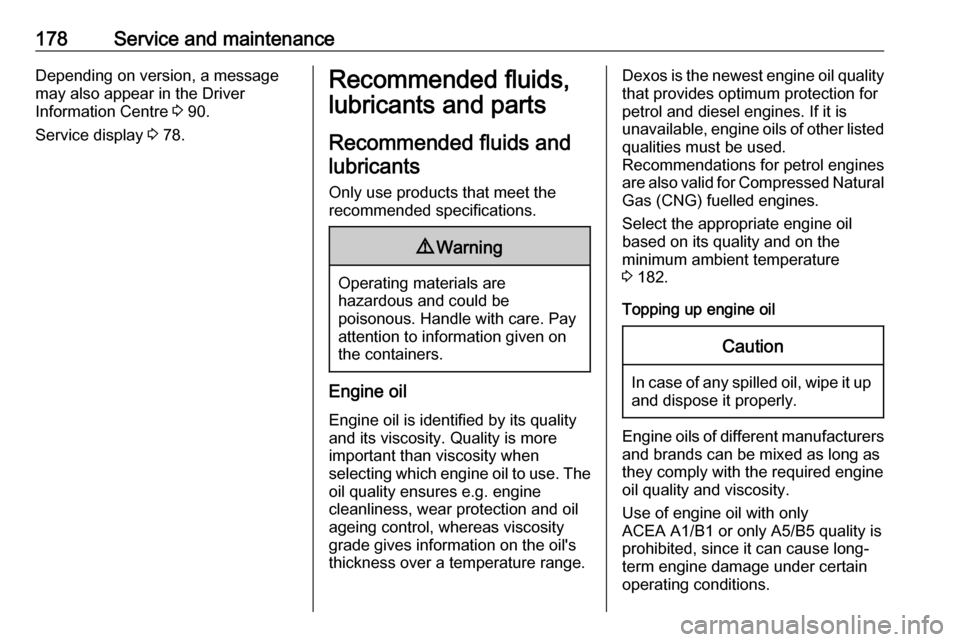
If the cooling system is cold, the
coolant level should be between the
MIN and MAX mark. Top up if the
level is low.
9 Warning
Allow the engine to cool before
opening the cap. Carefully open
the cap, relieving the pressure
slowly.
To top up, use a 1:1 mixture of
approved coolant concentrate mixed
with clean tap water. If no coolant
concentrate is available, use clean
tap water. Install the cap tightly. Have
Page 177 of 203

Vehicle care175Paintwork damageRectify minor paintwork damage witha touch-up pen before rust forms.
Have more extensive damage or rust areas repaired by a workshop.
Underbody
Some areas of the vehicle underbody
have a PVC undercoating while other critical areas have a durable
protective wax coating.
After the underbody is washed, check
the underbody and have it waxed if
necessary.
Bitumen/rubber materials could
damage the PVC coating. Have
underbody work carried out by a
workshop.
Before and after winter, wash the
underbody and have the protective
wax coating checked.
Natural gas system
Do not direct the steam jet or high-
pressure jet towards natural gas
system components. It is particularly
important to protect the natural gastank and the pressure valves on the
vehicle underbody and the bulkhead in the engine compartment.
These components must not be
treated using chemical cleaners or
preservatives.
Have components of the natural gas
system cleaned by a workshop
authorised to carry out maintenance
of natural gas vehicles.
Towing equipment
Do not clean the coupling ball bar with a steam-jet or high-pressure jet
cleaner.
Interior care
Interior and upholstery
Only clean the vehicle interior,
including the instrument panel fascia
and panelling, with a dry cloth or
interior cleaner.
Clean the leather upholstery with
clear water and a soft cloth. In case of heavy soiling, use leather care.The instrument cluster and the
displays should only be cleaned using
a soft damp cloth. If necessary, use a
weak soap solution.
Clean fabric upholstery with a
vacuum cleaner and brush. Remove
stains with an upholstery cleaner.
Clothing fabrics may not be
colourfast. This could cause visible
discolourations, especially on light-
coloured upholstery. Removable
stains and discolourations should be
cleaned as soon as possible.
Clean seat belts with lukewarm water or interior cleaner.Caution
Close Velcro fasteners as open
Velcro fasteners on clothing could damage seat upholstery.
The same applies to clothing with
sharp-edged objects, like zips or
belts or studded jeans.
Page 179 of 203

Service and maintenance177Service and
maintenanceGeneral information ...................177
Service information ..................177
Recommended fluids, lubricants and parts .................................... 178
Recommended fluids and lubricants ................................ 178General information
Service information In order to ensure economical and
safe vehicle operation and to
maintain the value of your vehicle, it
is of vital importance that all
maintenance work is carried out at the proper intervals as specified.
The detailed, up-to-date service
schedule for your vehicle is available
at the workshop.
Service display 3 78.
Engine identification 3 181.
European service intervals Petrol and CNG engines
Maintenance of your vehicle is
required every 18,000 miles or
two years, whichever occurs first.
Diesel engines
Maintenance of your vehicle is
required every 21,000 miles or
two years, whichever occurs first,
unless otherwise indicated in the
Driver Information Centre 3 90.A shorter service interval can be valid
for severe driving behaviour, e.g. for
taxis and police vehicles.
Service display 3 78.
Confirmations Confirmation of service is recorded inthe Service and warranty booklet.
The date and mileage is completed
with the stamp and signature of the
servicing workshop.
Make sure that the Service and
warranty booklet is completed
correctly as continuous proof of
service is essential if any warranty or
goodwill claims are to be met, and is
also a benefit when selling the
vehicle.
Service interval with remaining
engine oil life duration
The service interval is based on
several parameters depending on
usage.
When the engine oil requires
changing, control indicator I will
flash in the instrument cluster 3 88.
Page 180 of 203
178Service and maintenanceDepending on version, a message
may also appear in the Driver
Information Centre 3 90.
Service display 3 78.Recommended fluids,
lubricants and parts
Recommended fluids andlubricants
Only use products that meet the
recommended specifications.9 Warning
Operating materials are
hazardous and could be
poisonous. Handle with care. Pay
attention to information given on
the containers.
Engine oil
Engine oil is identified by its quality
and its viscosity. Quality is more
important than viscosity when
selecting which engine oil to use. The oil quality ensures e.g. engine
cleanliness, wear protection and oil
ageing control, whereas viscosity
grade gives information on the oil's
thickness over a temperature range.
Dexos is the newest engine oil quality
that provides optimum protection for
petrol and diesel engines. If it is
unavailable, engine oils of other listed qualities must be used.
Recommendations for petrol engines
are also valid for Compressed Natural
Gas (CNG) fuelled engines.
Select the appropriate engine oil
based on its quality and on the
minimum ambient temperature
3 182.
Topping up engine oilCaution
In case of any spilled oil, wipe it up and dispose it properly.
Engine oils of different manufacturersand brands can be mixed as long as
they comply with the required engine
oil quality and viscosity.
Use of engine oil with only
ACEA A1/B1 or only A5/B5 quality is
prohibited, since it can cause long-
term engine damage under certain
operating conditions.
Page 181 of 203

Service and maintenance179Select the appropriate engine oil
based on its quality and on the
minimum ambient temperature
3 182.
Additional engine oil additives
The use of additional engine oil
additives could cause damage and
invalidate the warranty.
Engine oil viscosity
The SAE viscosity grade gives
information on the thickness of the oil.
Multigrade oil is indicated by two
figures, e.g. SAE 5W-30. The first
figure, followed by a W, indicates the
low temperature viscosity and the
second figure the high temperature viscosity.
Select the appropriate viscosity grade depending on the minimum ambient
temperature 3 182.
All of the recommended viscosity
grades are suitable for high ambient
temperatures.
Coolant and antifreeze
Use only antifreeze approved for the
vehicle. Consult a workshop.The system is factory filled with
coolant designed for excellent
corrosion protection and frost
protection down to approx. -28 °C. In
regions with very low temperatures,
the factory filled coolant provides frost
protection down to approx. -37 °C.
This concentration should be
maintained all year round.
The use of additional coolant
additives that intend to give additional
corrosion protection or seal against
minor leaks can cause function
problems. Liability for consequences
resulting from the use of additional
coolant additives will be rejected.
Washer fluid
Use only washer fluid approved for
the vehicle to prevent damage of wiper blades, paintwork, plastic and
rubber parts. Consult a workshop.
Brake and clutch fluidOver time, brake fluid absorbs
moisture which will reduce braking
effectiveness. The brake fluid should
therefore be replaced at the specified
interval.
Page 184 of 203

182Technical dataVehicle dataRecommended fluids andlubricants
Required engine oil qualityEngine oil quality: Europedexos 2✔
For countries with International
service interval 3 177, you may use
the oil qualities listed below:
Engine oil quality: Internationaldexos 2✔ACEA C3✔ACEA A3/B4✔Engine oil viscosity gradesAmbient temperaturedown to
-25 °CSAE 0W-30 or
SAE 0W-40
SAE 5W-30 or
SAE 5W-40below
-25 °CSAE 0W-30 or
SAE 0W-40
Page 192 of 203
![VAUXHALL COMBO D 2018 User Guide 190Technical dataCapacities
Engine oilEngine1.4i1.4Turbo1.4CNG1.3CDTI1.6CDTI2.0CDTIincluding Filter [l]3.02.92.93.2 / 3.9 17)4.94.9between MIN and MAX [l]1.01.01.01.01.01.017)
Euro 5+ / Euro 6.
Fuel t](/img/38/19406/w960_19406-191.png "VAUXHALL COMBO D 2018 User Guide 190Technical dataCapacities
Engine oilEngine1.4i1.4Turbo1.4CNG1.3CDTI1.6CDTI2.0CDTIincluding Filter [l]3.02.92.93.2 / 3.9 17)4.94.9between MIN and MAX [l]1.01.01.01.01.01.017)
Euro 5+ / Euro 6.
Fuel t")
190Technical dataCapacities
Engine oilEngine1.4i1.4Turbo1.4CNG1.3CDTI1.6CDTI2.0CDTIincluding Filter [l]3.02.92.93.2 / 3.9 17)4.94.9between MIN and MAX [l]1.01.01.01.01.01.017)
Euro 5+ / Euro 6.
Fuel tank
Petrol/diesel, nominal capacity [l]60Natural gas CNG, nominal capacity [kg]
Petrol, nominal capacity [l]16.15 / 22.1 18)
2218) L1 / L2.
Page 198 of 203

196IndexAAccessories and vehicle modifications .......................... 140
Adjustable air vents ...................110
Airbag activation ........................... 90
Airbag and belt tensioners ...........82
Airbag deactivation ..........52, 83, 90
Airbag label............................. 47, 52
Airbag system .............................. 47
Air conditioning regular operation ................................ 111
Air conditioning system .............. 107
Air intake .................................... 111
Air vents...................................... 110
Alert .............................................. 95
Antilock brake system ................ 126
Antilock brake system (ABS) .......84
Anti-Slip Regulator (ASR) ...........128
Anti-theft locking system .............. 28
Appearance care ........................173
Armrest ......................................... 39
Ashtrays ....................................... 75
ASR (Anti-Slip Regulator) ...........128
Audible warning chimes................ 95
Autoclose ...................................... 90
Automatic fuel cut-off ............96, 115
Automatic locking .........................90
Autostop ..................................... 116
AUX socket ................................... 74B
Battery ........................................ 146
Battery discharge protection ......105
Belts.............................................. 44
Bonnet ....................................... 142
Brake and clutch fluid .................178
Brake assist ............................... 127
Brake fluid .................................. 146
Brake pad wear ............................ 84
Brakes ............................... 126, 145
Brake system ............................... 84
Breakdown.................................. 172
Bulb replacement ....................... 149
C Capacities .................................. 190
Car Pass ...................................... 20
Catalytic converter .....................120
Central locking system ................23
Centre high-mounted brake light 152
Change engine oil .......................88
Changing tyre and wheel size ...163
Charging system .......................... 83
Child locks ................................... 24
Child restraint installation locations ................................... 57
Child restraints.............................. 54
Child restraint systems ................54
Child safety system for rear windows .................................... 31
Page 199 of 203

197Chimes......................................... 95
Cigarette lighter ........................... 75
Climate control ............................. 15
Climate control systems .............106
Clock....................................... 72, 90
CNG.............................. 77, 135, 190
Collision damage repair ..............193
Control indicators.......................... 79
Control of the vehicle .................113
Controls ........................................ 70
Convex shape .............................. 29
Coolant and antifreeze ...............178
Cruise control ...................... 90, 130
Cupholders .................................. 61
D
Danger, Warnings and Cautions ...4
Date .............................................. 90
Daytime running lights ..........90, 100
Declaration of conformity ............192
Diesel particle filter ...............86, 120
Distance to next service ...............90
Door open .................................... 90
Doors ...................................... 25, 27
Drain fuel filter ............................. 89
Driver assistance systems ..........130
Driver Information Centre .............90
Driving characteristics and towing tips .............................. 138
Driving hints ................................ 113E
Eco mode (E).............................. 124
Electric adjustment ......................29
Electrical system......................... 155
Electronic climate control system 108
Electronic driving programmes ..124
Electronic Stability Control ..85, 129
Electronic Stability Control (ESC). 85
End-of-life vehicle recovery .......141
Engine compartment fuse box ...156
Engine coolant ........................... 144
Engine coolant temperature ........86
Engine coolant temperature gauge ....................................... 78
Engine data ............................... 183
Engine exhaust .......................... 120
Engine identification ...................181
Engine oil ...........143, 178, 182, 190
Engine oil pressure ......................87
ESC (Electronic Stability Control) 129
Event data recorders ..................194
Exit lighting ................................ 105
Extendable load compartment cover ................................... 63, 67
Exterior care .............................. 173
Exterior light ................................. 89
Exterior lighting ......................12, 99
Exterior mirrors ............................. 29F
Fault ........................................... 125
Fixed air vents ........................... 111
Fog light ....................................... 90
Fog lights ................................... 151
Folding front passenger seat ........37
Folding mirrors ............................. 30
Folding seats .......................... 40, 41
Front airbag system .....................51
Front fog lights ........................... 101
Front passenger seat Folding ...................................... 37
Table position ............................ 37
Front seats.................................... 35
Front storage ................................ 61
Front turn signal light ..................149
Fuel............................................. 134
Fuel consumption .........................90
Fuel consumption - CO 2-
Emissions ............................... 137
Fuel cut-off system .........81, 96, 115
Fuel for diesel engines ..............134
Fuel for natural gas operation ...135
Fuel for petrol engines ...............134
Fuel gauge ................................... 77
Fuel selector ................................ 77
Fuel system messages .........96, 115
Fuel tank ..................................... 190
Fuses ......................................... 155