ECU VAUXHALL COMBO D 2018 Owner's Guide
[x] Cancel search | Manufacturer: VAUXHALL, Model Year: 2018, Model line: COMBO D, Model: VAUXHALL COMBO D 2018Pages: 203, PDF Size: 4.76 MB
Page 70 of 203

68Storage● The load must not obstruct theoperation of the pedals, parking
brake and gear selector lever, or
hinder the freedom of movement of the driver. Do not place any
unsecured objects in the interior.
● Do not drive with an open load compartment.9Warning
Always make sure that the load in
the vehicle is securely stowed.
Otherwise objects can be thrown
around inside the vehicle and
cause personal injury or damage
to the load or vehicle.
● The payload is the difference between the permitted gross
vehicle weight (see identification
plate 3 181) and the EC kerb
weight.
To calculate the payload, enter
the data for your vehicle in the
weights table at the front of this
manual.
The EC kerb weight includes
weights for the driver (68 kg),
luggage (7 kg) and all fluids (fuel
tank 90% full).
Optional equipment and
accessories increase the kerb
weight.
● Driving with a roof load increases
the sensitivity of the vehicle to
cross-winds and has a
detrimental effect on vehicle
handling due to the vehicle's
higher centre of gravity.
Distribute the load evenly and secure it properly with retaining
straps. Adjust the tyre pressure
and vehicle speed according to
the load conditions. Check and
retighten the straps frequently.
Do not drive faster than 75 mph.
The permissible roof load (which
includes the weight of the roof
rack) is 100 kg. The roof load is
the combined weight of the roof
rack and the load.
Page 144 of 203

142Vehicle careVehicle checks
Performing work9 Warning
Only perform engine compartment
checks when the ignition is off.
The cooling fan may start
operating even if the ignition is off.
9 Danger
The ignition system use extremely
high voltage. Do not touch.
Bonnet
Opening
Pull the release lever (located on the
lower left side of the instrument panel) and return it to its original position.
Move the safety catch sideways and
open the bonnet.
Secure the bonnet support.
Page 169 of 203
Vehicle care167
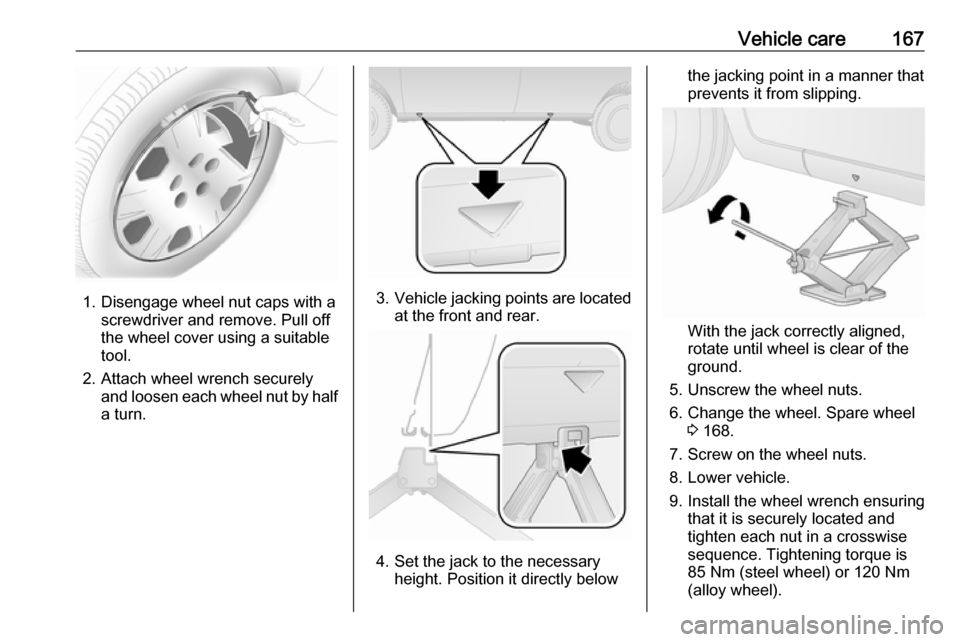
1. Disengage wheel nut caps with ascrewdriver and remove. Pull off
the wheel cover using a suitable
tool.
2. Attach wheel wrench securely and loosen each wheel nut by halfa turn.3. Vehicle jacking points are located
at the front and rear.
4. Set the jack to the necessary height. Position it directly below
the jacking point in a manner that
prevents it from slipping.
With the jack correctly aligned,
rotate until wheel is clear of the
ground.
5. Unscrew the wheel nuts. 6. Change the wheel. Spare wheel 3 168.
7. Screw on the wheel nuts.
8. Lower vehicle.
9. Install the wheel wrench ensuring that it is securely located and
tighten each nut in a crosswise
sequence. Tightening torque is
85 Nm (steel wheel) or 120 Nm
(alloy wheel).
Page 171 of 203

Vehicle care1694. Withdraw spare wheel frombeneath the vehicle.
5. Unscrew knob 2 and release
cable attachment 1 from spare
wheel.
6. Change the wheel.
7. Position the replaced wheel at the
rear of the vehicle with the outside of the wheel facing downwards.
8. Pass the retainer 1 through the
hole in the rim, inserting the
locating pin into one of the bolt
holes and secure with knob 2.
9. Insert the wheel wrench into the aperture in the load compartment
floor and rotate to fully raise the
spare wheel.
Have the defective tyre renewed or
repaired as soon as possible.
CNG vehicles Vehicles with CNG; the spare wheel
is located in the load compartment.1. Unscrew two bolts using the wheel wrench and remove spare
wheel from bracket.
Vehicle tools 3 159.
2. Change the wheel.
Page 172 of 203

170Vehicle care3.Position the replaced spare wheel
onto the bracket ensuring correct
alignment of the locating pin.
4. Secure spare wheel by tightening two bolts using the wheel wrench.
Have the defective tyre renewed or
repaired as soon as possible.
Directional tyres
If possible, fit directional tyres such
that they roll in the direction of travel.
The rolling direction is indicated by a
symbol (e.g. an arrow) on the
sidewall.
The following applies to tyres fitted
opposing the rolling direction:
● Driveability may be affected. Have the defective tyre renewed
or repaired as soon as possible
and fit it instead of the spare
wheel.
● Drive particularly carefully on wet
and snow-covered road
surfaces.Jump starting
Do not start with quick charger.
A vehicle with a discharged battery
can be started using jump leads and
the battery of another vehicle.9 Warning
Be extremely careful when starting
with jump leads. Any deviation
from the following instructions can
lead to injuries or damage caused
by battery explosion or damage to the electrical systems of both
vehicles.
9 Warning
Avoid contact of the vehicle
battery with eyes, skin, fabrics and painted surfaces. The fluid
contains sulphuric acid which can
cause injuries and damage in the
event of direct contact.
● Never expose the vehicle battery
to naked flames or sparks.
● A discharged vehicle battery can already freeze at a temperature
of 0 °C. Defrost the frozen battery
before connecting jump leads.
● Wear eye protection and protective clothing when
handling a vehicle battery.
● Use a booster battery with the same voltage (12 V). Its capacity
(Ah) must not be much less than
that of the discharged vehicle
battery.
● Use jump leads with insulated terminals and a cross section of
at least 16 mm 2
(25 mm 2
for
diesel engines).
● Do not disconnect the discharged
battery from the vehicle.
● Switch off all unnecessary electrical consumers.
● Do not lean over the vehicle battery during jump starting.
● Do not allow the terminals of one
lead to touch those of the other
lead.
Page 196 of 203

194Customer informationVehicle data recording
and privacy
Event data recorders Data storage modules in the
vehicle
A large number of electronic
components of your vehicle contain
data storage modules temporarily or
permanently storing technical data
about the condition of the vehicle,
events and errors. In general, this
technical information documents the
condition of parts, modules, systems
or the environment:
● operating conditions of system components (e.g. filling levels)
● status messages of the vehicle and its single components (e.g.
number of wheel revolutions / rotational speed, deceleration,
lateral acceleration)
● dysfunctions and defects in important system components● vehicle reactions in particulardriving situations (e.g. inflation of
an airbag, activation of the
stability regulation system)
● environmental conditions (e.g. temperature)
This data is exclusively technical and
helps identifying and correcting errors as well as optimizing vehicle
functions.
Motion profiles indicating travelled
routes cannot be created with this
data.
If services are used (e.g. repair
works, service processes, warranty
cases, quality assurance),
employees of the service network
(manufacturer included) are able to
read out this technical information
from the event and error data storage
modules applying special diagnostic
devices. If required, you will receive
further information at these
workshops. After an error has been
corrected, the data is deleted from the
error storage module or it is
constantly overwritten.When using the vehicle, situations
may occur in which technical data
related to other information (accident
report, damages on the vehicle,
witness statements etc.) may be
associated with a specific person -
possibly, with the assistance of an
expert.
Additional functions contractually
agreed upon with the client (e.g.
vehicle location in emergency cases)
allow the transmission of particular
vehicle data from the vehicle.
Radio Frequency
Identification (RFID)
RFID technology is used in some
vehicles for functions such as tyre
pressure monitoring and ignition
system security. It is also used in
connection with conveniences such
as radio remote controls for door
locking/unlocking and starting, and in- vehicle transmitters for garage dooropeners. RFID technology in
Vauxhall vehicles does not use or
record personal information or link
with any other Vauxhall system
containing personal information.
Page 202 of 203

200T
Tachometer ................................. 76
Tailgate ......................................... 27
Tail lights ................................... 151
Technical data ............................ 183
Temperature ................................. 90
Third row seats ............................ 41
Three-point seat belt .................... 45
Toll road stickers .......................... 31
Tools .......................................... 159
Top-Tether .................................... 54
Towing ................................ 138, 172
Towing another vehicle .............172
Towing the vehicle .....................172
Traction Control system ............. 128
Trailer coupling ........................... 138
Trailer towing ............................. 138
Transmission ......................... 16, 84
Transmission display ...........79, 122
Tread depth ............................... 162
Trip computer ......................... 90, 96
Trip odometer .............................. 76
Turn and lane-change signals ...101
Turn signal ................................... 82
Tyre chains ................................ 163
Tyre designations ......................160
Tyre pressure ............................ 160
Tyre pressure monitoring system ............................... 87, 161Tyre pressures ........................... 191
Tyre repair kit ............................. 164
U
Ultrasonic parking assist ...... 85, 131
Underseat storage .......................62
Unit of measurement ....................90
Upholstery .................................. 175
USB port ....................................... 74
Using this manual ..........................3
V Vehicle battery ........................... 146
Vehicle checks............................ 142
Vehicle data ................................ 182
Vehicle data recording and privacy ..................................... 194
Vehicle dimensions .................... 188
Vehicle Identification Number ....180
Vehicle jack ................................ 159
Vehicle security ............................ 28
Vehicle shutdown ...........81, 96, 115
Vehicle specific data ......................3
Vehicle storage ........................... 141
Vehicle tools ............................... 159
Vehicle unlocking ........................... 6
Vehicle weight ........................... 187
Ventilation ................................... 106
Volume ......................................... 90W
Warning chime.............................. 90
Warning chimes ........................... 95
Warning lights ............................... 76
Washer and wiper systems .........14
Washer fluid ............................... 145
Wheel changing .........................166
Wheel covers ............................. 163
Wheels and tyres .......................159
Windows ....................................... 31
Windscreen................................... 31 Windscreen stickers .....................31
Windscreen wiper/washer ...........71
Winter tyres ............................... 159
Wiper blade replacement ..........148