tyre pressure VAUXHALL COMBO E 2020 User Guide
[x] Cancel search | Manufacturer: VAUXHALL, Model Year: 2020, Model line: COMBO E, Model: VAUXHALL COMBO E 2020Pages: 279, PDF Size: 28.6 MB
Page 239 of 279
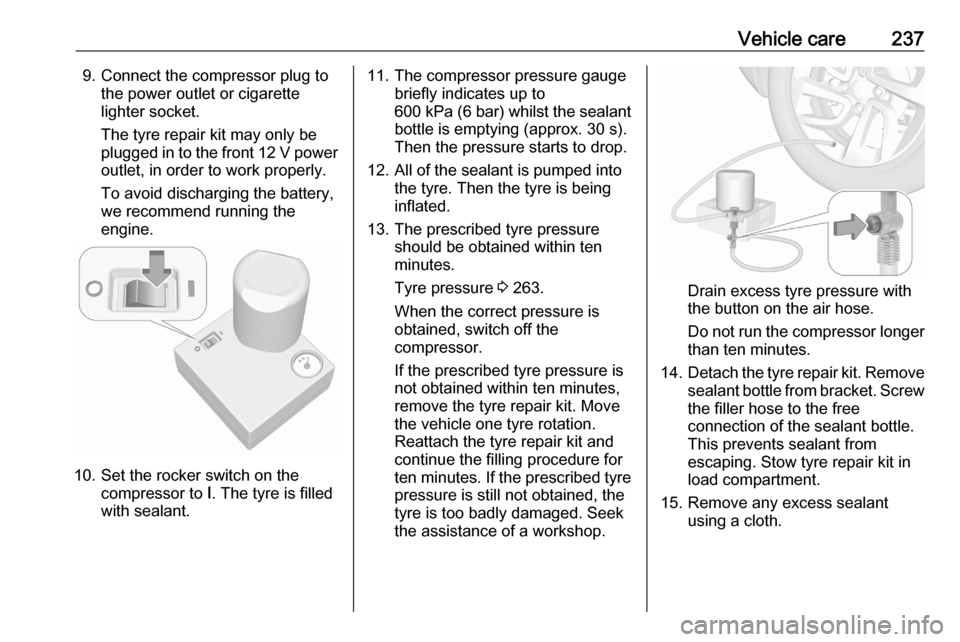
Vehicle care2379. Connect the compressor plug tothe power outlet or cigarette
lighter socket.
The tyre repair kit may only be
plugged in to the front 12 V power outlet, in order to work properly.
To avoid discharging the battery,
we recommend running the
engine.
10. Set the rocker switch on the compressor to I. The tyre is filled
with sealant.
11. The compressor pressure gauge briefly indicates up to
600 kPa (6 bar) whilst the sealant
bottle is emptying (approx. 30 s).
Then the pressure starts to drop.
12. All of the sealant is pumped into the tyre. Then the tyre is being
inflated.
13. The prescribed tyre pressure should be obtained within ten
minutes.
Tyre pressure 3 263.
When the correct pressure is
obtained, switch off the
compressor.
If the prescribed tyre pressure is
not obtained within ten minutes,
remove the tyre repair kit. Move
the vehicle one tyre rotation.
Reattach the tyre repair kit and
continue the filling procedure for ten minutes. If the prescribed tyre
pressure is still not obtained, the
tyre is too badly damaged. Seek
the assistance of a workshop.
Drain excess tyre pressure with
the button on the air hose.
Do not run the compressor longer than ten minutes.
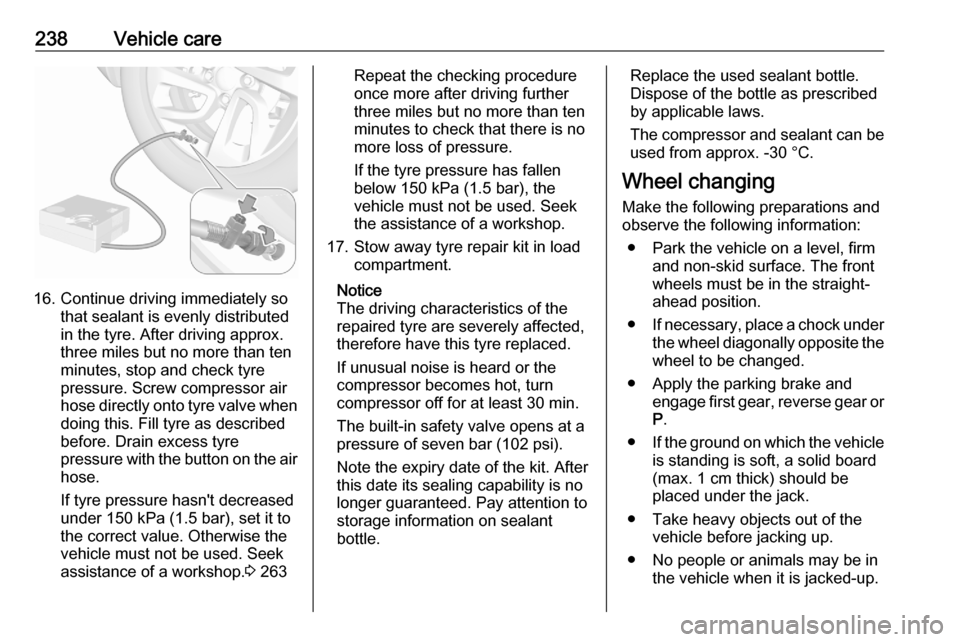
14. Detach the tyre repair kit. Remove
sealant bottle from bracket. Screw the filler hose to the free
connection of the sealant bottle.
This prevents sealant from
escaping. Stow tyre repair kit in
load compartment.
15. Remove any excess sealant using a cloth.
Page 240 of 279
238Vehicle care
16. Continue driving immediately sothat sealant is evenly distributed
in the tyre. After driving approx.
three miles but no more than ten
minutes, stop and check tyre
pressure. Screw compressor air
hose directly onto tyre valve when
doing this. Fill tyre as described
before. Drain excess tyre
pressure with the button on the air
hose.
If tyre pressure hasn't decreased
under 150 kPa (1.5 bar), set it to
the correct value. Otherwise the
vehicle must not be used. Seek
assistance of a workshop. 3 263
Repeat the checking procedure
once more after driving further
three miles but no more than ten
minutes to check that there is no
more loss of pressure.
If the tyre pressure has fallen
below 150 kPa (1.5 bar), the
vehicle must not be used. Seek
the assistance of a workshop.
17. Stow away tyre repair kit in load compartment.
Notice
The driving characteristics of the repaired tyre are severely affected,
therefore have this tyre replaced.
If unusual noise is heard or the
compressor becomes hot, turn
compressor off for at least 30 min.
The built-in safety valve opens at a
pressure of seven bar (102 psi).
Note the expiry date of the kit. After
this date its sealing capability is no
longer guaranteed. Pay attention to
storage information on sealant
bottle.Replace the used sealant bottle. Dispose of the bottle as prescribed
by applicable laws.
The compressor and sealant can be used from approx. -30 °C.
Wheel changing
Make the following preparations and
observe the following information:
● Park the vehicle on a level, firm and non-skid surface. The front
wheels must be in the straight- ahead position.
● If necessary, place a chock under
the wheel diagonally opposite the
wheel to be changed.
● Apply the parking brake and engage first gear, reverse gear orP .
● If the ground on which the vehicle
is standing is soft, a solid board
(max. 1 cm thick) should be
placed under the jack.
● Take heavy objects out of the vehicle before jacking up.
● No people or animals may be in the vehicle when it is jacked-up.
Page 245 of 279
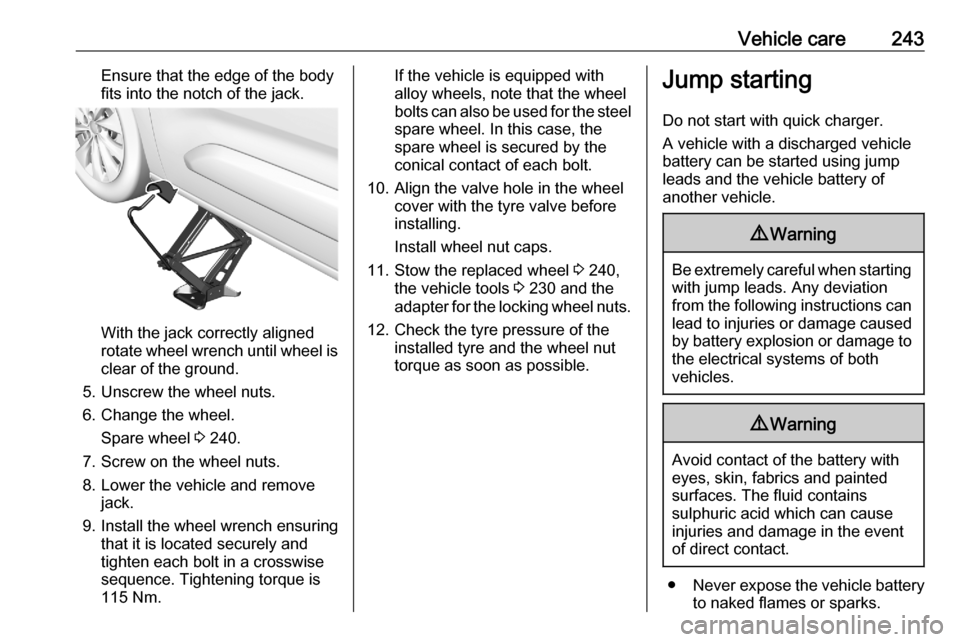
Vehicle care243Ensure that the edge of the body
fits into the notch of the jack.
With the jack correctly aligned
rotate wheel wrench until wheel is
clear of the ground.
5. Unscrew the wheel nuts.
6. Change the wheel. Spare wheel 3 240.
7. Screw on the wheel nuts.
8. Lower the vehicle and remove jack.
9. Install the wheel wrench ensuring that it is located securely and
tighten each bolt in a crosswise
sequence. Tightening torque is
115 Nm.
If the vehicle is equipped with
alloy wheels, note that the wheel
bolts can also be used for the steel spare wheel. In this case, the
spare wheel is secured by the
conical contact of each bolt.
10. Align the valve hole in the wheel cover with the tyre valve before
installing.
Install wheel nut caps.
11. Stow the replaced wheel 3 240,
the vehicle tools 3 230 and the
adapter for the locking wheel nuts.
12. Check the tyre pressure of the installed tyre and the wheel nuttorque as soon as possible.Jump starting
Do not start with quick charger.
A vehicle with a discharged vehicle
battery can be started using jump
leads and the vehicle battery of
another vehicle.9 Warning
Be extremely careful when starting
with jump leads. Any deviation
from the following instructions can
lead to injuries or damage caused
by battery explosion or damage to the electrical systems of both
vehicles.
9 Warning
Avoid contact of the battery with
eyes, skin, fabrics and painted
surfaces. The fluid contains
sulphuric acid which can cause
injuries and damage in the event
of direct contact.
● Never expose the vehicle battery
to naked flames or sparks.
Page 250 of 279

248Vehicle careThoroughly rinse and leather-off the
vehicle. Rinse leather frequently. Use
separate leathers for painted and
glass surfaces: remnants of wax on
the windows will impair vision.
Have the door hinges of all doors
greased by a workshop.
Exterior lights
Headlight and other light covers are
made of plastic. Do not use any
abrasive or caustic agents, do not use
an ice scraper, and do not clean them
dry.
Polishing and waxing
Polishing is necessary only if the paint
has become dull or if solid deposits
have become attached to it.
Plastic body parts must not be treated with wax or polishing agents.
Windows and wiper blades
Switch off wipers before handling in
their areas.
Use a soft lint-free cloth or chamois leather together with window cleaner
and insect remover.When cleaning the rear window from
inside, always wipe in parallel to the
heating element to prevent damage.
For mechanical removal of ice, use a
sharp-edged ice scraper. Press the
scraper firmly against the glass so
that no dirt can get under it and
scratch the glass.
Clean smearing wiper blades with a
soft cloth and window cleaner. Also
make sure to remove any residues
such as wax, insect residues and
similar from the window.
Ice residues, pollution and continuous wiping on dry windows will damage or
even destroy the wiper blades.
Glass panel
Use a soft lint-free cloth or chamois
leather together with window cleaner
to clean the glass panel.
Wheels and tyres
Do not use high-pressure jet
cleaners.
Clean rims with a pH-neutral wheel
cleaner.Rims are painted and can be treated
with the same agents as the body.
Paintwork damageRectify minor paintwork damage witha touch-up pen before rust forms.
Have more extensive damage or rust
areas repaired by a workshop.
Underbody Some areas of the vehicle underbody
have a PVC undercoating while other
critical areas have a durable
protective wax coating.
After the underbody is washed, check the underbody and have it waxed if
necessary.
Bitumen / rubber materials could
damage the PVC coating. Have
underbody work carried out by a
workshop.
Before and after winter, wash the
underbody and have the protective
wax coating checked.
Page 258 of 279
256Technical dataTechnical dataVehicle identification..................256
Vehicle identification number ..256
Identification plate ...................256
Engine identification ................257
Vehicle data ............................... 258
Recommended fluids and lubricants ................................ 258
Engine data ............................. 260
Vehicle dimensions .................262
Capacities ................................ 263
Tyre pressures ........................ 264Vehicle identification
Vehicle identificationnumber
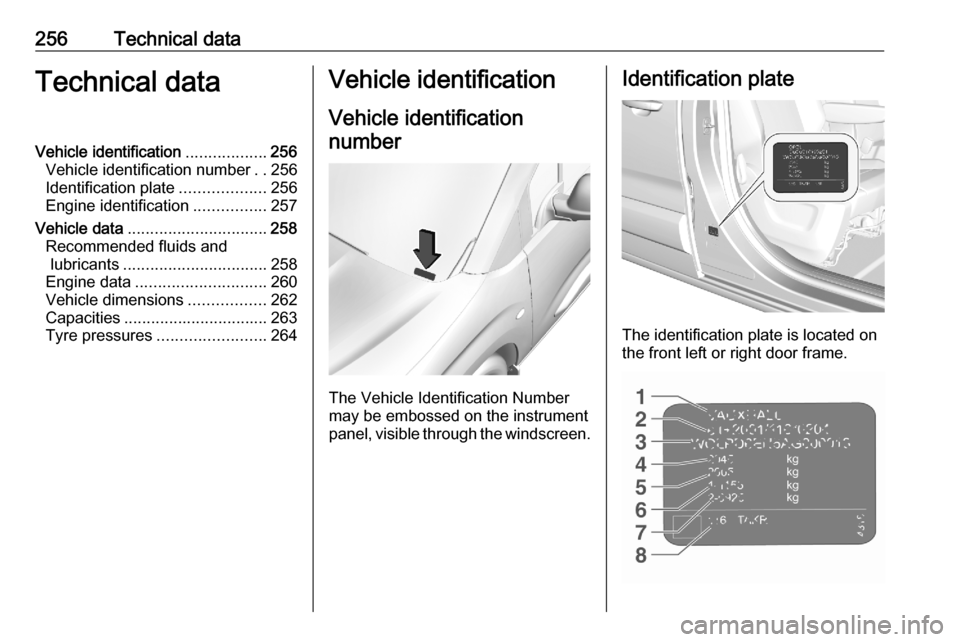
The Vehicle Identification Number
may be embossed on the instrument
panel, visible through the windscreen.
Identification plate
The identification plate is located on
the front left or right door frame.
Page 266 of 279
![VAUXHALL COMBO E 2020 User Guide 264Technical dataTyre pressures
ComboPayload 650 kgVehicle with up to 3 peopleWith full loadTyresfrontrearfrontrear[kPa/bar] ([psi])[kPa/bar] ([psi])[kPa/bar] ([psi])[kPa/bar] ([psi])195/65 R16260/2,6](/img/38/19410/w960_19410-265.png "VAUXHALL COMBO E 2020 User Guide 264Technical dataTyre pressures
ComboPayload 650 kgVehicle with up to 3 peopleWith full loadTyresfrontrearfrontrear[kPa/bar] ([psi])[kPa/bar] ([psi])[kPa/bar] ([psi])[kPa/bar] ([psi])195/65 R16260/2,6")
264Technical dataTyre pressures
ComboPayload 650 kgVehicle with up to 3 peopleWith full loadTyresfrontrearfrontrear[kPa/bar] ([psi])[kPa/bar] ([psi])[kPa/bar] ([psi])[kPa/bar] ([psi])195/65 R16260/2,6 (38)290/2,9 (42)260/2,6 (38)320/3,2 (46)205/60 R16250/2,5 (36)250/2,5 (36)250/2,5 (36)320/3,2 (46)215/65 R16260/2,6 (38)280/2,8 (41)260/2,6 (38)300/3,0 (44)
Page 271 of 279

Customer information269Depending on technical equipment
level, the data stored is as follows:
● system component operating states (e.g. fill level, tyre
pressure, battery status)
● faults and defects in important system components (e.g. lights,
brakes)
● system reactions in special driving situations (e.g. triggeringof an airbag, actuation of the
stability control systems)
● information on events damaging the vehicle
● for electric vehicles the amount of
charge in the high-voltage
battery, estimated range
In special cases (e.g. if the vehicle
has detected a malfunction), it may be
necessary to save data that would
otherwise just be volatile.
When you use services (e.g. repairs,
maintenance), the operating data
saved can be read together with the
vehicle identification number and
used when necessary. Staff working
for the service network ( e.g. garages,
manufacturers) or third parties (e.g.breakdown services) can read the
data from the vehicle. The same
applies to warranty work and quality
assurance measures.
Data is generally read via the OBD
(On-Board Diagnostics) port
prescribed by law in the vehicle. The operating data which is read out,
documents the technical condition of
the vehicle or individual components
and assists with fault diagnosis,
compliance with warranty obligations
and quality improvement. This data,
in particular information on
component stress, technical events,
operator errors and other faults, is
transmitted to the manufacturer
where appropriate, together with the
vehicle identification number. The
manufacturer is also subject to
product liability. The manufacturer
potentially also uses operating data
from vehicles for product recalls. This
data can also be used to check
customer warranty and guarantee
claims.
Fault memories in the vehicle can be
reset by a service company when
carrying out servicing or repairs or at
your request.Comfort and infotainment
functions
Comfort settings and custom settings can be stored in the vehicle and
changed or reset at any time.
Depending on the equipment level in
question, these include
● seat and steering wheel position settings
● chassis and air conditioning settings
● custom settings such as interior lighting
You can input your own data in the
infotainment functions for your
vehicle as part of the selected
features.
Depending on the equipment level in
question, these include
● multimedia data such as music, videos or photos for playback in
an integrated multimedia system
● address book data for use with an
integrated hands-free system or an integrated navigation system
Page 273 of 279

Customer information271processing and use of personal data
for the purposes of preparation of services take place solely on the
basis of legal permission, e.g. in the
case of a legally prescribed
emergency communication system or
a contractual agreement, or by virtue
of consent.
You can activate or deactivate the services and functions (which are
subject to charges to some extent)
and, in some cases, the vehicle's
entire radio network connection. This
does not include statutory functions
and services such as an emergency
communication system.
Third party services
If you make use of online services
from other providers (third parties),
these services are subject to the
liability and data protection and usage conditions of the provider in question.
The manufacturer frequently has no
influence over the content exchanged
in this regard.Therefore, please note the nature,
scope and purpose of the collection
and use of personal data within the
scope of third party services provided by the service provider in question.
Radio Frequency
Identification (RFID)
RFID technology is used in some
vehicles for functions such as tyre
pressure monitoring and immobiliser.
It is also used in connection with
conveniences such as radio remote
controls for door locking / unlocking
and starting. RFID technology in
Vauxhall vehicles does not use or
record personal information or link
with any other Vauxhall system
containing personal information.
Page 278 of 279

276Three-point seat belt .................... 55
Tools .......................................... 230
Tow bar....................................... 206
Towing ................................ 206, 245
Towing another vehicle .............246
Towing equipment .....................207
Towing the vehicle .....................245
Trailer coupling ........................... 206
Trailer stability assist .................210
Trailer towing ............................. 206
Transmission ............................... 17
Transmission display .................155
Tread depth ............................... 234
Trip odometer .............................. 97
Turn lights .......................... 100, 125
Tyre chains ................................ 235
Tyre deflation detection system . 233
Tyre designations ......................231
Tyre pressure ............................ 232
Tyre pressures ........................... 264
Tyre repair kit ............................. 235
U
Ultrasonic parking assist............. 183
Underseat storage .......................72
Upholstery .................................. 249
USB port ....................................... 93
Using this manual ..........................3V
Valet mode ................................. 110
Vauxhall Connect .......................119
Vehicle battery ........................... 217
Vehicle checks............................ 213
Vehicle data ................................ 258
Vehicle data recording and privacy ..................................... 268
Vehicle dimensions .................... 262
Vehicle identification number ....256
Vehicle jack ................................ 230
Vehicle locator lighting ...............129
Vehicle messages .....................114
Vehicle personalisation .............115
Vehicle security ............................ 34
Vehicle specific data ......................3
Vehicle storage ........................... 212
Vehicle tools ............................... 230
Vehicle unlocking ........................... 6 Ventilation ................................... 138
W Warning chimes .........................114
Warning lights ............................... 97
Warning triangle .......................... 84
Washer and wiper systems .........13
Washer fluid ............................... 216
Wheel changing .........................238
Wheel covers ............................. 235
Wheels and tyres .......................231Windows....................................... 40
Windscreen................................... 40
Windscreen wiper and washer ....90
Winter tyres ............................... 231
Wiper blade replacement ..........219