ECU VAUXHALL CORSA 2014.5 User Guide
[x] Cancel search | Manufacturer: VAUXHALL, Model Year: 2014.5, Model line: CORSA, Model: VAUXHALL CORSA 2014.5Pages: 231, PDF Size: 6.8 MB
Page 68 of 231
66StorageRear floor storage cover
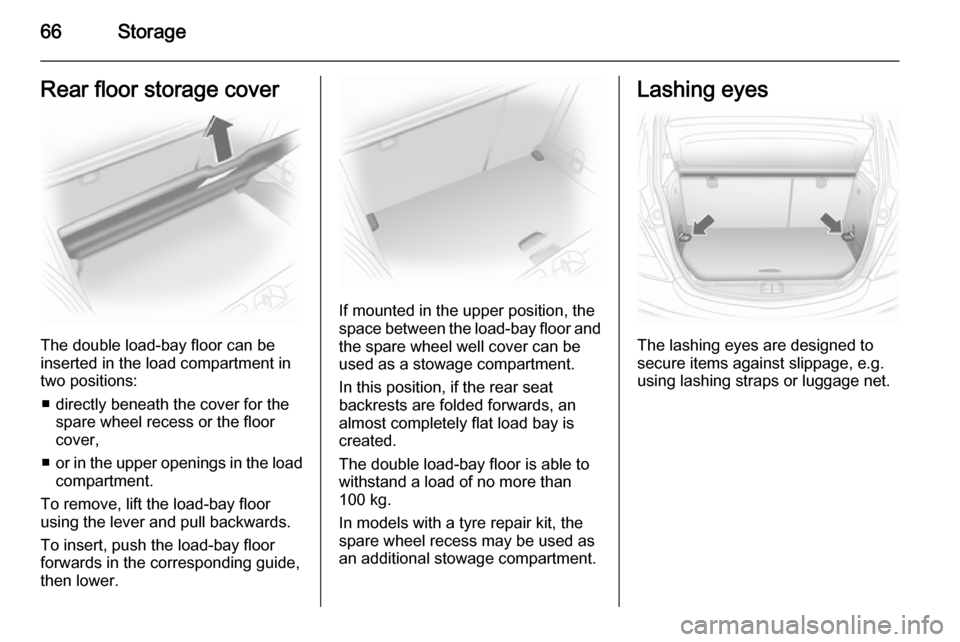
The double load-bay floor can be
inserted in the load compartment in
two positions:
■ directly beneath the cover for the spare wheel recess or the floor
cover,
■ or in the upper openings in the load
compartment.
To remove, lift the load-bay floor
using the lever and pull backwards.
To insert, push the load-bay floor
forwards in the corresponding guide,
then lower.
If mounted in the upper position, the
space between the load-bay floor and
the spare wheel well cover can be
used as a stowage compartment.
In this position, if the rear seat
backrests are folded forwards, an
almost completely flat load bay is
created.
The double load-bay floor is able to
withstand a load of no more than
100 kg.
In models with a tyre repair kit, the spare wheel recess may be used asan additional stowage compartment.
Lashing eyes
The lashing eyes are designed to
secure items against slippage, e.g.
using lashing straps or luggage net.
Page 70 of 231
68Storage
Fitting on model with sunroofDisengage covers concealing roof
rack mounts by pushing sliders in
direction of arrow (e.g. with a coin)
and remove upwards. To close roof
rack mounts, first insert covers at
front and engage sliders at rear.
Attach roof rack at appropriate points, see supplied roof rack system
instructions.Loading information
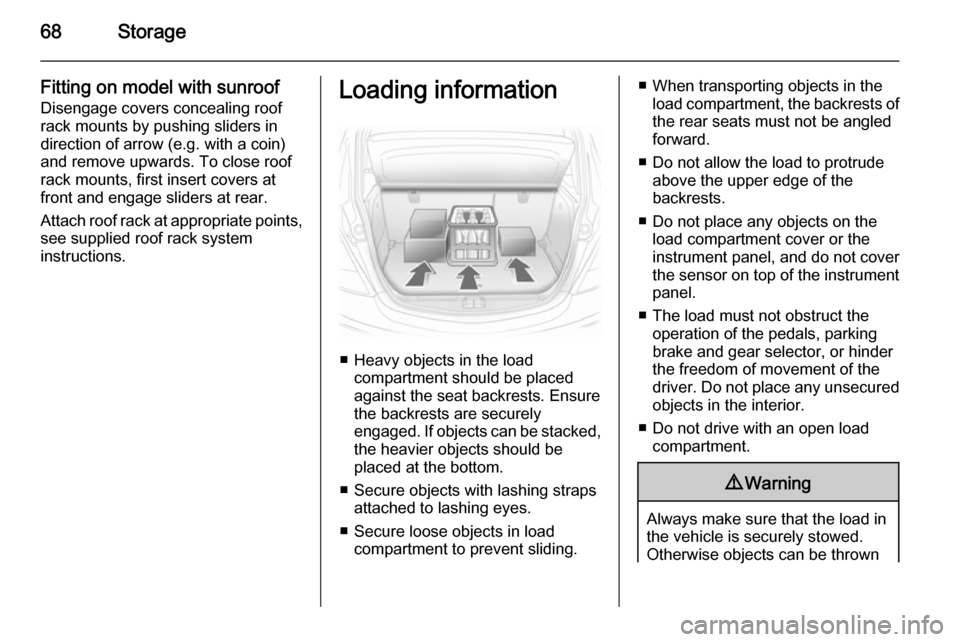
■ Heavy objects in the load compartment should be placedagainst the seat backrests. Ensure
the backrests are securely
engaged. If objects can be stacked, the heavier objects should be
placed at the bottom.
■ Secure objects with lashing straps attached to lashing eyes.
■ Secure loose objects in load compartment to prevent sliding.
■ When transporting objects in theload compartment, the backrests of
the rear seats must not be angled
forward.
■ Do not allow the load to protrude above the upper edge of the
backrests.
■ Do not place any objects on the load compartment cover or theinstrument panel, and do not cover
the sensor on top of the instrument panel.
■ The load must not obstruct the operation of the pedals, parking
brake and gear selector, or hinder
the freedom of movement of the
driver. Do not place any unsecured objects in the interior.
■ Do not drive with an open load compartment.9 Warning
Always make sure that the load in
the vehicle is securely stowed.
Otherwise objects can be thrown
Page 71 of 231

Storage69
around inside the vehicle and
cause personal injury or damage
to the load or car.
■ The payload is the difference between the permitted gross
vehicle weight (see identification
plate 3 197) and the EC kerb
weight.
To calculate the payload weight,
enter the data for your vehicle in the
Weights table at the front of this
manual.
The EC kerb weight includes
weights for the driver (68 kg),
luggage (7 kg) and all fluids (tank
90 % full).
Optional equipment and
accessories increase the kerb
weight.
■ Driving with a roof load increases the sensitivity of the vehicle to
cross-winds and has a detrimental
effect on vehicle handling due to
the vehicle's higher centre of
gravity. Distribute the load evenly
and secure it properly with retaining
straps. Adjust the tyre pressure and
vehicle speed according to the load
conditions. Check and retighten the straps frequently.
Do not drive faster than 75 mph.
The permissible roof load is 75 kg. The roof load is the combined
weight of the roof rack and the load.
Page 127 of 231

Driving and operating125
Always move the selector lever in the
appropriate direction as far as it will
go. Upon release, it automatically
returns to the centre position.N=Neutral position.A=Switch between automatic and
manual mode. The
transmission display shows A
or M.R=Reverse gear. Engage only
when vehicle is stationary.+=Shift to a higher gear.-=Shift to a lower gear.
Starting off
Depress the foot brake and move the
selector lever to A, + or -. The
transmission is in automatic mode
and first gear is engaged. If R is
selected, reverse gear is engaged.
The vehicle starts to move when the
brake is released.
To start off without depressing the
foot brake, accelerate immediately
after engaging a gear.
If neither the accelerator nor the
brake pedal are depressed, no gear
is engaged and A or R flashes for a
brief time in the display.
Stopping the vehicle In A, first gear is engaged and the
clutch is released when the vehicle is
stopped. In R, reverse gear remains
engaged.
Engine braking
Automatic mode
When driving downhill, the manual
transmission automated does not
shift into higher gears until a fairly
high engine speed has been reached. It shifts down in good time when
braking.
Manual mode
To utilise the engine braking effect,
select a lower gear in good time when
driving downhill.Rocking the vehicle
Rocking the vehicle is only
permissible if the vehicle is stuck in
sand, mud or snow. Move the selector
lever between R and A (or + or -) in a
repeat pattern. Do not race the engine and avoid sudden acceleration.
Parking
Apply the parking brake. The most recently engaged gear (see
transmission display) remains
engaged. With N, no gear is engaged.
When the ignition is switched off the
transmission no longer responds to
movement of the selector lever.
Manual mode
If a higher gear is selected when the
engine speed is too low, or a lower
gear when the speed is too high, the
shift is not executed. This prevents
the engine from running at too low or
too high an engine speed.
If engine speed is too low, the
transmission automatically shifts to a
lower gear.
Page 144 of 231

142Driving and operating
If the permitted rear axle load is
exceeded a maximum speed of
60 mph applies. If lower national
maximum speeds are specified for
trailer operation, they must be
complied with.
Towing equipmentCaution
When operating without a trailer,
remove the coupling ball bar.
Stowage of coupling ball bar
The coupling ball bar is stowed in a
bag in the spare wheel well and
secured to the lashing eyes in the
load compartment.
When inserting, fit protective cap over
rotary knob with key.
Fitting the coupling ball bar
Push both bolts inwards and remove
the cover on the bumper.
Disengage and fold down the socket. Remove the sealing plug from the
opening for the coupling ball bar and
stow it.
Page 149 of 231
Vehicle care1479Danger
The ignition system and Xenon
headlights use extremely high
voltage. Do not touch.
The caps for topping up the engine oil, the coolant, the washer fluid and the
oil dipstick handle are yellow, for ease
of identification.
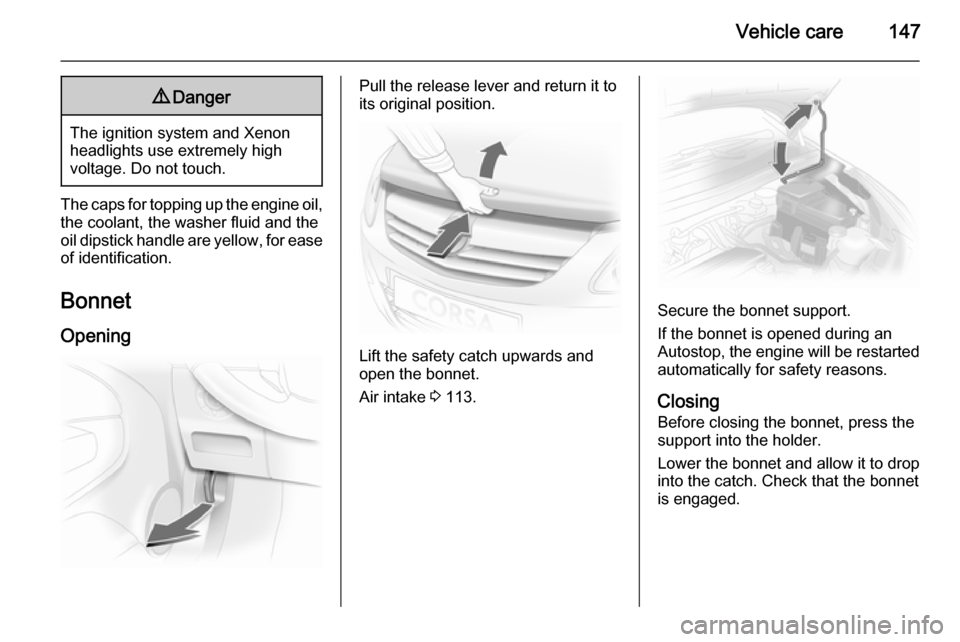
Bonnet
Opening
Pull the release lever and return it to
its original position.
Lift the safety catch upwards and
open the bonnet.
Air intake 3 113.
Secure the bonnet support.
If the bonnet is opened during an Autostop, the engine will be restarted automatically for safety reasons.
Closing Before closing the bonnet, press the
support into the holder.
Lower the bonnet and allow it to drop
into the catch. Check that the bonnet
is engaged.
Page 163 of 231

Vehicle care161
5. Gently press the three lockinglugs on the outside of the bulb
holder outwards and remove bulb
holder.
6. Push bulb into socket slightly, rotate anti-clockwise, remove and
renew bulb.
Rear fog light, may be only on one side ( 1)
Reverse light ( 2)
Turn signal light ( 3)
Tail light/side light ( 4)
Tail light/brake light ( 5)
7. Engage bulb holder in bulb
housing, ensuring that it properly
engages.
8. Ensure that the bulb holder seal is
positioned as illustrated.
9. Insert bulb housing in vehicle body, tighten securing nuts by
hand. Engage plug connector.
Close cover.
After bulb replacement, check the tail lights for proper functionality: switch
on the ignition, operate the brake,
switch on the sidelights.
Page 165 of 231

Vehicle care163
5. Gently press the three lockinglugs on the outside of the bulb
holder outwards and remove bulb
holder.
6. Push bulb into socket slightly, rotate anti-clockwise, remove and
renew bulb.
Reverse light (right side), rear fog
light (left side) ( 1)
Tail light ( 2)
Turn signal light ( 3)
Tail light/brake light ( 4)
Tail light ( 5)
7. Engage bulb holder in bulb
housing, ensuring that it properly
engages.
8. Ensure that the bulb holder seal is
positioned as illustrated. Fit the
round seal on the fastening bolt.
9. Insert bulb housing in vehicle body, and tighten securing nuts byhand. Engage plug connector.
Close and lock cover.
After bulb replacement, check the tail
lights for proper functionality: switch
on the ignition, operate the brake,
switch on the sidelights.
Side turn signal lights
To replace bulb, remove lamp
housing:
1. On left vehicle side, slide lamp to the front and remove it out of the
front wing with the rear end.
On right vehicle side, slide lamp to
the rear and remove it out of the front wing with the front end.
Page 186 of 231

184Vehicle care
1. Pull off the wheel cover with thehook. Vehicle tools 3 170.
For wheel covers with visible
wheel bolts: The cover can remain
on the wheel. Do not remove the
retaining rings on the wheel bolts.
Alloy wheels: Disengage wheel
bolt caps with a suitable
screwdriver and remove. To
protect the wheel, place a soft
cloth between the screwdriver
and the alloy wheel.2. Install the wheel wrench ensuring that it locates securely and
slacken each bolt by half a turn.
The wheels might be protected by
locking wheel bolts. To loosen
these specific bolts first attach the
key adapter onto the head of the
bolt before installing the wheel
wrench. The key adapter is
located in the glovebox.3. Ensure the jack is positioned correctly with the vehicle jacking
points.
With versions of the Corsa VXR
with sill panelling or retrofitted sill
panelling, no jack must be used.
The vehicle may be damaged.
Page 187 of 231

Vehicle care185
4. Set the jack to the necessaryheight. Position it directly below
the jacking point in a manner that
prevents it from slipping.
Variant 1:Variant 2:
Attach jack handle and with the
jack correctly aligned rotate handle until wheel is clear of theground.
5. Unscrew the wheel bolts.
6. Change the wheel.
7. Screw in the wheel bolts.
8. Lower vehicle.
9. Install the wheel wrench ensuring that it locates securely and tighten
each bolt in a crosswise
sequence. Tightening torque is
110 Nm.
10. Align the valve hole in the wheel cover with the tyre valve before
installing.
Install wheel bolt caps.
11. Stow the replaced wheel 3 177,
the vehicle tools 3 170 and the
key adapter 3 53.
12. Check the tyre pressure of the installed tyre and also the wheelbolt torque as soon as possible.
Have the defective tyre renewed or
repaired.
Spare wheel
Some vehicles are equipped with a
tyre repair kit instead of a spare
wheel.