automatic transmission VAUXHALL CORSA 2014.5 User Guide
[x] Cancel search | Manufacturer: VAUXHALL, Model Year: 2014.5, Model line: CORSA, Model: VAUXHALL CORSA 2014.5Pages: 231, PDF Size: 6.8 MB
Page 124 of 231

122Driving and operating
■The automatic neutral shift function
automatically shifts to idling when
the vehicle is stopped with a
forward gear engaged.
■ The adaptive programme tailors gearshifting to the driving
conditions, e.g. greater load or
gradients.
Winter programme T
Activate the Winter programme to
assist starting-off on a slippery road
surface.
Activation
Press the T button with P, R , N , D or
3 engaged. The vehicle starts off in
3rd gear.
Deactivation
The Winter programme is switched off by:
■ pressing the T button again,
■ manually selecting 2 or 1,
■ turning off the ignition,
■ or if the transmission oil temperature is too high.
KickdownIf the accelerator pedal is pressed
past the pressure point, the
transmission shifts to a lower gear depending on engine speed.
Fault
In the event of a fault, A illuminates.
The transmission no longer shifts
automatically. Continued travel is
possible with manual shifting.
2nd gear is not available. Manual
shifting:1=1st gear2=3rd gear3, D=4th gear
Have the cause of the fault remedied
by a workshop.
Interruption of power
supply
In the event of an interruption of
power supply, the selector lever
cannot be moved out of the P
position.
If the battery is discharged, start the
vehicle using jump leads 3 187.
Page 126 of 231
124Driving and operatingCaution
It is not advisable to drive with thehand resting on the selector lever.
Manual transmission
automated
This transmission permits manual
(manual mode) or automatic gear
shifting (automatic mode), both with
automatic clutch control.
Transmission display
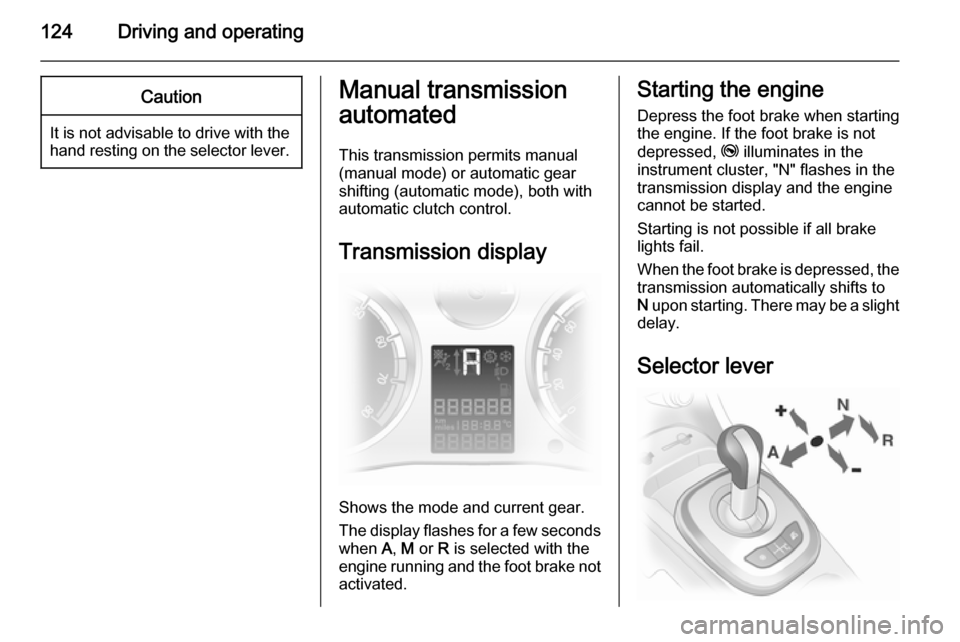
Shows the mode and current gear.
The display flashes for a few seconds
when A, M or R is selected with the
engine running and the foot brake not
activated.
Starting the engine
Depress the foot brake when starting
the engine. If the foot brake is not
depressed, j illuminates in the
instrument cluster, "N" flashes in the
transmission display and the engine
cannot be started.
Starting is not possible if all brake
lights fail.
When the foot brake is depressed, the
transmission automatically shifts to
N upon starting. There may be a slight
delay.
Selector lever
Page 127 of 231

Driving and operating125
Always move the selector lever in the
appropriate direction as far as it will
go. Upon release, it automatically
returns to the centre position.N=Neutral position.A=Switch between automatic and
manual mode. The
transmission display shows A
or M.R=Reverse gear. Engage only
when vehicle is stationary.+=Shift to a higher gear.-=Shift to a lower gear.
Starting off
Depress the foot brake and move the
selector lever to A, + or -. The
transmission is in automatic mode
and first gear is engaged. If R is
selected, reverse gear is engaged.
The vehicle starts to move when the
brake is released.
To start off without depressing the
foot brake, accelerate immediately
after engaging a gear.
If neither the accelerator nor the
brake pedal are depressed, no gear
is engaged and A or R flashes for a
brief time in the display.
Stopping the vehicle In A, first gear is engaged and the
clutch is released when the vehicle is
stopped. In R, reverse gear remains
engaged.
Engine braking
Automatic mode
When driving downhill, the manual
transmission automated does not
shift into higher gears until a fairly
high engine speed has been reached. It shifts down in good time when
braking.
Manual mode
To utilise the engine braking effect,
select a lower gear in good time when
driving downhill.Rocking the vehicle
Rocking the vehicle is only
permissible if the vehicle is stuck in
sand, mud or snow. Move the selector
lever between R and A (or + or -) in a
repeat pattern. Do not race the engine and avoid sudden acceleration.
Parking
Apply the parking brake. The most recently engaged gear (see
transmission display) remains
engaged. With N, no gear is engaged.
When the ignition is switched off the
transmission no longer responds to
movement of the selector lever.
Manual mode
If a higher gear is selected when the
engine speed is too low, or a lower
gear when the speed is too high, the
shift is not executed. This prevents
the engine from running at too low or
too high an engine speed.
If engine speed is too low, the
transmission automatically shifts to a
lower gear.
Page 128 of 231

126Driving and operating
If engine speed is too high, the
transmission only switches to a higher gear via kickdown.
When + or - is selected in automatic
mode, the transmission switches to
manual mode and shifts accordingly.
Electronic driving
programmes ■ Following a cold start, the operating
temperature programme increases engine speed to quickly bring the
catalytic converter to the required
temperature.
■ The adaptive programme tailors gearshifting to the driving
conditions, e.g. greater load or
gradients.Sport mode
Shift times are reduced when the
Sport mode is enabled, and the gears are shifted at higher engine speeds,
although not when cruise control is
activated.
Activation
Press the S button.
Control indicator 1 3 82.
Deactivation
The Sport mode is switched off by:
■ pressing the S button again,
■ turning off the ignition,
■ activating the winter mode T.
Winter mode T
Activate the Winter mode if you have
problems starting off on a slippery
road surface.
Page 129 of 231

Driving and operating127
Activation
Press the T button. The transmission
switches to automatic mode. The
vehicle starts off in 2nd gear. Sport
mode is deactivated.
Deactivation
The Winter mode is switched off by:
■ pressing the T button again,
■ turning off the ignition,
■ switching to manual mode (when switched back to automatic mode,
the Winter programme is again
active),
■ when clutch temperature is too high.Kickdown
If the accelerator pedal is pressed
past the pressure point, the
transmission shifts to a lower gear depending on engine speed.
Fault
To prevent damage to the manual transmission automated, the clutch is
engaged automatically at high clutch
temperatures.
A illuminates in the event of a fault.
Continued driving is possible. Manual
mode cannot be used for shifting.
If F appears in the transmission
display, continued driving is not
possible.
Have the cause of the fault remedied by a workshop.
Interruption of power
supply
The clutch is not disengaged if there is an interruption of the power supply
when a gear is engaged. The vehicle
cannot move.
If the battery is discharged, start the
vehicle using jump leads 3 187.
If the cause of the fault is not a
discharged battery, seek the
assistance of a workshop.
Page 133 of 231

Driving and operating131
When ESP®Plus
is deactivated the
control indicator v illuminates.
ESPoff also appears in the service
display.9 Warning
Do not deactivate ESP® Plus
if a
run-flat tyre has lost pressure.
ESP® Plus
is reactivated by pressing
the v button. ESPon appears in the
service display. ESP® Plus
is also
reactivated the next time the ignition is switched on.
Driver assistance
systems9 Warning
Driver assistance systems are
developed to support the driver
and not to replace the driver's
attention.
The driver accepts full
responsibility when driving the
vehicle.
When using driver assistance
systems, always take care
regarding the current traffic
situation.
Cruise control
The cruise control can store and
maintain speeds of approx. 20 to
120 mph.
Deviations from the stored speeds may occur when driving uphill or
downhill.
For safety reasons the cruise control cannot be activated until the foot
brake has been operated once.
Do not use the cruise control if it is not advisable to maintain a constant
speed.
With automatic transmission or
manual transmission automated, only
activate cruise control in automatic
mode.
Control indicator m 3 85.
Page 170 of 231
168Vehicle care
No.Circuit1Starter2Air conditioning system3Diesel fuel filter heater4Horn5Manual transmission auto‐
mated, automatic transmission6Engine control unit7Fog lights8Engine cooling9Engine cooling10Manual transmission auto‐
mated11Glow plugs, ignition system12Headlight range adjustment,
Adaptive forward lighting13Air conditioning system14Manual transmission auto‐
mated15High beam (right)No.Circuit16High beam (left)17Main relay18Engine control unit19Airbags20Main relay21Main relay22Central control unit23Tyre repair kit24Fuel pump25ABS26Heated rear window27ABS28Interior fan29Cigarette lighter30Air conditioning system31Power window (left)32Power window (right)No.Circuit33Heated exterior mirrors34–35–
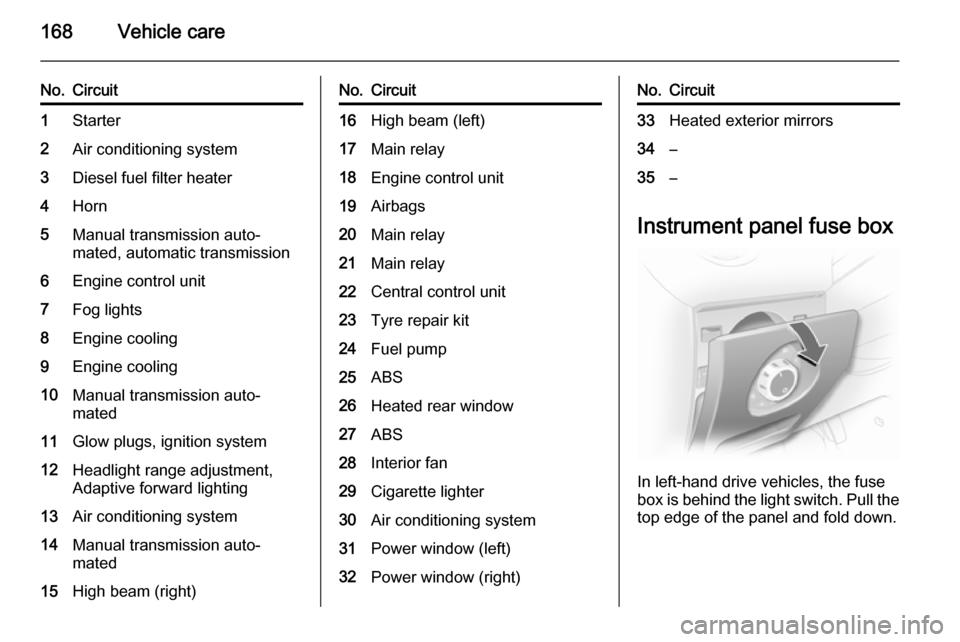
Instrument panel fuse box
In left-hand drive vehicles, the fuse
box is behind the light switch. Pull the top edge of the panel and fold down.
Page 189 of 231

Vehicle care187Jump starting
Do not start with quick charger.
A vehicle with a discharged battery
can be started using jump leads and the battery of another vehicle.9 Warning
Be extremely careful when starting
with jump leads. Any deviation
from the following instructions can
lead to injuries or damage caused
by battery explosion or damage to the electrical systems of both
vehicles.
9 Warning
Avoid contact of the battery with
eyes, skin, fabrics and painted
surfaces. The fluid contains
sulphuric acid which can cause
injuries and damage in the event
of direct contact.
Notice
Any deviation from the instructions
given in this paragraph may lead to
a temporary deactivation of the stop-
start system.
■ Never expose the battery to naked flames or sparks.
■ A discharged battery can already freeze at temperatures of 0 °C.
Defrost the frozen battery before
connecting jump leads.
■ Avoid contact with eyes, skin, fabrics and painted surfaces. The
fluid contains sulphuric acid which
can cause injuries and damage in
the event of direct contact.
■ Wear eye protection and protective
clothing when handling a battery.
■ Use a booster battery with the same voltage (12 Volts). Its
capacity (Ah) must not be much less than that of the discharged
battery.
■ Use jump leads with insulated terminals and a cross section of at
least 16 mm 2
(25 mm 2
for diesel
engines).■ Do not disconnect the discharged battery from the vehicle.
■ Switch off all unnecessary electrical
consumers.
■ Do not lean over the battery during jump starting.
■ Do not allow the terminals of one lead to touch those of the other
lead.
■ The vehicles must not come into contact with each other during thejump starting process.
■ Apply the parking brake, transmission in neutral, automatic
transmission in P.
■ Open the positive terminal protection caps of both batteries.
Page 192 of 231

190Vehicle care
Vehicles with automatic transmissionmust be towed facing forwards, not
faster than 50 mph nor further than 60 miles . In all other cases and when
the transmission is defective, the front axle must be raised off the ground.
Seek the assistance of a workshop.
Manual transmission automated
3 124.
After towing, unscrew the towing eye
and refit the cover.
Towing another vehicle
Disengage cap at bottom and remove downwards.
The towing eye is stowed with the
vehicle tools 3 170.
Screw in the towing eye as far as it will
go until it stops in a horizontal
position.
The lashing eye at the rear
underneath the vehicle must never be used as a towing eye.
Attach a tow rope – or better still a tow
rod – to the towing eye.
The towing eye must only be used for towing and not recovering a vehicle.
Caution
Drive slowly. Do not drive jerkily.
Excessive tractive force can
damage the vehicle.
After towing, unscrew the towing eye and refit the cover.
Page 207 of 231
![VAUXHALL CORSA 2014.5 User Guide Technical data205Performance5-door vehicleEngineA10XEPA12XELA12XERA14XELA14XERA14NELMaximum speed 4)
[mph]Manual transmission9699107 5)6)108112120Manual transmission automated––107–––Automa](/img/38/19422/w960_19422-206.png "VAUXHALL CORSA 2014.5 User Guide Technical data205Performance5-door vehicleEngineA10XEPA12XELA12XERA14XELA14XERA14NELMaximum speed 4)
[mph]Manual transmission9699107 5)6)108112120Manual transmission automated––107–––Automa")
Technical data205Performance5-door vehicleEngineA10XEPA12XELA12XERA14XELA14XERA14NELMaximum speed 4)
[mph]Manual transmission9699107 5)6)108112120Manual transmission automated––107–––Automatic transmission––––107–4)
The maximum speed indicated is achievable at kerb weight (without driver) plus 200 kg payload. Optional equipment could reduce the specified maximum
speed of the vehicle.
5) LPG engine in petrol mode: 106.
6) LPG engine in LPG mode: 104.EngineA13DTCA13DTRA13DTE EcoA17DTSMaximum speed 4)
[mph]Manual transmission101108110124Manual transmission automated––––Automatic transmission––––4) The maximum speed indicated is achievable at kerb weight (without driver) plus 200 kg payload. Optional equipment could reduce the specified maximum
speed of the vehicle.