heating VAUXHALL CORSA 2014.5 User Guide
[x] Cancel search | Manufacturer: VAUXHALL, Model Year: 2014.5, Model line: CORSA, Model: VAUXHALL CORSA 2014.5Pages: 231, PDF Size: 6.8 MB
Page 115 of 231
Climate control113
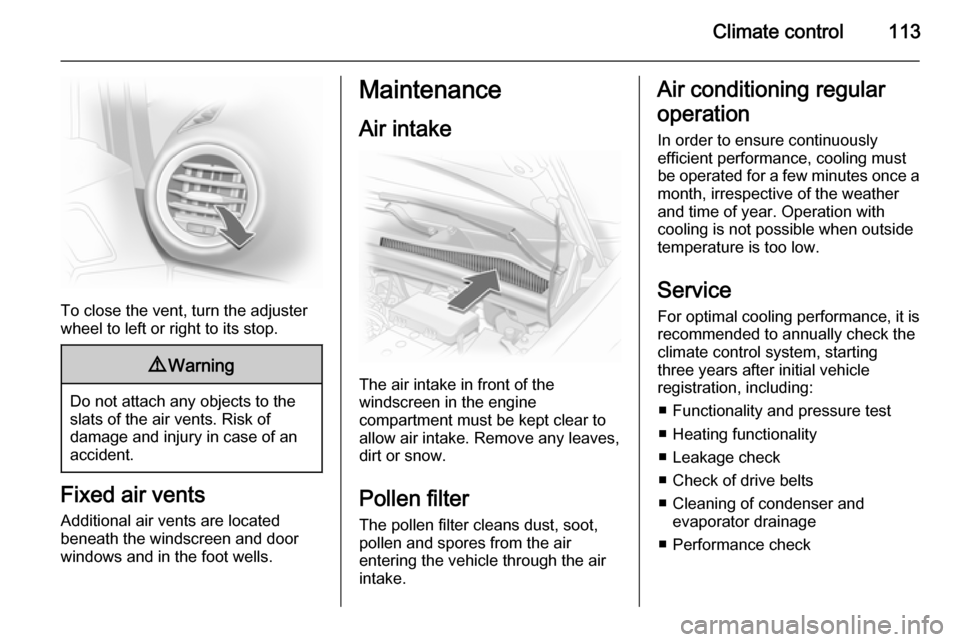
To close the vent, turn the adjuster
wheel to left or right to its stop.
9 Warning
Do not attach any objects to the
slats of the air vents. Risk of
damage and injury in case of an
accident.
Fixed air vents
Additional air vents are located
beneath the windscreen and door windows and in the foot wells.
Maintenance
Air intake
The air intake in front of the
windscreen in the engine
compartment must be kept clear to
allow air intake. Remove any leaves,
dirt or snow.
Pollen filter
The pollen filter cleans dust, soot,
pollen and spores from the air
entering the vehicle through the air
intake.
Air conditioning regular
operation In order to ensure continuously
efficient performance, cooling must
be operated for a few minutes once a
month, irrespective of the weather
and time of year. Operation with
cooling is not possible when outside
temperature is too low.
Service For optimal cooling performance, it isrecommended to annually check the
climate control system, starting
three years after initial vehicle
registration, including:
■ Functionality and pressure test■ Heating functionality
■ Leakage check
■ Check of drive belts
■ Cleaning of condenser and evaporator drainage
■ Performance check
Page 117 of 231
Driving and operating115Starting and operating
New vehicle running-in Do not brake unnecessarily hard for
the first few journeys.
During the first drive, smoke may
occur because of wax and oil
evaporating off the exhaust system.
Park the vehicle in the open for a
while after the first drive and avoid
inhaling the fumes.
During the running-in period fuel and
engine oil consumption may be
higher and the cleaning process of the diesel particle filter may take
place more often. Autostop may be inhibited to allow for charging the
battery.
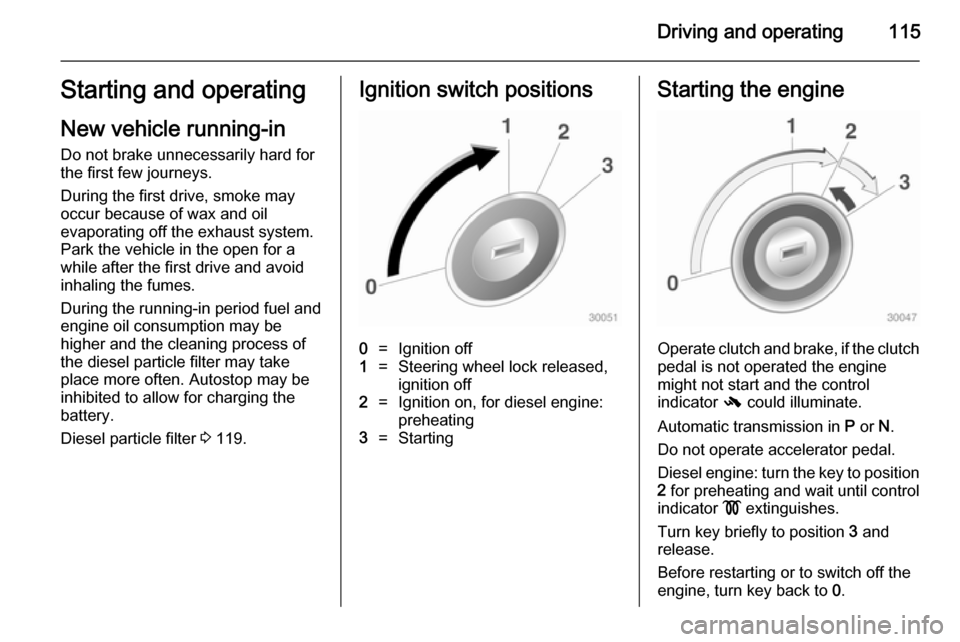
Diesel particle filter 3 119.Ignition switch positions0=Ignition off1=Steering wheel lock released,
ignition off2=Ignition on, for diesel engine:
preheating3=StartingStarting the engine
Operate clutch and brake, if the clutch pedal is not operated the engine
might not start and the control
indicator - could illuminate.
Automatic transmission in P or N.
Do not operate accelerator pedal.
Diesel engine: turn the key to position 2 for preheating and wait until control
indicator ! extinguishes.
Turn key briefly to position 3 and
release.
Before restarting or to switch off the engine, turn key back to 0.
Page 119 of 231
Driving and operating117
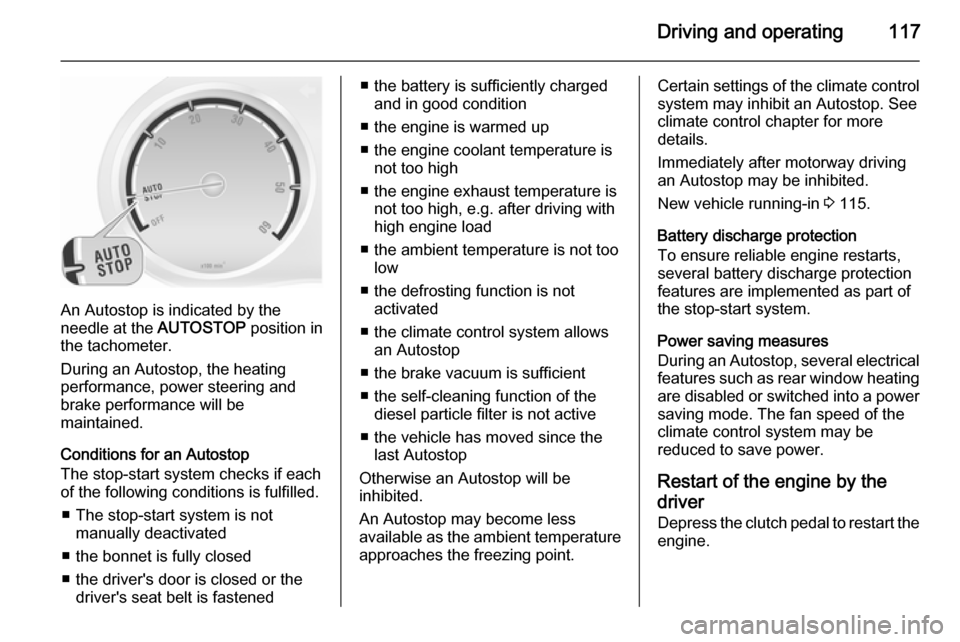
An Autostop is indicated by the
needle at the AUTOSTOP position in
the tachometer.
During an Autostop, the heating
performance, power steering and
brake performance will be
maintained.
Conditions for an Autostop
The stop-start system checks if each
of the following conditions is fulfilled.
■ The stop-start system is not manually deactivated
■ the bonnet is fully closed
■ the driver's door is closed or the driver's seat belt is fastened
■ the battery is sufficiently chargedand in good condition
■ the engine is warmed up
■ the engine coolant temperature is not too high
■ the engine exhaust temperature is not too high, e.g. after driving with
high engine load
■ the ambient temperature is not too low
■ the defrosting function is not activated
■ the climate control system allows an Autostop
■ the brake vacuum is sufficient
■ the self-cleaning function of the diesel particle filter is not active
■ the vehicle has moved since the last Autostop
Otherwise an Autostop will be
inhibited.
An Autostop may become less
available as the ambient temperature
approaches the freezing point.Certain settings of the climate control
system may inhibit an Autostop. See
climate control chapter for more
details.
Immediately after motorway driving
an Autostop may be inhibited.
New vehicle running-in 3 115.
Battery discharge protection
To ensure reliable engine restarts,
several battery discharge protection
features are implemented as part of
the stop-start system.
Power saving measures
During an Autostop, several electrical
features such as rear window heating
are disabled or switched into a power saving mode. The fan speed of the
climate control system may be
reduced to save power.
Restart of the engine by the
driver
Depress the clutch pedal to restart the
engine.
Page 137 of 231
Driving and operating135Caution
Use of fuel that does not comply toEN 590 or similar can lead to
engine powerloss, increased wear
or engine damage and may affect
your warranty.
Do not use marine diesel oils, heating
oils, Aquazole and similar diesel-
water emulsions. Diesel fuels must
not be diluted with fuels for petrol
engines.
Fuel for liquid gas
operation
Liquid gas is known as LPG
(Liquefied Petroleum Gas) or under
its French name GPL (Gaz de Pétrole Liquéfié). LPG is also known as
Autogas.
LPG consists mainly of propane and
butane. The octane rating is between
105 and 115, depending on the
butane proportion. LPG is stored
liquid at around 5 - 10 bar pressure.
The boiling point depends on the
pressure and mixing ratio. At ambient pressure, it is between -42 °C (pure
propane) and -0.5 °C (pure butane).Caution
The system works at an ambient
temperature of approx. -8 °C to
100 °C.
Full function of the LPG system can
only be guaranteed with liquid gas
which complies with the minimum
requirements of DIN EN 589.
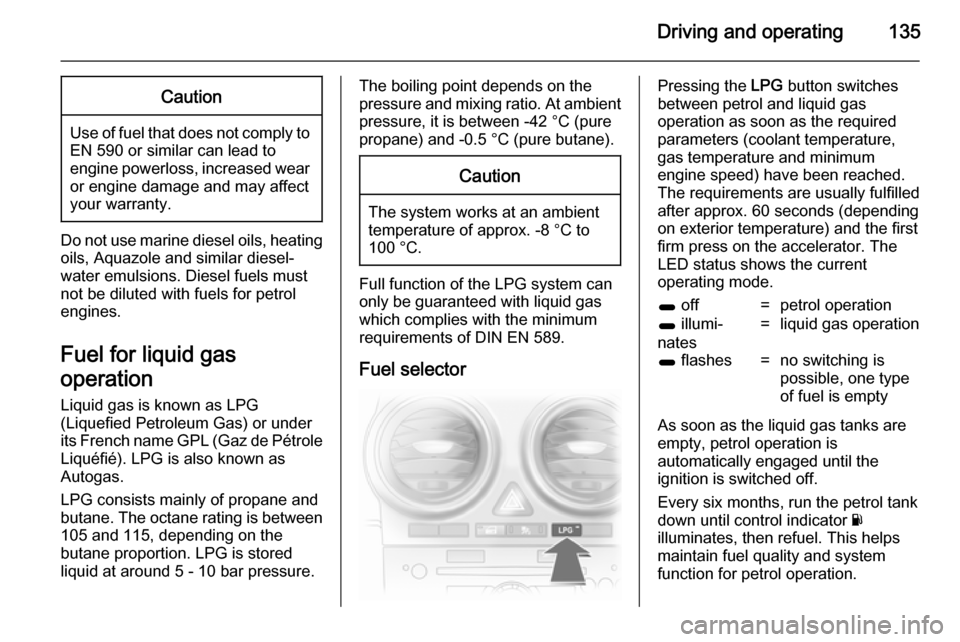
Fuel selector
Pressing the LPG button switches
between petrol and liquid gas
operation as soon as the required
parameters (coolant temperature,
gas temperature and minimum
engine speed) have been reached.
The requirements are usually fulfilled
after approx. 60 seconds (depending
on exterior temperature) and the first
firm press on the accelerator. The
LED status shows the current
operating mode.1 off=petrol operation1 illumi‐
nates=liquid gas operation1 flashes=no switching is
possible, one type
of fuel is empty
As soon as the liquid gas tanks are
empty, petrol operation is
automatically engaged until the
ignition is switched off.
Every six months, run the petrol tank
down until control indicator Y
illuminates, then refuel. This helps
maintain fuel quality and system
function for petrol operation.
Page 194 of 231

192Vehicle care
Windows and windscreen wiperblades
Use a soft lint-free cloth or chamois leather together with window cleanerand insect remover.
When cleaning the rear window from
inside, always wipe in parallel to the
heating element to prevent damage.
For mechanical removal of ice, use a
sharp-edged ice scraper. Press the
scraper firmly against the glass so
that no dirt can get under it and
scratch the glass.
Clean smearing wiper blades with a
soft cloth and window cleaner.
Sunroof
Never clean with solvents or abrasive
agents, fuels, aggressive media (e.g.
paint cleaner, acetone-containing
solutions etc.), acidic or highly
alkaline media or abrasive pads. Do
not apply wax or polishing agents to
the sunroof.
Wheels and tyres Do not use high-pressure jet
cleaners.Clean rims with a pH-neutral wheel
cleaner.
Rims are painted and can be treated
with the same agents as the body.
Paintwork damage Rectify minor paintwork damage witha touch-up pen before rust forms.
Have more extensive damage or rust
areas repaired by a workshop.
Underbody
Some areas of the vehicle underbody
have a PVC undercoating while other critical areas have a durable
protective wax coating.
After the underbody is washed, check
the underbody and have it waxed if
necessary.
Bitumen/rubber materials could
damage the PVC coating. Have
underbody work carried out by a
workshop.
Before and after winter, wash the
underbody and have the protective
wax coating checked.Liquid gas system9 Danger
Liquid gas is heavier than air and
can collect in sink points.
Take care when performing work
at the underbody in a pit.
For painting work and when using a
drying booth at a temperature above
60 °C, the liquid gas tank must be
removed.
Do not make any modifications to the
liquid gas system.
Towing equipment Do not clean the coupling ball bar with
a steam-jet or high-pressure jet
cleaner.
Rear carrier system Clean the rear carrier system with a
steam-jet or high-pressure jet cleaner
at least once a year.
Operate the rear carrier system
periodically if not in regular use, in
particular during winter.
Page 228 of 231

226
Head restraint adjustment .............7
Head restraints ............................ 34
Heated mirrors ............................. 28
Heated rear window ..................... 31
Heated steering wheel .................71
Heating ........................................ 38
Heating and ventilation system . 106
High beam ............................. 85, 99
Hill start assist ........................... 130
Horn ....................................... 13, 71
I
Identification plate .....................197
Ignition switch positions .............115
Immobiliser .................................. 26
Indicators ...................................... 76
Information displays...................... 86
Instrument cluster ........................76
Instrument panel fuse box .........168
Instrument panel illumination control .................................... 103
Instrument panel overview ........... 10
Interior care ............................... 193
Interior lighting ............................ 103
Interior lights ...................... 103, 165
Interior mirrors .............................. 29
Interruption of power supply 122, 127
Introduction .................................... 3
Isofix child restraint systems ........ 52J
Jump starting ............................. 187
K Key, memorised settings ..............21
Keys ............................................. 19
Keys, locks ................................... 19
L
Lashing eyes ............................... 66
Lighting ........................................ 90
Lighting features .........................105
Light switch .................................. 98
Load compartment ................24, 63
Load compartment cover .............64
Load compartment fuse box ......169
Load compartment lighting .........104
Loading information .....................68
Low engine oil level .....................84
Low fuel ....................................... 84
M
Malfunction indicator light ............81
Manual anti-dazzle ......................29
Manual mode ............................. 125
Manual transmission .................. 123
Manual transmission automated 124
Manual windows ..........................30
Memorised settings ......................21Mirror adjustment ........................... 8
Misted light covers .....................103
N New vehicle running-in ..............115
Number plate light .....................164
O
Object detection systems ...........132
Odometer ..................................... 76
Oil, engine .......................... 195, 199
Outside temperature ....................73
Overrun cut-off ........................... 116
P Parking ................................ 18, 118
Parking assist ............................ 132
Parking brake ............................ 129
Parking lights ............................. 102
Particle filter ................................ 119
Performance .............................. 205
Performing work ........................146
Pollen filter ................................. 113
Power outlets ............................... 75
Power steering.............................. 82
Power windows ............................ 30
Preheating and diesel particle filter .......................................... 83
Puncture ..................................... 183