roof VAUXHALL CORSA 2014.5 User Guide
[x] Cancel search | Manufacturer: VAUXHALL, Model Year: 2014.5, Model line: CORSA, Model: VAUXHALL CORSA 2014.5Pages: 231, PDF Size: 6.8 MB
Page 70 of 231
68Storage
Fitting on model with sunroofDisengage covers concealing roof
rack mounts by pushing sliders in
direction of arrow (e.g. with a coin)
and remove upwards. To close roof
rack mounts, first insert covers at
front and engage sliders at rear.
Attach roof rack at appropriate points, see supplied roof rack system
instructions.Loading information
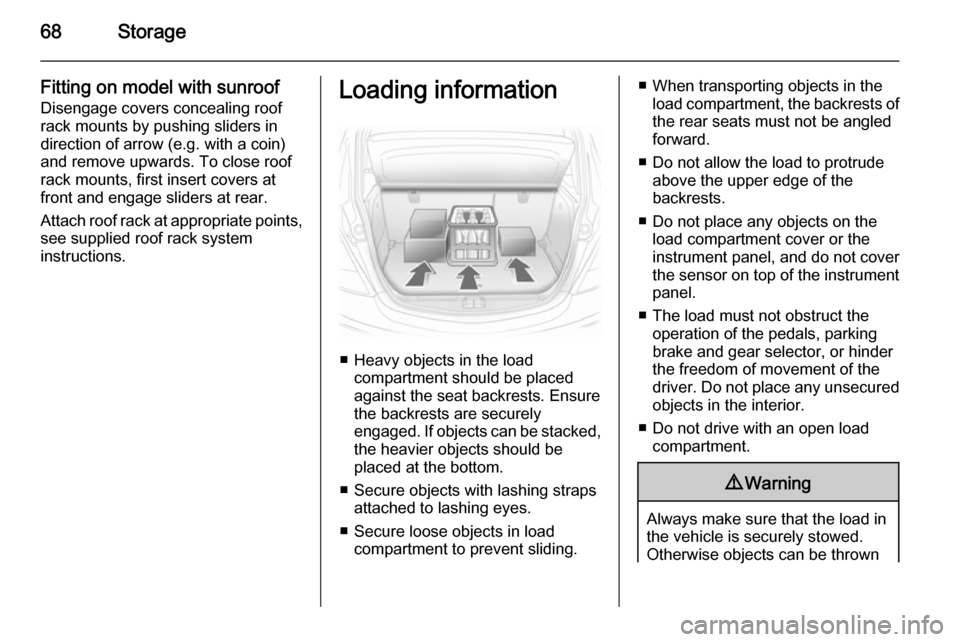
■ Heavy objects in the load compartment should be placedagainst the seat backrests. Ensure
the backrests are securely
engaged. If objects can be stacked, the heavier objects should be
placed at the bottom.
■ Secure objects with lashing straps attached to lashing eyes.
■ Secure loose objects in load compartment to prevent sliding.
■ When transporting objects in theload compartment, the backrests of
the rear seats must not be angled
forward.
■ Do not allow the load to protrude above the upper edge of the
backrests.
■ Do not place any objects on the load compartment cover or theinstrument panel, and do not cover
the sensor on top of the instrument panel.
■ The load must not obstruct the operation of the pedals, parking
brake and gear selector, or hinder
the freedom of movement of the
driver. Do not place any unsecured objects in the interior.
■ Do not drive with an open load compartment.9 Warning
Always make sure that the load in
the vehicle is securely stowed.
Otherwise objects can be thrown
Page 71 of 231

Storage69
around inside the vehicle and
cause personal injury or damage
to the load or car.
■ The payload is the difference between the permitted gross
vehicle weight (see identification
plate 3 197) and the EC kerb
weight.
To calculate the payload weight,
enter the data for your vehicle in the
Weights table at the front of this
manual.
The EC kerb weight includes
weights for the driver (68 kg),
luggage (7 kg) and all fluids (tank
90 % full).
Optional equipment and
accessories increase the kerb
weight.
■ Driving with a roof load increases the sensitivity of the vehicle to
cross-winds and has a detrimental
effect on vehicle handling due to
the vehicle's higher centre of
gravity. Distribute the load evenly
and secure it properly with retaining
straps. Adjust the tyre pressure and
vehicle speed according to the load
conditions. Check and retighten the straps frequently.
Do not drive faster than 75 mph.
The permissible roof load is 75 kg. The roof load is the combined
weight of the roof rack and the load.
Page 172 of 231

170Vehicle care
The fuse box is on the left side of theload compartment behind a cover.
Remove the cover.No.Circuit1Adaptive forward lighting2–3Seat heater (left)4Seat heater (right)5–6–No.Circuit7–8Rear carrier system, towing
equipment9–10–11–12–13–14–15Rear carrier system, towing
equipment16–17SunroofVehicle tools
Tools
To open the compartment, disengagethe cover and open it, or, depending
on the version, lift the floor cover.
Page 193 of 231

Vehicle care191Appearance care
Exterior care
Locks The locks are lubricated at the factoryusing a high quality lock cylinder
grease. Use de-icing agent only when
absolutely necessary, as this has a
degreasing effect and impairs lock function. After using de-icing agent,
have the locks regreased by a
workshop.
Washing The paintwork of your vehicle is
exposed to environmental influences.
Wash and wax your vehicle regularly.
When using automatic car washes,
select a programme that includes
waxing.
Bird droppings, dead insects, resin,
pollen and the like should be cleaned off immediately, as they contain
aggressive constituents which can
cause paint damage.If using a car wash, comply with the
car wash manufacturer's instructions.
The windscreen wipers and rear
window wiper must be switched off.
Remove antenna and external
accessories such as roof racks etc.
If you wash your vehicle by hand,
make sure that the insides of the
wheel housings are also thoroughly
rinsed out.
Clean edges and folds on opened
doors and the bonnet as well as the
areas they cover.Caution
Always use a cleaning agent with
a pH value of 4 to 9.
Do not use cleaning agents on hot surfaces.
Have the door hinges of all doors
greased by a workshop.
Do not clean the engine compartment with a steam-jet or high-pressure jet
cleaner.
Thoroughly rinse and leather-off the vehicle. Rinse leather frequently. Use
separate leathers for painted and
glass surfaces: remnants of wax on
the windows will impair vision.
Exterior lights
Headlight and other light covers are
made of plastic. Do not use any
abrasive or caustic agents, do not use an ice scraper, and do not clean them
dry.
Polishing and waxing Wax the vehicle regularly (at the
latest when water no longer beads).
Otherwise, the paintwork will dry out.
Polishing is necessary only if the paint
has become dull or if solid deposits
have become attached to it.
Paintwork polish with silicone forms a
protective film, making waxing
unnecessary.
Plastic body parts must not be treated with wax or polishing agents.
Page 194 of 231

192Vehicle care
Windows and windscreen wiperblades
Use a soft lint-free cloth or chamois leather together with window cleanerand insect remover.
When cleaning the rear window from
inside, always wipe in parallel to the
heating element to prevent damage.
For mechanical removal of ice, use a
sharp-edged ice scraper. Press the
scraper firmly against the glass so
that no dirt can get under it and
scratch the glass.
Clean smearing wiper blades with a
soft cloth and window cleaner.
Sunroof
Never clean with solvents or abrasive
agents, fuels, aggressive media (e.g.
paint cleaner, acetone-containing
solutions etc.), acidic or highly
alkaline media or abrasive pads. Do
not apply wax or polishing agents to
the sunroof.
Wheels and tyres Do not use high-pressure jet
cleaners.Clean rims with a pH-neutral wheel
cleaner.
Rims are painted and can be treated
with the same agents as the body.
Paintwork damage Rectify minor paintwork damage witha touch-up pen before rust forms.
Have more extensive damage or rust
areas repaired by a workshop.
Underbody
Some areas of the vehicle underbody
have a PVC undercoating while other critical areas have a durable
protective wax coating.
After the underbody is washed, check
the underbody and have it waxed if
necessary.
Bitumen/rubber materials could
damage the PVC coating. Have
underbody work carried out by a
workshop.
Before and after winter, wash the
underbody and have the protective
wax coating checked.Liquid gas system9 Danger
Liquid gas is heavier than air and
can collect in sink points.
Take care when performing work
at the underbody in a pit.
For painting work and when using a
drying booth at a temperature above
60 °C, the liquid gas tank must be
removed.
Do not make any modifications to the
liquid gas system.
Towing equipment Do not clean the coupling ball bar with
a steam-jet or high-pressure jet
cleaner.
Rear carrier system Clean the rear carrier system with a
steam-jet or high-pressure jet cleaner
at least once a year.
Operate the rear carrier system
periodically if not in regular use, in
particular during winter.
Page 196 of 231

194Service and maintenanceService and
maintenanceGeneral information ...................194
Recommended fluids, lubricants and parts .................................... 195General information
Service information In order to ensure economical and
safe vehicle operation and to
maintain the value of your vehicle, it
is of vital importance that all
maintenance work is carried out at the proper intervals as specified.
The detailed, up-to-date service
schedule for your vehicle is available
at the workshop.
European service intervals
Service is due every 20000 miles or
1 year, whichever occurs first.
The European schedule is valid for
the following countries:
Andorra, Austria, Belgium, Bosnia-
Herzegovina, Bulgaria, Croatia,
Cyprus, Czech Republic, Denmark,
Estonia, Finland, France, Germany,
Greece, Greenland, Hungary,
Iceland, Ireland, Italy, Latvia,
Lithuania, Luxembourg, Macedonia,
Malta, Montenegro, Netherlands,Norway, Poland, Portugal, Romania,
Slovakia, Slovenia, Spain, Sweden, Switzerland, United Kingdom.
International service intervalsService is due every 10000 miles or
1 year, whichever occurs first.
The international service intervals are
valid for the countries which are not listed in the European service
intervals.
Confirmations
Confirmation of service is recorded in
the Service and Warranty Booklet.
The date and mileage is completed
with the stamp and signature of the
servicing workshop.
Make sure that the Service and
Warranty Booklet is completed
correctly as continuous proof of
service is essential if any warranty or
goodwill claims are to be met, and is
also a benefit when selling the
vehicle.
Page 229 of 231

227
Q
Quickheat ................................... 112
R Radio Frequency Identification (RFID) ..................................... 223
Radio remote control ...................20
Reading lights ............................ 104
Rear carrier system ......................54
Rear floor storage cover ..............66
Rear fog light ............................... 85
Rear fog lights ........................... 102
Rear window wiper/washer .......... 73
Recommended fluids and lubricants ........................ 195, 199
Refuelling ................................... 137
Reversing lights .........................103
Ride control systems ..................130
Roof .............................................. 32
Roof load ...................................... 68
Roof rack ..................................... 67
S
Seat adjustment ....................... 6, 36
Seat belt ........................................ 8
Seat belt reminder .......................80
Seat belts ..................................... 38
Seat folding .................................. 37
Seat position ................................ 35
Selector lever ..................... 121, 124Service ............................... 113, 194
Service display ............................ 78
Service information ....................194
Service vehicle soon .................... 81
Side airbag system ......................45
Sidelights ...................................... 98
Side turn signal lights ................163
Smartphone controller ..................89
Spare wheel ............................... 185
Speedometer ............................... 76
Sport mode .................................. 82
Starting and operating ................115
Starting off ................................... 16
Starting the engine ............115, 124
Steering ...................................... 114
Steering wheel adjustment ......9, 70
Steering wheel controls ...............70
Stop-start system........................ 116
Stop watch ................................... 95
Storage ......................................... 53
Storage compartments .................53
Sunroof ........................................ 32
Sun visors .................................... 31
Symbols ......................................... 4
T
Tachometer ................................. 77
Tail lights ................................... 160
Three-point seat belt .................... 39
Tools .......................................... 170Top-tether child restraint systems 52
Tow bar....................................... 140 Towing ................................ 140, 189
Towing another vehicle .............190
Towing equipment .....................142
Towing the vehicle .....................189
Trailer coupling ........................... 140
Trailer towing ............................. 141
Transmission ............................... 15
Transmission display ...78, 120, 124
Tread depth ............................... 176
Trip computer .............................. 91
Trip computer in Graphic-Info- Display or Colour-Info-Display . 92
Triple-Info-Display .......................86
Trip odometer .............................. 77
Turn and lane-change signals ...101
Turn signal ................................... 80
Tyre chains ................................ 177
Tyre deflation detection system . 175
Tyre designations ......................172
Tyre pressure ............................ 173
Tyre pressure monitoring system 174
Tyre pressures ........................... 217
Tyre repair kit ............................. 177
Tyres .......................................... 172
U Ultrasonic parking assist ...... 82, 132
Underseat storage .......................54