light VAUXHALL CORSA 2014.5 Repair Manual
[x] Cancel search | Manufacturer: VAUXHALL, Model Year: 2014.5, Model line: CORSA, Model: VAUXHALL CORSA 2014.5Pages: 231, PDF Size: 6.8 MB
Page 171 of 231
Vehicle care169
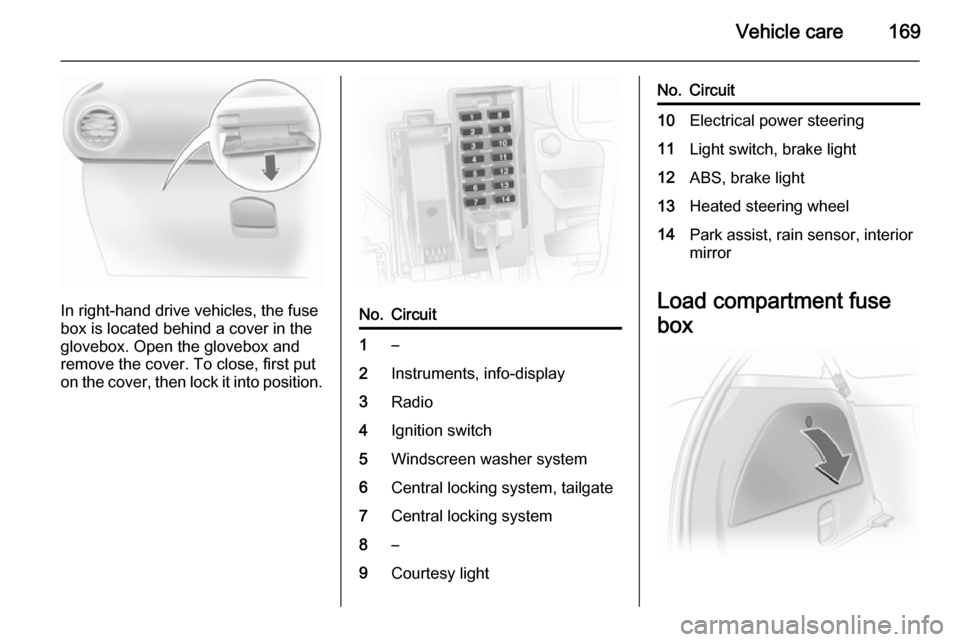
In right-hand drive vehicles, the fuse
box is located behind a cover in the
glovebox. Open the glovebox and
remove the cover. To close, first put
on the cover, then lock it into position.
No.Circuit1–2Instruments, info-display3Radio4Ignition switch5Windscreen washer system6Central locking system, tailgate7Central locking system8–9Courtesy lightNo.Circuit10Electrical power steering11Light switch, brake light12ABS, brake light13Heated steering wheel14Park assist, rain sensor, interior mirror
Load compartment fuse
box
Page 172 of 231

170Vehicle care
The fuse box is on the left side of theload compartment behind a cover.
Remove the cover.No.Circuit1Adaptive forward lighting2–3Seat heater (left)4Seat heater (right)5–6–No.Circuit7–8Rear carrier system, towing
equipment9–10–11–12–13–14–15Rear carrier system, towing
equipment16–17SunroofVehicle tools
Tools
To open the compartment, disengagethe cover and open it, or, depending
on the version, lift the floor cover.
Page 176 of 231

174Vehicle careTyre pressure monitoring
system The vehicle may be fitted with a tyrepressure monitoring system or a tyre
deflation detection system 3 175.Caution
Modifications made to the tyre
pressure monitoring system
(TPMS) by anyone other than an
authorised service facility may
void authorisation to use the
system.
The tyre pressure monitoring system
checks the pressure of all four wheels once a minute when vehicle speed
exceeds a certain limit.
Caution
Tyre pressure monitoring system
warns only about low tyre pressure
condition and does not replace
regular tyre maintenance by the
driver.
All wheels must be equipped with pressure sensors and the tyres must
have the prescribed pressure.
Notice
In countries where the tyre pressure
monitoring system is legally
required, the use of wheels without
pressure sensors will invalidate the
vehicle type approval.
Winter tyres or additional wheel sets
have to be fitted with sensors,
otherwise the system will not work
and the control indicator A illuminates
continuously.
If A lights up, stop as soon as
possible and inflate the tyres as
recommended 3 217.
After inflating, driving may be
required to extinguish A.
If A lights up at lower temperatures
and extinguishes after some driving,
this could be an early indicator for getting low pressure. Check tyre
pressure.
The tyre pressure monitoring system
malfunction indicator is combined
with the low tyre pressure controlindicator. If the system detects a
malfunction, the control indicator will
flash for approx. 1 minute and then
remain continuously illuminated. This sequence will continue upon
subsequent vehicle start‐ups as long as the malfunction exists.
A temporary spare wheel is not
equipped with a pressure sensor. The
tyre pressure monitoring system is
not operational for these wheels.
Control indicator A illuminates.
Operating electronic devices or being
near facilities using radio wave
frequencies similar to the tyre
pressure monitoring system could
cause the tyre pressure monitoring
system sensors to malfunction.
Tyre pressure monitoring system malfunctions may occur for a variety
of reasons, including the installation
of replacement or alternate tyres or
wheels on the vehicle that prevent the tyre pressure monitoring system fromfunctioning properly. Always check
the tyre pressure monitoring system
malfunction control indicator after
replacing one or more tyres or wheels
Page 183 of 231

Vehicle care181
3. Remove the electrical connectioncable and air hose from the
stowage compartments on the
underside of the compressor.
4. Screw the compressor air hose to
the connection on the sealant
bottle.
5. Fit the sealant bottle into the retainer on the compressor.
Set the compressor near the tyre
in such a way that the sealant
bottle is upright.
6. Unscrew valve cap from defective
tyre.
7. Screw the filler hose to the tyre valve.
8. The switch on the compressor must be set to J.
9. Connect the compressor plug to
the power outlet or cigarette
lighter socket.
To avoid discharging the battery,
we recommend running the
engine.
10. Set the rocker switch on the compressor to I. The tyre is filled
with sealant.
11. The compressor pressure gauge briefly indicates up to 6 bar whilstthe sealant bottle is emptying
(approx. 30 seconds). Then the
pressure starts to drop.
Page 185 of 231

Vehicle care183
General informationNotice
The driving characteristics of the
repaired tyre are severely affected, therefore have this tyre replaced.
If unusual noise is heard or the
compressor becomes hot, turn
compressor off for at least
30 minutes.
The built-in safety valve opens at a
pressure of 7 bar (102 psi).
Note the expiry date of the kit. After
this date its sealing capability is no
longer guaranteed. Pay attention to
storage information on sealant
bottle.
Replace the used sealant bottle. Dispose of the bottle as prescribed
by applicable laws.
The compressor and sealant can be used from approx. -30 °C.
The adapters supplied can be used
to pump up other items e.g.
footballs, air mattresses, inflatable
dinghies etc. They are located on theunderside of the compressor. To
remove, screw on compressor air hose and withdraw adapter.
Wheel changing
Some vehicles are equipped with a
tyre repair kit instead of a spare wheel 3 177.
Make the following preparations and
observe the following information:
■ Park the vehicle on a level, firm and
non-skid surface. The front wheels
must be in the straight-ahead
position.
■ Apply the parking brake and engage first gear, reverse gear or
P .
■ Remove the spare wheel 3 185.
■ Never change more than one wheel
at a time.
■ Use the jack only to change wheels
in case of puncture, not for
seasonal winter or summer tyre
change.■ If the ground on which the vehicle is standing is soft, a solid board
(max. 1 cm thick) should be placed
under the jack.
■ Take heavy objects out of the vehicle before jacking up.
■ No people or animals may be in the
vehicle when it is jacked-up.
■ Never crawl under a jacked-up vehicle.
■ Do not start the vehicle when it is raised on the jack.
■ Before screwing in the wheel bolts,
clean them and lightly coat the
taper of each wheel bolt with
commercially available grease.
Page 190 of 231

188Vehicle care
Lead connection order:1. Connect the red lead to the positive terminal of the booster
battery.
2. Connect the other end of the red lead to the positive terminal of the
discharged battery. The positive
terminal has a cover cap on it.
Undo the cap to access the
positive terminal.
3. Connect the black lead to the negative terminal of the booster
battery.
4. Connect the other end of the black
lead to a vehicle grounding point,
such as the engine block or an
engine mounting bolt. Connect as far away from the discharged
battery as possible, however at
least 60 cm.
Position the leads so that they cannot
catch on rotating parts in the engine
compartment.
To start the engine:
1. Start the engine of the vehicle providing the jump.
2. After 5 minutes, start the other engine. Start attempts should be
made for no longer than
15 seconds at an interval of
1 minute.
3. Allow both engines to idle for approx. 3 minutes with the leads
connected.
4. Switch on electrical consumers (e.g. headlights, heated rear
window) of the vehicle receiving
the jump start.
5. Reverse above sequence exactly when removing leads.
6. Close the cover over the positive pole.
Page 191 of 231

Vehicle care189Towing
Towing the vehicle
Insert a suitable screwdriver in the
slot at the lower bend of the cap.
Release the cap by carefully moving
the screwdriver downwards.
Corsa VXR: Disengage and remove
cap by pressing on the lower part of
the cap.
The towing eye is stowed with the
vehicle tools 3 170 . The towing eye is
located in a recess.
Screw in the towing eye as far as it will
go until it stops in a horizontal
position.
Attach a tow rope – or better still a tow
rod – to the towing eye.
The towing eye must only be used for towing and not recovering the vehicle.
Switch on ignition to release steering
wheel lock and to permit operation of
brake lights, horn and windscreen
wiper.
Transmission in neutral.Caution
Drive slowly. Do not drive jerkily.
Excessive tractive force can
damage the vehicle.
When the engine is not running,
considerably more force is needed to
brake and steer.
To prevent the entry of exhaust gases from the towing vehicle, switch on the
air recirculation and close the
windows.
Page 193 of 231

Vehicle care191Appearance care
Exterior care
Locks The locks are lubricated at the factoryusing a high quality lock cylinder
grease. Use de-icing agent only when
absolutely necessary, as this has a
degreasing effect and impairs lock function. After using de-icing agent,
have the locks regreased by a
workshop.
Washing The paintwork of your vehicle is
exposed to environmental influences.
Wash and wax your vehicle regularly.
When using automatic car washes,
select a programme that includes
waxing.
Bird droppings, dead insects, resin,
pollen and the like should be cleaned off immediately, as they contain
aggressive constituents which can
cause paint damage.If using a car wash, comply with the
car wash manufacturer's instructions.
The windscreen wipers and rear
window wiper must be switched off.
Remove antenna and external
accessories such as roof racks etc.
If you wash your vehicle by hand,
make sure that the insides of the
wheel housings are also thoroughly
rinsed out.
Clean edges and folds on opened
doors and the bonnet as well as the
areas they cover.Caution
Always use a cleaning agent with
a pH value of 4 to 9.
Do not use cleaning agents on hot surfaces.
Have the door hinges of all doors
greased by a workshop.
Do not clean the engine compartment with a steam-jet or high-pressure jet
cleaner.
Thoroughly rinse and leather-off the vehicle. Rinse leather frequently. Use
separate leathers for painted and
glass surfaces: remnants of wax on
the windows will impair vision.
Exterior lights
Headlight and other light covers are
made of plastic. Do not use any
abrasive or caustic agents, do not use an ice scraper, and do not clean them
dry.
Polishing and waxing Wax the vehicle regularly (at the
latest when water no longer beads).
Otherwise, the paintwork will dry out.
Polishing is necessary only if the paint
has become dull or if solid deposits
have become attached to it.
Paintwork polish with silicone forms a
protective film, making waxing
unnecessary.
Plastic body parts must not be treated with wax or polishing agents.
Page 195 of 231

Vehicle care193Interior careInterior and upholsteryOnly clean the vehicle interior,
including the instrument panel fascia
and panelling, with a dry cloth or
interior cleaner.
Clean the leather upholstery with clear water and a soft cloth. In case of
heavy soiling, use leather care.
The instrument cluster and the
displays should only be cleaned using
a soft damp cloth. If necessary use a weak soap solution.
Clean fabric upholstery with a
vacuum cleaner and brush. Remove
stains with an upholstery cleaner.
Clothing fabrics may not be
colourfast. This could cause visible
discolourations, especially on light-
coloured upholstery. Removable
stains and discolourations should be
cleaned as soon as possible.
Clean seat belts with lukewarm water or interior cleaner.Caution
Close Velcro fasteners as open
Velcro fasteners on clothing could damage seat upholstery.
The same applies to clothing with
sharp-edged objects, like zips or
belts or studded jeans.
Plastic and rubber parts
Plastic and rubber parts can be
cleaned with the same cleaner as
used to clean the body. Use interior cleaner if necessary. Do not use any
other agent. Avoid solvents and petrol in particular. Do not use high-
pressure jet cleaners.
Page 226 of 231

224IndexAAccessories and vehicle modifications .......................... 145
Active head restraints ..................35
Adaptive forward lighting ..........
.................................. 85, 100, 156
Adjustable air vents ...................112
Airbag and belt tensioners ...........80
Airbag deactivation ................46, 80
Airbag label................................... 41 Airbag system .............................. 41
Air conditioning regular operation ................................ 113
Air conditioning system .............. 107
Air intake .................................... 113
Air vents...................................... 112
Antilock brake system ................ 128
Antilock brake system (ABS) .......82
Anti-theft alarm system ................25
Anti-theft locking system .............. 25
Appearance care ........................191
Apply footbrake ............................ 84 Ashtrays ....................................... 75
Automatic anti-dazzle ..................29
Automatic light control .................98
Automatic locking ........................24
Automatic transmission .............120
Auxiliary heater ........................... 112B
Battery discharge protection ......105
Battery voltage ............................. 90
Bicycle rack .................................. 54
Bonnet ....................................... 147
Brake and clutch fluid .................195
Brake and clutch system .............81
Brake assist ............................... 130
Brake fluid .................................. 150
Brake light switch ......................... 90
Brakes ............................... 128, 150
Breakdown.................................. 189
Bulb replacement ....................... 153
C Capacities .................................. 216
Car Pass ...................................... 19
Catalytic converter .....................120
Central locking system ................21
Centre console lighting ..............105
Changing tyre and wheel size ...176
Charging system .......................... 80
Child locks ................................... 24
Child restraint installation locations ................................... 49
Child restraints.............................. 48
Child restraint systems ................48
Cigarette lighter ........................... 75
Climate control ............................. 15