bonnet VAUXHALL CORSA 2014.5 Owner's Manual
[x] Cancel search | Manufacturer: VAUXHALL, Model Year: 2014.5, Model line: CORSA, Model: VAUXHALL CORSA 2014.5Pages: 231, PDF Size: 6.8 MB
Page 13 of 231

In brief11
1Side air vents ...................... 112
2 Light switch .......................... 98
Instrument illumination .......103
Rear fog light ....................... 102
Front fog lights ...................102
Headlight range
adjustment ........................... 99
3 Turn and lane-change
signals, headlight flash,
low beam and high beam ...101
Exit lighting .......................... 105
Parking lights ...................... 102
Cruise control ....................... 85
4 Steering wheel controls ........70
5 Horn ...................................... 71
Driver airbag ......................... 44
6 Instruments .......................... 76
7 Windscreen wiper,
windscreen washer system ...72
Trip computer ........................ 91
8 Centre air vents ................... 1129Info-Display ........................... 86
Trip computer ........................ 91
Electronic climate control
system ................................. 109
10 Left heated seat ....................38
Heated steering wheel ..........71
Tyre deflation detection
system ................................. 175
Parking assist ...................... 132
Hazard warning flashers .....101
Central locking system ..........21
Electronic stability program . 130
Airbag deactivation ...............46
Right heated seat ..................38
Eco button ........................... 116
Fuel selector ........................ 77
11 Front passenger airbag .........44
12 Glovebox .............................. 53
13 Climate control system ........ 10614Cigarette lighter ..................... 75
Power outlet .......................... 75
15 Ashtray .................................. 75
16 Ignition switch with
steering wheel lock .............115
17 Accelerator pedal ................115
18 Brake pedal ......................... 128
19 Clutch pedal ........................ 114
20 Steering wheel adjustment ...70
21 Bonnet release lever ...........147
Page 27 of 231

Keys, doors and windows25smelled, could enter the vehicle.
This can cause unconsciousness
and even death.
Notice
The installation of certain heavy accessories onto the tailgate may
affect its ability to remain open.
Closing
Use the interior handle.
Do not press the button under the
moulding while closing as this will unlock the tailgate again.
Vehicle security
Anti-theft locking system9 Warning
Do not use the system if there are
people in the vehicle! The doorscannot be unlocked from the
inside.
The system deadlocks all the doors.
All doors must be closed or the
system cannot be activated.
If the ignition was on, the driver's door
must be opened and closed once so
that the vehicle can be secured.
Unlocking the vehicle disables the
mechanical anti-theft locking system.
This is not possible with the central
locking button.
Activating with the remote
control
Press button p again within
10 seconds of locking.
Anti-theft alarm system
The anti-theft alarm system is
operated in conjunction with the
central locking system.
It monitors: ■ Doors, load compartment, bonnet,
■ Ignition.
Unlocking the vehicle deactivates the
anti-theft alarm system.
Page 28 of 231
26Keys, doors and windows
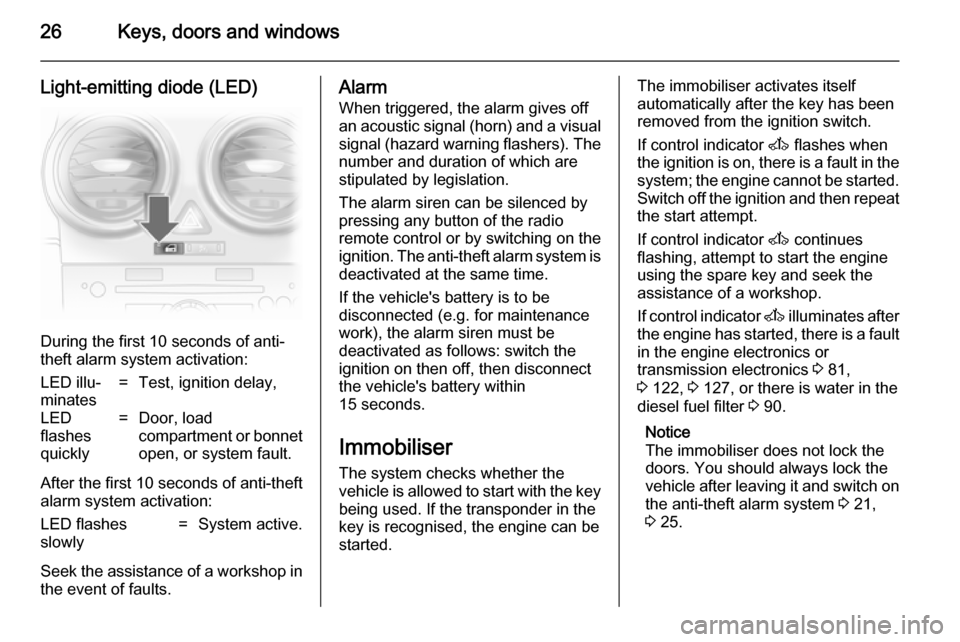
Light-emitting diode (LED)
During the first 10 seconds of anti-
theft alarm system activation:
LED illu‐
minates=Test, ignition delay,LED
flashes
quickly=Door, load
compartment or bonnet open, or system fault.
After the first 10 seconds of anti-theft
alarm system activation:
LED flashes
slowly=System active.
Seek the assistance of a workshop in
the event of faults.
Alarm
When triggered, the alarm gives off
an acoustic signal (horn) and a visual signal (hazard warning flashers). The
number and duration of which are
stipulated by legislation.
The alarm siren can be silenced by
pressing any button of the radio
remote control or by switching on the
ignition. The anti-theft alarm system is deactivated at the same time.
If the vehicle's battery is to be
disconnected (e.g. for maintenance
work), the alarm siren must be
deactivated as follows: switch the
ignition on then off, then disconnect
the vehicle's battery within
15 seconds.
Immobiliser
The system checks whether the
vehicle is allowed to start with the key being used. If the transponder in the
key is recognised, the engine can be
started.The immobiliser activates itself
automatically after the key has been removed from the ignition switch.
If control indicator A flashes when
the ignition is on, there is a fault in the
system; the engine cannot be started. Switch off the ignition and then repeat
the start attempt.
If control indicator A continues
flashing, attempt to start the engine
using the spare key and seek the
assistance of a workshop.
If control indicator A illuminates after
the engine has started, there is a fault in the engine electronics or
transmission electronics 3 81,
3 122, 3 127, or there is water in the
diesel fuel filter 3 90.
Notice
The immobiliser does not lock the doors. You should always lock the
vehicle after leaving it and switch on the anti-theft alarm system 3 21,
3 25.
Page 119 of 231
Driving and operating117
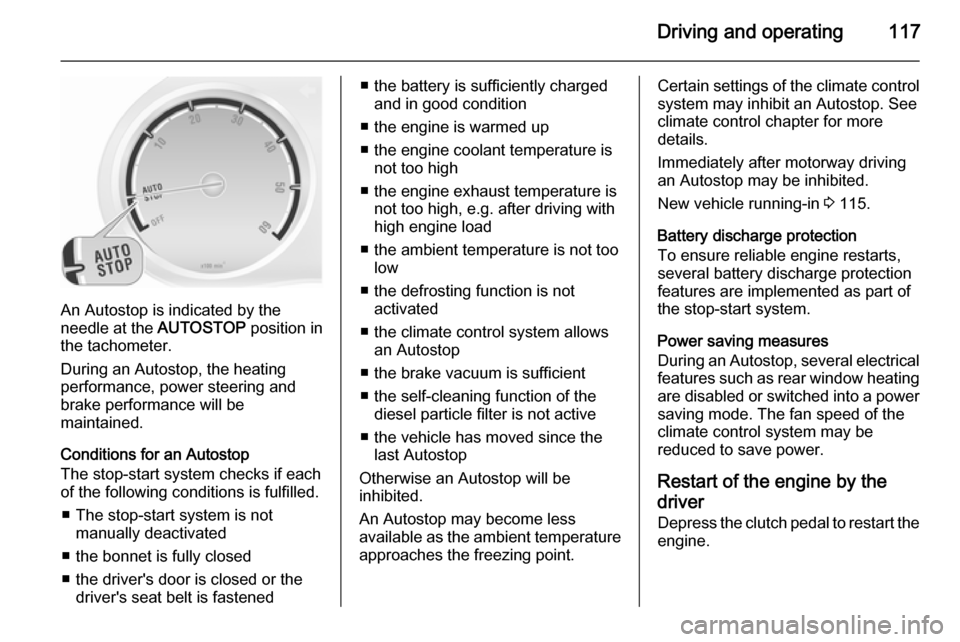
An Autostop is indicated by the
needle at the AUTOSTOP position in
the tachometer.
During an Autostop, the heating
performance, power steering and
brake performance will be
maintained.
Conditions for an Autostop
The stop-start system checks if each
of the following conditions is fulfilled.
■ The stop-start system is not manually deactivated
■ the bonnet is fully closed
■ the driver's door is closed or the driver's seat belt is fastened
■ the battery is sufficiently chargedand in good condition
■ the engine is warmed up
■ the engine coolant temperature is not too high
■ the engine exhaust temperature is not too high, e.g. after driving with
high engine load
■ the ambient temperature is not too low
■ the defrosting function is not activated
■ the climate control system allows an Autostop
■ the brake vacuum is sufficient
■ the self-cleaning function of the diesel particle filter is not active
■ the vehicle has moved since the last Autostop
Otherwise an Autostop will be
inhibited.
An Autostop may become less
available as the ambient temperature
approaches the freezing point.Certain settings of the climate control
system may inhibit an Autostop. See
climate control chapter for more
details.
Immediately after motorway driving
an Autostop may be inhibited.
New vehicle running-in 3 115.
Battery discharge protection
To ensure reliable engine restarts,
several battery discharge protection
features are implemented as part of
the stop-start system.
Power saving measures
During an Autostop, several electrical
features such as rear window heating
are disabled or switched into a power saving mode. The fan speed of the
climate control system may be
reduced to save power.
Restart of the engine by the
driver
Depress the clutch pedal to restart the
engine.
Page 120 of 231

118Driving and operating
The engine start is indicated by the
needle at the idle speed position in
the tachometer.
If the selector lever is shifted out of
neutral before depressing the clutch
first, control indicator - illuminates.
Control indicator - 3 81.
Restart of the engine by the
stop-start system
The selector lever has to be in N to
enable an automatic restart.
If one of the following conditions occurs during an Autostop, the
engine will be restarted automatically
by the stop-start system.
■ The stop-start system is manually deactivated
■ the bonnet is opened
■ the driver's seat belt is unfastened and the driver's door is opened
■ the engine temperature is too low
■ the battery is discharged
■ the brake vacuum is not sufficient
■ the vehicle starts to move
■ the defrosting function is activated■ the climate control system requests
an engine start
■ the air conditioning is manually switched on
If the bonnet is not fully closed, a
warning message is displayed in the
Driver Information Centre.
If an electrical accessory, e.g. a
portable CD player, is connected to
the power outlet, a brief power drop
during restart might be noticeable.
Parking ■ Do not park the vehicle on an easily
ignitable surface. The high
temperature of the exhaust system
could ignite the surface.
■ Always apply parking brake without
pressing release button. Apply as firmly as possible on downhill or
uphill slopes. Depress the foot
brake at the same time to reduce
operating force.
■ Switch off the engine and ignition. Turn the steering wheel until the
steering wheel lock engages.■ If the vehicle is on a level surface or
uphill slope, engage first gear or set the selector lever to P before
switching off the ignition. On an
uphill slope, turn the front wheels
away from the kerb.
If the vehicle is on a downhill slope, engage reverse gear or set theselector lever to P before switching
off the ignition. Turn the front
wheels towards the kerb.
■ Lock the vehicle and activate the anti-theft locking system and the
anti-theft alarm system.
Page 130 of 231
128Driving and operating
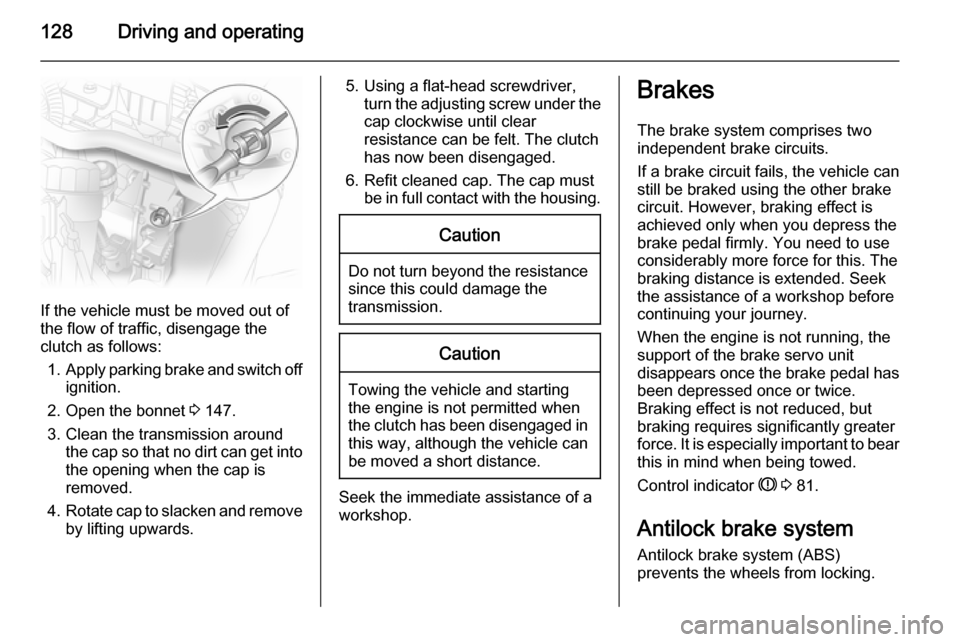
If the vehicle must be moved out of
the flow of traffic, disengage the
clutch as follows:
1. Apply parking brake and switch off
ignition.
2. Open the bonnet 3 147.
3. Clean the transmission around the cap so that no dirt can get into
the opening when the cap is
removed.
4. Rotate cap to slacken and remove
by lifting upwards.
5. Using a flat-head screwdriver,
turn the adjusting screw under the
cap clockwise until clear
resistance can be felt. The clutch
has now been disengaged.
6. Refit cleaned cap. The cap must be in full contact with the housing.Caution
Do not turn beyond the resistancesince this could damage the
transmission.
Caution
Towing the vehicle and starting
the engine is not permitted when
the clutch has been disengaged in this way, although the vehicle can
be moved a short distance.
Seek the immediate assistance of a
workshop.
Brakes
The brake system comprises two
independent brake circuits.
If a brake circuit fails, the vehicle can
still be braked using the other brake
circuit. However, braking effect is
achieved only when you depress the
brake pedal firmly. You need to use
considerably more force for this. The
braking distance is extended. Seek
the assistance of a workshop before continuing your journey.
When the engine is not running, the
support of the brake servo unit
disappears once the brake pedal has
been depressed once or twice.
Braking effect is not reduced, but
braking requires significantly greater
force. It is especially important to bear this in mind when being towed.
Control indicator R 3 81.
Antilock brake system Antilock brake system (ABS)
prevents the wheels from locking.
Page 148 of 231
146Vehicle care
■ Open bonnet, close all doors andlock the vehicle.
■ Disconnect the clamp from the negative terminal of the vehicle
battery. Beware that all systems are not functional, e.g. anti-theft alarm
system.
Putting back into operation Following must be done if the vehicle
is putting back into operation:
■ Connect the clamp to the negative terminal of the vehicle battery.
Activate the electronics of the
power windows.
■ Check tyre pressure.
■ Fill up the washer fluid reservoir.
■ Check the engine oil level.
■ Check the coolant level.
■ Fit the number plate if necessary.
End-of-life vehicle
recovery
Information on end-of-life vehicle
recovery centres and the recycling of
end-of-life vehicles is available on ourwebsite, where legally required. Only
entrust this work to an authorised
recycling centre.
Gas vehicles must be recycled by a
service centre authorised for gas
vehicles.Vehicle checks
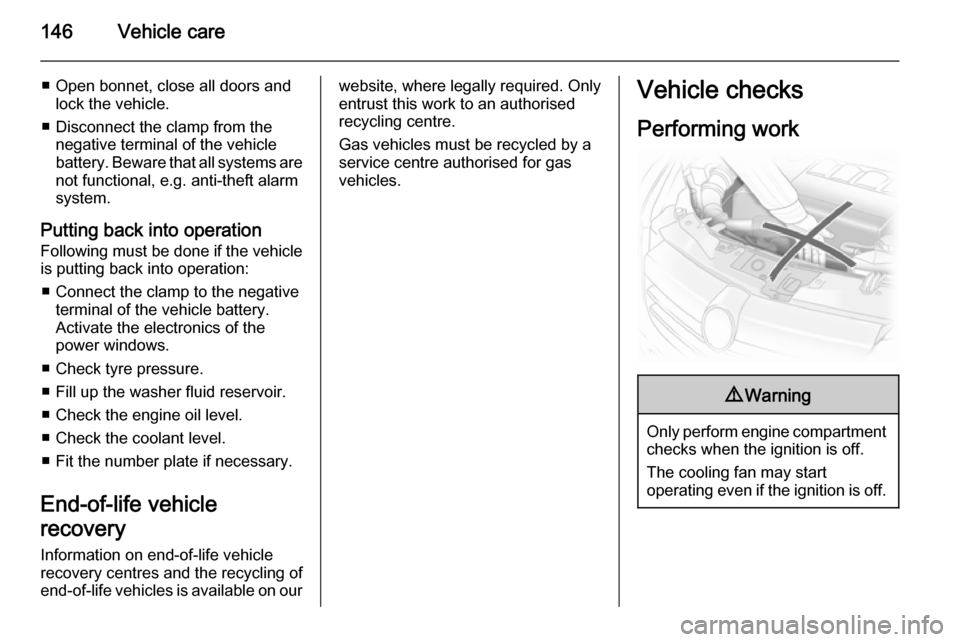
Performing work9 Warning
Only perform engine compartment
checks when the ignition is off.
The cooling fan may start
operating even if the ignition is off.
Page 149 of 231
Vehicle care1479Danger
The ignition system and Xenon
headlights use extremely high
voltage. Do not touch.
The caps for topping up the engine oil, the coolant, the washer fluid and the
oil dipstick handle are yellow, for ease
of identification.
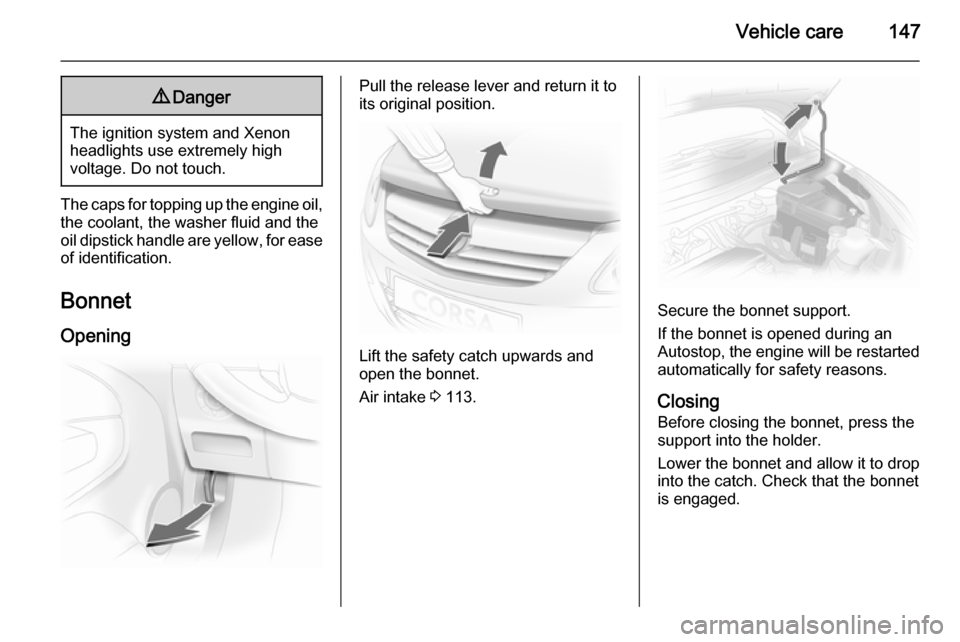
Bonnet
Opening
Pull the release lever and return it to
its original position.
Lift the safety catch upwards and
open the bonnet.
Air intake 3 113.
Secure the bonnet support.
If the bonnet is opened during an Autostop, the engine will be restarted automatically for safety reasons.
Closing Before closing the bonnet, press the
support into the holder.
Lower the bonnet and allow it to drop
into the catch. Check that the bonnet
is engaged.
Page 193 of 231

Vehicle care191Appearance care
Exterior care
Locks The locks are lubricated at the factoryusing a high quality lock cylinder
grease. Use de-icing agent only when
absolutely necessary, as this has a
degreasing effect and impairs lock function. After using de-icing agent,
have the locks regreased by a
workshop.
Washing The paintwork of your vehicle is
exposed to environmental influences.
Wash and wax your vehicle regularly.
When using automatic car washes,
select a programme that includes
waxing.
Bird droppings, dead insects, resin,
pollen and the like should be cleaned off immediately, as they contain
aggressive constituents which can
cause paint damage.If using a car wash, comply with the
car wash manufacturer's instructions.
The windscreen wipers and rear
window wiper must be switched off.
Remove antenna and external
accessories such as roof racks etc.
If you wash your vehicle by hand,
make sure that the insides of the
wheel housings are also thoroughly
rinsed out.
Clean edges and folds on opened
doors and the bonnet as well as the
areas they cover.Caution
Always use a cleaning agent with
a pH value of 4 to 9.
Do not use cleaning agents on hot surfaces.
Have the door hinges of all doors
greased by a workshop.
Do not clean the engine compartment with a steam-jet or high-pressure jet
cleaner.
Thoroughly rinse and leather-off the vehicle. Rinse leather frequently. Use
separate leathers for painted and
glass surfaces: remnants of wax on
the windows will impair vision.
Exterior lights
Headlight and other light covers are
made of plastic. Do not use any
abrasive or caustic agents, do not use an ice scraper, and do not clean them
dry.
Polishing and waxing Wax the vehicle regularly (at the
latest when water no longer beads).
Otherwise, the paintwork will dry out.
Polishing is necessary only if the paint
has become dull or if solid deposits
have become attached to it.
Paintwork polish with silicone forms a
protective film, making waxing
unnecessary.
Plastic body parts must not be treated with wax or polishing agents.
Page 226 of 231

224IndexAAccessories and vehicle modifications .......................... 145
Active head restraints ..................35
Adaptive forward lighting ..........
.................................. 85, 100, 156
Adjustable air vents ...................112
Airbag and belt tensioners ...........80
Airbag deactivation ................46, 80
Airbag label................................... 41 Airbag system .............................. 41
Air conditioning regular operation ................................ 113
Air conditioning system .............. 107
Air intake .................................... 113
Air vents...................................... 112
Antilock brake system ................ 128
Antilock brake system (ABS) .......82
Anti-theft alarm system ................25
Anti-theft locking system .............. 25
Appearance care ........................191
Apply footbrake ............................ 84 Ashtrays ....................................... 75
Automatic anti-dazzle ..................29
Automatic light control .................98
Automatic locking ........................24
Automatic transmission .............120
Auxiliary heater ........................... 112B
Battery discharge protection ......105
Battery voltage ............................. 90
Bicycle rack .................................. 54
Bonnet ....................................... 147
Brake and clutch fluid .................195
Brake and clutch system .............81
Brake assist ............................... 130
Brake fluid .................................. 150
Brake light switch ......................... 90
Brakes ............................... 128, 150
Breakdown.................................. 189
Bulb replacement ....................... 153
C Capacities .................................. 216
Car Pass ...................................... 19
Catalytic converter .....................120
Central locking system ................21
Centre console lighting ..............105
Changing tyre and wheel size ...176
Charging system .......................... 80
Child locks ................................... 24
Child restraint installation locations ................................... 49
Child restraints.............................. 48
Child restraint systems ................48
Cigarette lighter ........................... 75
Climate control ............................. 15