change wheel VAUXHALL CORSA 2014.5 Owner's Manual
[x] Cancel search | Manufacturer: VAUXHALL, Model Year: 2014.5, Model line: CORSA, Model: VAUXHALL CORSA 2014.5Pages: 231, PDF Size: 6.8 MB
Page 13 of 231

In brief11
1Side air vents ...................... 112
2 Light switch .......................... 98
Instrument illumination .......103
Rear fog light ....................... 102
Front fog lights ...................102
Headlight range
adjustment ........................... 99
3 Turn and lane-change
signals, headlight flash,
low beam and high beam ...101
Exit lighting .......................... 105
Parking lights ...................... 102
Cruise control ....................... 85
4 Steering wheel controls ........70
5 Horn ...................................... 71
Driver airbag ......................... 44
6 Instruments .......................... 76
7 Windscreen wiper,
windscreen washer system ...72
Trip computer ........................ 91
8 Centre air vents ................... 1129Info-Display ........................... 86
Trip computer ........................ 91
Electronic climate control
system ................................. 109
10 Left heated seat ....................38
Heated steering wheel ..........71
Tyre deflation detection
system ................................. 175
Parking assist ...................... 132
Hazard warning flashers .....101
Central locking system ..........21
Electronic stability program . 130
Airbag deactivation ...............46
Right heated seat ..................38
Eco button ........................... 116
Fuel selector ........................ 77
11 Front passenger airbag .........44
12 Glovebox .............................. 53
13 Climate control system ........ 10614Cigarette lighter ..................... 75
Power outlet .......................... 75
15 Ashtray .................................. 75
16 Ignition switch with
steering wheel lock .............115
17 Accelerator pedal ................115
18 Brake pedal ......................... 128
19 Clutch pedal ........................ 114
20 Steering wheel adjustment ...70
21 Bonnet release lever ...........147
Page 55 of 231

Storage53StorageStorage compartments................53
Load compartment .......................63
Roof rack system .........................67
Loading information .....................68Storage compartments9Warning
Do not store heavy or sharp
objects in the storage
compartments. Otherwise, the
storage compartment lid could
open and vehicle occupants could be injured by objects being thrown
around in the event of hard
braking, a sudden change in
direction or an accident.
Glovebox
The glovebox features:
■ a card holder in cheque card format
■ a pen holder
■ pocket torch holder
■ a key adapter for the locking wheel
bolts
The glovebox should be closed whilst driving.
Cupholders
A cupholder is located in the front of
the centre console.
In the 3-door passenger vehicle: also
located on the side of the rear seat.
Page 98 of 231

96Instruments and controls
■Pull turn signal stalk and wiper stalk
simultaneously to the steering
wheel until you hear a confirmation
signal (approx. 3 seconds).
■ The miles display shows P1.■ Push the turn signal stalk (left) up
or down and select the desired
function P1 - P7 .
■ Push the wiper stalk (right) up or
down and select status On or OFF ,
or input a value for speed ( P6) or
value for volume ( P7).
■ Pull turn signal stalk (left) and wiper
stalk (right) simultaneously to the
steering wheel until you hear a
confirmation signal (approx.
3 seconds).
The selected settings are now stored
for the key in the ignition switch. To
activate and deactivate the functions
and set the functions selected, please see the relevant sections.
Repeat the procedure to programme
additional keys.
Programmable functions P1 : Switch on the external lighting
using the remote control (Entry
lighting). Entry lighting 3 105.
P2 : Automatic rear windscreen wiper
when reverse gear is selected. Rear
window wiperwasher 3 73.
P3 : Lane change indication: three
flashes when the lever is moved
slightly. Turn and lane-change
signals 3 101.
Page 103 of 231

Lighting101Hazard warning flashers
Operated with the ¨ button.
The hazard warning flashers activate
automatically if the airbags deploy.
Turn and lane-change
signalsLever up=right turn signalLever down=left turn signal
The lever always springs back to its
original position.
If the lever is moved past the
resistance point, the turn signal is
switched on constantly. When the
steering wheel moves back, the turn
signal is automatically deactivated.
For three flashes, e.g. when changing lanes, press the lever until resistance
is felt and then release. This function
can be activated or deactivated
depending on the key used 3 95.
Move the lever to the resistance point
and hold for longer indication.
Switch the turn signal off manually by moving the lever slightly.
Acoustic turn signal The volume of the acoustic turn signal
can be adjusted. This function can be programmed depending on the key
used 3 95.
Page 114 of 231

112Climate control9Warning
The exchange of fresh air is
reduced in air recirculation mode.
In operation without cooling the air humidity increases, so the
windows may mist up from inside.
The quality of the passenger
compartment air deteriorates,
which may cause the vehicle
occupants to feel drowsy.
In warm and very humid ambient air conditions, the windscreen might mist up from outside, when cold air is
directed to it. If windscreen mists up
from outside, activate windscreen
wiper and deactivate s.
Auxiliary heater Air heater
Quickheat is an electric auxiliary air
heater which automatically warms up
the passenger compartment more
quickly.
Coolant heater
Diesel-engined vehicles have a fuel-
powered auxiliary heater.Air vents
Adjustable air vents At least one air vent must be open
while cooling is on in order to prevent
the evaporator from icing up due to
lack of air movement.
Set the direction of the air flow by
turning the adjuster wheel from right to left and raise or lower the horizontal slats.
Page 147 of 231

Vehicle care145Vehicle careGeneral Information...................145
Vehicle checks ........................... 146
Bulb replacement .......................153
Electrical system ........................166
Vehicle tools .............................. 170
Wheels and tyres .......................172
Jump starting ............................. 187
Towing ....................................... 189
Appearance care .......................191General Information
Accessories and vehicle
modifications
We recommend using genuine parts and accessories and factory
approved parts specific for your
vehicle type. We cannot assess or guarantee reliability of other products
- even if they have a regulatory or
otherwise granted approval.
Do not make any modifications to the electrical system, e.g. changes of
electronic control units (chip tuning).Caution
When transporting the vehicle on
a train or on a recovery vehicle, the
mud flaps might be damaged.
Vehicle storage
Storage for a long period of time
The following must be carried out if
the vehicle is to be stored for several
months:
■ Wash and wax the vehicle.
■ Have the wax in the engine compartment and underbody
checked.
■ Clean and preserve rubber seals.
■ Fill up fuel tank completely.
■ Change engine oil.
■ Drain washer fluid reservoir.
■ Check coolant antifreeze and corrosion protection.
■ Adjust tyre pressure to the value specified for full load.
■ Park vehicle in dry, well ventilated place. Engage first or reverse gear
or set selector lever to P. Prevent
the vehicle from rolling.
■ Do not apply parking brake.
Page 177 of 231

Vehicle care175
on your vehicle to ensure that the
replacement or alternate tyres and wheels allow the tyre pressure
monitoring system to continue to
function properly.
The use of commercially available
liquid tyre repair kits can impair the
function of the system. Factory
approved repair kits can be used.
System initialisation After a wheel change or tyre pressure
adjustment the system must be
initialised: inflate the cold tyres to the
prescribed pressure according to the
tyre information label or this
document 3 217. Then switch on
ignition and press and hold the DDS
button for approx. 4 seconds. The
control indicator A flashes three
times.
If the tyre pressure difference
between the left and the right wheel
on one axle is more than 30 kPa, tyre
pressure monitoring system
malfunction will be indicated, as the
vehicle starts moving for the first time after initialisation. Adjust tyre
pressure and repeat initialisation.Notice
The system needs to be initialised
after tyre pressure change,
otherwise it will not be able to warn
properly.
Each time the tyres are replaced, the
tyre pressure monitoring system
sensors have to be dismounted and
serviced. For the screwed sensor
replace the valve core and sealing
ring, for the clipped sensor replace
complete rubber valve stem.
Auto learn function
After changing wheels the vehicle
must be stationary for approx.
20 minutes, before the system
recalculates. The following relearn
process takes up to 10 minutes of
driving with a minimum speed of
16 mph.
Tyre deflation detection
system The tyre deflation detection system
continually checks the rotation speed
of all four tyres.
If a tyre loses pressure the control
indicator w illuminates red. Stop
immediately and check tyre pressure.
Control indicator w 3 83.
Page 178 of 231
176Vehicle care
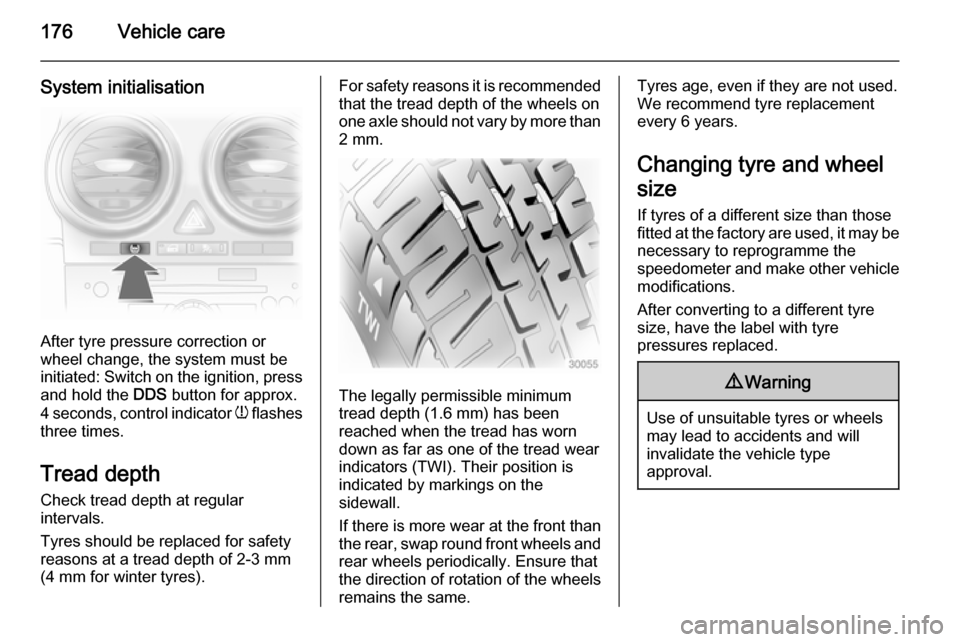
System initialisation
After tyre pressure correction or
wheel change, the system must be
initiated: Switch on the ignition, press and hold the DDS button for approx.
4 seconds, control indicator w flashes
three times.
Tread depth
Check tread depth at regular
intervals.
Tyres should be replaced for safety
reasons at a tread depth of 2-3 mm
(4 mm for winter tyres).
For safety reasons it is recommended
that the tread depth of the wheels on
one axle should not vary by more than 2 mm.
The legally permissible minimum
tread depth (1.6 mm) has been
reached when the tread has worn
down as far as one of the tread wear
indicators (TWI). Their position is
indicated by markings on the
sidewall.
If there is more wear at the front than
the rear, swap round front wheels and
rear wheels periodically. Ensure that
the direction of rotation of the wheels
remains the same.
Tyres age, even if they are not used.
We recommend tyre replacement
every 6 years.
Changing tyre and wheel
size If tyres of a different size than those
fitted at the factory are used, it may be necessary to reprogramme the
speedometer and make other vehicle
modifications.
After converting to a different tyre
size, have the label with tyre
pressures replaced.9 Warning
Use of unsuitable tyres or wheels
may lead to accidents and will
invalidate the vehicle type
approval.
Page 185 of 231

Vehicle care183
General informationNotice
The driving characteristics of the
repaired tyre are severely affected, therefore have this tyre replaced.
If unusual noise is heard or the
compressor becomes hot, turn
compressor off for at least
30 minutes.
The built-in safety valve opens at a
pressure of 7 bar (102 psi).
Note the expiry date of the kit. After
this date its sealing capability is no
longer guaranteed. Pay attention to
storage information on sealant
bottle.
Replace the used sealant bottle. Dispose of the bottle as prescribed
by applicable laws.
The compressor and sealant can be used from approx. -30 °C.
The adapters supplied can be used
to pump up other items e.g.
footballs, air mattresses, inflatable
dinghies etc. They are located on theunderside of the compressor. To
remove, screw on compressor air hose and withdraw adapter.
Wheel changing
Some vehicles are equipped with a
tyre repair kit instead of a spare wheel 3 177.
Make the following preparations and
observe the following information:
■ Park the vehicle on a level, firm and
non-skid surface. The front wheels
must be in the straight-ahead
position.
■ Apply the parking brake and engage first gear, reverse gear or
P .
■ Remove the spare wheel 3 185.
■ Never change more than one wheel
at a time.
■ Use the jack only to change wheels
in case of puncture, not for
seasonal winter or summer tyre
change.■ If the ground on which the vehicle is standing is soft, a solid board
(max. 1 cm thick) should be placed
under the jack.
■ Take heavy objects out of the vehicle before jacking up.
■ No people or animals may be in the
vehicle when it is jacked-up.
■ Never crawl under a jacked-up vehicle.
■ Do not start the vehicle when it is raised on the jack.
■ Before screwing in the wheel bolts,
clean them and lightly coat the
taper of each wheel bolt with
commercially available grease.
Page 187 of 231

Vehicle care185
4. Set the jack to the necessaryheight. Position it directly below
the jacking point in a manner that
prevents it from slipping.
Variant 1:Variant 2:
Attach jack handle and with the
jack correctly aligned rotate handle until wheel is clear of theground.
5. Unscrew the wheel bolts.
6. Change the wheel.
7. Screw in the wheel bolts.
8. Lower vehicle.
9. Install the wheel wrench ensuring that it locates securely and tighten
each bolt in a crosswise
sequence. Tightening torque is
110 Nm.
10. Align the valve hole in the wheel cover with the tyre valve before
installing.
Install wheel bolt caps.
11. Stow the replaced wheel 3 177,
the vehicle tools 3 170 and the
key adapter 3 53.
12. Check the tyre pressure of the installed tyre and also the wheelbolt torque as soon as possible.
Have the defective tyre renewed or
repaired.
Spare wheel
Some vehicles are equipped with a
tyre repair kit instead of a spare
wheel.