maintenance VAUXHALL CORSA 2014.5 Owner's Manual
[x] Cancel search | Manufacturer: VAUXHALL, Model Year: 2014.5, Model line: CORSA, Model: VAUXHALL CORSA 2014.5Pages: 231, PDF Size: 6.8 MB
Page 3 of 231

Introduction.................................... 2
In brief ............................................ 6
Keys, doors and windows ............19
Seats, restraints ........................... 34
Storage ........................................ 53
Instruments and controls .............70
Lighting ........................................ 98
Climate control ........................... 106
Driving and operating .................114
Vehicle care ............................... 145
Service and maintenance ..........194
Technical data ........................... 197
Customer information ................222
Index .......................................... 224Contents
Page 5 of 231

Introduction3Vehicle specific data
Please enter your vehicle's data on
the previous page to keep it easily
accessible. This information is
available in the sections "Service and maintenance" and "Technical data"
as well as on the identification plate.
Introduction
Your vehicle is a designed
combination of advanced technology, safety, environmental friendliness
and economy.
This Owner's Manual provides you
with all the necessary information to
enable you to drive your vehicle
safely and efficiently.
Make sure your passengers are
aware of the possible risk of accident
and injury which may result from
improper use of the vehicle.
You must always comply with the
specific laws and regulations of the
country that you are in. These laws
may differ from the information in this Owner's Manual.When this Owner's Manual refers to aworkshop visit, we recommend your
Vauxhall Authorised Repairer. For
gas vehicles, we recommend a
Vauxhall Authorised Repairer
licensed to service gas vehicles.
All Vauxhall Authorised Repairers
provide first-class service at
reasonable prices. Experienced
mechanics trained by Vauxhall work
according to specific Vauxhall
instructions.
The customer literature pack should
always be kept ready to hand in the
vehicle.
Using this manual ■ This manual describes all options and features available for this
model. Certain descriptions,
including those for display and
menu functions, may not apply to
your vehicle due to model variant,
country specifications, special
equipment or accessories.
■ The "In brief" section will give you an initial overview.■ The table of contents at thebeginning of this manual and withineach section shows where the
information is located.
■ The index will enable you to search
for specific information.
■ This Owner's Manual depicts left- hand drive vehicles. Operation is
similar for right-hand drive vehicles.
■ The Owner's Manual uses the factory engine designations. The
corresponding sales designations
can be found in the section
"Technical data".
■ Directional data, e.g. left or right, or
front or back, always relate to the
direction of travel.
■ The vehicle display screens may not support your specific language.
■ In this manual all display messages
and interior labellings are written in bold type.
Page 28 of 231
26Keys, doors and windows
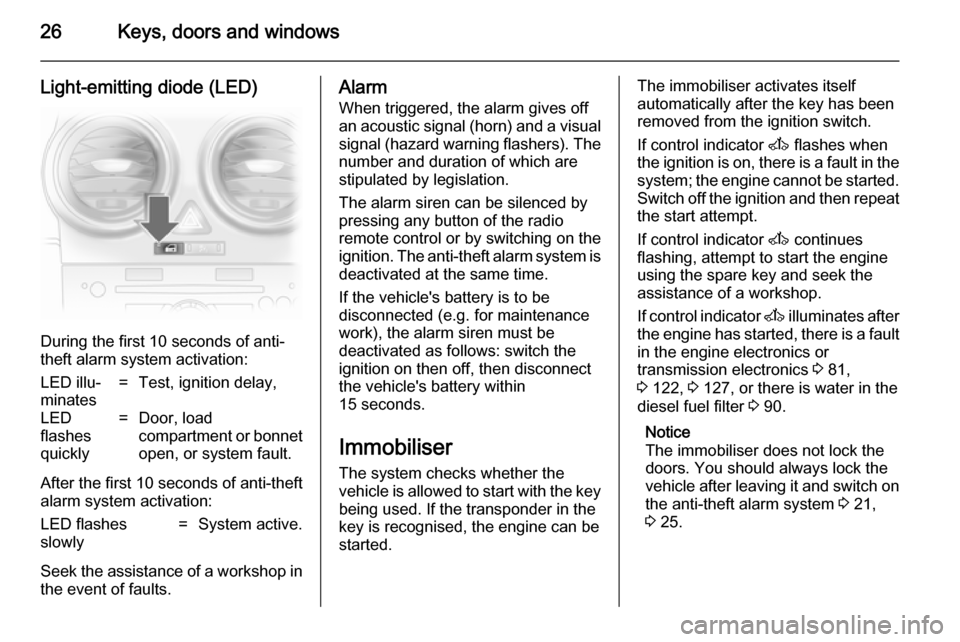
Light-emitting diode (LED)
During the first 10 seconds of anti-
theft alarm system activation:
LED illu‐
minates=Test, ignition delay,LED
flashes
quickly=Door, load
compartment or bonnet open, or system fault.
After the first 10 seconds of anti-theft
alarm system activation:
LED flashes
slowly=System active.
Seek the assistance of a workshop in
the event of faults.
Alarm
When triggered, the alarm gives off
an acoustic signal (horn) and a visual signal (hazard warning flashers). The
number and duration of which are
stipulated by legislation.
The alarm siren can be silenced by
pressing any button of the radio
remote control or by switching on the
ignition. The anti-theft alarm system is deactivated at the same time.
If the vehicle's battery is to be
disconnected (e.g. for maintenance
work), the alarm siren must be
deactivated as follows: switch the
ignition on then off, then disconnect
the vehicle's battery within
15 seconds.
Immobiliser
The system checks whether the
vehicle is allowed to start with the key being used. If the transponder in the
key is recognised, the engine can be
started.The immobiliser activates itself
automatically after the key has been removed from the ignition switch.
If control indicator A flashes when
the ignition is on, there is a fault in the
system; the engine cannot be started. Switch off the ignition and then repeat
the start attempt.
If control indicator A continues
flashing, attempt to start the engine
using the spare key and seek the
assistance of a workshop.
If control indicator A illuminates after
the engine has started, there is a fault in the engine electronics or
transmission electronics 3 81,
3 122, 3 127, or there is water in the
diesel fuel filter 3 90.
Notice
The immobiliser does not lock the doors. You should always lock the
vehicle after leaving it and switch on the anti-theft alarm system 3 21,
3 25.
Page 108 of 231

106Climate controlClimate controlClimate control systems ............. 106
Air vents ..................................... 112
Maintenance .............................. 113Climate control systems
Heating and ventilation
system
Controls for: ■ Temperature
■ Fan speed
■ Air distribution
Heated rear window Ü 3 31.
Temperature
red=warmblue=coldHeating will not be fully effective until
engine has reached normal operating temperature.
Fan speed
Adjust the air flow by switching the fan to the desired speed.
Air distributionM=to head areaL=to head area and foot wellK=to foot wellJ=to windscreen, front door
windows and foot welll=to windscreen and front door
windows
Intermediate settings are possible.
Demisting and defrosting the windows ■ Set temperature control to warmest
level.
■ Set fan speed to highest level.
■ Set air distribution control to l.
■ Switch on heated rear window Ü.
Page 115 of 231
Climate control113
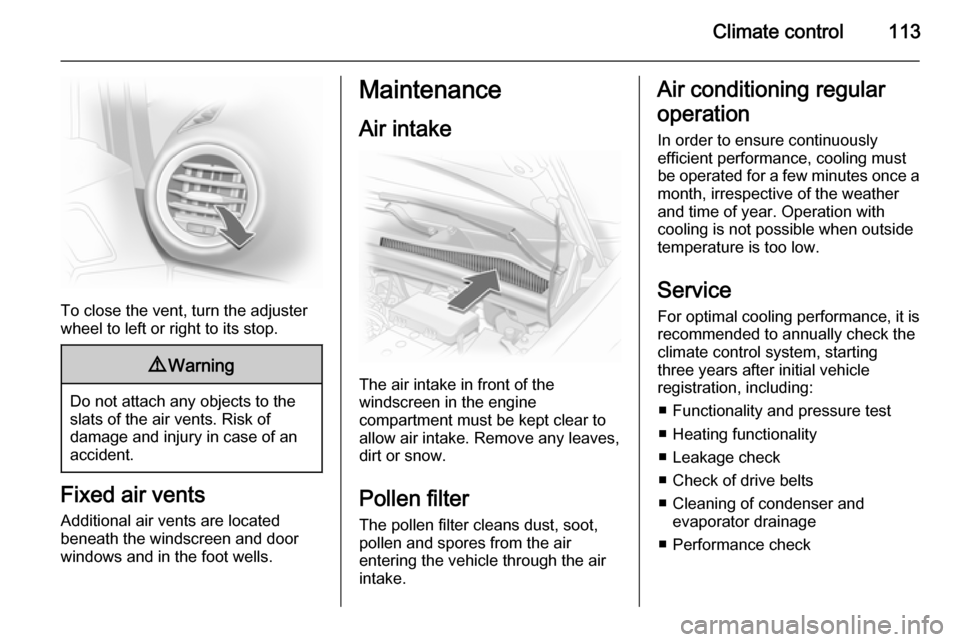
To close the vent, turn the adjuster
wheel to left or right to its stop.
9 Warning
Do not attach any objects to the
slats of the air vents. Risk of
damage and injury in case of an
accident.
Fixed air vents
Additional air vents are located
beneath the windscreen and door windows and in the foot wells.
Maintenance
Air intake
The air intake in front of the
windscreen in the engine
compartment must be kept clear to
allow air intake. Remove any leaves,
dirt or snow.
Pollen filter
The pollen filter cleans dust, soot,
pollen and spores from the air
entering the vehicle through the air
intake.
Air conditioning regular
operation In order to ensure continuously
efficient performance, cooling must
be operated for a few minutes once a
month, irrespective of the weather
and time of year. Operation with
cooling is not possible when outside
temperature is too low.
Service For optimal cooling performance, it isrecommended to annually check the
climate control system, starting
three years after initial vehicle
registration, including:
■ Functionality and pressure test■ Heating functionality
■ Leakage check
■ Check of drive belts
■ Cleaning of condenser and evaporator drainage
■ Performance check
Page 152 of 231

150Vehicle careBrakesA squealing noise indicates that the
brake lining is at its minimum
thickness. Continued driving is
possible but have the brake lining
replaced as soon as possible.
Once new brake linings are installed,
do not brake unnecessarily hard for
the first few journeys.
Brake fluid9 Warning
Brake fluid is poisonous and
corrosive. Avoid contact with eyes, skin, fabrics and painted surfaces.
The brake fluid level must be betweenthe MIN and the MAX marks.
If fluid level is below MIN seek the
assistance of a workshop.
Brake and clutch fluid 3 195.
Vehicle battery Vehicles without stop-start system
will be equipped with a lead acid
battery. Vehicles with stop-start
system will be equipped with an
AGM battery which is not a lead acid
battery.
The vehicle battery is maintenance-
free provided that the driving profile
allows sufficient charging of the
battery. Short-distance-driving and
frequent engine starts can discharge
the battery. Avoid the use of
unnecessary electrical consumers.
Batteries do not belong in household
waste. They must be disposed of at
an appropriate recycling collection
point.
Laying up the vehicle for more than
4 weeks can lead to battery
discharge. Disconnect the clamp from the negative terminal of the vehicle
battery.
Ensure the ignition is switched off
before connecting or disconnecting
the vehicle battery.
Page 176 of 231

174Vehicle careTyre pressure monitoring
system The vehicle may be fitted with a tyrepressure monitoring system or a tyre
deflation detection system 3 175.Caution
Modifications made to the tyre
pressure monitoring system
(TPMS) by anyone other than an
authorised service facility may
void authorisation to use the
system.
The tyre pressure monitoring system
checks the pressure of all four wheels once a minute when vehicle speed
exceeds a certain limit.
Caution
Tyre pressure monitoring system
warns only about low tyre pressure
condition and does not replace
regular tyre maintenance by the
driver.
All wheels must be equipped with pressure sensors and the tyres must
have the prescribed pressure.
Notice
In countries where the tyre pressure
monitoring system is legally
required, the use of wheels without
pressure sensors will invalidate the
vehicle type approval.
Winter tyres or additional wheel sets
have to be fitted with sensors,
otherwise the system will not work
and the control indicator A illuminates
continuously.
If A lights up, stop as soon as
possible and inflate the tyres as
recommended 3 217.
After inflating, driving may be
required to extinguish A.
If A lights up at lower temperatures
and extinguishes after some driving,
this could be an early indicator for getting low pressure. Check tyre
pressure.
The tyre pressure monitoring system
malfunction indicator is combined
with the low tyre pressure controlindicator. If the system detects a
malfunction, the control indicator will
flash for approx. 1 minute and then
remain continuously illuminated. This sequence will continue upon
subsequent vehicle start‐ups as long as the malfunction exists.
A temporary spare wheel is not
equipped with a pressure sensor. The
tyre pressure monitoring system is
not operational for these wheels.
Control indicator A illuminates.
Operating electronic devices or being
near facilities using radio wave
frequencies similar to the tyre
pressure monitoring system could
cause the tyre pressure monitoring
system sensors to malfunction.
Tyre pressure monitoring system malfunctions may occur for a variety
of reasons, including the installation
of replacement or alternate tyres or
wheels on the vehicle that prevent the tyre pressure monitoring system fromfunctioning properly. Always check
the tyre pressure monitoring system
malfunction control indicator after
replacing one or more tyres or wheels
Page 196 of 231

194Service and maintenanceService and
maintenanceGeneral information ...................194
Recommended fluids, lubricants and parts .................................... 195General information
Service information In order to ensure economical and
safe vehicle operation and to
maintain the value of your vehicle, it
is of vital importance that all
maintenance work is carried out at the proper intervals as specified.
The detailed, up-to-date service
schedule for your vehicle is available
at the workshop.
European service intervals
Service is due every 20000 miles or
1 year, whichever occurs first.
The European schedule is valid for
the following countries:
Andorra, Austria, Belgium, Bosnia-
Herzegovina, Bulgaria, Croatia,
Cyprus, Czech Republic, Denmark,
Estonia, Finland, France, Germany,
Greece, Greenland, Hungary,
Iceland, Ireland, Italy, Latvia,
Lithuania, Luxembourg, Macedonia,
Malta, Montenegro, Netherlands,Norway, Poland, Portugal, Romania,
Slovakia, Slovenia, Spain, Sweden, Switzerland, United Kingdom.
International service intervalsService is due every 10000 miles or
1 year, whichever occurs first.
The international service intervals are
valid for the countries which are not listed in the European service
intervals.
Confirmations
Confirmation of service is recorded in
the Service and Warranty Booklet.
The date and mileage is completed
with the stamp and signature of the
servicing workshop.
Make sure that the Service and
Warranty Booklet is completed
correctly as continuous proof of
service is essential if any warranty or
goodwill claims are to be met, and is
also a benefit when selling the
vehicle.
Page 197 of 231

Service and maintenance195
Fixed service intervalWhen service is due, InSP appears in
the odometer display for approx.
10 seconds when the ignition is
switched on. Have the next service performed by a workshop within
one week or 300 miles (whichever
occurs first).
Flexible service interval The service interval is based on
several parameters depending on
usage and calculated using these
parameters.
If the remaining distance is less than
1000 miles, InSP is displayed with a
remaining distance of 600 miles when
the ignition is switched on and off. If
less than 600 miles remain, InSP is
displayed for several seconds. Have
the next service performed by a
workshop within one week or
300 miles (whichever occurs first).Display of remaining distance:
1. Switch off ignition.
2. Briefly press the trip odometer reset button. The odometer
reading is shown.
3. Press and hold the reset button for
approx. 2 seconds. InSP and the
remaining distance are displayed.Recommended fluids,
lubricants and parts
Recommended fluids and lubricants Only use products that meet the
recommended specifications.
Damage resulting from the use of
products not in line with these
specifiations will not be covered by
the warranty.9 Warning
Operating materials are
hazardous and could be
poisonous. Handle with care. Pay
attention to information given on
the containers.
Engine oil
Engine oil is identified by its quality
and its viscosity. Quality is more
important than viscosity when
selecting which engine oil to use. The oil quality ensures e.g. engine
cleanliness, wear protection and oil
Page 198 of 231

196Service and maintenance
aging control, whereas viscosity
grade gives information on the oil's
thickness over a temperature range.
Dexos is the newest engine oil quality
that provides optimum protection for
gasoline and diesel engines. If it is unavailable, engine oils of other listed qualities have to be used.
Recommendations for gasoline
engines are also valid for
Compressed Natural Gas (CNG),
Liquified Petroleum Gas (LPG) and
Ethanol (E85) fuelled engines.
Select the appropriate engine oil
based on its quality and on the
minimum ambient temperature
3 199.
Topping up engine oil
Engine oils of different manufacturers
and brands can be mixed as long as
they comply with the required engine
oil quality and viscosity.
Use of engine oil with only
ACEA A1/B1 or only A5/B5 quality is
prohibited, since it can cause long-
term engine damage under certain
operating conditions.Select the appropriate engine oil
based on its quality and on the
minimum ambient temperature
3 199.
Additional engine oil additives
The use of additional engine oil
additives could cause damage and
invalidate the warranty.
Engine oil viscosity grades
The SAE viscosity grade gives
information of the thickness of the oil.
Multigrade oil is indicated by two
figures, e.g. SAE 5W-30. The first
figure, followed by a W, indicates the
low temperature viscosity and the
second figure the high temperature viscosity.
Select the appropriate viscosity grade depending on the minimum ambient
temperature 3 199.
All of the recommended viscosity
grades are suitable for high ambient
temperatures.Coolant and antifreeze
Use only organic acid type-long life
coolant (LLC) antifreeze approved for
the vehicle. Consult a workshop.
The system is factory filled with
coolant designed for excellent
corrosion protection and frost
protection down to approx. -28 °C. In
northern countries with very low
temperatures the factory filled coolant
provides frost protection down to
approx. -37 °C. This concentration
should be maintained all year round.
The use of additional coolant
additives that intend to give additional
corrosion protection or seal against
minor leaks can cause function
problems. Liability for consequences
resulting from the use of additional coolant additives will be rejected.
Brake and clutch fluid Over time, brake fluid absorbs
moisture which will reduce braking
effectiveness. The brake fluid should
therefore be replaced at the specified
interval.