park assist VAUXHALL CORSA 2014.5 Owner's Manual
[x] Cancel search | Manufacturer: VAUXHALL, Model Year: 2014.5, Model line: CORSA, Model: VAUXHALL CORSA 2014.5Pages: 231, PDF Size: 6.8 MB
Page 13 of 231

In brief11
1Side air vents ...................... 112
2 Light switch .......................... 98
Instrument illumination .......103
Rear fog light ....................... 102
Front fog lights ...................102
Headlight range
adjustment ........................... 99
3 Turn and lane-change
signals, headlight flash,
low beam and high beam ...101
Exit lighting .......................... 105
Parking lights ...................... 102
Cruise control ....................... 85
4 Steering wheel controls ........70
5 Horn ...................................... 71
Driver airbag ......................... 44
6 Instruments .......................... 76
7 Windscreen wiper,
windscreen washer system ...72
Trip computer ........................ 91
8 Centre air vents ................... 1129Info-Display ........................... 86
Trip computer ........................ 91
Electronic climate control
system ................................. 109
10 Left heated seat ....................38
Heated steering wheel ..........71
Tyre deflation detection
system ................................. 175
Parking assist ...................... 132
Hazard warning flashers .....101
Central locking system ..........21
Electronic stability program . 130
Airbag deactivation ...............46
Right heated seat ..................38
Eco button ........................... 116
Fuel selector ........................ 77
11 Front passenger airbag .........44
12 Glovebox .............................. 53
13 Climate control system ........ 10614Cigarette lighter ..................... 75
Power outlet .......................... 75
15 Ashtray .................................. 75
16 Ignition switch with
steering wheel lock .............115
17 Accelerator pedal ................115
18 Brake pedal ......................... 128
19 Clutch pedal ........................ 114
20 Steering wheel adjustment ...70
21 Bonnet release lever ...........147
Page 83 of 231
Instruments and controls81
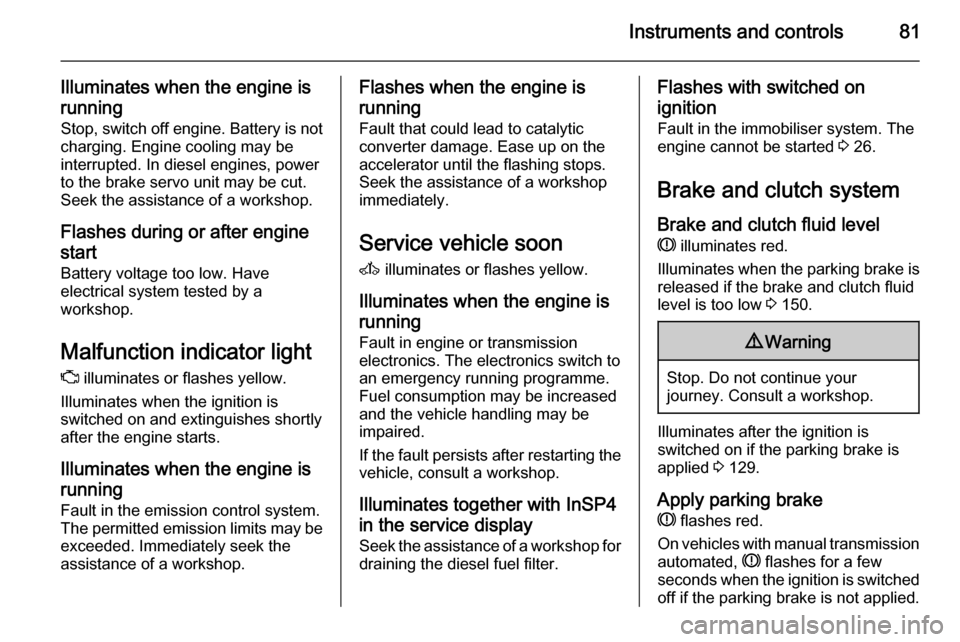
Illuminates when the engine is
running Stop, switch off engine. Battery is not
charging. Engine cooling may be
interrupted. In diesel engines, power
to the brake servo unit may be cut.
Seek the assistance of a workshop.
Flashes during or after engine start Battery voltage too low. Have
electrical system tested by a
workshop.
Malfunction indicator light
Z illuminates or flashes yellow.
Illuminates when the ignition is
switched on and extinguishes shortly
after the engine starts.
Illuminates when the engine isrunning
Fault in the emission control system. The permitted emission limits may be
exceeded. Immediately seek the
assistance of a workshop.Flashes when the engine is
running
Fault that could lead to catalytic
converter damage. Ease up on the
accelerator until the flashing stops.
Seek the assistance of a workshop
immediately.
Service vehicle soon A illuminates or flashes yellow.
Illuminates when the engine is
running
Fault in engine or transmission
electronics. The electronics switch to
an emergency running programme.
Fuel consumption may be increased
and the vehicle handling may be
impaired.
If the fault persists after restarting the vehicle, consult a workshop.
Illuminates together with InSP4
in the service display
Seek the assistance of a workshop for
draining the diesel fuel filter.Flashes with switched on
ignition
Fault in the immobiliser system. The
engine cannot be started 3 26.
Brake and clutch system
Brake and clutch fluid level R illuminates red.
Illuminates when the parking brake is
released if the brake and clutch fluid
level is too low 3 150.9 Warning
Stop. Do not continue your
journey. Consult a workshop.
Illuminates after the ignition is
switched on if the parking brake is
applied 3 129.
Apply parking brake
R flashes red.
On vehicles with manual transmission
automated, R flashes for a few
seconds when the ignition is switched
off if the parking brake is not applied.
Page 84 of 231
82Instruments and controls
On vehicles with manual transmission
automated, R flashes when the
driver's door is opened if no gear is engaged and the parking brake is not
applied.
Apply clutch pedal
- illuminates yellow.
Clutch pedal needs to be operated to start the engine.
Stop-start system 3 116.
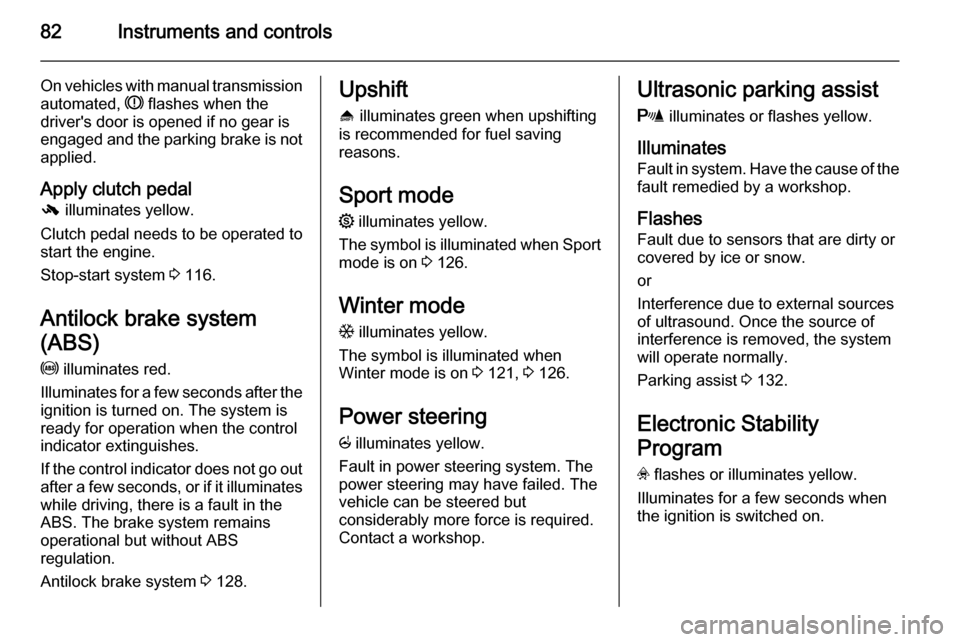
Antilock brake system
(ABS) u illuminates red.
Illuminates for a few seconds after the ignition is turned on. The system is
ready for operation when the control indicator extinguishes.
If the control indicator does not go out after a few seconds, or if it illuminates while driving, there is a fault in the
ABS. The brake system remains
operational but without ABS
regulation.
Antilock brake system 3 128.Upshift
[ illuminates green when upshifting
is recommended for fuel saving
reasons.
Sport mode
1 illuminates yellow.
The symbol is illuminated when Sport mode is on 3 126.
Winter mode T illuminates yellow.
The symbol is illuminated when
Winter mode is on 3 121, 3 126.
Power steering
p illuminates yellow.
Fault in power steering system. The
power steering may have failed. The
vehicle can be steered but
considerably more force is required.
Contact a workshop.Ultrasonic parking assist
r illuminates or flashes yellow.
Illuminates
Fault in system. Have the cause of the fault remedied by a workshop.
Flashes Fault due to sensors that are dirty orcovered by ice or snow.
or
Interference due to external sources
of ultrasound. Once the source of interference is removed, the system
will operate normally.
Parking assist 3 132.
Electronic Stability
Program
v flashes or illuminates yellow.
Illuminates for a few seconds when
the ignition is switched on.
Page 130 of 231
128Driving and operating
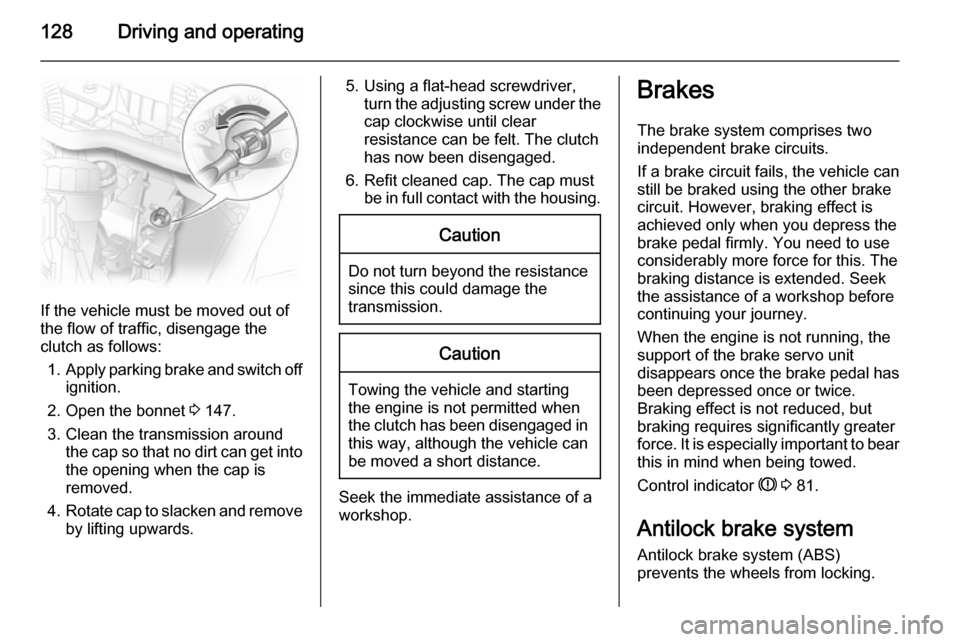
If the vehicle must be moved out of
the flow of traffic, disengage the
clutch as follows:
1. Apply parking brake and switch off
ignition.
2. Open the bonnet 3 147.
3. Clean the transmission around the cap so that no dirt can get into
the opening when the cap is
removed.
4. Rotate cap to slacken and remove
by lifting upwards.
5. Using a flat-head screwdriver,
turn the adjusting screw under the
cap clockwise until clear
resistance can be felt. The clutch
has now been disengaged.
6. Refit cleaned cap. The cap must be in full contact with the housing.Caution
Do not turn beyond the resistancesince this could damage the
transmission.
Caution
Towing the vehicle and starting
the engine is not permitted when
the clutch has been disengaged in this way, although the vehicle can
be moved a short distance.
Seek the immediate assistance of a
workshop.
Brakes
The brake system comprises two
independent brake circuits.
If a brake circuit fails, the vehicle can
still be braked using the other brake
circuit. However, braking effect is
achieved only when you depress the
brake pedal firmly. You need to use
considerably more force for this. The
braking distance is extended. Seek
the assistance of a workshop before continuing your journey.
When the engine is not running, the
support of the brake servo unit
disappears once the brake pedal has
been depressed once or twice.
Braking effect is not reduced, but
braking requires significantly greater
force. It is especially important to bear this in mind when being towed.
Control indicator R 3 81.
Antilock brake system Antilock brake system (ABS)
prevents the wheels from locking.
Page 134 of 231

132Driving and operating
ActivationTurn switch m up and release: the
current speed is stored and
maintained.
Vehicle speed can be increased by depressing the accelerator pedal.
When the accelerator pedal is
released, the previously stored speed
is resumed.
The speed is saved until the ignition
is switched off.
To resume the saved speed, turn
switch g downwards at a speed
above 20 mph.
Increase speed With cruise control active, turn switchm upwards and hold, or turn briefly
several times: speed is increased
continuously or in small increments.
When switch m is released the
current speed is stored and
maintained.Reduce speed
With cruise control active, turn switch g downwards and hold, or turn briefly
several times: speed is reduced
continuously or in small increments.
When switch g is released the current
speed is stored and maintained.
Deactivation
Briefly press the § button: cruise
control is deactivated.
Automatic deactivation:
■ Vehicle speed below approx. 20 mph
■ The brake pedal is depressed
■ The clutch pedal is depressed
■ Selector lever in N.
To reset the saved speed, turn switch g downwards.Parking assist
The parking assist makes parking
easier by measuring the distance between the vehicle and obstacles,
and giving acoustic signals. It is the
driver, however, who bears full
responsibility for the parking
manoeuvre.
The system consists of four ultrasonic parking sensors in the rear bumper.
Control indicator r 3 82.
Activation
When reverse gear is engaged, the
system is activated automatically.
Page 135 of 231

Driving and operating133
IndicationAn obstacle is indicated by a buzzing
sound. The interval between the sounds becomes shorter as the
vehicle gets closer to the obstacle.
When the distance is less than
30 cm, the buzzing is continuous.
Deactivation
The system automatically switches itself off when reverse gear is
disengaged.
If the vehicle is equipped with the
r button, the system can be
deactivated by pressing the button.
Fault
In the event of a fault in the system,
r illuminates.
Additionally, r flashes if a
malfunction of the system due to
temporary conditions like snow
covered sensors is detected.
Control indicator r 3 82.
Important hints for using the
parking assist systems9 Warning
Under certain circumstances,
various reflective surfaces on
objects or clothing as well as
external noise sources may cause the system to fail to detect
obstacles.
Special attention must be paid to
low obstacles which can damage
the lower part of the bumper.
Caution
Performance of the sensors can
be reduced when sensors are
covered, e.g. by ice or snow.
Performance of the parking assist
systems can be reduced due to
heavy loading.
Special conditions apply if there
are taller vehicles involved (e.g.
off-road vehicles, mini vans,
vans). Object identification in the
upper part of these vehicles
cannot be guaranteed.
Objects with a very small reflection
cross-section, e.g. objects of
narrow size or soft materials, may
not be detected by the system.
Parking assist will not avoid a
collision with objects which are out
of the detection range of the
sensors.
Page 136 of 231

134Driving and operating
Notice
The parking assist system
automatically detects factory-fitted
towing equipment. It is deactivated
when the connector is plugged in.
The sensor may detect a non-
existent object (echo disturbance)
caused by external acoustic or
mechanical disturbances.
Notice
If engaging a forward gear and
exceeding a certain speed, the rear
parking assist will be deactivated
when the rear carrier system is
extended.
If engaging reverse at first, the
parking assist will detect the rear
carrier system and provide a buzzing
sound. Press r briefly to
deactivate the parking assist.Fuel
Fuel for petrol engines Only use unleaded fuel that complies
with European standard EN 228 or
E DIN 51626-1 or equivalent.
Your engine is capable of running
with E10 fuel that fulfills these
standards. E10 fuel contains up to
10 % bioethanol.
Use fuel with the recommended
octane rating 3 202. Use of fuel with
too low an octane rating can reduce
engine power and torque and slightly increases fuel consumption.Caution
Do not use fuel or fuel additives
that contain metallic compounds
such as manganese-based
additives. This may cause engine
damage.
Caution
Use of fuel that does not comply to EN 228 or E DIN 51626-1 or
equivalent can lead to deposits or
engine damage and may affect
your warranty.
Caution
Use of fuel with too low an octane
rating could lead to uncontrolled combustion and engine damage.
Fuel for diesel engines
Only use diesel fuel that complies
with EN 590.
In countries outside the European
Union use Euro-Diesel fuel with a
sulfur concentration below 50 ppm.
Page 138 of 231

136Driving and operating
Fill the tank completely at regular
intervals to prevent corrosion in the
tank.
Faults and remedies
If gas mode is not possible, check the following:
■ Is there enough liquid gas present?
■ Is there enough petrol present for starting?
Due to extreme temperatures in
combination with the gas
composition, it may take slightly
longer before the system switches
from petrol to liquid gas mode.
In extreme situations, the system may
also switch back to petrol mode if the
minimum requirements are not
fulfilled.
Seek the assistance of a workshop in the event of all other faults.Caution
Repairs and adjustments may onlybe made by trained specialists in
order to maintain the safety and
warranty on the LPG system.
Liquid gas is given a particular odour
(odorised) so that any leaks can be
detected easily.
9 Warning
If you smell gas in the vehicle or in
the immediate vicinity, switch to petrol mode immediately. No
smoking. No naked flames or
ignition sources.
If possible, close the manual shut-off
valve on the multivalve. The
multivalve is located on the liquid gas
tank in the load compartment,
underneath the rear floor cover.
Turn the thumb wheel clockwise.
If no further gas odour is perceptible
when the manual shut-off valve is
closed, the vehicle can be used in
petrol mode. If the gas odour persists, do not start the engine. Have the
cause of the fault remedied by a
workshop.
When using underground car parks,
follow the instructions of the operator
and local laws.
Notice
In the event of an accident, switch off
the ignition and lights. Close the
manual shut-off valve on multivalve.
Page 154 of 231

152Vehicle care
Meaning of symbols:■ No sparks, naked flames or smoking.
■ Always shield eyes. Explosive gases can cause blindness or
injury.
■ Keep the vehicle battery out of reach of children.
■ The vehicle battery contains sulphuric acid which could cause
blindness or serious burn injuries.
■ See the Owner's Manual for further
information.
■ Explosive gas may be present in the vicinity of the vehicle battery.Diesel fuel system
bleeding
If the tank has been run dry, the diesel fuel system must be bled. Switch on
the ignition three times for
15 seconds at a time. Then crank the
engine for a maximum of
40 seconds (for technical reasons
only 30 seconds are possible with
engine A 17 DTS). Repeat this
process after no less than 5 seconds .
If the engine fails to start, seek the
assistance of a workshop.Wiper blade replacement
Service setting for front windscreen wipers
Switch off the ignition but do not
remove ignition key or open driver's
door.
Within 4 seconds, push the wiper
lever down and release as soon as
the wipers are vertical.
Page 171 of 231
Vehicle care169
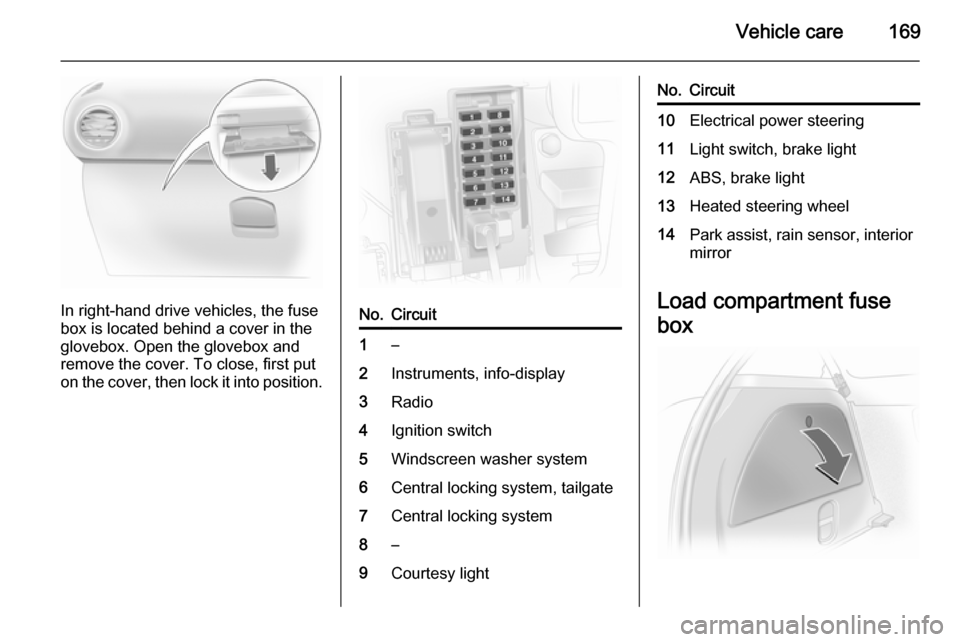
In right-hand drive vehicles, the fuse
box is located behind a cover in the
glovebox. Open the glovebox and
remove the cover. To close, first put
on the cover, then lock it into position.
No.Circuit1–2Instruments, info-display3Radio4Ignition switch5Windscreen washer system6Central locking system, tailgate7Central locking system8–9Courtesy lightNo.Circuit10Electrical power steering11Light switch, brake light12ABS, brake light13Heated steering wheel14Park assist, rain sensor, interior mirror
Load compartment fuse
box