belt VAUXHALL CORSA 2015.75 User Guide
[x] Cancel search | Manufacturer: VAUXHALL, Model Year: 2015.75, Model line: CORSA, Model: VAUXHALL CORSA 2015.75Pages: 261, PDF Size: 7.61 MB
Page 44 of 261
42Seats, restraints
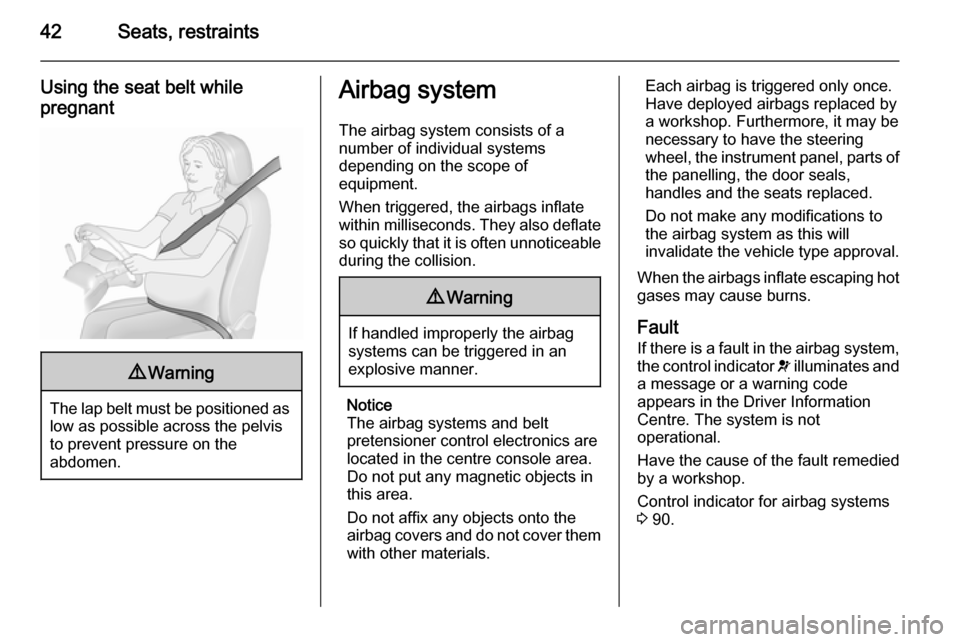
Using the seat belt whilepregnant9 Warning
The lap belt must be positioned as
low as possible across the pelvis
to prevent pressure on the
abdomen.
Airbag system
The airbag system consists of a
number of individual systems
depending on the scope of
equipment.
When triggered, the airbags inflate
within milliseconds. They also deflate
so quickly that it is often unnoticeable
during the collision.9 Warning
If handled improperly the airbag
systems can be triggered in an
explosive manner.
Notice
The airbag systems and belt
pretensioner control electronics are
located in the centre console area.
Do not put any magnetic objects in
this area.
Do not affix any objects onto the
airbag covers and do not cover them with other materials.
Each airbag is triggered only once.
Have deployed airbags replaced by
a workshop. Furthermore, it may be
necessary to have the steering
wheel, the instrument panel, parts of
the panelling, the door seals,
handles and the seats replaced.
Do not make any modifications to
the airbag system as this will
invalidate the vehicle type approval.
When the airbags inflate escaping hot gases may cause burns.
Fault If there is a fault in the airbag system,
the control indicator v illuminates and
a message or a warning code
appears in the Driver Information
Centre. The system is not
operational.
Have the cause of the fault remedied by a workshop.
Control indicator for airbag systems
3 90.
Page 48 of 261
46Seats, restraints
The inflated airbags cushion the
impact, thereby reducing the risk of
injury to the upper body and head of
the front seat occupants
considerably.9 Warning
Optimum protection is only
provided when the seat is in the
proper position.
Seat position 3 35.
Keep the area in which the airbag
inflates clear of obstructions.
Fit the seat belt correctly and
engage securely. Only then is the
airbag able to protect.
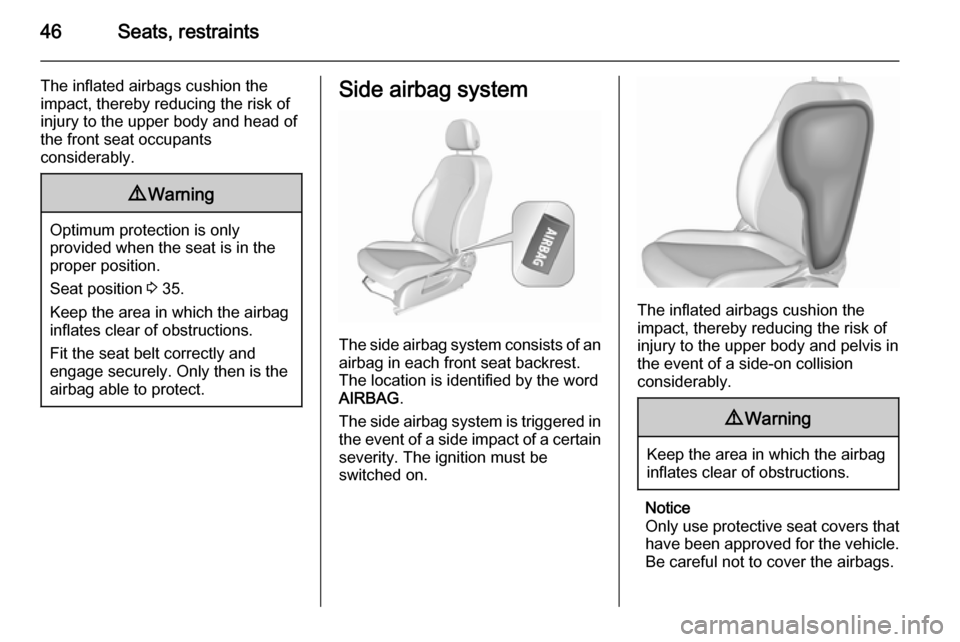
Side airbag system
The side airbag system consists of an
airbag in each front seat backrest.
The location is identified by the word
AIRBAG .
The side airbag system is triggered in the event of a side impact of a certain
severity. The ignition must be
switched on.
The inflated airbags cushion the
impact, thereby reducing the risk of
injury to the upper body and pelvis in
the event of a side-on collision
considerably.
9 Warning
Keep the area in which the airbag
inflates clear of obstructions.
Notice
Only use protective seat covers that
have been approved for the vehicle.Be careful not to cover the airbags.
Page 49 of 261
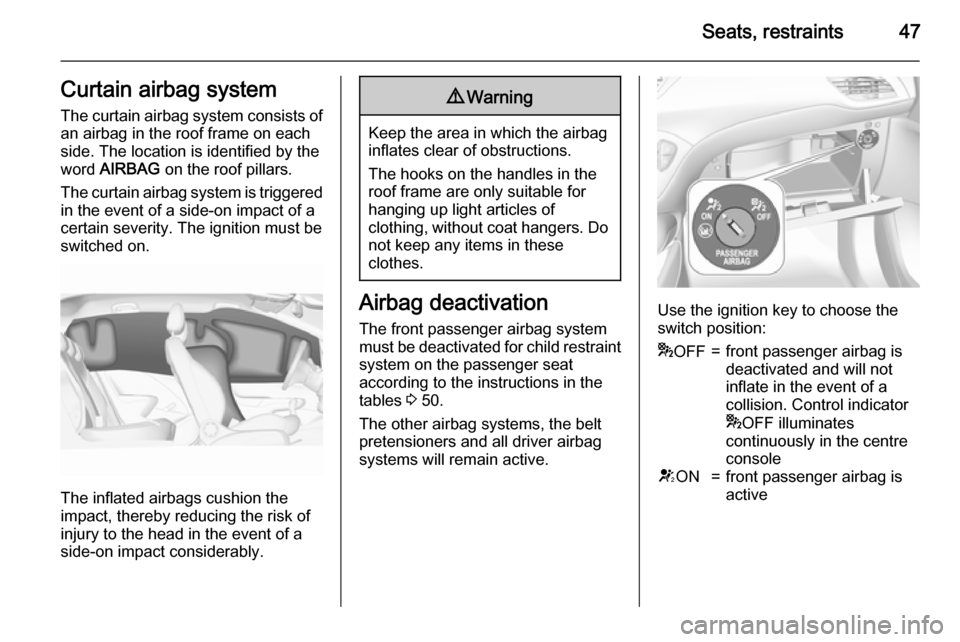
Seats, restraints47Curtain airbag system
The curtain airbag system consists of an airbag in the roof frame on each
side. The location is identified by the
word AIRBAG on the roof pillars.
The curtain airbag system is triggered in the event of a side-on impact of a
certain severity. The ignition must be
switched on.
The inflated airbags cushion the
impact, thereby reducing the risk of
injury to the head in the event of a
side-on impact considerably.
9 Warning
Keep the area in which the airbag
inflates clear of obstructions.
The hooks on the handles in the
roof frame are only suitable for
hanging up light articles of
clothing, without coat hangers. Do not keep any items in these
clothes.
Airbag deactivation
The front passenger airbag system
must be deactivated for child restraint system on the passenger seat
according to the instructions in the
tables 3 50.
The other airbag systems, the belt
pretensioners and all driver airbag
systems will remain active.Use the ignition key to choose the
switch position:
* OFF=front passenger airbag is
deactivated and will not
inflate in the event of a
collision. Control indicator
* OFF illuminates
continuously in the centre consoleV ON=front passenger airbag is
active
Page 51 of 261
Seats, restraints499Danger
If using a rear-facing child restraint
system on the front passenger
seat, the airbag system for the
front passenger seat must be
deactivated. This also applies to certain forward-facing child
restraint systems as indicated in
the tables 3 50.
Airbag deactivation 3 47.
Airbag label 3 42.
The rear seats are the most
convenient location to fasten a child restraint system.
Children should travel facing
rearwards in the vehicle as long as
possible. This ensures that the child's backbone, which is still very weak, is
under less strain in the event of an
accident.
Selecting the right system
Only use suitable restraint systems,
e.g. those that comply with valid
UN ECE regulations.
Ensure that the child restraint system to be installed is compatible with the
vehicle type. Refer to the tables on
the following pages, the instructions
supplied with the child restraint
system and the vehicle type list of
non-universal child restraint systems.
Ensure that the mounting location of
the child restraint system within the
vehicle is correct, see following
tables.
Allow children to enter and exit the
vehicle only on the side facing away
from the traffic.
When the child restraint system is not in use, secure the seat with a seat belt
or remove it from the vehicle.
Child restraint systems could be
fastened with ISOFIX mounting
brackets, Top-tether if available,
and/or a three-point seat belt. Refer
to the following tables.
Notice
Do not affix anything on the child
restraint systems and do not cover
them with any other materials.A child restraint system which has
been subjected to stress in an
accident must be replaced.
Page 52 of 261

50Seats, restraintsChild restraint installation locationsPermissible options for fastening a child restraint system with a three-point seat belt
Weight and age class
On front passenger seat
On rear outboard seatsOn rear centre seat
activated airbagdeactivated airbagGroup 0: up to 10 kg
or approx. 10 monthsXU 1,2U/L 3XGroup 0+: up to 13 kg
or approx. 2 yearsXU 1,2U/L 3XGroup I: 9 to 18 kg
or approx. 8 months to 4 yearsXU 1,2U/L 3,4XGroup II: 15 to 25 kg
or approx. 3 to 7 yearsU 1,2XU/L 3,4XGroup III: 22 to 36 kg
or approx. 6 to 12 yearsU 1,2XU/L 3,4XU=universal suitability in conjunction with three-point seat beltL=suitable for particular child restraint systems of the 'specific-vehicle', 'restricted' or 'semi-universal' categories. The child
restraint system must be approved for the specific vehicle type (refer to the vehicle type list of the child restraint system)X=no child restraint system permitted in this weight class1=move seat forwards as far as necessary and adjust seat backrest inclination as far as necessary to a vertical positionto ensure that the belt runs forwards from the upper anchorage point
Page 53 of 261

Seats, restraints51
2=move seat height adjustment upwards as far as necessary and adjust seat backrest inclination as far as necessary toa vertical position to ensure that the belt is tight on the buckle side3=move the respective front seat ahead of the child restraint system forwards as far as necessary4=adjust the respective backrest to the rearmost position 3 67, adjust the respective headrest as necessary or remove
if required 3 34
Permissible options for fitting an ISOFIX child restraint system
Weight classSize classFixture
On front passenger seat 5On rear outboard
seatsOn rear
centre seatactivated airbagdeactivated airbagGroup 0: up to 10 kg
or approx. 10 monthsEISO/R1XILIL 3XGroup 0+: up to 13 kg
or approx. 2 yearsEISO/R1XILIL 3XDISO/R2XILIL3XCISO/R3XILIL3XGroup I: 9 to 18 kg
or approx. 8 months to 4 yearsDISO/R2XILIL 3,4XCISO/R3XILIL 3,4XBISO/F2XIL/IUFIL, IUF 3,4XB1ISO/F2XXIL/IUFIL, IUF3,4XAISO/F3XIL/IUFIL, IUF 3,4X
Page 54 of 261

52Seats, restraints
Weight classSize classFixture
On front passenger seat5
On rear outboard
seatsOn rear
centre seatactivated airbagdeactivated airbagGroup II: 15 to 25 kg
or approx. 3 to 7 yearsIL 1,2XIL3,4XGroup III: 22 to 36 kg
or approx. 6 to 12 yearsIL 1,2XIL 3,4XIL=suitable for particular ISOFIX restraint systems of the "specific-vehicle", "restricted" or "semi-universal" categories.
(ISOFIX/Top-tether fastening points optional for the front passenger seat but not available for sport seats). The ISOFIX restraint system must be approved for the specific vehicle type (refer to the vehicle type list of the child
restraint system)IUF=suitable for ISOFIX forward-facing child restraint systems of universal category approved for use in this weight class
(ISOFIX/Top-tether fastening points optional for the front passenger seat (not available for sport seats)X=no ISOFIX child restraint system approved in this weight class1=move seat forwards as far as necessary and adjust seat backrest inclination as far as necessary to a vertical position to ensure that the belt runs forwards from the upper anchorage point2=move seat height adjustment upwards as far as necessary and adjust seat backrest inclination as far as necessary
to a vertical position to ensure that the belt is tight on the buckle side3=move the respective front seat ahead of the child restraint system forwards as far as necessary4=adjust the respective backrest to the rearmost position 3 67 , adjust the respective headrest as necessary or remove
if required 3 345=ISOFIX/Top-tether fastening points optional for the front passenger seat (not available for sport seats)
Page 70 of 261
68Storage
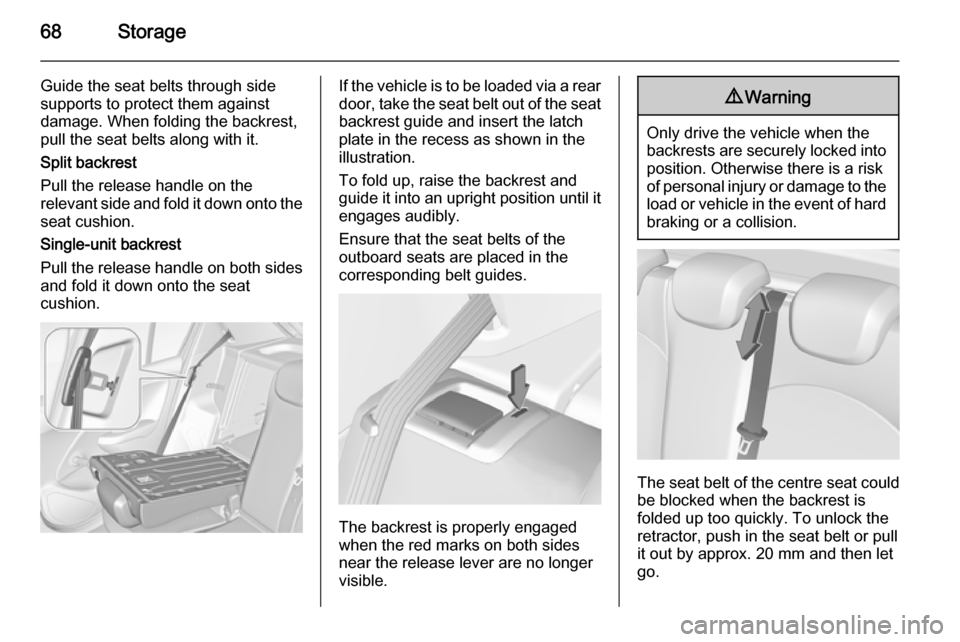
Guide the seat belts through side
supports to protect them against
damage. When folding the backrest,
pull the seat belts along with it.
Split backrest
Pull the release handle on the
relevant side and fold it down onto the seat cushion.
Single-unit backrest
Pull the release handle on both sides
and fold it down onto the seat
cushion.If the vehicle is to be loaded via a rear
door, take the seat belt out of the seat
backrest guide and insert the latch
plate in the recess as shown in the
illustration.
To fold up, raise the backrest and
guide it into an upright position until it engages audibly.
Ensure that the seat belts of the
outboard seats are placed in the corresponding belt guides.
The backrest is properly engaged
when the red marks on both sides
near the release lever are no longer
visible.
9 Warning
Only drive the vehicle when the
backrests are securely locked into position. Otherwise there is a risk
of personal injury or damage to the
load or vehicle in the event of hard braking or a collision.
The seat belt of the centre seat could
be blocked when the backrest is
folded up too quickly. To unlock the
retractor, push in the seat belt or pull
it out by approx. 20 mm and then let
go.
Page 91 of 261
Instruments and controls89
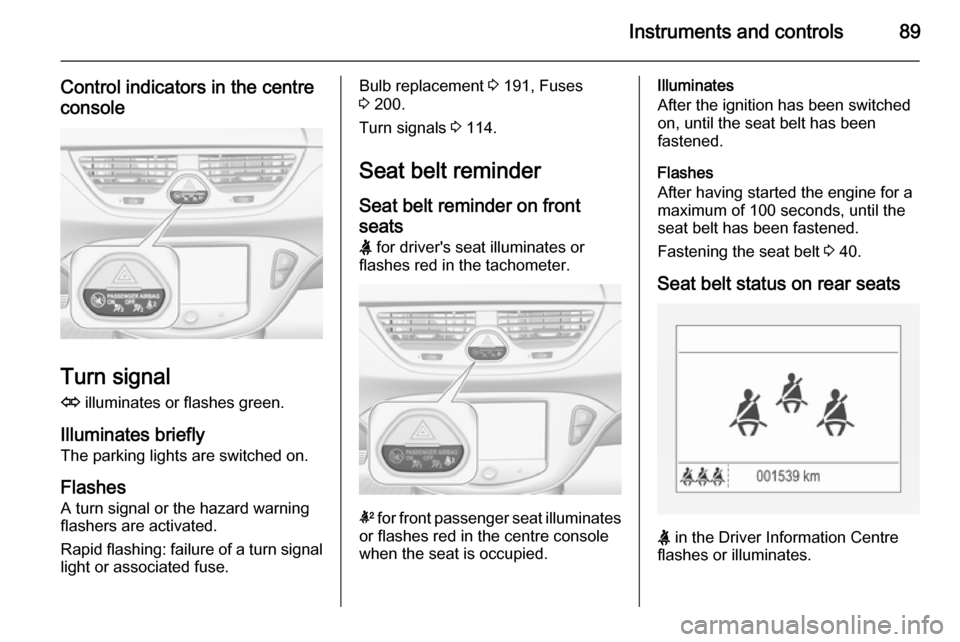
Control indicators in the centre
console
Turn signal
O illuminates or flashes green.
Illuminates briefly The parking lights are switched on.
Flashes A turn signal or the hazard warning
flashers are activated.
Rapid flashing: failure of a turn signal
light or associated fuse.
Bulb replacement 3 191, Fuses
3 200.
Turn signals 3 114.
Seat belt reminder Seat belt reminder on front
seats X for driver's seat illuminates or
flashes red in the tachometer.
k for front passenger seat illuminates
or flashes red in the centre console
when the seat is occupied.
Illuminates
After the ignition has been switched on, until the seat belt has been
fastened.
Flashes
After having started the engine for a
maximum of 100 seconds, until the
seat belt has been fastened.
Fastening the seat belt 3 40.
Seat belt status on rear seats
X in the Driver Information Centre
flashes or illuminates.
Page 92 of 261
90Instruments and controls
Illuminates
After having started the engine for a minimum of 35 seconds, until the seat
belt has been fastened.
If an unfastened seat belt is fastened
whilst driving.
Flashes
After starting-off, when the seat belt is
unfastened.
Fastening the seat belt 3 40.
Airbag and belt tensioners v illuminates red.
When the ignition is switched on, the control indicator illuminates for
approx. four seconds. If it does not
illuminate, does not go out after
four seconds or illuminates whilst driving, there is a fault in the airbag
system. Seek the assistance of a
workshop. The airbags and belt
pretensioners may fail to trigger in the
event of an accident.
Deployment of the belt pretensioners
or airbags is indicated by continuous
illumination of v.9
Warning
Have the cause of the fault
remedied immediately by a
workshop.
Belt pretensioners, airbag system
3 39, 3 42.
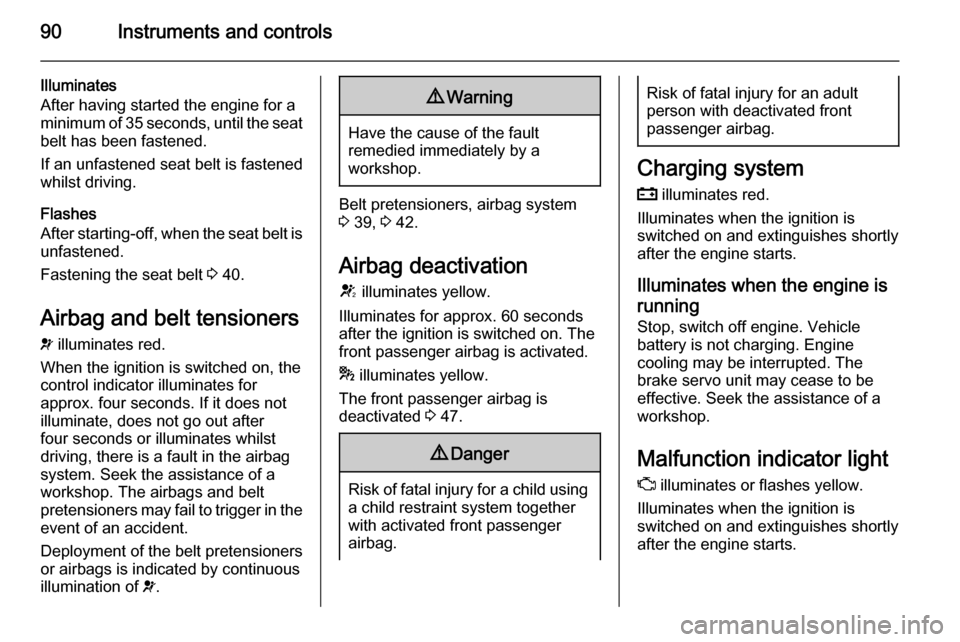
Airbag deactivation
V illuminates yellow.
Illuminates for approx. 60 seconds
after the ignition is switched on. The
front passenger airbag is activated.
* illuminates yellow.
The front passenger airbag is
deactivated 3 47.
9 Danger
Risk of fatal injury for a child using
a child restraint system together
with activated front passenger
airbag.
Risk of fatal injury for an adult
person with deactivated front
passenger airbag.
Charging system
p illuminates red.
Illuminates when the ignition is
switched on and extinguishes shortly
after the engine starts.
Illuminates when the engine is
running
Stop, switch off engine. Vehicle
battery is not charging. Engine
cooling may be interrupted. The
brake servo unit may cease to be
effective. Seek the assistance of a
workshop.
Malfunction indicator light
Z illuminates or flashes yellow.
Illuminates when the ignition is
switched on and extinguishes shortly
after the engine starts.