transmission VAUXHALL CORSA 2015 Owner's Manual
[x] Cancel search | Manufacturer: VAUXHALL, Model Year: 2015, Model line: CORSA, Model: VAUXHALL CORSA 2015Pages: 249, PDF Size: 7.32 MB
Page 13 of 249

In brief11
1Power windows .....................30
2 Exterior mirrors .....................28
3 Cruise control .....................147
Speed limiter ...................... 149
Forward collision alert ........150
4 Turn and lane-change
signals, headlight flash,
low beam and high beam ....112
Exit lighting ......................... 116
Parking lights ...................... 113
Buttons for Driver
Information Centre ................93
5 Instruments .......................... 82
6 Forward collision alert
indicator ............................. 150
7 Driver Information Centre ...... 93
8 Infotainment controls ...........74
9 Windscreen wiper,
windscreen washer
system, rear wiper, rear
washer system ......................76
10 Central locking system ..........22
City mode ............................ 146Eco button for stop-start
system ................................. 131
Parking assist ..................... 153
Seat heating .......................... 38
Heated steering wheel ..........75
11 Anti-theft alarm system
status LED ........................... 26
12 Hazard warning flashers ....112
Control indicator for airbag
deactivation .......................... 88
Control indicator for front
passenger seat belt .............87
13 Colour-Info-Display ..............98
Graphic-Info-Display .............99
14 Centre air vents .................. 126
15 Side air vents passenger
side ..................................... 126
16 Airbag deactivation switch
(behind glovebox lid) ............46
17 Glovebox .............................. 56
Fuse box ............................ 196
18 Climate control system ........ 118
19 Power outlet .......................... 8120AUX input, USB input ...........10
21 Selector lever,
transmission ....................... 139
22 Parking brake ......................144
23 Ignition switch with
steering wheel lock ............129
24 Horn ..................................... 75
Driver airbag ........................ 44
25 Bonnet release lever ..........178
26 Steering wheel adjustment ..74
27 Light switch ........................ 108
Headlight range
adjustment ......................... 110
Rear fog light ...................... 113
Fuse box ............................ 196
Brightness of instrument
panel illumination ................114
Page 18 of 249
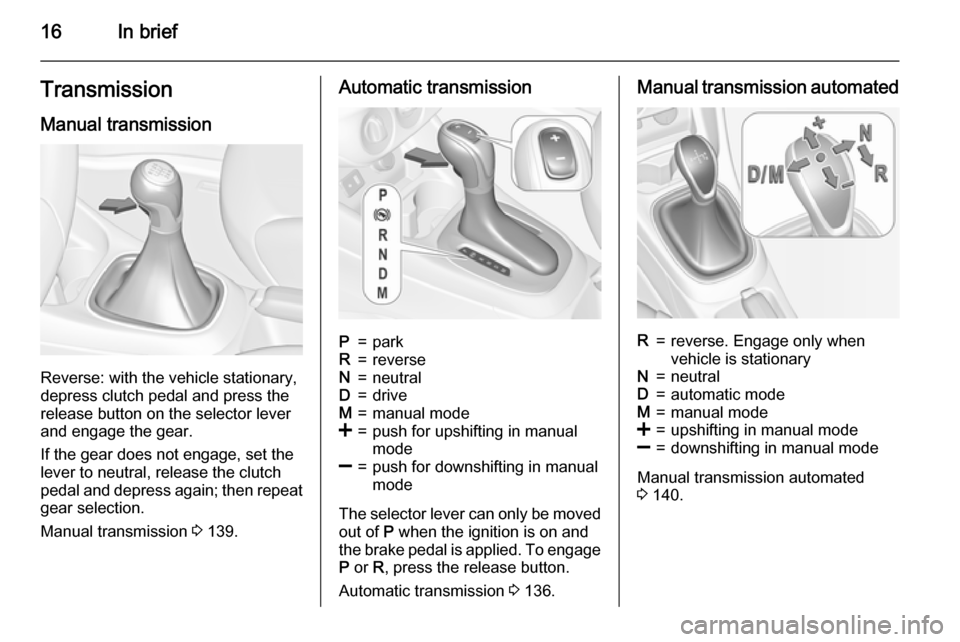
16In briefTransmission
Manual transmission
Reverse: with the vehicle stationary,
depress clutch pedal and press the release button on the selector lever
and engage the gear.
If the gear does not engage, set the
lever to neutral, release the clutch
pedal and depress again; then repeat
gear selection.
Manual transmission 3 139.
Automatic transmissionP=parkR=reverseN=neutralD=driveM=manual mode<=push for upshifting in manual
mode]=push for downshifting in manual
mode
The selector lever can only be moved
out of P when the ignition is on and
the brake pedal is applied. To engage
P or R, press the release button.
Automatic transmission 3 136.
Manual transmission automatedR=reverse. Engage only when
vehicle is stationaryN=neutralD=automatic modeM=manual mode<=upshifting in manual mode]=downshifting in manual mode
Manual transmission automated
3 140.
Page 19 of 249
In brief17Starting offCheck before starting off ■ Tyre pressure and condition 3 199,
3 237.
■ Engine oil level and fluid levels 3 178.
■ All windows, mirrors, exterior lighting and number plates are free
from dirt, snow and ice and are
operational.
■ Proper position of mirrors, seats, and seat belts 3 28, 3 35,
3 39.
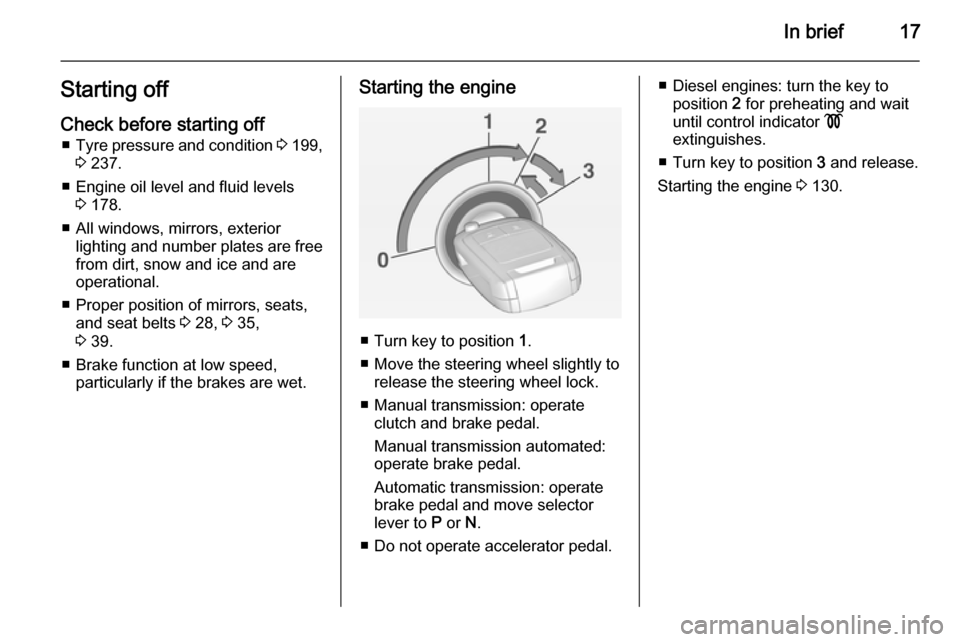
■ Brake function at low speed, particularly if the brakes are wet.Starting the engine
■ Turn key to position 1.
■ Move the steering wheel slightly to release the steering wheel lock.
■ Manual transmission: operate clutch and brake pedal.
Manual transmission automated:
operate brake pedal.
Automatic transmission: operate
brake pedal and move selector
lever to P or N.
■ Do not operate accelerator pedal.
■ Diesel engines: turn the key to position 2 for preheating and wait
until control indicator !
extinguishes.
■ Turn key to position 3 and release.
Starting the engine 3 130.
Page 20 of 249
18In brief
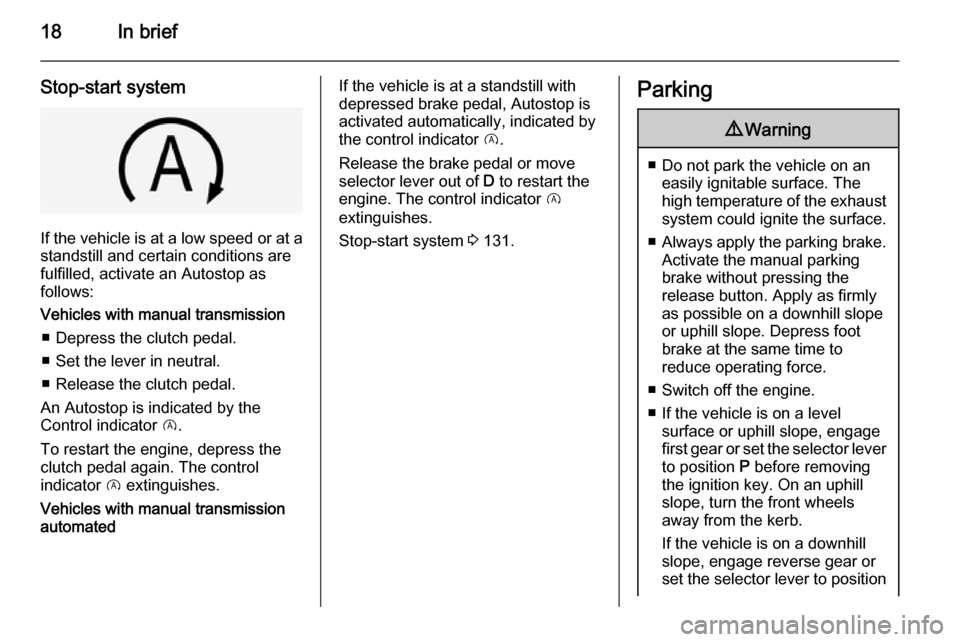
Stop-start system
If the vehicle is at a low speed or at astandstill and certain conditions are
fulfilled, activate an Autostop as
follows:
Vehicles with manual transmission ■ Depress the clutch pedal.
■ Set the lever in neutral.
■ Release the clutch pedal.
An Autostop is indicated by the
Control indicator D.
To restart the engine, depress the clutch pedal again. The control
indicator D extinguishes.
Vehicles with manual transmission
automated
If the vehicle is at a standstill with
depressed brake pedal, Autostop is
activated automatically, indicated by
the control indicator D.
Release the brake pedal or move
selector lever out of D to restart the
engine. The control indicator D
extinguishes.
Stop-start system 3 131.Parking9 Warning
■ Do not park the vehicle on an
easily ignitable surface. The
high temperature of the exhaust system could ignite the surface.
■ Always apply the parking brake.
Activate the manual parking
brake without pressing the
release button. Apply as firmly
as possible on a downhill slope
or uphill slope. Depress foot
brake at the same time to
reduce operating force.
■ Switch off the engine.
■ If the vehicle is on a level surface or uphill slope, engage
first gear or set the selector lever
to position P before removing
the ignition key. On an uphill
slope, turn the front wheels
away from the kerb.
If the vehicle is on a downhill
slope, engage reverse gear or
set the selector lever to position
Page 21 of 249

In brief19P before removing the ignition
key. Turn the front wheels
towards the kerb.
■ Close the windows and the sunroof.
■ Remove the ignition key. Turn the steering wheel until the
steering wheel lock is felt to
engage.
For vehicles with automatic
transmission, the key can only
be removed when the selector
lever is in position P.
For vehicles with manual
transmission automated, the
key can only be removed from
the ignition switch when the park brake is applied.
■ Lock the vehicle with button e on
the radio remote control.
Activate the anti-theft alarm system 3 26.
■ The engine cooling fans may run after the engine has been switched
off 3 177.
Caution
After running at high engine
speeds or with high engine loads,
operate the engine briefly at a low load or run in neutral for
approx. 30 seconds before
switching off, in order to protect
the turbocharger.
Keys, locks 3 20, Laying-up the
vehicle for a long period of time
3 176.
Page 26 of 249

24Keys, doors and windows
Locking
Manually lock the driver's door by
turning the key in the lock.
Fault in central locking systemUnlocking
Manually unlock the driver's door by
turning the key in the lock. The other
doors can be opened by pulling the
interior handle twice. The load
compartment and fuel filler flap
cannot be opened.
To deactivate the anti-theft locking
system, switch on the ignition 3 26.
Locking
Press inside locking knob of all doors
except driver's door. Then close the
driver's door and lock it from the
outside with the key. The fuel filler flap
and tailgate cannot be locked.Automatic locking
This security feature can be
configured to automatically lock
doors, load compartment and fuel
filler flap as soon as a certain speed
is exceeded.
Additionally it is configurable to
unlock the driver's door or all doors
after the ignition is switched off and
the ignition key is removed (manual
transmission) or the selector lever is
moved to position P (automatic
transmission).
Settings can be changed in the
Info-Display.
Vehicle personalisation 3 103.
The settings can be saved for the key being used 3 22.
Child locks9 Warning
Use the child locks whenever
children are occupying the rear
seats.
Using a key or suitable screwdriver,
turn button on rear door lock to the
horizontal position. The door cannot
be opened from inside.
Page 103 of 249

Instruments and controls101
No.Vehicle message9Turn steering wheel, start
engine again12Vehicle overloaded13Compressor overheated15Centre high-mounted brake
light failure16Brake light failure17Headlight levelling malfunction18Left low beam failure19Rear fog light failure20Right low beam failure21Left sidelight failure22Right sidelight failure23Reversing light failure24Number plate light failure25Left front turn signal failure26Left rear turn signal failureNo.Vehicle message27Right front turn signal failure28Right rear turn signal failure29Check trailer brake light30Check trailer reversing light31Check left trailer turn signal32Check right trailer turn signal33Check trailer rear fog light34Check trailer rear light35Replace battery in radio remote
control48Clean side blind spot alert
system49Lane departure warning
unavailable53Tighten gas cap54Water in diesel fuel filter55Diesel particle filter is full
3 134No.Vehicle message56Tyre pressure imbalance on
front axle57Tyre pressure imbalance on
rear axle58Tyres without TPMS sensors
detected59Open and then close driver
window60Open and then close front
passenger window65Theft attempted66Service theft alarm system67Service steering wheel lock68Service power steering75Service air conditioning76Service side blind spot alert
system79Top up engine oil81Service transmission
Page 104 of 249

102Instruments and controls
No.Vehicle message82Change engine oil soon84Engine power reduced89Service vehicle soon94Shift to park before exiting95Service airbag128Bonnet open134Park assist fault, clean bumper136Service parking assist145Check washer fluid level174Low vehicle battery258Park assist off
Vehicle messages on Uplevel-
Display The vehicle messages are displayedas text. Follow the instructions given
in the messages.
The system displays messages
regarding the following topics:
■ service messages
■ fluid levels
■ anti-theft alarm system
■ brakes
■ ride control systems
■ cruise control, speed limiter
■ forward collision alert
■ parking assist systems
■ lighting, bulb replacement
■ wiper/washer system
■ doors, windows
■ side blind spot alert
■ traffic sign assistant
■ lane departure warning
■ radio remote control
■ seat belts
■ airbag systems
■ engine and transmission
■ tyre pressure
■ diesel particle filter
■ vehicle battery statusVehicle messages on
Colour-Info-Display
Some important messages appear
additionally in the
Colour-Info-Display. Some
messages only pop-up for a few
seconds.
Warning chimes
When starting the engine or
whilst driving Only one warning chime will sound at
a time.
The warning chime regarding
unfastened seat belts has priority
over any other warning chime.
■ If seat belt is not fastened.
■ If a door or the tailgate is not fully closed when starting off.
■ If a certain speed is exceeded with parking brake applied.
■ If a programmed speed is exceeded.
Page 130 of 249

128Driving and operatingDriving and operatingDriving hints............................... 128
Starting and operating ...............129
Engine exhaust .......................... 134
Automatic transmission .............. 136
Manual transmission ..................139
Manual transmission automa‐
ted .............................................. 140
Brakes ........................................ 143
Ride control systems .................145
Driver assistance systems .........147
Fuel ............................................ 168
Trailer hitch ................................ 171Driving hints
Control of the vehicleNever coast with engine not
running
Many systems will not function in this
situation ( e.g. brake servo unit, power
steering). Driving in this manner is a
danger to yourself and others.
All systems function during an
Autostop.
Stop-start system 3 131.
Idle boost
If charging of the vehicle battery is
required due to battery condition, the
power output of the generator must be increased. This will be achieved by
an idle boost which may be audible.
A message appears in the Driver
Information Centre.
Pedals To ensure the pedal travel is
uninhibited, there must be no mats in
the area of the pedals.Driving downhill
Engage a gear when driving downhill to ensure that sufficient brake
pressure is available.
Page 132 of 249
130Driving and operatingStarting the engine
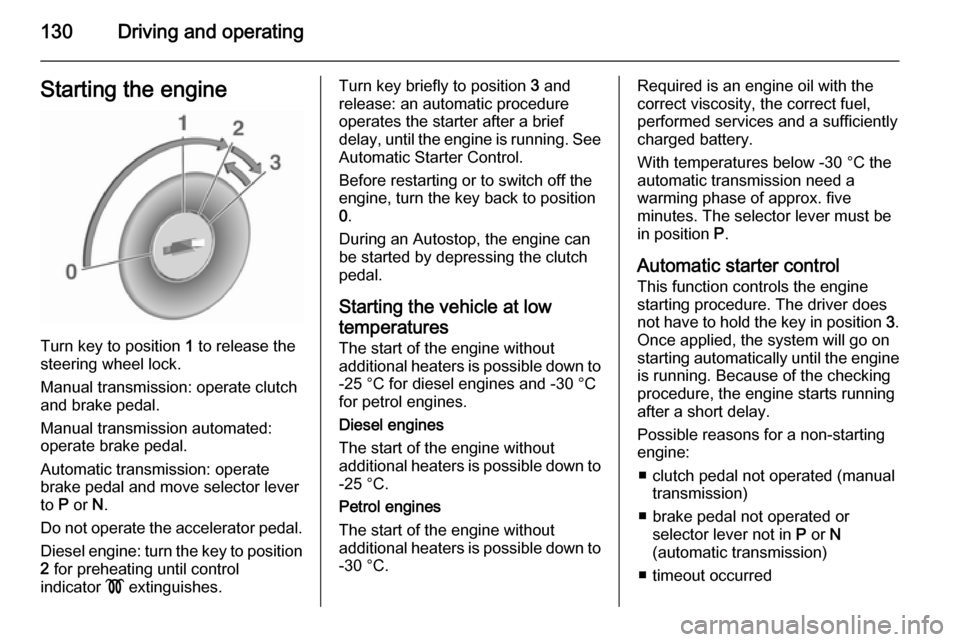
Turn key to position 1 to release the
steering wheel lock.
Manual transmission: operate clutch
and brake pedal.
Manual transmission automated:
operate brake pedal.
Automatic transmission: operate
brake pedal and move selector lever
to P or N.
Do not operate the accelerator pedal. Diesel engine: turn the key to position2 for preheating until control
indicator ! extinguishes.
Turn key briefly to position 3 and
release: an automatic procedure operates the starter after a brief
delay, until the engine is running. See
Automatic Starter Control.
Before restarting or to switch off the
engine, turn the key back to position
0 .
During an Autostop, the engine can
be started by depressing the clutch
pedal.
Starting the vehicle at low
temperatures
The start of the engine without
additional heaters is possible down to -25 °С for diesel engines and -30 °C
for petrol engines.
Diesel engines
The start of the engine without
additional heaters is possible down to -25 °С.
Petrol engines
The start of the engine without
additional heaters is possible down to
-30 °C.Required is an engine oil with the
correct viscosity, the correct fuel,
performed services and a sufficiently
charged battery.
With temperatures below -30 °C the
automatic transmission need a
warming phase of approx. five
minutes. The selector lever must be
in position P.
Automatic starter control This function controls the engine
starting procedure. The driver does
not have to hold the key in position 3.
Once applied, the system will go on starting automatically until the engine is running. Because of the checking
procedure, the engine starts running
after a short delay.
Possible reasons for a non-starting
engine:
■ clutch pedal not operated (manual transmission)
■ brake pedal not operated or selector lever not in P or N
(automatic transmission)
■ timeout occurred