battery VAUXHALL CORSA 2016.5 Owner's Guide
[x] Cancel search | Manufacturer: VAUXHALL, Model Year: 2016.5, Model line: CORSA, Model: VAUXHALL CORSA 2016.5Pages: 265, PDF Size: 7.81 MB
Page 208 of 265

206Vehicle careNo.Circuit1Trailer interface module, rear
carrier system2-3Battery sensor4Chassis control module fuel
pump5ABS6Low beam and Daytime running light left, Xenon high beam
shutter left and right7–8MTA Transmission control
module, LPG control module9Body control module voltage
detection10Headlamp levelling11Rear wiper12Heated rear window13Low beam and Daytime running
light rightNo.Circuit14Heated exterior mirror15–16Brake booster kit17Ignition, crank power supply18Engine control module19Fuel pump20–21Engine solenoids, engine
sensors22–23Injection system24Washer system25–26Engine sensors27Heater shut off valve28Engine control module29Engine control moduleNo.Circuit30Engine control module31High beam left, Xenon low
beam left32High beam right, Xenon low
beam right33Engine control module34Horn35Air condition compressor clutch36Front fog lights
Page 221 of 265

Vehicle care2194.Screw the compressor air hose to
the connection on the sealant
bottle.
5. Fit the sealant bottle into the retainer on the compressor.
Set the compressor near the tyre
in such a way that the sealant
bottle is upright.
6. Unscrew valve cap from defective
tyre.
7. Screw the filler hose to the tyre valve.
8. The switch on the compressor must be set to J.
9. Connect the compressor plug to
the power outlet or cigarette
lighter socket.
To avoid discharging the battery,
we recommend running the
engine.
10. Set the rocker switch on the compressor to I. The tyre is filled
with sealant.
11. The compressor pressure gauge briefly indicates up to six bar
whilst the sealant bottle is
emptying (approx. 30 seconds).
Then the pressure starts to drop.
12. All of the sealant is pumped into the tyre. Then the tyre is inflated.
13. The prescribed tyre pressureshould be obtained within ten
minutes. Tyre pressure 3 250.
When the correct pressure is
obtained, switch off the
compressor.
If the prescribed tyre pressure is
not obtained within ten minutes,
remove the tyre repair kit. Move
the vehicle one tyre rotation.
Reattach the tyre repair kit and
continue the filling procedure for
ten minutes. If the prescribed tyre
pressure is still not obtained, the
tyre is too badly damaged. Seek
the assistance of a workshop.
Page 223 of 265
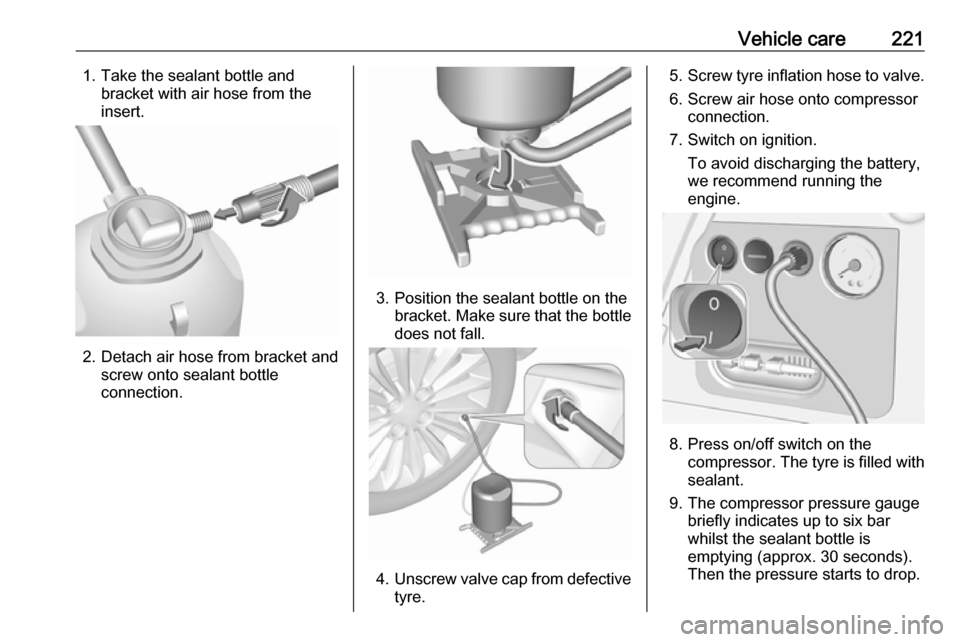
Vehicle care2211. Take the sealant bottle andbracket with air hose from the
insert.
2. Detach air hose from bracket and screw onto sealant bottle
connection.
3. Position the sealant bottle on the bracket. Make sure that the bottle
does not fall.
4. Unscrew valve cap from defective
tyre.
5. Screw tyre inflation hose to valve.
6. Screw air hose onto compressor connection.
7. Switch on ignition. To avoid discharging the battery,
we recommend running the
engine.
8. Press on/off switch on the compressor. The tyre is filled withsealant.
9. The compressor pressure gauge briefly indicates up to six bar
whilst the sealant bottle is
emptying (approx. 30 seconds).
Then the pressure starts to drop.
Page 229 of 265

Vehicle care227The following applies to tyres fitted
opposing the rolling direction:
● Driveability may be affected. Have the defective tyre renewed
or repaired as soon as possible
and fit it instead of the spare
wheel.
● Drive particularly carefully on wet
and snow-covered road
surfaces.Jump starting
Do not start with a quick charger.
A vehicle with a discharged vehicle
battery can be started using jump
leads and the vehicle battery of
another vehicle.9 Warning
Be extremely careful when starting
with jump leads. Any deviation
from the following instructions can
lead to injuries or damage caused
by battery explosion or damage to the electrical systems of both
vehicles.
9 Warning
Avoid contact of the battery with
eyes, skin, fabrics and painted
surfaces. The fluid contains
sulphuric acid which can cause
injuries and damage in the event
of direct contact.
● Never expose the battery to naked flames or sparks.
● A discharged vehicle battery canalready freeze at a temperature
of 0 °C. Defrost the frozen battery
before connecting jump leads.
● Wear eye protection and protective clothing when
handling a battery.
● Use a booster battery with the same voltage (12 Volts). Its
capacity (Ah) must not be much less than that of the discharged
vehicle battery.
● Use jump leads with insulated terminals and a cross section of
at least 16 mm 2
(25 mm 2
for
diesel engines).
● Do not disconnect the discharged
vehicle battery from the vehicle.
● Switch off all unnecessary electrical consumers.
● Do not lean over the battery during jump starting.
● Do not allow the terminals of one
lead to touch those of the other
lead.
● The vehicles must not come into contact with each other during
the jump starting process.
Page 230 of 265

228Vehicle care● Apply the parking brake,transmission in neutral,
automatic transmission in P.
● Open the positive terminal protection caps of both vehiclebatteries.
Lead connection order:
1. Connect the red lead to the positive terminal of the booster
vehicle battery.
2. Connect the other end of the red lead to the positive terminal of the
discharged vehicle battery.
3. Connect the black lead to the negative terminal of the booster
vehicle battery.
4. Connect the other end of the black
lead to a vehicle grounding point,
such as the engine block or an
engine mounting bolt. Connect as far away from the discharged
vehicle battery as possible,
however at least 60 cm.
Route the leads so that they cannot
catch on rotating parts in the engine
compartment.
To start the engine: 1. Start the engine of the vehicle providing the jump.
2. After five minutes, start the other engine. Start attempts should be
made for no longer than
15 seconds at an interval of one
minute.
3. Allow both engines to idle for approx. three minutes with the
leads connected.4. Switch on electrical consumers (e.g. headlights, heated rear
window) of the vehicle receiving
the jump start.
5. Reverse above sequence exactly when removing leads.
Page 260 of 265

258IndexAAccessories and vehicle modifications .......................... 188
Adjustable air vents ...................130
Airbag and belt tensioners ...........90
Airbag deactivation ................48, 91
Airbag label................................... 43 Airbag system .............................. 43
Air conditioning regular operation ................................ 131
Air conditioning system .............. 123
Air intake .................................... 130
Air vents...................................... 130
Antilock brake system ................ 148
Antilock brake system (ABS) .......92
Anti-theft alarm system ................27
Anti-theft locking system .............. 26
Appearance care ........................231
Ashtrays ....................................... 83
Automatic anti-dazzle ..................30
Automatic light control ...............113
Automatic locking ........................24
Automatic transmission .............140
Autostop ............................... 95, 135
B Battery discharge protection ......121
Battery voltage ........................... 104
Belts.............................................. 40
Bicycle rack .................................. 59Bonnet ....................................... 189
Brake and clutch fluid .................235
Brake and clutch system .............92
Brake assist ............................... 149
Brake fluid .................................. 193
Brakes ............................... 148, 193
Breakdown.................................. 229
Bulb replacement ....................... 196
C Capacities .................................. 249
Car Pass ...................................... 21
Catalytic converter .....................140
Central locking system ................22
Centre high-mounted brake light 203
Changing tyre and wheel size ...216
Charging system .......................... 91
Child locks ................................... 25
Child restraint installation locations ................................... 51
Child restraints.............................. 49
Child restraint systems ................49
Cigarette lighter ........................... 82
City mode ................................... 152
Climate control ............................. 15
Climate control systems .............122
Clock ............................................ 80
Code ........................................... 102
Collision damage repair ..............254
Colour-Info-Display .....................100
Page 264 of 265

262Upholstery.................................. 233
Using this manual ..........................3
V Vehicle battery ........................... 193
Vehicle checks............................ 189 Vehicle data ................................ 239
Vehicle data recording and privacy ..................................... 256
Vehicle detected ahead ................95
Vehicle dimensions .................... 248
Vehicle Identification Number ....237
Vehicle jack ................................ 209
Vehicle messages .....................102
Vehicle personalisation .............105
Vehicle security ............................ 26
Vehicle specific data ......................3
Vehicle storage ........................... 188
Vehicle tools ............................... 209
Vehicle unlocking ........................... 6
Vehicle weight ........................... 246
Ventilation ................................... 122
W
Warning chimes .........................104
Warning lights ............................... 83
Warning triangle .......................... 72
Washer and wiper systems .........14
Washer fluid ............................... 193
Wheel changing .........................223
Wheel covers ............................. 217Wheels and tyres .......................210
Windows ....................................... 30
Windscreen................................... 30 Windscreen wiper/washer ...........77
Winter tyres ............................... 210
Wiper blade replacement ..........195
X Xenon headlights .......................199
Xenon lighting system ................115