fuel pressure VAUXHALL CORSA 2016 User Guide
[x] Cancel search | Manufacturer: VAUXHALL, Model Year: 2016, Model line: CORSA, Model: VAUXHALL CORSA 2016Pages: 267, PDF Size: 7.79 MB
Page 181 of 267
Driving and operating179Fuel for liquid gas operation
Liquid gas is known as LPG
(Liquefied Petroleum Gas) or under
its French name GPL (Gaz de Pétrole Liquéfié). LPG is also known as
Autogas.
LPG consists mainly of propane and
butane. The octane rating is between 105 and 115, depending on the
butane proportion. LPG is stored
liquid at around five to ten bar
pressure.
The boiling point depends on the
pressure and mixing ratio. At ambient
pressure, it is between -42 °C (pure
propane) and -0.5 °C (pure butane).Caution
The system works at an ambient
temperature of approx. -8 °C to
100 °C.
Full function of the LPG system can
only be guaranteed with liquid gas
which complies with the minimum
requirements of DIN EN 589.
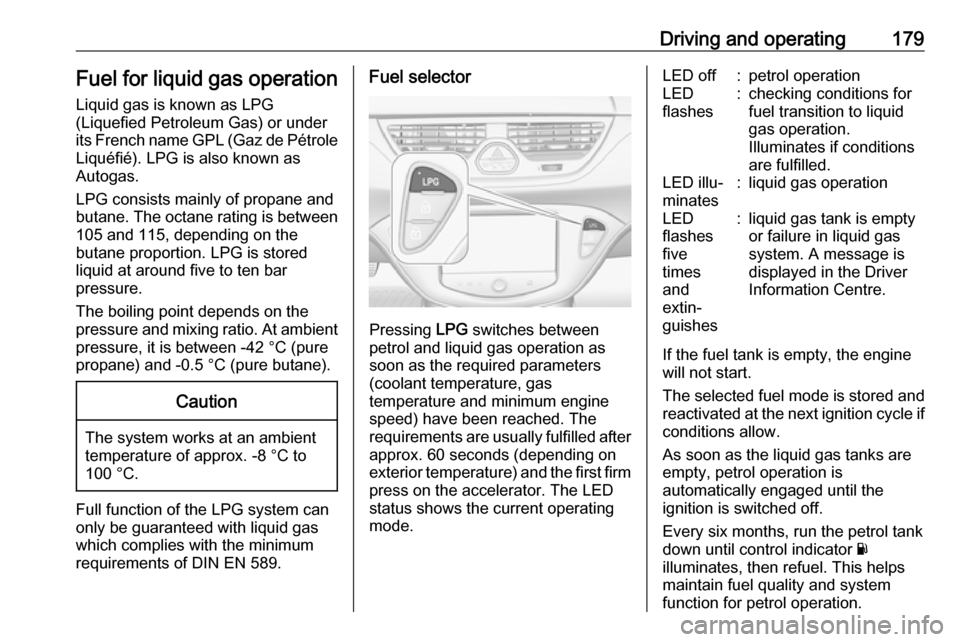
Fuel selector
Pressing LPG switches between
petrol and liquid gas operation as
soon as the required parameters (coolant temperature, gas
temperature and minimum engine
speed) have been reached. The
requirements are usually fulfilled after
approx. 60 seconds (depending on
exterior temperature) and the first firm press on the accelerator. The LED
status shows the current operating
mode.
LED off:petrol operationLED
flashes:checking conditions for
fuel transition to liquid
gas operation.
Illuminates if conditions
are fulfilled.LED illu‐
minates:liquid gas operationLED
flashes
five
times
and
extin‐
guishes:liquid gas tank is empty
or failure in liquid gas
system. A message is
displayed in the Driver
Information Centre.
If the fuel tank is empty, the engine
will not start.
The selected fuel mode is stored and reactivated at the next ignition cycle if
conditions allow.
As soon as the liquid gas tanks are
empty, petrol operation is
automatically engaged until the
ignition is switched off.
Every six months, run the petrol tank down until control indicator Y
illuminates, then refuel. This helps
maintain fuel quality and system
function for petrol operation.
Page 186 of 267

184Driving and operatingGeneral information
The official fuel consumption and
specific CO 2 emission figures quoted
relate to the EU base model with
standard equipment.
Fuel consumption data and CO 2
emission data are determined
according to regulation R (EC)
No. 715/2007 (in the latest applicable
version), taking into consideration the
vehicle weight in running order, as specified by the regulation.
The figures are provided only for the
purpose of comparison between
different vehicle variants and must
not be taken as a guarantee for the
actual fuel consumption of a
particular vehicle. Additional
equipment may result in slightly
higher results than the stated
consumption and CO 2 figures.
Furthermore, fuel consumption is dependent on personal driving styleas well as road and traffic conditions.Trailer hitch
General information
Only use towing equipment that has
been approved for your vehicle.
Entrust retrofitting of towing
equipment to a workshop. It may be
necessary to make changes that
affect the cooling system, heat
shields or other equipment.
The bulb outage detection function for trailer brake light cannot detect a
partial bulb outage, e.g. in case of four
times five watt bulbs, the function only detects lamp outage when only a
single five Watt lamp remains or none remain.
Fitting of towing equipment could
cover the opening of the towing eye.
If this is the case use the coupling ball
bar for towing. Always keep the
coupling ball bar in the vehicle when
not in use.Driving characteristics and
towing tips
Before attaching a trailer, lubricate the coupling ball. However, do not do
so if a stabiliser, which acts on the coupling ball, is being used to reduce snaking movements.
For trailers with low driving stability
and caravan trailers with a permitted
gross vehicle weight of more than
1000 kg a speed of 50 mph must not
be exceeded; the use of a stabiliser is
recommended.
If the trailer starts snaking, drive more slowly, do not attempt to correct the
steering and brake sharply if
necessary.
When driving downhill, drive in the
same gear as if driving uphill and
drive at a similar speed.
Adjust tyre pressure to the value
specified for full load 3 252.
Page 191 of 267

Vehicle care189Vehicle careGeneral Information...................190
Accessories and vehicle modifications .......................... 190
Vehicle storage ........................190
End-of-life vehicle recovery .....190
Vehicle checks ........................... 191
Performing work ......................191
Bonnet ..................................... 191
Engine oil ................................. 192
Engine coolant ......................... 193
Washer fluid ............................ 195
Brakes ..................................... 195
Brake fluid ............................... 195
Vehicle battery ......................... 195
Diesel fuel system bleeding .....197
Wiper blade replacement ........197
Bulb replacement .......................198
Halogen headlights ..................198
Xenon headlights .....................201
Fog lights ................................. 202
Front turn signal lights .............202
Tail lights ................................. 202
Side turn signal lights ..............204
Centre high-mounted brake light ......................................... 205Number plate light...................205
Interior lights ............................ 205
Instrument panel illumination ...205
Electrical system ........................206
Fuses ....................................... 206
Engine compartment fuse box . 207
Instrument panel fuse box .......209
Vehicle tools .............................. 211
Tools ........................................ 211
Wheels and tyres .......................212
Winter tyres ............................. 212
Tyre designations ....................212
Tyre pressure .......................... 212
Tyre pressure monitoring system .................................... 213
Tread depth ............................. 217
Changing tyre and wheel size . 218
Wheel covers ........................... 218
Tyre chains .............................. 218
Tyre repair kit .......................... 219
Wheel changing .......................224
Spare wheel ............................ 226
Jump starting ............................. 228
Towing ....................................... 230
Towing the vehicle ...................230
Towing another vehicle ...........231Appearance care .......................232
Exterior care ............................ 232
Interior care ............................. 234
Page 192 of 267

190Vehicle careGeneral Information
Accessories and vehicle modifications
We recommend the use of genuine
parts and accessories and factory
approved parts specific for your
vehicle type. We cannot assess or guarantee reliability of other products
- even if they have a regulatory or
otherwise granted approval.
Do not make any modifications to the electrical system, e.g. changes of
electronic control units (chip tuning).Caution
When transporting the vehicle on
a train or on a recovery vehicle, the
mud flaps may be damaged.
Vehicle storage
Storage for a long period of time
If the vehicle is to be stored for several months:
● Wash and wax the vehicle.
● Have the wax in the engine compartment and underbody
checked.
● Clean and preserve the rubber seals.
● Fill up fuel tank completely.
● Change the engine oil.
● Drain the washer fluid reservoir.
● Check the coolant antifreeze and
corrosion protection.
● Adjust tyre pressure to the value specified for full load.
● Park the vehicle in a dry, well ventilated place. Engage first or
reverse gear or set selector lever
to P. Prevent the vehicle from
rolling.
● Do not apply the parking brake.● Open the bonnet, close all doors and lock the vehicle.
● Disconnect the clamp from the negative terminal of the vehicle
battery. Beware that all systems
are not functional, e.g. anti-theft
alarm system.
Putting back into operation
When the vehicle is to be put back into
operation:
● Connect the clamp to the negative terminal of the vehicle
battery. Activate the electronics
of the power windows.
● Check tyre pressure.
● Fill up the washer fluid reservoir.
● Check the engine oil level.
● Check the coolant level.
● Fit the number plate if necessary.
End-of-life vehicle recovery
Information on end-of-life vehicle
recovery centres and the recycling of
end-of-life vehicles is available on our website. Only entrust this work to an
authorised recycling centre.
Page 215 of 267

Vehicle care213Tyre pressure 3 252.
The tyre pressure information label
on the right door frame indicates the original equipment tyres and thecorrespondent tyre pressures.
The tyre pressure data refers to cold
tyres. It applies to summer and winter
tyres.
The ECO tyre pressure serves to
achieve the smallest amount of fuel
consumption possible.
Incorrect tyre pressures will impair
safety, vehicle handling, comfort and fuel economy and will increase tyre
wear.
Tyre pressures differ depending on
various options.
For the correct tyre pressure value,
follow the procedure below:
● Identify the engine identifier code. Engine data 3 244.
● Identify the respective tyre.
The tyre pressure tables show all
possible tyre combinations 3 252.For the tyres approved for your
vehicle, refer to the EEC Certificate of Conformity provided with your vehicle
or other national registration
documents.
The driver is responsible for correct adjustment of tyre pressure.9 Warning
If the pressure is too low, this can
result in considerable tyre warm-
up and internal damage, leading to tread separation and even to tyre
blow-out at high speeds.
If the tyre pressure must be reduced
or increased, switch off ignition. After
adjusting tyre pressure switch on
ignition and select the relevant setting on the page Tyre load in the Driver
Information Centre 3 96.
Temperature dependency The tyre pressure depends on the
temperature of the tyre. During
driving, tyre temperature and
pressure increase. Tyre pressure
values provided on the tyre
information label and tyre pressure
chart are valid for cold tyres, which means at 20 °C.
The pressure increases by nearly
1.5 psi for a 10 °C temperature
increase. This must be considered
when warm tyres are checked.
The tyre pressure value displayed in
the Driver Information Centre shows
the real tyre pressure. A cooled down
tyre will show a decreased value,
which does not indicate an air leak.
Tyre pressure monitoringsystem
The tyre pressure monitoring system
checks the pressure of all four tyres
once a minute when vehicle speed
exceeds a certain limit.Caution
Tyre pressure monitoring system
warns only about low tyre pressure condition and does not replace
regular tyre maintenance by the
driver.
Page 235 of 267

Vehicle care233Thoroughly rinse and leather-off the
vehicle. Rinse leather frequently. Use
separate leathers for painted and
glass surfaces: remnants of wax on the windows will impair vision.
Exterior lights
Headlight and other light covers are
made of plastic. Do not use any
abrasive or caustic agents, do not use
an ice scraper, and do not clean them
dry.
Polishing and waxing
Wax painted parts of the vehicle
regularly (at the latest when water no longer beads). Otherwise, the
paintwork will dry out.
Polishing is necessary only if the paint
has become dull or if solid deposits
have become attached to it.
Paintwork polish with silicone forms a
protective film, making waxing
unnecessary.
Unpainted plastic body parts must not be treated with wax or polishing
agents.Matt filmed body parts or decor tapes must not be polished, to avoid
gleaming. Do not use hot wax
programmes in automatic car washes
if the vehicle is equipped with these parts.
Matt painted decor parts, e.g. mirror
housing cover, must not be polished.
Otherwise these parts would become agleam or the colour would be
dissolved.
Windows and windscreen wiper
blades
Use a soft lint-free cloth or chamois
leather together with window cleaner
and insect remover.
When cleaning the rear window from
inside, always wipe in parallel to the
heating element to prevent damage.
For mechanical removal of ice, use a
sharp-edged ice scraper. Press the
scraper firmly against the glass so
that no dirt can get under it and
scratch the glass.
Clean smearing wiper blades with a
soft cloth and window cleaner.Remove dirt residues from smearing
wiper blades by using a soft cloth and window cleaner. Also make sure to
remove any residues such as wax,
insect residues and similar from the
window.
Ice residues, pollution and continuous wiping on dry windows will damage or
even destroy the wiper blades.
Sunroof Never clean with solvents or abrasive
agents, fuels, aggressive media (e.g.
paint cleaner, acetone-containing
solutions etc.), acidic or highly
alkaline media or abrasive pads. Do
not apply wax or polishing agents to
the sunroof.
Wheels and tyres Do not use high-pressure jet
cleaners.
Clean rims with a pH-neutral wheel
cleaner.
Rims are painted and can be treated
with the same agents as the body.
Page 263 of 267

261Control indicators.......................... 87
Control of the vehicle .................136
Controls ........................................ 76
Convex shape .............................. 28
Coolant and antifreeze ...............237
Corner lighting ............................ 117
Cruise control ...................... 95, 156
Cupholders .................................. 57
Curtain airbag system .................. 48
D Danger, Warnings and Cautions ...4
Daytime running lights ...............117
Declaration of conformity ............254
Diesel fuel system bleeding .......197
Diesel particle filter ...............93, 142
Door open .................................... 95
Doors ............................................ 25
Driver assistance systems ..........156
Driver Information Centre .............96
Driving characteristics and towing tips .............................. 184
Driving hints ................................ 136
E Easy entry..................................... 38
Electric adjustment ......................28
Electrical system......................... 206
Electronic climate control system 128
Electronic driving programmes . ........................................ 145, 150Electronic Stability Control.......... 154
Electronic Stability Control and Traction Control system ............93
Electronic Stability Control off....... 93
End-of-life vehicle recovery .......190
Engine compartment fuse box ...207
Engine coolant ........................... 193
Engine coolant temperature gauge ....................................... 86
Engine data ............................... 244
Engine exhaust .......................... 142
Engine identification ...................240
Engine oil ................... 192, 237, 241
Engine oil pressure ......................94
Entry lighting .............................. 122
Event data recorders ..................258
Exit lighting ................................ 123
Exterior care .............................. 232
Exterior light ................................. 95
Exterior lighting ....................12, 114
Exterior mirrors ............................. 28
F
Fault ................................... 146, 150
First aid ......................................... 72
First aid kit ................................... 72
Fixed air vents ........................... 133
Flex-Fix system ............................ 59
Fog light ....................................... 95
Fog lights ................................... 202Folding mirrors ............................. 29
Following distance indication ......161
Forward collision alert................. 159
Front airbag system .....................46
Front fog lights ........................... 119
Front seats.................................... 36
Front storage ................................ 58
Front turn signal lights ...............202
Fuel............................................. 178
Fuel consumption - CO 2-
Emissions ............................... 183
Fuel for diesel engines ..............178
Fuel for liquid gas operation .......179
Fuel for petrol engines ...............178
Fuel gauge ................................... 85 Fuel selector ................................ 85
Fuses ......................................... 206
G Gauges ......................................... 83
Gear shifting ................................. 92
General information ...................184
Glovebox ..................................... 57
Graphic-Info-Display ...................102
H Halogen headlights ....................198
Hand brake ......................... 151, 152
Hazard warning flashers ............118
Headlight flash ........................... 116
Headlight range adjustment ......116
Page 265 of 267

263RRadio Frequency Identification (RFID) ..................................... 259
Radio remote control ...................21
Reading lights ............................ 122
Rear carrier system ......................59
Rear floor storage cover ..............70
Rear fog light ....................... 95, 119
Rear view camera ...................... 172
Rear window wiper/washer .......... 79
Recommended fluids and lubricants ........................ 237, 241
Reduced engine power ................94
Refuelling ................................... 180
Retained power off .....................137
Reversing lights .........................120
Ride control systems ..................153
Roof .............................................. 33
Roof load ...................................... 73
Roof rack ..................................... 72
S Safety belts ................................... 40
Seat adjustment ....................... 7, 37
Seat belt ........................................ 8
Seat belt reminder .......................90
Seat belts ..................................... 40
Seat folding .................................. 38
Seat heating ................................. 39
Seat position ................................ 36Selector lever ..................... 144, 148
Service ....................................... 134
Service display ............................ 86
Service information ....................236
Service vehicle soon .................... 91
Side airbag system ......................47
Side blind spot alert ....................171
Sidelights .................................... 114
Side turn signal lights ................204
Software acknowledgement .......256
Spare wheel ............................... 226
Speed limiter......................... 95, 158
Speedometer ............................... 83
Starting and operating ................136
Starting off ................................... 17
Starting the engine ............137, 148
Steering wheel adjustment ......9, 76
Steering wheel controls ...............76
Stop-start system........................ 138
Storage ......................................... 57
Storage compartments .................57
Sunroof ........................................ 33
Sun visors .................................... 32
Symbols ......................................... 4
T
Tachometer ................................. 84
Tail lights ................................... 202
Three-point seat belt .................... 41
Tools .......................................... 211Top-tether fastening eyes ............55
Tow bar....................................... 184
Towing ................................ 184, 230
Towing another vehicle .............231
Towing equipment .....................186
Towing the vehicle .....................230
Traction Control system ............. 153 Traction Control system off........... 93
Traffic sign assistant .............95, 174
Trailer coupling ........................... 184
Trailer stability assist .................188
Trailer towing ............................. 185
Transmission ............................... 16
Transmission display .........143, 148
Tread depth ............................... 217
Trip odometer .............................. 83
Turn and lane-change signals ...119
Turn signal ................................... 89
Tyre chains ................................ 218
Tyre designations ......................212
Tyre pressure ............................ 212
Tyre pressure monitoring system ............................... 94, 213
Tyre pressures ........................... 252
Tyre repair kit ............................. 219
U
Ultrasonic parking assist ...... 93, 161
Underseat storage .......................59