Transmission VAUXHALL CORSA 2016 Owner's Guide
[x] Cancel search | Manufacturer: VAUXHALL, Model Year: 2016, Model line: CORSA, Model: VAUXHALL CORSA 2016Pages: 267, PDF Size: 7.79 MB
Page 231 of 267
Vehicle care229● A discharged vehicle battery canalready freeze at a temperature
of 0 °C. Defrost the frozen battery before connecting jump leads.
● Wear eye protection and protective clothing when
handling a battery.
● Use a booster battery with the same voltage (12 Volts). Its
capacity (Ah) must not be much
less than that of the discharged
vehicle battery.
● Use jump leads with insulated terminals and a cross section of
at least 16 mm 2
(25 mm 2
for
diesel engines).
● Do not disconnect the discharged
vehicle battery from the vehicle.
● Switch off all unnecessary electrical consumers.
● Do not lean over the battery during jump starting.
● Do not allow the terminals of one
lead to touch those of the other
lead.
● The vehicles must not come into contact with each other during
the jump starting process.● Apply the parking brake, transmission in neutral,
automatic transmission in P.
● Open the positive terminal protection caps of both vehiclebatteries.
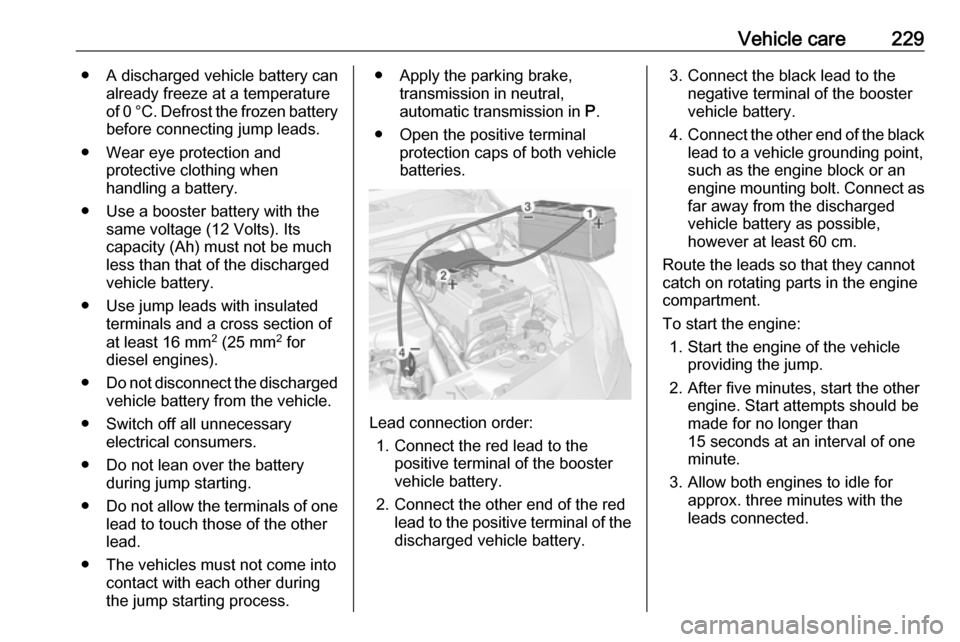
Lead connection order:
1. Connect the red lead to the positive terminal of the booster
vehicle battery.
2. Connect the other end of the red lead to the positive terminal of the
discharged vehicle battery.
3. Connect the black lead to the negative terminal of the booster
vehicle battery.
4. Connect the other end of the black
lead to a vehicle grounding point,
such as the engine block or an
engine mounting bolt. Connect as far away from the discharged
vehicle battery as possible,
however at least 60 cm.
Route the leads so that they cannot
catch on rotating parts in the engine
compartment.
To start the engine: 1. Start the engine of the vehicle providing the jump.
2. After five minutes, start the other engine. Start attempts should be
made for no longer than
15 seconds at an interval of one
minute.
3. Allow both engines to idle for approx. three minutes with the
leads connected.
Page 232 of 267

230Vehicle care4. Switch on electrical consumers(e.g. headlights, heated rear
window) of the vehicle receiving
the jump start.
5. Reverse above sequence exactly when removing leads.Towing
Towing the vehicle
Insert a screwdriver in the slot at the
lower part of the cap. Release the cap
by carefully moving the screwdriver
downwards.
The towing eye is stowed with the
vehicle tools 3 211.
Screw in the towing eye as far as it will
go until it stops in a horizontal
position.
Attach a tow rope – or better still a tow
rod – to the towing eye.
The towing eye must only be used for
towing and not for recovering the
vehicle.
Switch on ignition to release steering wheel lock and to permit operation of
brake lights, horn and windscreen
wiper.
Transmission in neutral.
Page 233 of 267

Vehicle care231Caution
Drive slowly. Do not drive jerkily.
Excessive tractive force can
damage the vehicle.
When the engine is not running,
considerably more force is needed to
brake and steer.
To prevent the entry of exhaust gases from the towing vehicle, switch on the
air recirculation and close the
windows.
Vehicles with automatic transmission: the vehicle must be towed facing
forwards, not faster than 50 mph nor
further than 60 miles. In all other
cases and when the transmission is
defective, the front axle must be
raised off the ground.
Vehicles with manual transmission
automated: the vehicle must only be
towed facing forwards with the front
axle raised off the ground.
Seek the assistance of a workshop. After towing, unscrew the towing eye.
Insert cap at the top and engage
downwards.
Towing another vehicle
Insert a screwdriver in the slot at the
lower bend of the cap. Release the
cap by carefully moving the
screwdriver downwards.
The towing eye is stowed with the
vehicle tools 3 211.
Screw in the towing eye as far as it will
go until it stops in a horizontal
position.
The lashing eye at the rear
underneath the vehicle must never be used as a towing eye.
Attach a tow rope – or even better a
tow bar – to the towing eye.
The towing eye must only be used for
towing and not for recovering a
vehicle.
Page 248 of 267
![VAUXHALL CORSA 2016 Owners Guide 246Technical dataEngine identifier codeB13DTCB13DTEB13DTEB13DTRSales designation1.31.31.31.3Engineering codeB13DTCB13DTEB13DTEB13DTRPiston displacement [cm3
]1248124812481248Engine power [kW]55557070a](/img/38/19428/w960_19428-247.png "VAUXHALL CORSA 2016 Owners Guide 246Technical dataEngine identifier codeB13DTCB13DTEB13DTEB13DTRSales designation1.31.31.31.3Engineering codeB13DTCB13DTEB13DTEB13DTRPiston displacement [cm3
]1248124812481248Engine power [kW]55557070a")
246Technical dataEngine identifier codeB13DTCB13DTEB13DTEB13DTRSales designation1.31.31.31.3Engineering codeB13DTCB13DTEB13DTEB13DTRPiston displacement [cm3
]1248124812481248Engine power [kW]55557070at rpm3750375037503750Torque [Nm]190190190210at rpm1500 - 25001500 - 25001500 - 35001500 - 3000Fuel typeDieselDieselDieselDieselGas––––PerformanceEngineB10XFLB10XFTB12XELB14XEJB14XELB14NEJMaximum speed [mph]Manual transmission112122101104109115Manual transmission automated––––109–Automatic transmission––––106–
Page 249 of 267
![VAUXHALL CORSA 2016 Owners Guide Technical data247EngineB14XEL LPGB14NEHB16LERMaximum speed [mph]Manual transmission109129143Manual transmission automated–––Automatic transmission–––
Engine
B13DTCB13DTE
55kWB13DTE
70kWB13](/img/38/19428/w960_19428-248.png "VAUXHALL CORSA 2016 Owners Guide Technical data247EngineB14XEL LPGB14NEHB16LERMaximum speed [mph]Manual transmission109129143Manual transmission automated–––Automatic transmission–––
Engine
B13DTCB13DTE
55kWB13DTE
70kWB13")
Technical data247EngineB14XEL LPGB14NEHB16LERMaximum speed [mph]Manual transmission109129143Manual transmission automated–––Automatic transmission–––
Engine
B13DTCB13DTE
55kWB13DTE
70kWB13DTRMaximum speed [mph]Manual transmission102113113110Manual transmission automated–113113–Automatic transmission––––
Page 250 of 267

248Technical dataVehicle weight
Kerb weight, 5-door vehicle, basic model without any optional equipmentEngineManual transmissionManual transmission automatedAutomatic transmissionwithout / with air conditioning
[kg]B10XFL1199 / 1214––B10XFT1199 / 1214––B12XEL1163 / 1178––B14XEJ1163 / 1178––B14XEL1163 / 11781163 / 11781199 / 1214B14XEL LPG1237 / 1252––B14NEJ1237 / 1252––B14NEH1259 / 1274––without / with air conditioning
[kg]B13DTC1237 / 1252––B13DTE1237 / 13311237 / 1331–B13DTR1259 / 1274––
Optional equipment and accessories increase the kerb weight.
Loading information 3 73.
Page 251 of 267

Technical data249Kerb weight, 3-door vehicle and van, basic model without any optional equipmentEngineManual transmissionManual transmissionautomatedAutomatic transmissionwithout / with air conditioning
[kg]B10XFL1163 / 1178––B10XFT1163 / 1178––B12XEL1120 / 1135––B14XEJ1141 / 1156––B14XEL1141 / 11561141 / 11561163 / 1178B14XEL LPG1199 / 1214––B14NEJ1199 / 1214––B14NEH1199 / 1214––B16LER1278 / 1293––without/with air conditioning
[kg]B13DTC1199 / 1214––B13DTE1199 / 12141199 / 1214–B13DTR1237 / 1252––
Optional equipment and accessories increase the kerb weight.
Loading information 3 73.
Page 256 of 267

254Customer informationCustomer
informationCustomer information ................254
Declaration of conformity .........254
Collision damage repair ...........256
Software acknowledgement ....256
Vehicle data recording and pri‐ vacy ........................................... 258
Event data recorders ...............258
Radio Frequency Identification (RFID) ..................................... 259Customer information
Declaration of conformity
Transmission systems
This vehicle has systems that
transmit and/or receive radio waves
subject to Directive 1999/5/EC.
These systems are in compliance
with the essential requirements and
other relevant provisions of Directive
1999/5/EC. Copies of the original
Declarations of Conformity can be
obtained on our website.
Page 261 of 267

Customer information259When using the vehicle, situations
may occur in which these technical
data related to other information
(accident report, damages on the
vehicle, witness statements etc.) may
be associated with a specific person - possibly, with the assistance of an
expert.
Additional functions contractually
agreed upon with the client (e.g.
vehicle location in emergency cases)
allow the transmission of particular vehicle data from the vehicle.
Radio Frequency Identification (RFID)
RFID technology is used in some
vehicles for functions such as tyre
pressure monitoring and ignition
system security. It is also used in
connection with conveniences such
as radio remote controls for door
locking/unlocking and starting, and in-
vehicle transmitters for garage door
openers. RFID technology in
Vauxhall vehicles does not use or
record personal information or link with any other Vauxhall system
containing personal information.
Page 262 of 267

260IndexAAccessories and vehicle modifications .......................... 190
Adjustable air vents ...................133
Airbag and belt tensioners ...........90
Airbag deactivation ................48, 91
Airbag label................................... 43 Airbag system .............................. 43
Air conditioning regular operation ................................ 134
Air conditioning system .............. 126
Air intake .................................... 133
Air vents...................................... 133
Antilock brake system ................ 151
Antilock brake system (ABS) .......92
Anti-theft alarm system ................27
Anti-theft locking system .............. 26
Appearance care ........................232
Ashtrays ....................................... 83
Automatic anti-dazzle ..................30
Automatic light control ...............115
Automatic locking ........................24
Automatic transmission .............143
Autostop ....................................... 95
B Battery discharge protection ......123
Battery voltage ........................... 106 Belts.............................................. 40
Bicycle rack .................................. 59Bonnet ....................................... 191
Brake and clutch fluid .................237
Brake and clutch system .............92
Brake assist ............................... 152
Brake fluid .................................. 195
Brakes ............................... 151, 195
Breakdown.................................. 230
Bulb replacement ....................... 198
C Capacities .................................. 251
Car Pass ...................................... 21
Catalytic converter .....................143
Central locking system ................22
Centre high-mounted brake light 205
Changing tyre and wheel size ...218
Charging system .......................... 91
Child locks ................................... 25
Child restraint installation locations ................................... 51
Child restraints.............................. 49
Child restraint systems ................49
Cigarette lighter ........................... 82
City mode ................................... 155
Climate control ............................. 15 Climate control systems .............125
Clock ............................................ 80
Code ........................................... 103
Collision damage repair ..............256
Colour-Info-Display .....................101