transmission VAUXHALL CORSA F 2020 Owner's Guide
[x] Cancel search | Manufacturer: VAUXHALL, Model Year: 2020, Model line: CORSA F, Model: VAUXHALL CORSA F 2020Pages: 227, PDF Size: 18.77 MB
Page 130 of 227
128Driving and operatingThe adaptive cruise control is
deactivated automatically in the
following cases:
● The brake pedal is depressed.
● The vehicle accelerates above 112 mph (manual and automatic
transmission) or slows down
below 19 mph (manual
transmission).
● The electric parking brake is applied.
● The traction control system or electronic stability control is
deactivated or operating.
● The selector lever of automatic transmissions is neither in D nor
in M.
● A fault is detected in the electronic stability control or the
radar system.
● Immediately after the clutch pedal has been depressed or afew seconds after the clutch
pedal has been depressed
(depending on the manual
transmission).Switching off the system
Press w, the adaptive cruise control
mode is disabled and the adaptive
cruise control indication extinguishes
in the Driver Information Centre.
Pressing 5 to activate the speed
limiter deactivates adaptive cruise
control.
Switching off the ignition deletes the
stored set speed.
Driver's attention ● Use the adaptive cruise control carefully on bends or mountainroads, as it can lose the vehicle
ahead and needs time to detect it again.
● Do not use the system on slippery roads as it can create
rapid changes in tyre traction
(wheel spinning), so that you
could lose control of the vehicle.
● Do not use the adaptive cruise control during rain, snow or
heavy dirt, as the radar sensor
can be covered by a water film,
dust, ice or snow. This reduces or
suppresses completely thevisibility. In case of sensor
blockage, clean the sensor
cover.
● Do not use the system when the spare wheel is in use.
System limits9 Warning
The system's automatic brake
force does not permit hard braking and the braking level may not be
sufficient to avoid a collision.
● After a sudden lane change, the system needs a certain time to
detect the next preceding
vehicle. So if a new vehicle is
detected, the system may
accelerate instead of braking.
● The adaptive cruise control does ignore the oncoming traffic.
● The adaptive cruise control does not consider pedestrians and
animals for braking and driving
off.
Page 134 of 227
132Driving and operatingOn vehicles equipped with radar
sensor and front camera, the active
emergency braking operates from
3 mph to 87 mph when a vehicle has
been detected.
Active emergency braking only works when the seat belts of the front
passengers are fastened.
The system includes: ● brake preparation system
● emergency automatic braking ● smart brake assist
● forward collision alert
● front pedestrian protection
Brake preparation system
When approaching a vehicle ahead
or a pedestrian so quickly that a
collision is likely, the brake
preparation system slightly
pressurises the brakes. This reduces
the response time, when braking is
requested.Emergency automatic braking
After activation of brake preparation
system and just before the imminent
collision, this function automatically
applies limited braking to reduce the
impact speed of the collision or
prohibit a crash.
If active emergency braking is
applied, m flashes in the instrument
cluster.
Emergency automatic braking can
only occur if a vehicle or a pedestrian
ahead is detected.
Forward collision alert 3 134
Front pedestrian protection 3 136
Below a speed of 19 mph, emergency automatic braking may slow down thevehicle to a complete stop. If the
speed exceeds 19 mph, emergency
automatic braking reduces the speed. However, the driver must apply the
brake.
Emergency automatic braking may slow the vehicle to a complete stop to
try to avoid a potential crash.● Automatic transmission: If the vehicle comes to a complete
stop, automatic braking is
maintained for up to two
seconds. Keep the brake pedal
depressed to prevent the vehicle
from starting off again.
● Manual transmission: If the vehicle comes to a complete
stop, the engine may stall.
Operation of the function may be felt
by a slight vibration in the brake
pedal.9 Warning
Emergency automatic braking is
an emergency crash preparation
feature and is not designed to
avoid crashes. Do not rely on the
system to brake the vehicle.
Emergency automatic braking will
not brake outside of its operating speed range and only responds to
detected vehicles and
pedestrians.
Page 142 of 227
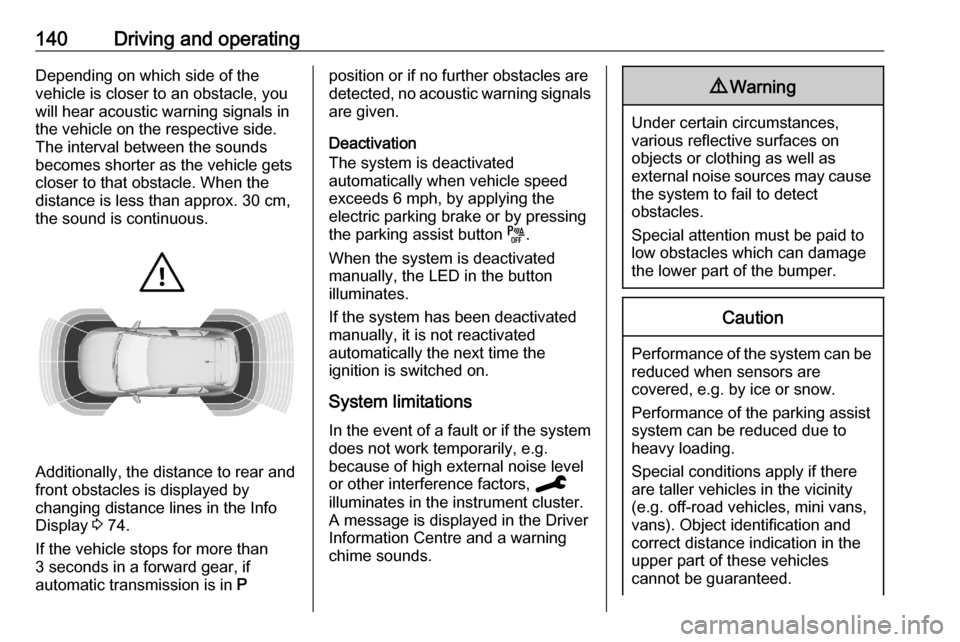
140Driving and operatingDepending on which side of the
vehicle is closer to an obstacle, you will hear acoustic warning signals inthe vehicle on the respective side.
The interval between the sounds
becomes shorter as the vehicle gets
closer to that obstacle. When the
distance is less than approx. 30 cm,
the sound is continuous.
Additionally, the distance to rear and
front obstacles is displayed by
changing distance lines in the Info Display 3 74.
If the vehicle stops for more than
3 seconds in a forward gear, if
automatic transmission is in P
position or if no further obstacles are
detected, no acoustic warning signals
are given.
Deactivation
The system is deactivated
automatically when vehicle speed
exceeds 6 mph, by applying the
electric parking brake or by pressing
the parking assist button e.
When the system is deactivated
manually, the LED in the button
illuminates.
If the system has been deactivated
manually, it is not reactivated
automatically the next time the
ignition is switched on.
System limitations
In the event of a fault or if the system does not work temporarily, e.g.
because of high external noise level
or other interference factors, C
illuminates in the instrument cluster. A message is displayed in the Driver
Information Centre and a warning
chime sounds.9 Warning
Under certain circumstances,
various reflective surfaces on
objects or clothing as well as
external noise sources may cause the system to fail to detect
obstacles.
Special attention must be paid to
low obstacles which can damage
the lower part of the bumper.
Caution
Performance of the system can be reduced when sensors are
covered, e.g. by ice or snow.
Performance of the parking assist
system can be reduced due to
heavy loading.
Special conditions apply if there
are taller vehicles in the vicinity
(e.g. off-road vehicles, mini vans,
vans). Object identification and correct distance indication in the
upper part of these vehicles
cannot be guaranteed.
Page 177 of 227
Vehicle care175No.Circuit20Fuel pump22Automatic transmission25Fuse box (trailer)28Selective catalytic reduction
system29Windscreen wiper31Climate control system32Steering wheel
After having changed defective fuses,
close the fuse box cover and lock it.
If the fuse box cover is not closed
correctly, malfunction may occur.
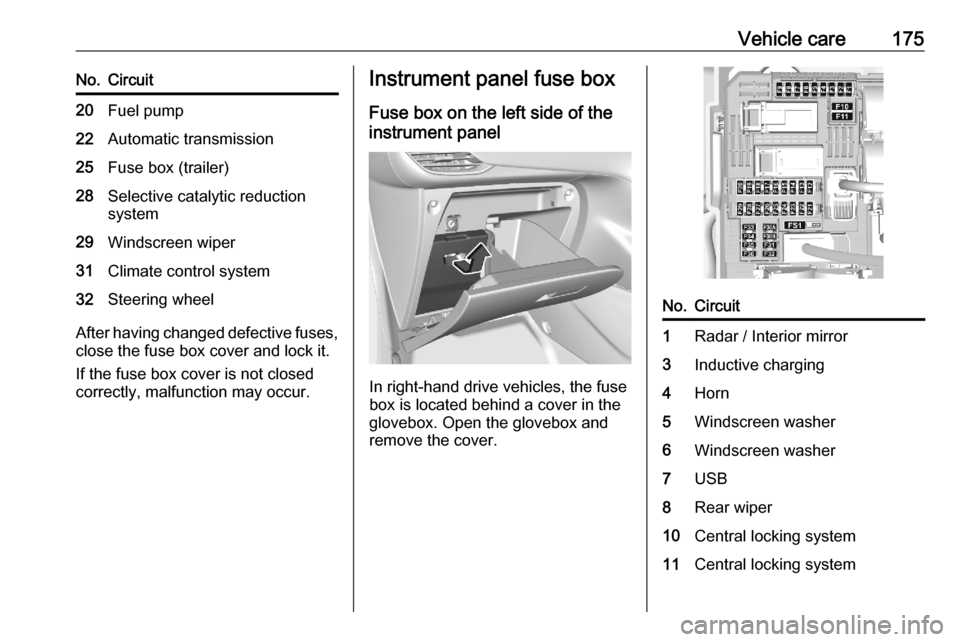
Instrument panel fuse box
Fuse box on the left side of the
instrument panel
In right-hand drive vehicles, the fuse
box is located behind a cover in the
glovebox. Open the glovebox and
remove the cover.
No.Circuit1Radar / Interior mirror3Inductive charging4Horn5Windscreen washer6Windscreen washer7USB8Rear wiper10Central locking system11Central locking system
Page 178 of 227
176Vehicle careNo.Circuit12Diagnostic connector module13Climate control system14Alarm / Vauxhall Connect17Instrument cluster21Power button / Anti-theft lockingsystem22Rain sensor / Light sensor /
Camera23Seatbelt reminder247" Touchscreen / Parking
assist / Rear view camera25Airbag27Anti-theft alarm system297" Touchscreen / Infotainment31Cigarette lighter / 12 V power
outlet32Heated steering wheelNo.Circuit33Climate control system / Auto‐
matic transmission34Parking assist / Exterior mirror
adjustment
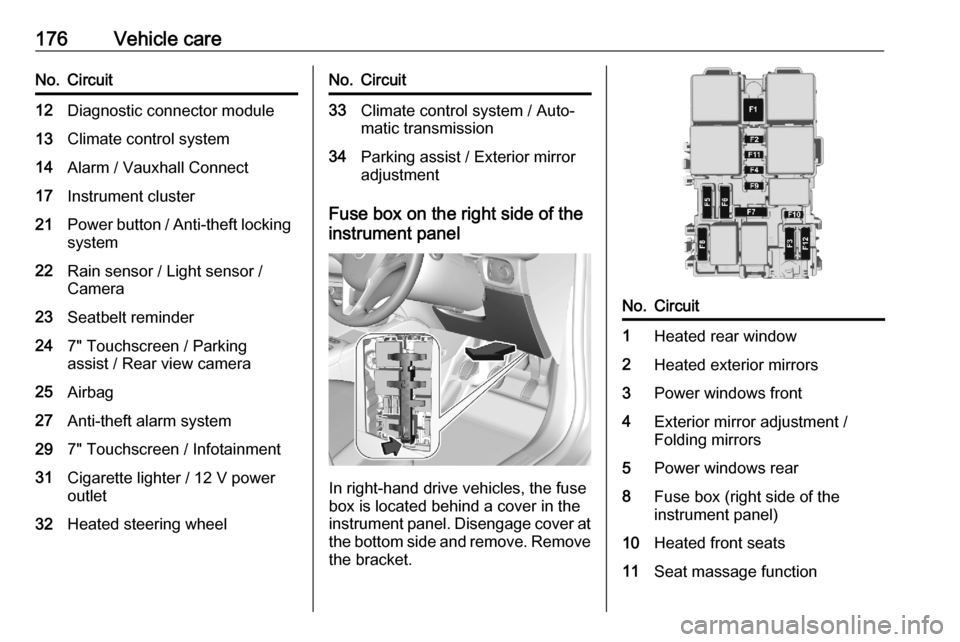
Fuse box on the right side of the
instrument panel
In right-hand drive vehicles, the fuse
box is located behind a cover in the
instrument panel. Disengage cover at
the bottom side and remove. Remove
the bracket.
No.Circuit1Heated rear window2Heated exterior mirrors3Power windows front4Exterior mirror adjustment /
Folding mirrors5Power windows rear8Fuse box (right side of the
instrument panel)10Heated front seats11Seat massage function
Page 192 of 227
190Vehicle care● A discharged vehicle battery canalready freeze at a temperature
of 0 °C. Defrost the frozen battery before connecting jump leads.
● Wear eye protection and protective clothing when
handling a battery.
● Use a booster battery with the same voltage (12 V). Its capacity
(Ah) must not be much less than
that of the discharged vehicle
battery.
● Use jump leads with insulated terminals and a cross section of
at least 16 mm 2
(25 mm 2
for
diesel engines).
● Do not disconnect the discharged
vehicle battery from the vehicle.
● Switch off all unnecessary electrical consumers.
● Do not lean over the vehicle battery during jump starting.
● Do not allow the terminals of one
lead to touch those of the other
lead.● The vehicles must not come into contact with each other during
the jump starting process.
● Apply the parking brake, transmission in neutral,
automatic transmission in P.
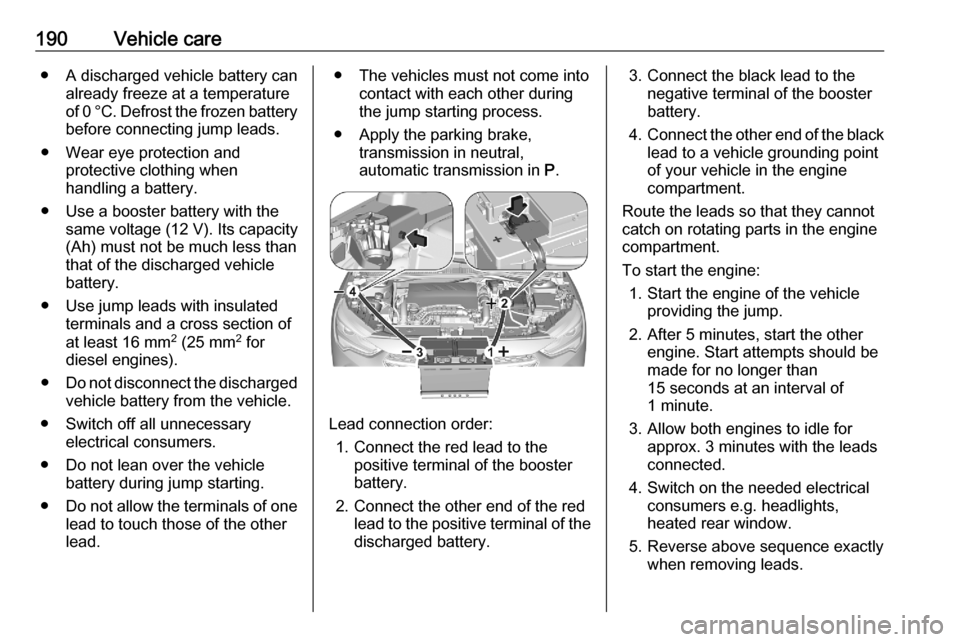
Lead connection order:
1. Connect the red lead to the positive terminal of the booster
battery.
2. Connect the other end of the red lead to the positive terminal of the
discharged battery.
3. Connect the black lead to the negative terminal of the booster
battery.
4. Connect the other end of the black
lead to a vehicle grounding point
of your vehicle in the engine
compartment.
Route the leads so that they cannot
catch on rotating parts in the engine
compartment.
To start the engine: 1. Start the engine of the vehicle providing the jump.
2. After 5 minutes, start the other engine. Start attempts should be
made for no longer than
15 seconds at an interval of 1 minute.
3. Allow both engines to idle for approx. 3 minutes with the leads
connected.
4. Switch on the needed electrical consumers e.g. headlights,
heated rear window.
5. Reverse above sequence exactly when removing leads.
Page 194 of 227
192Vehicle care
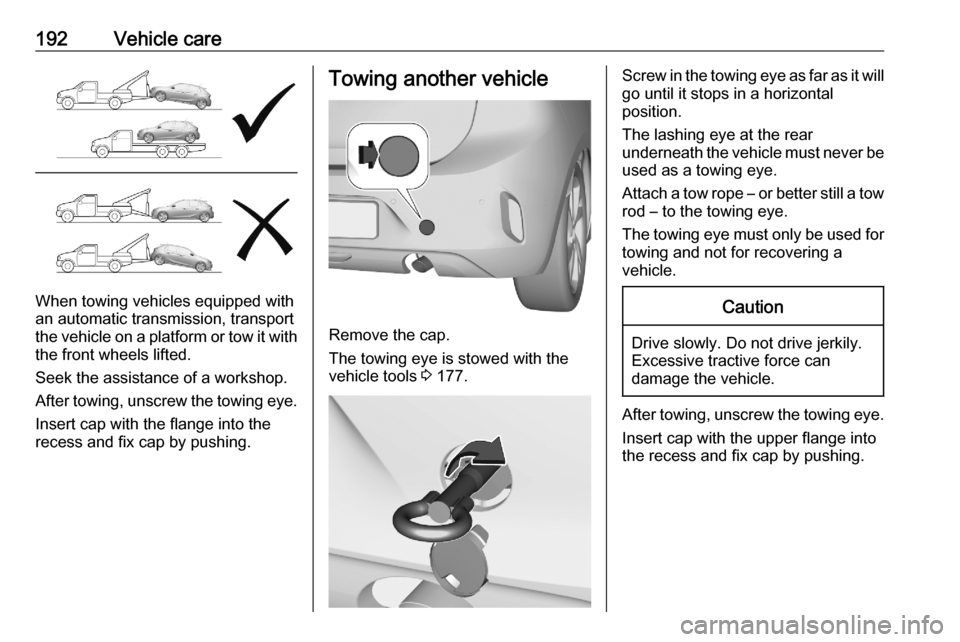
When towing vehicles equipped with
an automatic transmission, transport
the vehicle on a platform or tow it with
the front wheels lifted.
Seek the assistance of a workshop.
After towing, unscrew the towing eye.
Insert cap with the flange into the
recess and fix cap by pushing.
Towing another vehicle
Remove the cap.
The towing eye is stowed with the
vehicle tools 3 177.
Screw in the towing eye as far as it will
go until it stops in a horizontal
position.
The lashing eye at the rear
underneath the vehicle must never be used as a towing eye.
Attach a tow rope – or better still a tow
rod – to the towing eye.
The towing eye must only be used for towing and not for recovering a
vehicle.Caution
Drive slowly. Do not drive jerkily.
Excessive tractive force can
damage the vehicle.
After towing, unscrew the towing eye.
Insert cap with the upper flange into
the recess and fix cap by pushing.
Page 208 of 227

206Technical dataPerformanceEngineEB2FAEB2ADTDEB2ADTSDV5RDMaximum speed [mph]Manual transmission108117–117Automatic transmission–117129–
Page 212 of 227

210Customer informationCustomer
informationCustomer information ................210
Declaration of conformity .........210
REACH .................................... 212
Software acknowledgement ....212
Software update ......................214
Registered trademarks ............214
Vehicle data recording and pri‐
vacy ........................................... 215
Event data recorders ...............215
Radio Frequency Identification (RFID) ..................................... 218Customer information
Declaration of conformity
Radio transmission systems
This vehicle has systems that
transmit and / or receive radio waves
subject to Directive 2014/53/EU. The
manufacturers of the systems listed
below declare conformity with
Directive 2014/53/EU. The full text of
the EU declaration of conformity for each system is available at the
following internet address:
www.opel.com/conformity.
Importer is
Opel / Vauxhall, Bahnhofsplatz,
65423 Ruesselsheim am Main,
Germany.
Infotainment system Multimedia Navi
Pro / Multimedia Navi
Continental Automotive Czech
Republic s.r.o
Prumyslová 1851, 250 01 Brandys
nad Labem, Czech RepublicOperation
frequency
(MHz)Maximum
output (dBm)BT2402.0 -
2480.04.1Wifi2412.0 -
2462.016.7
Infotainment system Radio
Hangsheng technology GmbH
Bouchéstr. 12, 12435 Berlin,
Germany
Operation frequency:
2402.0 - 2480.0 MHz
Maximum output: 4 dBm
Infotainment system Multimedia
Robert Bosch Car Multimedia GmbH
Robert-Bosch-Strasse 200, 31139
Hildesheim, Germany
Operation frequency:
2400.0 - 2483.5 MHz
Maximum output: 4 dBm
Wireless charger
Continental Automotive GmbH
Page 222 of 227
220IndexAAccessories and vehicle modifications .......................... 160
Active emergency braking ....72, 131
Adaptive cruise control ..............123
AdBlue .................................. 70, 106
Adjustable air vents .....................95
Advanced parking assist ............141
Airbag and belt tensioners ...........66
Airbag deactivation ................38, 66
Airbag label................................... 33 Airbag system .............................. 33
Air conditioning regular operation 96
Air conditioning system ................ 89
Air intake ...................................... 96
Air vents........................................ 95
Antilock brake system ................ 114
Antilock brake system (ABS) .......68
Anti-theft alarm system ................18
Anti-theft locking system .............. 17
Appearance care ........................193
Armrest ......................................... 30
Ashtrays ....................................... 60 Automatic anti-dazzle ..................22
Automatic crash notification (ACN) 77
Automatic light control .................80
Automatic locking ........................15
Automatic operation of electric parking brake off .......................68
Automatic transmission .............109Autostop............................... 71, 102
Auxiliary heater ............................. 95
B Battery discharge protection ........87
BlueInjection ............................... 106
Bonnet ....................................... 162
Brake and clutch fluid .................199
Brake and clutch system .............67
Brake assist ............................... 117
Brake fluid .................................. 165
Brakes ........................................ 165
Breakdown.................................. 191
Bulb replacement ....................... 169
C Capacities .................................. 208
Catalytic converter .....................106
Central locking system ................11
Centre console storage ...............47
Changing tyre and wheel size ...180
Charging system .......................... 66
Child locks ................................... 16
Child restraint installation locations ................................... 43
Child restraints.............................. 40
Child restraint systems ................40
Cigarette lighter ........................... 60
Climate control systems ...............88
Clock............................................. 58
Control indicators.......................... 65