check engine VAUXHALL CROSSLAND X 2019.75 User Guide
[x] Cancel search | Manufacturer: VAUXHALL, Model Year: 2019.75, Model line: CROSSLAND X, Model: VAUXHALL CROSSLAND X 2019.75Pages: 247, PDF Size: 7.77 MB
Page 132 of 247

130Driving and operatingTop up AdBlue: Starting impossible in1500 mi
Additionally, control indicator Y
illuminates continuously and a chime
sounds with every message pop-up.
At an AdBlue range below 380 miles,
the following warning message is
being displayed, shows up at each start and each 12 miles range
reduction:
Top up AdBlue: Starting impossible in 380 mi
Additionally, control indicator Y
flashes continuously and a chime
sounds with every message pop-up.
Notice
In case of high AdBlue consumption, the Driver Information Centre may
display this warning without the
previous warning stages.
The last warning level is entered
when the AdBlue tank is empty.
Restart of the engine is not possible.
The following warning message is
being displayed and cannot be
dismissed:
Top up AdBlue: Starting impossibleAdditionally, control indicator Y
flashes continuously and engine
cannot be restarted until AdBlue tank
is being filled with at least 5 l.
High emission warnings If the exhaust emission rises above a
certain value, warnings similar to the
range warnings will be displayed in
the Driver Information Centre.
Requests to have the exhaust system checked and finally the
announcement of the prevention of
an engine restart are displayed.
These restrictions are a legal
requirement.
Consult a workshop for assistance.
Refilling AdBlueCaution
Only use AdBlue that complies
with European standards
DIN 70 070 and ISO 22241-1.
Do not use additives.
Do not dilute AdBlue.
Otherwise the selective catalytic
reduction system could be
damaged.
Notice
Whenever a filling pump with a
nozzle for passenger cars is not
available at a filling station, use only
AdBlue bottles or canisters with a
sealed refill adapter for refilling, to
prevent splashback and overspill,
and in order to ensure that the fumes
from the tank are captured and do
not emerge. AdBlue in bottles or
canisters is available in many filling
stations and can be purchased e.g. at Vauxhall dealers and other retail
outlets.
Since AdBlue has a limited
durability, check the date of expiry
before refilling.
Notice
Refill the tank to a level of at least
5 l to ensure that the new AdBlue
level is being detected.
In case AdBlue refill is not
successfully detected:
Page 138 of 247
136Driving and operatingBrakes
The brake system comprises two
independent brake circuits.
If a brake circuit fails, the vehicle can
still be braked using the other brake
circuit. However, braking effect is
achieved only when the brake pedal
is depressed firmly. Considerably
more force is needed for this. The
braking distance is extended. Seek the assistance of a workshop before
continuing the journey.
When the engine is not running, the
support of the brake servo unit
disappears once the brake pedal has been depressed once or twice.
Braking effect is not reduced, but
braking requires significantly greater
force. It is especially important to bear this in mind when being towed.
Control indicator R 3 83.
Antilock brake system
Antilock brake system (ABS)
prevents the wheels from locking.ABS starts to regulate brake pressure as soon as a wheel shows a tendency to lock. The vehicle remains
steerable, even during hard braking.
ABS control is made apparent
through a pulse in the brake pedal
and the noise of the regulation
process.
For optimum braking, keep the brake
pedal fully depressed throughout the
braking process, despite the fact that the pedal is pulsating. Do not reduce
the pressure on the pedal.
When braking in an emergency, the
hazard warning flashers are switched
on automatically depending on the
force of deceleration. They are
switched off automatically the first
time you accelerate.
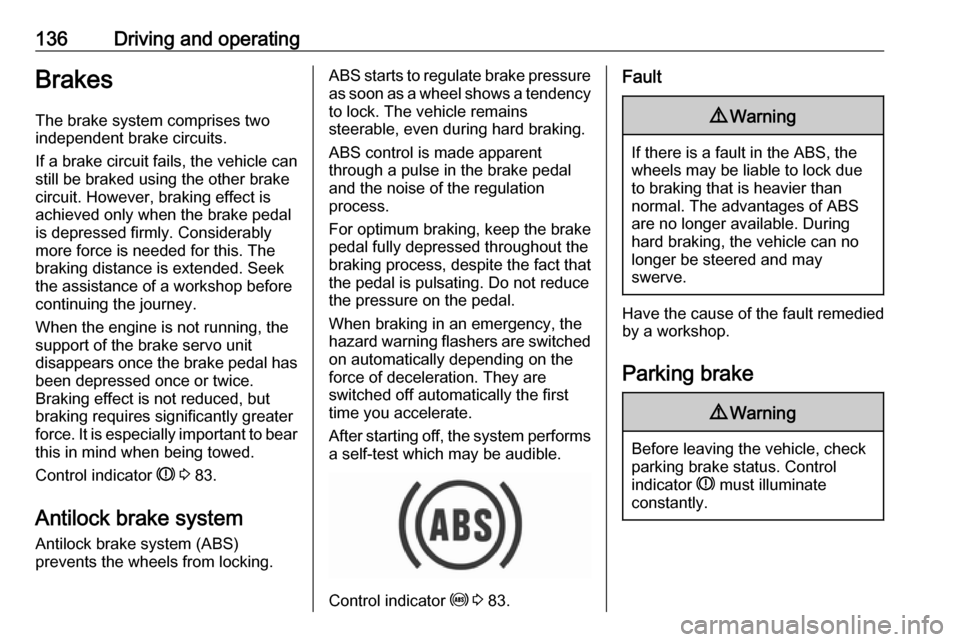
After starting off, the system performs
a self-test which may be audible.
Control indicator u 3 83.
Fault9 Warning
If there is a fault in the ABS, the
wheels may be liable to lock due
to braking that is heavier than
normal. The advantages of ABS are no longer available. During
hard braking, the vehicle can no longer be steered and may
swerve.
Have the cause of the fault remedied
by a workshop.
Parking brake
9 Warning
Before leaving the vehicle, check
parking brake status. Control
indicator R must illuminate
constantly.
Page 157 of 247
Driving and operating155
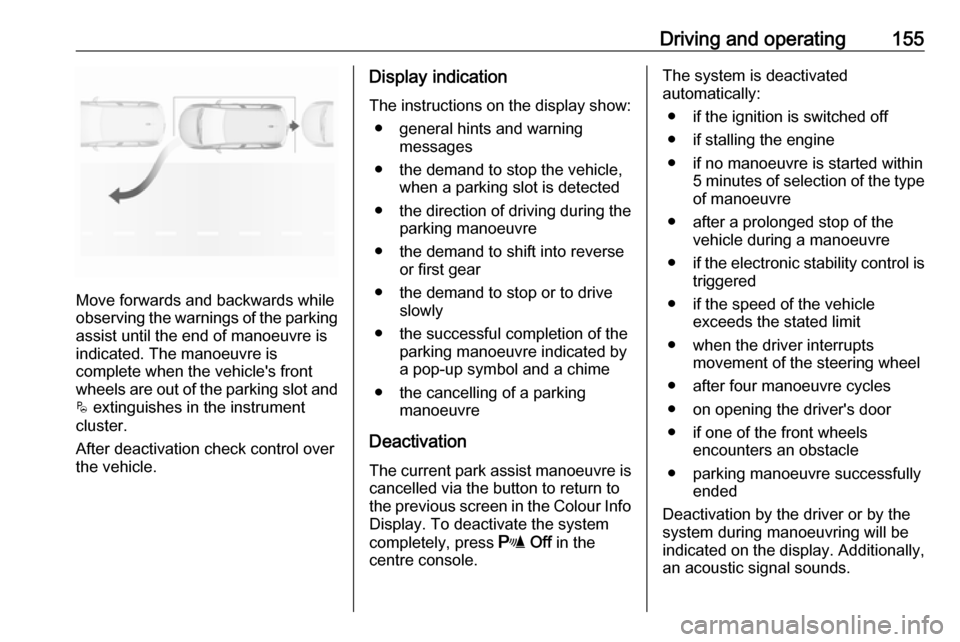
Move forwards and backwards while
observing the warnings of the parking
assist until the end of manoeuvre is
indicated. The manoeuvre is
complete when the vehicle's front
wheels are out of the parking slot and $ extinguishes in the instrument
cluster.
After deactivation check control over
the vehicle.
Display indication
The instructions on the display show: ● general hints and warning messages
● the demand to stop the vehicle, when a parking slot is detected
● the direction of driving during the
parking manoeuvre
● the demand to shift into reverse or first gear
● the demand to stop or to drive slowly
● the successful completion of the parking manoeuvre indicated bya pop-up symbol and a chime
● the cancelling of a parking manoeuvre
Deactivation
The current park assist manoeuvre is
cancelled via the button to return to
the previous screen in the Colour Info Display. To deactivate the system
completely, press r Off in the
centre console.The system is deactivated
automatically:
● if the ignition is switched off
● if stalling the engine
● if no manoeuvre is started within 5 minutes of selection of the type
of manoeuvre
● after a prolonged stop of the vehicle during a manoeuvre
● if the electronic stability control is
triggered
● if the speed of the vehicle exceeds the stated limit
● when the driver interrupts movement of the steering wheel
● after four manoeuvre cycles
● on opening the driver's door
● if one of the front wheels encounters an obstacle
● parking manoeuvre successfully ended
Deactivation by the driver or by the
system during manoeuvring will be indicated on the display. Additionally,
an acoustic signal sounds.
Page 174 of 247

172Vehicle careVehicle careGeneral Information...................172
Accessories and vehicle modifications .......................... 172
Vehicle storage ........................173
End-of-life vehicle recovery .....173
Vehicle checks ........................... 174
Performing work ......................174
Bonnet ..................................... 174
Engine oil ................................. 175
Engine coolant ......................... 176
Washer fluid ............................ 176
Brakes ..................................... 177
Brake fluid ............................... 177
Vehicle battery ......................... 177
Diesel fuel system bleeding .....179
Wiper blade replacement ........179
Bulb replacement .......................180
Halogen headlights ..................180
LED headlights ........................ 183
Front fog lights ......................... 183
Tail lights ................................. 183
Side turn lights ......................... 187
Number plate light ...................188
Interior lights ............................ 188Electrical system........................188
Fuses ....................................... 188
Engine compartment fuse box . 189
Instrument panel fuse box .......190
Vehicle tools .............................. 192
Tools ........................................ 192
Wheels and tyres .......................193
Winter tyres ............................. 193
Tyre designations ....................193
Tyre pressure .......................... 194
Tyre deflation detection system .................................... 195
Tread depth ............................. 196
Changing tyre and wheel size . 196
Wheel covers ........................... 196
Tyre chains .............................. 197
Tyre repair kit .......................... 197
Wheel changing .......................200
Spare wheel ............................ 201
Jump starting ............................. 205
Towing ....................................... 206
Towing the vehicle ...................206
Towing another vehicle ...........207
Appearance care .......................208
Exterior care ............................ 208
Interior care ............................. 210
Floor mats ............................... 211General Information
Accessories and vehicle modifications
We recommend the use of genuine parts and accessories and factory
approved parts specific for this
vehicle type. We cannot assess or
guarantee reliability of other products - even if they have a regulatory or
otherwise granted approval.
Any modification, conversion or other
changes made to standard vehicle
specifications (including, without
limitation, software modifications,
modifications of the electronic control units) may invalidate the warranty
offered by Vauxhall.
Furthermore, such changes may
affect driver assistance systems, may
impact fuel consumption, CO 2
emissions and other emissions of the
vehicle and cause the vehicle to no
longer conform to the operating
permit, impacting the validity of your
vehicle registration.
Page 175 of 247

Vehicle care173Caution
When transporting the vehicle on
a train or on a recovery vehicle, the
mud flaps might be damaged.
Vehicle storage
Storage for a long period of time
If the vehicle is to be stored for several months:
● Wash and wax the vehicle.
● Have the wax in the engine compartment and underbody
checked.
● Clean and preserve the rubber seals.
● Fill up fuel tank completely.
● Change the engine oil.
● Drain the washer fluid reservoir.
● Check the coolant antifreeze and
corrosion protection.
● Adjust tyre pressure to the value specified for full load.
● Park the vehicle in a dry, wellventilated place. Prevent the
vehicle from rolling.
● Engage first or reverse gear or set selector lever to P.
● Do not apply the parking brake.
● Open the bonnet, close all doors and lock the vehicle.
● Disconnect the clamp from the negative terminal of the vehicle
battery. Note that all systems are
not functional, e.g. central locking system.
Anti-theft alarm system 3 31.
Putting back into operation
When the vehicle is to be put back into
operation:
● Connect the clamp to the negative terminal of the vehicle
battery. Initialize the power
windows 3 36.
● Check tyre pressure.
● Fill up the washer fluid reservoir.
● Check the engine oil level.● Check the coolant level.
● Fit the number plate if necessary.
End-of-life vehicle recovery
Information on end-of-life vehicle
recovery centres and the recycling of
end-of-life vehicles is available on our website, where legally required. Only
entrust this work to an authorised
recycling centre.
Page 176 of 247
174Vehicle careVehicle checks
Performing work9 Warning
Only perform engine compartment
checks when the ignition is off.
The cooling fan may start
operating even if the ignition is off.
9 Danger
The ignition system uses
extremely high voltage. Do not
touch.
Bonnet
Opening
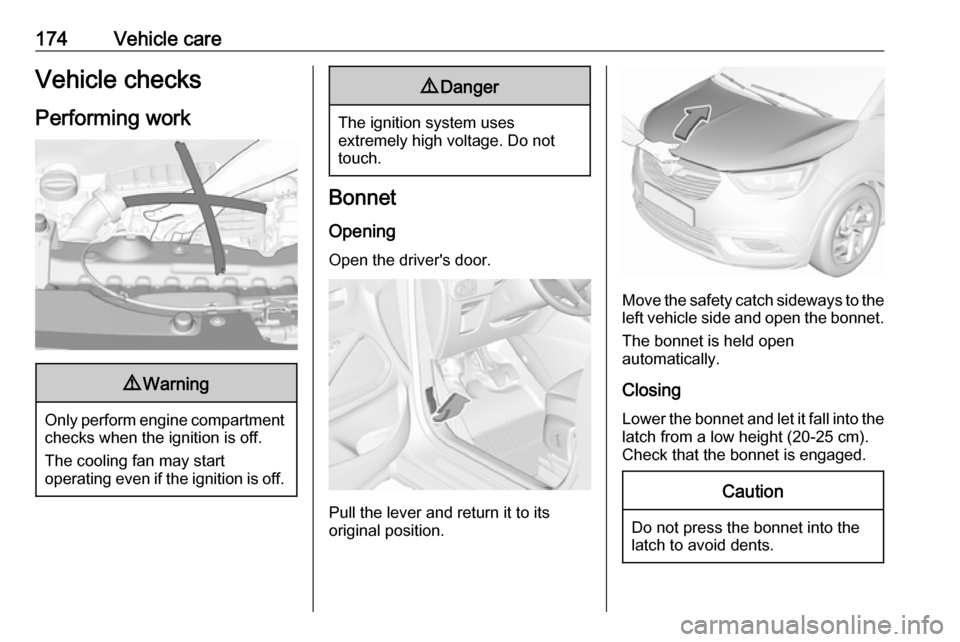
Open the driver's door.
Pull the lever and return it to its
original position.
Move the safety catch sideways to the
left vehicle side and open the bonnet.
The bonnet is held open
automatically.
Closing
Lower the bonnet and let it fall into the latch from a low height (20-25 cm).
Check that the bonnet is engaged.
Caution
Do not press the bonnet into the
latch to avoid dents.
Page 177 of 247
Vehicle care175Engine oil
Check the engine oil level manually
on a regular basis to prevent damage
to the engine. Ensure that the correct specification of engine oil is used.
Recommended fluids and lubricants
3 217.
The maximum engine oil
consumption is 0.6 l per 600 miles.
Check with the vehicle on a level
surface. The engine must be at
operating temperature and switched
off for at least 5 minutes.Caution
It is the owner's responsibility to
maintain the proper level of an
appropriate quality oil in the
engine.
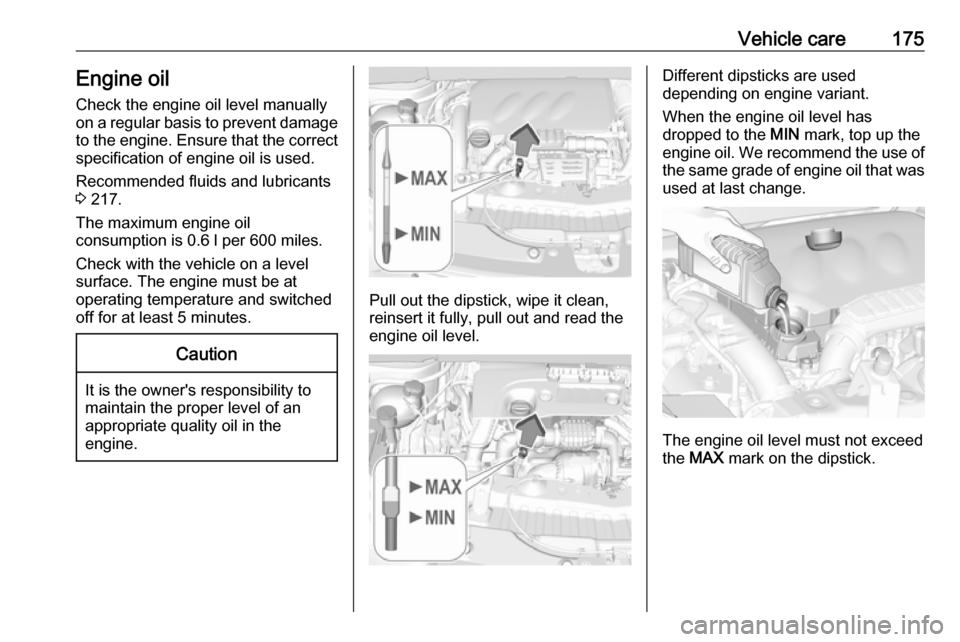
Pull out the dipstick, wipe it clean,
reinsert it fully, pull out and read the
engine oil level.
Different dipsticks are used
depending on engine variant.
When the engine oil level has
dropped to the MIN mark, top up the
engine oil. We recommend the use of the same grade of engine oil that was
used at last change.
The engine oil level must not exceed
the MAX mark on the dipstick.
Page 178 of 247
176Vehicle careCaution
Overfilled engine oil must be
drained or suctioned out. If the oil exceeds the maximum level, do
not start the vehicle and contact a
workshop.
Capacities 3 226.
Fit the cap on straight and tighten it.
Engine coolant The factory filled coolant provides
freeze protection down to approx.
-37 °C.
Caution
Only use approved antifreeze.
Coolant and antifreeze 3 217.
Coolant level
Caution
Too low a coolant level can cause engine damage.
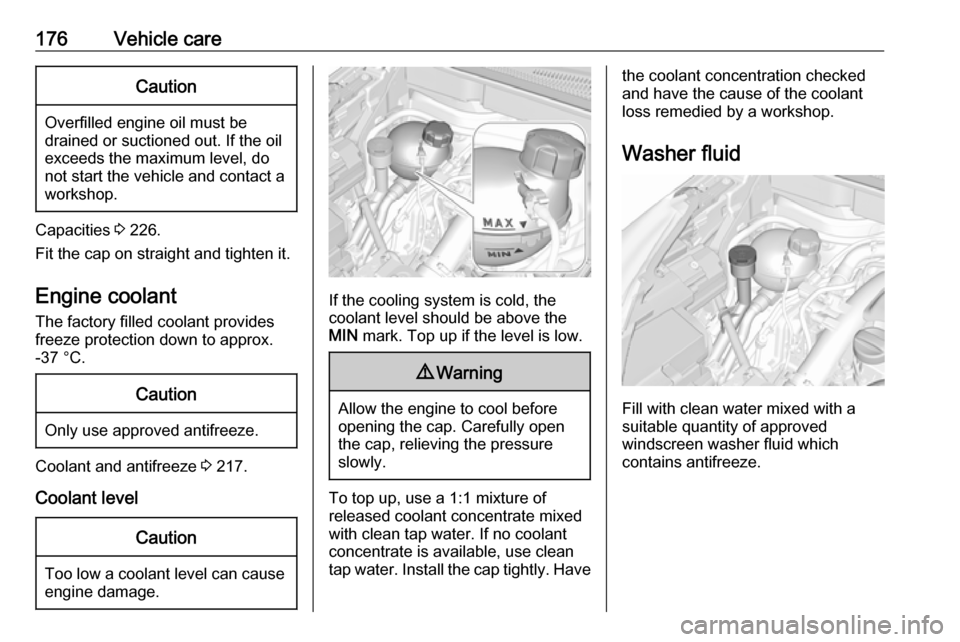
If the cooling system is cold, the
coolant level should be above the
MIN mark. Top up if the level is low.
9Warning
Allow the engine to cool before
opening the cap. Carefully open
the cap, relieving the pressure
slowly.
To top up, use a 1:1 mixture of
released coolant concentrate mixed
with clean tap water. If no coolant
concentrate is available, use clean
tap water. Install the cap tightly. Have
the coolant concentration checked
and have the cause of the coolant
loss remedied by a workshop.
Washer fluid
Fill with clean water mixed with a
suitable quantity of approved
windscreen washer fluid which
contains antifreeze.
Page 182 of 247
180Vehicle careAttach the wiper blade slightly angledto the wiper arm and push until it
engages.
Lower wiper arm carefully.Bulb replacement
Switch off the ignition and switch off
the relevant switch or close the doors.
Only hold a new bulb at the base. Do
not touch the bulb glass with bare
hands.
Use only the same bulb type for
replacement.
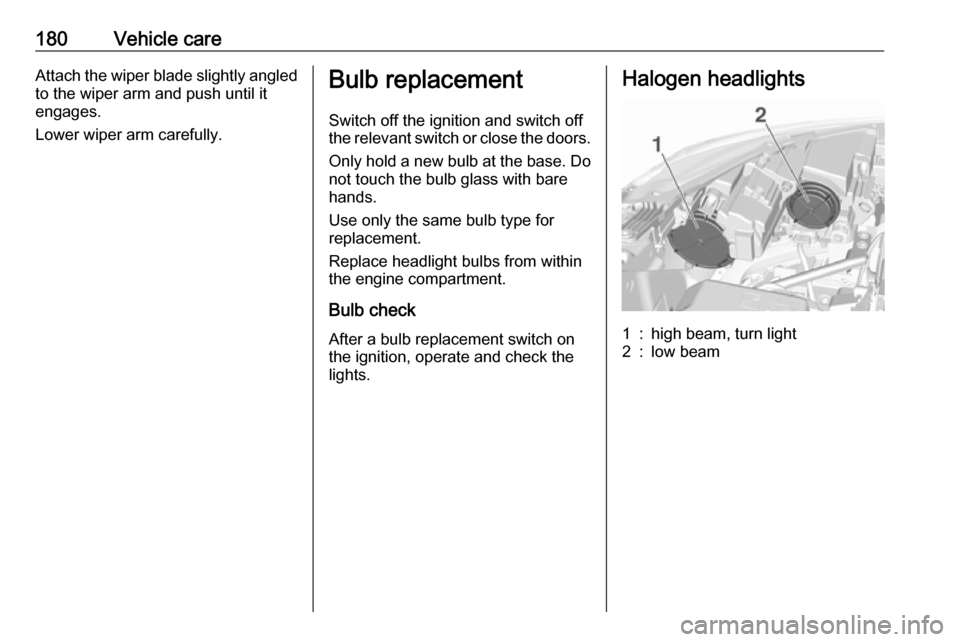
Replace headlight bulbs from within the engine compartment.
Bulb check After a bulb replacement switch on
the ignition, operate and check the
lights.Halogen headlights1:high beam, turn light2:low beam
Page 222 of 247

220Technical dataInformation on identification label:1:manufacturer2:type approval number3:vehicle identification number4:permissible gross vehicle weight
rating in kg5:permissible gross train weight
in kg6:maximum permissible front axle
load in kg7:maximum permissible rear axle
load in kg8:vehicle-specific or country-
specific data
The combined total of front and rear
axle loads must not exceed the
permissible gross vehicle weight.
Vehicle's kerb weight depends on the
specification of the vehicle, e.g.
optional equipment and accessories. Refer to the EEC Certificate of
Conformity provided with your vehicle
or other national registration
documents.
The technical data is determined in
accordance with European
Community standards. We reserve
the right to make modifications.
Specifications in the vehicle
documents always have priority over
those given in this manual.
Engine identification
The technical data tables use the
engine identifier code. The engine
data table additionally shows the
engineering code.
Engine data 3 223.
To identify the respective engine,
refer to the EEC Certificate of
Conformity provided with this vehicle
or other national registration
documents.
The Certificate of Conformity shows the engine identifier code, other
national publications may show the
engineering code. Check piston
displacement and engine power to
identify the respective engine.