change wheel VAUXHALL INSIGNIA 2014 User Guide
[x] Cancel search | Manufacturer: VAUXHALL, Model Year: 2014, Model line: INSIGNIA, Model: VAUXHALL INSIGNIA 2014Pages: 321, PDF Size: 8.83 MB
Page 180 of 321
178Driving and operating
Driver's attention■ Use adaptive cruise control carefully on bends or mountain
roads, as it can lose the vehicle
ahead and need time to detect it
again.
■ Do not use the system on slippery roads as it can create rapid
changes in tyre traction (wheel spinning), so that you could lose
control of the vehicle.
■ Do not use adaptive cruise control during rain, snow or heavy dirt, as
the radar sensor can be covered by a water film, dust, ice or snow. This
reduces or suppresses completely
the visibility. In case of sensor
blockage, clean the sensor cover.
System limits ■ The system's automatic brake force
does not permit hard braking and
the braking level may not be
sufficient to avoid a collision.
■ After a sudden lane change, the system needs a certain time to
detect the next preceding vehicle.So if a new vehicle is detected, the
system may accelerate instead of
braking.
■ Adaptive cruise control does ignore
the oncoming traffic.
■ Adaptive cruise control does not brake for pedestrians, animals or
stopped vehicles.
Bends
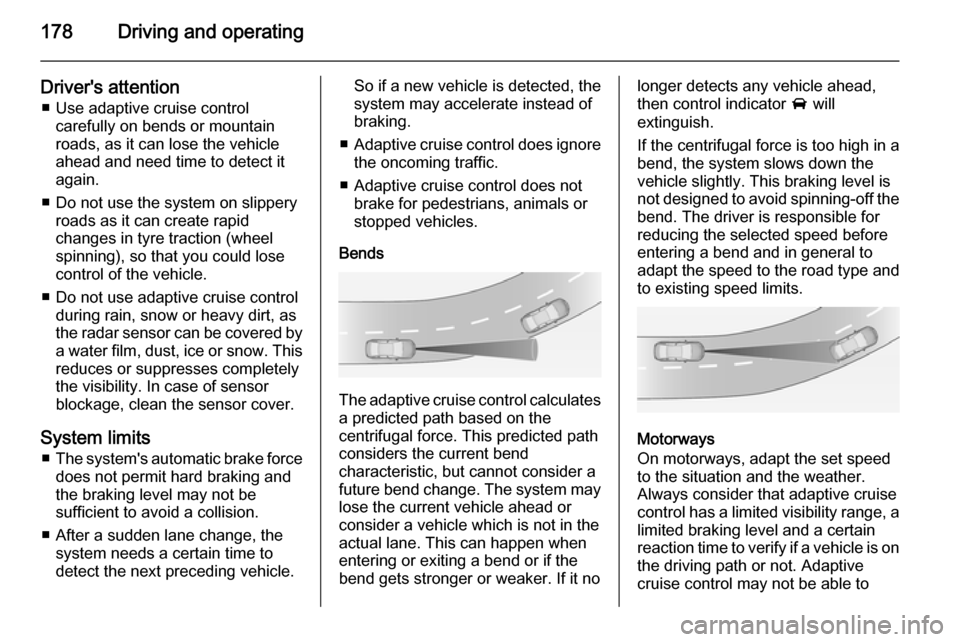
The adaptive cruise control calculates
a predicted path based on the
centrifugal force. This predicted path
considers the current bend
characteristic, but cannot consider a
future bend change. The system may lose the current vehicle ahead or
consider a vehicle which is not in the
actual lane. This can happen when
entering or exiting a bend or if the
bend gets stronger or weaker. If it no
longer detects any vehicle ahead,
then control indicator A will
extinguish.
If the centrifugal force is too high in a bend, the system slows down the vehicle slightly. This braking level is
not designed to avoid spinning-off the
bend. The driver is responsible for
reducing the selected speed before
entering a bend and in general to
adapt the speed to the road type and
to existing speed limits.
Motorways
On motorways, adapt the set speed
to the situation and the weather.
Always consider that adaptive cruise
control has a limited visibility range, a
limited braking level and a certain
reaction time to verify if a vehicle is on
the driving path or not. Adaptive
cruise control may not be able to
Page 210 of 321

208Driving and operating
General informationThe official fuel consumption and
specific CO 2 emission figures quoted
relate to the EU base model with
standard equipment.
Fuel consumption data and CO 2
emission data are determined
according to regulation R (EC) No.
715/2007 (in the version respectively
applicable), taking into consideration
the vehicle weight in running order, as
specified by the regulation.
The figures are provided only for the
purpose of comparison between different vehicle variants and mustnot be taken as a guarantee for the
actual fuel consumption of a
particular vehicle. Additional
equipment may result in slightly
higher results than the stated
consumption and CO 2 figures.
Furthermore, fuel consumption is
dependent on personal driving style as well as road and traffic conditions.Trailer hitch
General information The factory-fitted towing equipment is
folded up under the rear bumper
fascia.
Entrust retrofitting of towing
equipment to a workshop. It may be
necessary to make changes that
affect the cooling system, heat
shields or other equipment. Only use
towing equipment that has been
approved for your vehicle.
To avoid vehicle damage, the power
tailgate cannot be operated with the
radio remote control when a trailer is
electrically connected.
Fitting of towing equipment could
cover the opening of the towing eye. If this is the case use the coupling ball
bar for towing.Driving characteristics and
towing tips Before attaching a trailer, lubricate
the coupling ball. However, do not do
so if a stabiliser, which acts on the coupling ball, is being used to reduce snaking movements.
For trailers with low driving stability
and trailers with a permitted gross
vehicle weight of more than 1400 kg
(Front-wheel drive)/1600 kg (All-
wheel drive) the use of a stabiliser is
strongly recommended when driving
above 50 mph.
If the trailer starts snaking, drive more slowly, do not attempt to correct the
steering and brake sharply if
necessary.
When driving downhill, drive in the
same gear as if driving uphill and
drive at a similar speed.
Adjust tyre pressure to the value
specified for full load 3 288.
Page 214 of 321

212Vehicle careVehicle careGeneral Information...................212
Vehicle checks ........................... 213
Bulb replacement .......................221
Electrical system ........................232
Vehicle tools .............................. 238
Wheels and tyres .......................239
Jump starting ............................. 252
Towing ....................................... 253
Appearance care .......................257General Information
Accessories and vehicle
modifications
We recommend to use genuine parts and accessories and factory
approved parts specific for your
vehicle type. We cannot assess or
guarantee reliability of other products
- even if they have a regulatory or
otherwise granted approval.
Do not make any modifications to the
electrical system, e.g. changes of
electronic control units (chip tuning).Caution
When transporting the vehicle on
a train or on a recovery vehicle, the
mud flaps might be damaged.
Vehicle storage
Storage for a long period of time
If the vehicle is to be stored for several months:
■ Wash and wax the vehicle.
■ Have the wax in the engine compartment and underbody
checked.
■ Clean and preserve rubber seals.
■ Fill up fuel tank completely.
■ Change engine oil.
■ Drain washer fluid reservoir.
■ Check coolant antifreeze and corrosion protection.
■ Adjust tyre pressure to the value specified for full load.
■ Park vehicle in dry, well ventilated place. Engage first or reverse gear
or set selector lever to P. Prevent
the vehicle from rolling.
■ Do not apply parking brake.
Page 249 of 321

Vehicle care247
Notice
The driving characteristics of the
repaired tyre is severely affected,
therefore have this tyre replaced.
If unusual noise is heard or the
compressor becomes hot, turn
compressor off for at least 30
minutes.
The built-in safety valve opens at a
pressure of 7 bar.
Note the expiry date of the kit. After
this date its sealing capability is no
longer guaranteed. Pay attention to
storage information on sealant
bottle.
Replace the used sealant bottle. Dispose of the bottle as prescribed
by applicable laws.
The compressor and sealant can be used from approx. -30 °C.
The adapters supplied can be used
to pump up other items e.g.
footballs, air mattresses, inflatable
dinghies etc. They are located on the
underside of the compressor. To
remove, screw on compressor air hose and withdraw adapter.Wheel changing
Some vehicles are equipped with a
tyre repair kit instead of a spare wheel 3 244.
Make the following preparations and
observe the following information:
■ Park the vehicle on a level, firm and
non-skid surface. The front wheels
must be in the straight-ahead
position.
■ Apply the parking brake and engage first gear, reverse gear or
P .
■ Remove the spare wheel 3 249.
■ Never change more than one wheel
at once.
■ Use the jack only to change wheels
in case of puncture, not for
seasonal winter or summer tyre
change.
■ If the ground on which the vehicle is standing is soft, a solid board
(max. 1 cm thick) should be placed
under the jack.
■ No people or animals may be in the
vehicle when it is jacked-up.■ Never crawl under a jacked-up vehicle.
■ Do not start the vehicle when it is raised on the jack.
■ Clean wheel nuts and thread with a
clean cloth before mounting the
wheel.9 Warning
Do not grease wheel bolt, wheel
nut and wheel nut cone.
1. Disengage wheel nut caps with a screwdriver and remove. Pull off
Page 251 of 321
Vehicle care249
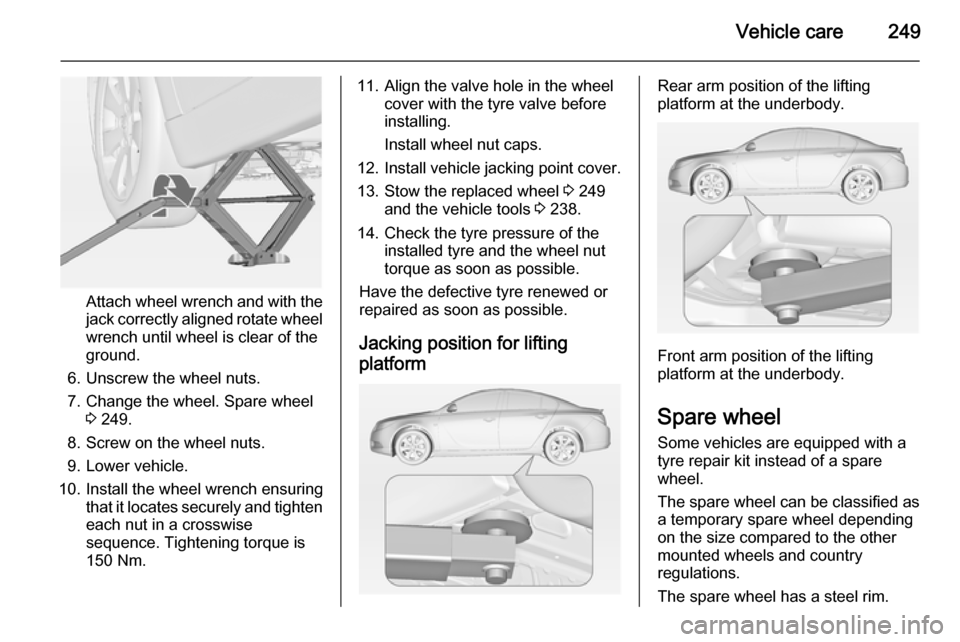
Attach wheel wrench and with the
jack correctly aligned rotate wheel wrench until wheel is clear of the
ground.
6. Unscrew the wheel nuts. 7. Change the wheel. Spare wheel 3 249.
8. Screw on the wheel nuts.
9. Lower vehicle.
10. Install the wheel wrench ensuring that it locates securely and tighten
each nut in a crosswise
sequence. Tightening torque is
150 Nm.
11. Align the valve hole in the wheel cover with the tyre valve before
installing.
Install wheel nut caps.
12. Install vehicle jacking point cover.
13. Stow the replaced wheel 3 249
and the vehicle tools 3 238.
14. Check the tyre pressure of the installed tyre and the wheel nuttorque as soon as possible.
Have the defective tyre renewed or
repaired as soon as possible.
Jacking position for liftingplatformRear arm position of the lifting
platform at the underbody.
Front arm position of the lifting
platform at the underbody.
Spare wheel Some vehicles are equipped with a
tyre repair kit instead of a spare
wheel.
The spare wheel can be classified as
a temporary spare wheel depending
on the size compared to the other
mounted wheels and country
regulations.
The spare wheel has a steel rim.
Page 252 of 321
250Vehicle careCaution
The use of a spare wheel that issmaller than the other wheels or in combination with winter tyres
could affect driveability. Have the defective tyre replaced as soon as
possible.
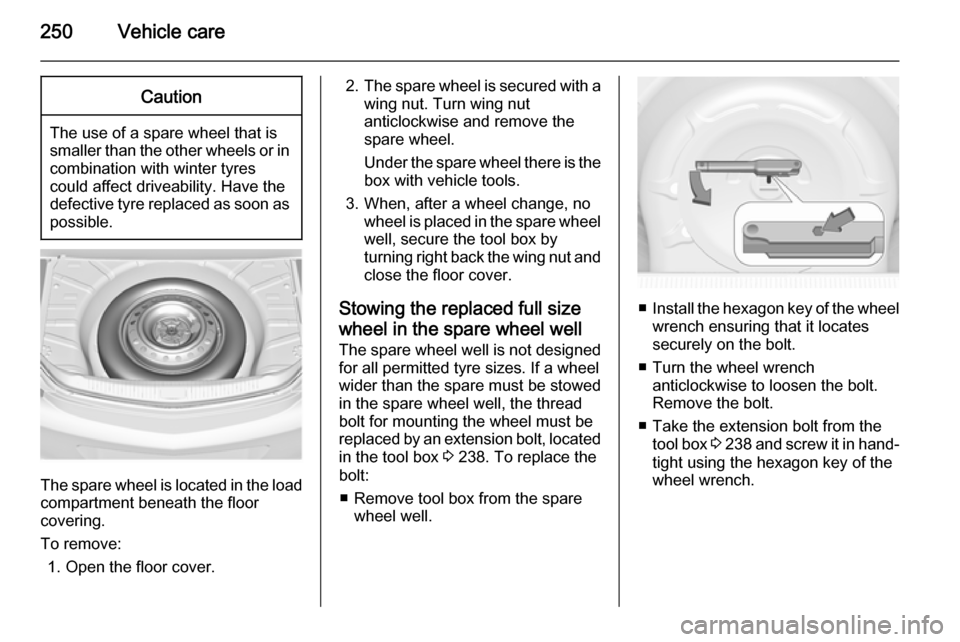
The spare wheel is located in the load
compartment beneath the floor
covering.
To remove:
1. Open the floor cover.
2. The spare wheel is secured with a
wing nut. Turn wing nut
anticlockwise and remove the
spare wheel.
Under the spare wheel there is the box with vehicle tools.
3. When, after a wheel change, no wheel is placed in the spare wheel
well, secure the tool box by
turning right back the wing nut and close the floor cover.
Stowing the replaced full size wheel in the spare wheel well
The spare wheel well is not designed for all permitted tyre sizes. If a wheel
wider than the spare must be stowed
in the spare wheel well, the thread
bolt for mounting the wheel must be
replaced by an extension bolt, located
in the tool box 3 238. To replace the
bolt:
■ Remove tool box from the spare wheel well.
■Install the hexagon key of the wheel
wrench ensuring that it locates
securely on the bolt.
■ Turn the wheel wrench anticlockwise to loosen the bolt.
Remove the bolt.
■ Take the extension bolt from the tool box 3 238 and screw it in hand-
tight using the hexagon key of the
wheel wrench.
Page 253 of 321
Vehicle care251
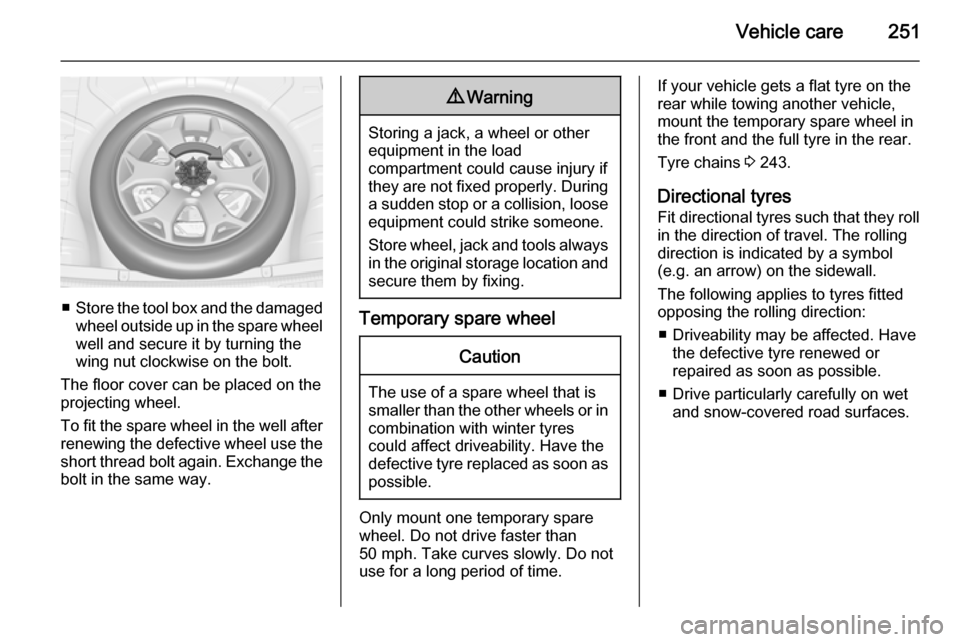
■Store the tool box and the damaged
wheel outside up in the spare wheel well and secure it by turning the
wing nut clockwise on the bolt.
The floor cover can be placed on the
projecting wheel.
To fit the spare wheel in the well after
renewing the defective wheel use the
short thread bolt again. Exchange the bolt in the same way.
9 Warning
Storing a jack, a wheel or other
equipment in the load
compartment could cause injury if they are not fixed properly. During a sudden stop or a collision, looseequipment could strike someone.
Store wheel, jack and tools always
in the original storage location and secure them by fixing.
Temporary spare wheel
Caution
The use of a spare wheel that issmaller than the other wheels or in
combination with winter tyres
could affect driveability. Have the defective tyre replaced as soon as
possible.
Only mount one temporary spare
wheel. Do not drive faster than
50 mph. Take curves slowly. Do not
use for a long period of time.
If your vehicle gets a flat tyre on the
rear while towing another vehicle,
mount the temporary spare wheel in
the front and the full tyre in the rear.
Tyre chains 3 243.
Directional tyres Fit directional tyres such that they roll
in the direction of travel. The rolling
direction is indicated by a symbol
(e.g. an arrow) on the sidewall.
The following applies to tyres fitted
opposing the rolling direction:
■ Driveability may be affected. Have the defective tyre renewed or
repaired as soon as possible.
■ Drive particularly carefully on wet and snow-covered road surfaces.
Page 318 of 321

316
GGauges ......................................... 95
Gear shifting ............................... 102
General information ...................208
Glovebox ..................................... 66
H
Halogen headlights ....................222
Hand brake ......................... 162, 163
Hazard warning flashers ............127
Headlight flash ........................... 123
Headlight range adjustment ......123
Headlights................................... 121
Headlights when driving abroad 124
Head restraint adjustment .............8
Head restraints ............................ 44
Heated mirrors ............................. 37
Heated rear window ..................... 41
Heated steering wheel .................82
Heating ........................................ 52
High beam ......................... 104, 122
High beam assist ................105, 122
Hill start assist ........................... 165
Horn ....................................... 13, 82
I
Identification plate .....................263
Ignition switch positions .............148
Immobiliser .......................... 35, 104
Indicators ...................................... 95Information displays.................... 106
Instrument cluster ........................90
Instrument panel fuse box .........235
Instrument panel illumination .....231
Instrument panel illumination control .................................... 129
Instrument panel overview ........... 10
Interactive driving system ...........167
Interior care ............................... 258
Interior lighting ............................ 129
Interior lights ...................... 129, 231
Interior mirrors .............................. 38
Interruption of power supply ......159
Introduction .................................... 3
ISOFIX child restraint systems ....65
J Jump starting ............................. 252
K Key, memorised settings ..............22
Keys ............................................. 19
Keys, locks ................................... 19
L
Lane change alert .......................192
Lane departure warning .....102, 200
Lashing eyes ............................... 72
Lighting features .........................130
Light switch ................................ 121Load compartment ................28, 68
Load compartment cover .............70
Load compartment fuse box ......237
Loading information .....................79
Low fuel ..................................... 104
M
Malfunction indicator light ..........101
Manual anti-dazzle ......................38
Manual mode ............................. 158
Manual transmission .................. 161
Memorised settings ......................22
Mirror adjustment ........................... 9
Misted light covers .....................128
N New vehicle running-in ..............148
Number plate light .....................230
O
Object detection systems ...........186
Odometer ..................................... 95
Oil, engine .......................... 261, 265
Outside temperature ....................85
Overrun cut-off ........................... 151
P Parking ................................ 18, 154
Parking assist ...................... 37, 186
Parking brake ............................ 163
Page 320 of 321

318
Tread depth ............................... 242
Trip odometer .............................. 95
Turn and lane-change signals ...127
Turn signal ................................... 99
Tyre chains ................................ 243
Tyre designations ......................239
Tyre pressure ............................ 239
Tyre pressure monitoring system ............................ 103, 240
Tyre pressures ........................... 288
Tyre repair kit ............................. 244
U Ultrasonic parking assist ...102, 186
Upholstery .................................. 258
Upshift ........................................ 102
Using this manual ..........................3
V Valet mode ................................. 113
Variable effort steering ...............102
Vehicle battery ........................... 218
Vehicle checks............................ 213
Vehicle data ................................ 265
Vehicle data recording and privacy ..................................... 311
Vehicle detected ahead ..............105
Vehicle dimensions .................... 285
Vehicle Identification Number ....263
Vehicle jack ................................ 238Vehicle messages .....................115
Vehicle personalisation .............117
Vehicle security ............................ 32
Vehicle specific data ......................3
Vehicle storage ........................... 212
Vehicle tools ............................... 238
Vehicle unlocking ........................... 6
Vehicle weight ........................... 274
Ventilating ..................................... 53
Ventilation ................................... 133
W
Warning chimes .........................116
Warning lights ............................... 95
Warning triangle .......................... 77
Washer and wiper systems .........13
Washer fluid ............................... 217
Wheel changing .........................247
Wheel covers ............................. 243
Wheels and tyres .......................239
Windows ....................................... 38
Windscreen................................... 38
Windscreen wiper/washer ...........83
Winter tyres ............................... 239
Wiper blade replacement ..........220
X Xenon headlights .......................224