window VAUXHALL INSIGNIA 2015.5 Workshop Manual
[x] Cancel search | Manufacturer: VAUXHALL, Model Year: 2015.5, Model line: INSIGNIA, Model: VAUXHALL INSIGNIA 2015.5Pages: 331, PDF Size: 9.08 MB
Page 161 of 331

Driving and operating159
■ The stop-start system is manuallydeactivated.
■ The bonnet is opened.
■ The driver's seat belt is unfastened
and the driver's door is opened.
■ The engine temperature is too low.
■ The charging level of the vehicle battery is below a defined level.
■ The brake vacuum is not sufficient.
■ The vehicle is driven at least at walking speed.
■ The climate control system requests an engine start.
■ The air conditioning is manually switched on.
If the bonnet is not fully closed, a warning message is displayed in the
Driver Information Centre.
If an electrical accessory, e.g. a
portable CD player, is connected to
the power outlet, a brief power drop during the restart might be noticeable.Parking9 Warning
■ Do not park the vehicle on an
easily ignitable surface. The
high temperature of the exhaust system could ignite the surface.
■ Always apply the parking brake.
Activate the manual parking
brake without pressing the
release button. Apply as firmly
as possible on a downhill slope
or uphill slope. Depress foot
brake at the same time to
reduce operating force.
For vehicles with electric
parking brake, pull switch m for
approx. one second.
The electric parking brake is
applied when control indicator
m illuminates 3 106.
■ Switch off the engine. ■ If the vehicle is on a level surface or uphill slope, engage
first gear or set the selector lever
to position P before removing
the ignition key. On an uphill
slope, turn the front wheels
away from the kerb.
If the vehicle is on a downhill
slope, engage reverse gear or
set the selector lever to position P before removing the ignition
key. Turn the front wheels
towards the kerb.
■ Close the windows and the sunroof.
■ Remove the ignition key. Turn the steering wheel until the
steering wheel lock is felt to
engage.
For vehicles with automatic
transmission, the key can only
be removed when the selector
lever is in position P.
■
Lock the vehicle with button e on
the radio remote control.
Page 162 of 331
160Driving and operating
Activate the anti-theft alarm system
3 33.
■ The engine cooling fans may run after the engine has been switchedoff 3 223.Caution
After running at high engine
speeds or with high engine loads,
operate the engine briefly at a low load or run in neutral for
approx. 30 seconds before
switching off, in order to protect
the turbocharger.
Notice
In the event of an accident with airbag deployment, the engine is
turned off automatically if the vehicle
comes to a standstill within a certain time.
Engine exhaust9 Danger
Engine exhaust gases contain
poisonous carbon monoxide,
which is colourless and odourless and could be fatal if inhaled.
If exhaust gases enter the interior
of the vehicle, open the windows.
Have the cause of the fault
rectified by a workshop.
Avoid driving with an open load
compartment, otherwise exhaust
gases could enter the vehicle.
Diesel particle filter
The diesel particle filter system filters
harmful soot particles out of the
exhaust gases. The system includes
a self-cleaning function that runs
automatically during driving without
any notification. The filter is cleaned
by periodically burning off the soot
particles at high temperature. This
process takes place automatically
under set driving conditions and may
take up to 25 minutes. Typically it
needs between 7 and 12 minutes.
Autostop is not available and fuel
consumption may be higher during
this period. The emission of smells
and smoke during this process is
normal.
Under certain driving conditions, e.g.
short distances, the system cannot
clean itself automatically.
If the cleaning of the filter is required
and if previous driving conditions did
not enable automatic cleaning, it will
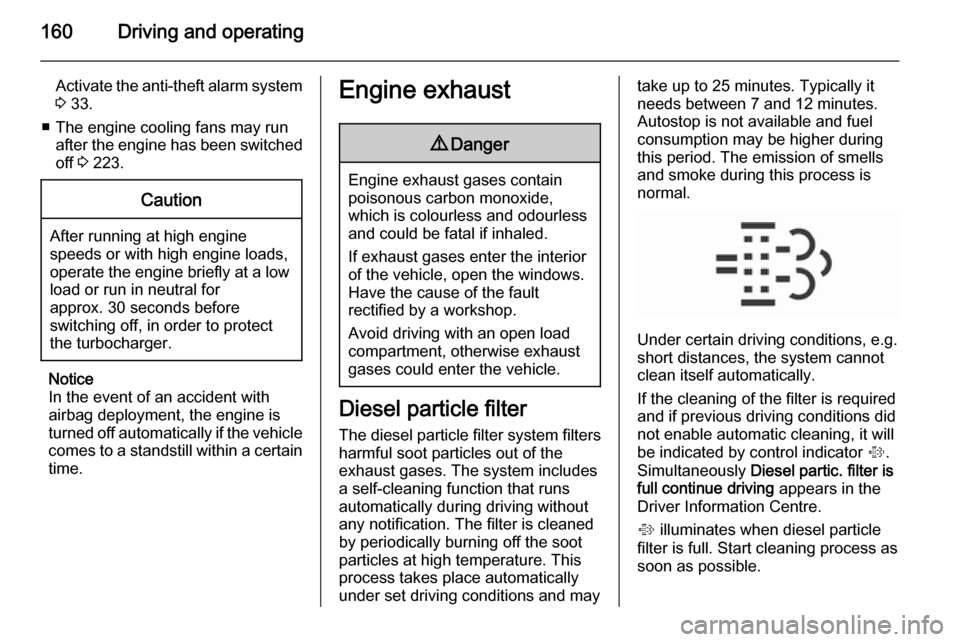
be indicated by control indicator %.
Simultaneously Diesel partic. filter is
full continue driving appears in the
Driver Information Centre.
% illuminates when diesel particle
filter is full. Start cleaning process as
soon as possible.
Page 225 of 331

Vehicle care223
■ Open bonnet, close all doors andlock the vehicle.
■ Disconnect the clamp from the negative terminal of the vehicle
battery. Beware that all systems are
not functional, e.g. anti-theft alarm
system.
Putting back into operation
When the vehicle is to be put back into
operation:
■ Connect the clamp to the negative terminal of the vehicle battery.
Activate the electronics of the
power windows.
■ Check tyre pressure.
■ Fill up the washer fluid reservoir.
■ Check the engine oil level.
■ Check the coolant level.
■ Fit the number plate if necessary.
End-of-life vehicle
recovery
Information on end-of-life vehicle
recovery centres and the recycling of
end-of-life vehicles is available on ourwebsite, where legally required. Only
entrust this work to an authorised
recycling centre.
Gas vehicles must be recycled by a
service centre authorised for gas
vehicles.Vehicle checks
Performing work9 Warning
Only perform engine compartment
checks when the ignition is off.
The cooling fan may start
operating even if the ignition is off.
Page 233 of 331
Vehicle care231Wiper blade replacementWiper blades on the windscreen
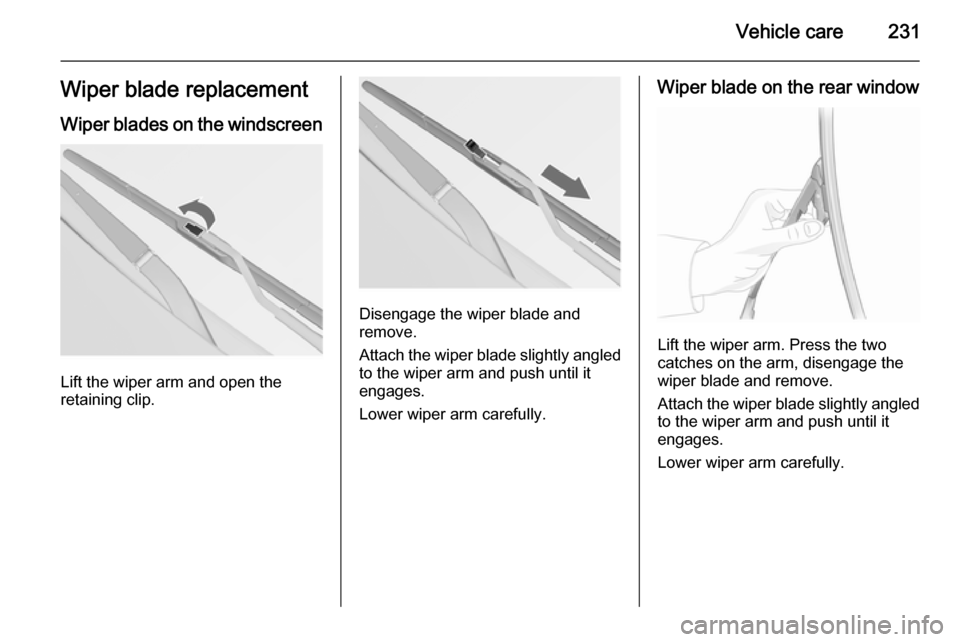
Lift the wiper arm and open the
retaining clip.
Disengage the wiper blade and
remove.
Attach the wiper blade slightly angled
to the wiper arm and push until it
engages.
Lower wiper arm carefully.
Wiper blade on the rear window
Lift the wiper arm. Press the two
catches on the arm, disengage the
wiper blade and remove.
Attach the wiper blade slightly angled
to the wiper arm and push until it
engages.
Lower wiper arm carefully.
Page 246 of 331

244Vehicle care
No.Circuit1Transmission control module2Engine control module3–4–5Ignition/Transmission control
module/Engine control module6Windscreen wiper7–8Fuel injection/Ignition system9Fuel injection/Ignition system10Engine control module11Lambda probe12Starter13Sensor throttle heating14Lighting15Rear window wiperNo.Circuit16Vacuum pump/Mass air flow
meter/Water in fuel sensor/DC
transformer17–18Adaptive forward lighting19Adaptive forward lighting20Fuel pump21Rear power windows22ABS23Variable effort steering24Front power windows25Power outlets26ABS27Electric parking brake28Heated rear window29Left power seat30Right power seatNo.Circuit31Air conditioning system32Body control module33Heated front seats34Sunroof35Infotainment system36–37Right high beam38Left high beam39–40–41Vacuum pump42Radiator fan43Vehicle battery/DC transformer
(only on vehicles with stop-start
system)44Headlamp washer system45Radiator fan
Page 247 of 331

Vehicle care245
No.Circuit46Terminal 87/Main relay47Lambda probe48Fog lights49Right low beam50Left low beam51Horn52Ignition53Ignition/Ventilated front seats54Ignition55Power windows/Mirror folding56Windscreen washer57–58–59Diesel fuel heating/Emission
control system60Mirror heating61Mirror heatingNo.Circuit62–63Rear window sensor64Adaptive forward lighting65Auxiliary pump (only on vehicles
with stop-start system)66Rear window washer system67Fuel system control module68–69Vehicle battery sensor70Rain sensor71Vehicle battery sensor
After changing of defective fuses,
close the fuse box cover and press
until it engages.
If the fuse box cover is not closed
correctly, malfunctions may occur.
Instrument panel fuse box
In left-hand drive vehicles, the fuse
box is behind the storage
compartment in the instrument panel.
Open compartment, compress the
locking tabs, fold compartment down and remove.
Page 266 of 331
264Vehicle care
far away from the discharged
battery as possible, however at
least 60 cm.
Route the leads so that they cannot
catch on rotating parts in the engine
compartment.
To start the engine: 1. Start the engine of the vehicle providing the jump.
2. After 5 minutes, start the other engine. Start attempts should be
made for no longer than
15 seconds at an interval of
1 minute.
3. Allow both engines to idle for approx. 3 minutes with the leads
connected.
4. Switch on electrical consumers (e.g. headlights, heated rear
window) of the vehicle receiving
the jump start.
5. Reverse above sequence exactly when removing leads.Towing
Towing the vehicle
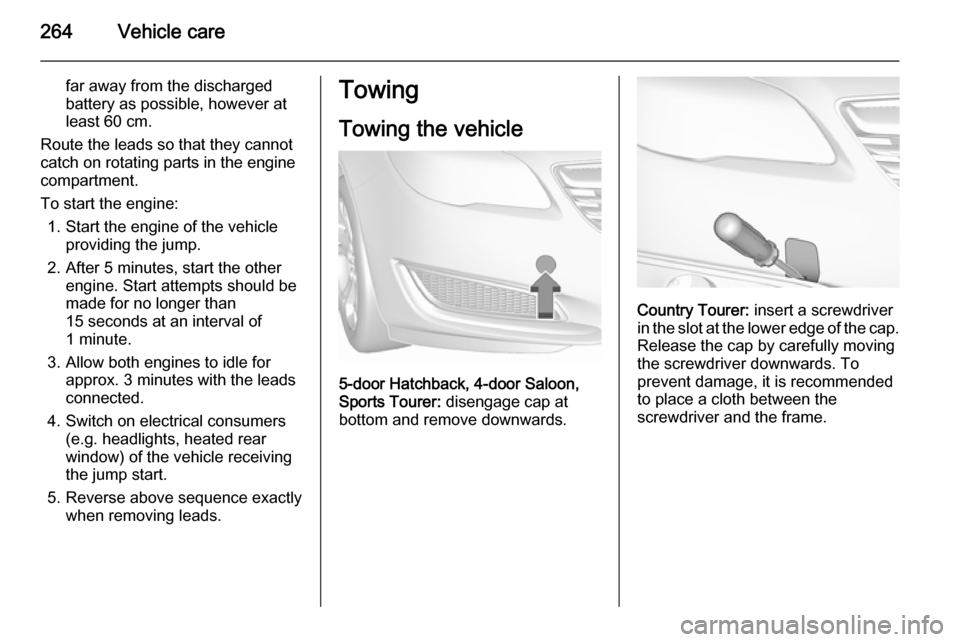
5-door Hatchback, 4-door Saloon,
Sports Tourer: disengage cap at
bottom and remove downwards.
Country Tourer: insert a screwdriver
in the slot at the lower edge of the cap. Release the cap by carefully moving
the screwdriver downwards. To
prevent damage, it is recommended
to place a cloth between the
screwdriver and the frame.
Page 267 of 331
Vehicle care265
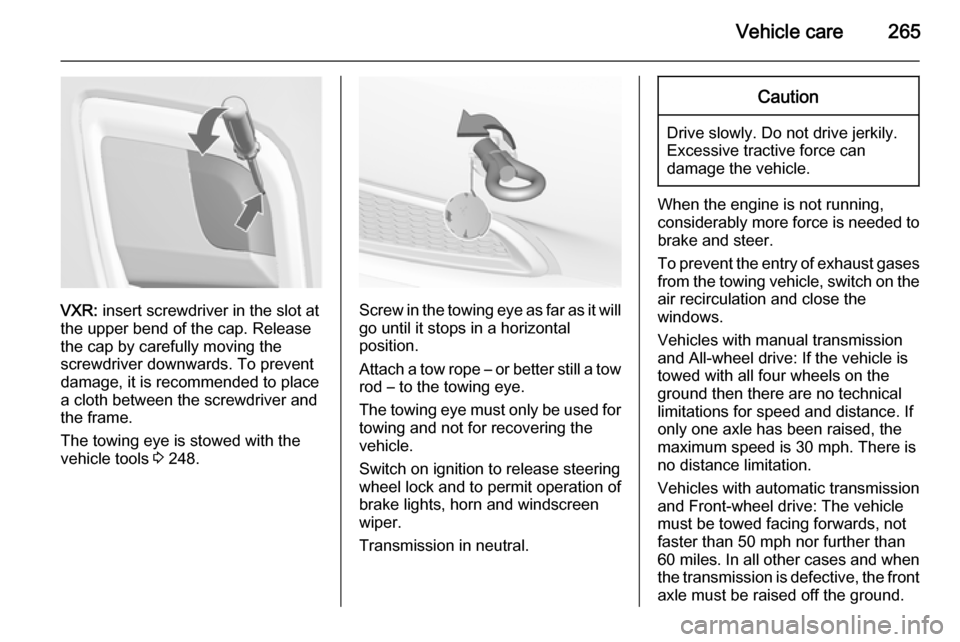
VXR: insert screwdriver in the slot at
the upper bend of the cap. Release
the cap by carefully moving the
screwdriver downwards. To prevent
damage, it is recommended to place
a cloth between the screwdriver and
the frame.
The towing eye is stowed with the vehicle tools 3 248.Screw in the towing eye as far as it will
go until it stops in a horizontal
position.
Attach a tow rope – or better still a tow
rod – to the towing eye.
The towing eye must only be used for towing and not for recovering the
vehicle.
Switch on ignition to release steering
wheel lock and to permit operation of
brake lights, horn and windscreen
wiper.
Transmission in neutral.
Caution
Drive slowly. Do not drive jerkily.
Excessive tractive force can
damage the vehicle.
When the engine is not running,
considerably more force is needed to
brake and steer.
To prevent the entry of exhaust gases from the towing vehicle, switch on the
air recirculation and close the
windows.
Vehicles with manual transmission
and All-wheel drive: If the vehicle is
towed with all four wheels on the
ground then there are no technical
limitations for speed and distance. If
only one axle has been raised, the
maximum speed is 30 mph. There is
no distance limitation.
Vehicles with automatic transmission
and Front-wheel drive: The vehicle
must be towed facing forwards, not
faster than 50 mph nor further than
60 miles . In all other cases and when
the transmission is defective, the front
axle must be raised off the ground.
Page 270 of 331

268Vehicle care
If using a vehicle wash, comply with
the vehicle wash manufacturer's
instructions. The windscreen wiper and rear window wiper must be
switched off. Remove antenna and
external accessories such as roof
racks etc.
If you wash your vehicle by hand,
make sure that the insides of the
wheel housings are also thoroughly
rinsed out.
Wax painted parts of the vehicle
regularly.
Clean edges and folds on opened
doors and the bonnet as well as the
areas they cover.Caution
Always use a cleaning agent with
a pH value of 4 to 9.
Do not use cleaning agents on hot surfaces.
Do not clean the engine compartmentwith a steam-jet or high-pressure jet
cleaner.
Thoroughly rinse and leather-off the vehicle. Rinse leather frequently. Use
separate leathers for painted and
glass surfaces: remnants of wax on
the windows will impair vision.
Have the door hinges of all doors
greased by a workshop.
Exterior lights Headlight and other light covers aremade of plastic. Do not use any
abrasive or caustic agents, do not use
an ice scraper, and do not clean them dry.
Polishing and waxing
Wax the vehicle regularly (at the
latest when water no longer beads).
Otherwise, the paintwork will dry out.
Polishing is necessary only if the paint
has become dull or if solid deposits
have become attached to it.
Paintwork polish with silicone forms a
protective film, making waxing
unnecessary.
Plastic body parts must not be treated with wax or polishing agents.Windows and windscreen wiper
blades
Use a soft lint-free cloth or chamois leather together with window cleaner and insect remover.
When cleaning the rear window from
inside, always wipe in parallel to the
heating element to prevent damage.
For mechanical removal of ice, use a
sharp-edged ice scraper. Press the
scraper firmly against the glass so
that no dirt can get under it and
scratch the glass.
Clean smearing wiper blades with a
soft cloth and window cleaner.
Remove dirt residues from smearing
wiper blades by using a soft cloth and window cleaner. Also make sure to
remove any residues such as wax,
insect residues and similar from the
window.
Ice residues, pollution and continuous wiping on dry windows will damage or
even destroy the wiper blades.
Page 328 of 331

326
Fuel for petrol engines ...............210
Fuel gauge ................................. 101
Fuel selector .............................. 102
Fuses ......................................... 242
G Gauges ....................................... 100
Gear shifting ............................... 107
General information ...................218
Glovebox ..................................... 70
H Halogen headlights ....................232
Hand brake ......................... 169, 170
Hazard warning flashers ............132
Headlight flash ........................... 128
Headlight range adjustment ......128
Headlights................................... 126 Headlights when driving abroad 129
Head restraint adjustment .............8
Head restraints ............................ 45
Heated mirrors ............................. 38
Heated rear window ..................... 41
Heated steering wheel .................87
Heating ........................................ 53
High beam ......................... 110, 127
High beam assist ................110, 127
Hill start assist ........................... 172
Horn ....................................... 13, 87I
Identification plate .....................274
Ignition switch positions .............153
Immobiliser .......................... 36, 109
Indicators .................................... 100
Information displays.................... 111
Instrument cluster ........................95
Instrument panel fuse box .........245
Instrument panel illumination .....241
Instrument panel illumination control .................................... 134
Instrument panel overview ........... 10
Interactive driving system ...........174
Interior care ............................... 269
Interior lighting ............................ 134
Interior lights ...................... 134, 241
Interior mirrors .............................. 38
Interruption of power supply ......168
Introduction .................................... 3
ISOFIX child restraint systems ....69
J Jump starting ............................. 262
K Key, memorised settings ..............23
Keys ............................................. 20
Keys, locks ................................... 20L
Lane change alert .......................201
Lane departure warning .....107, 209
Lashing eyes ............................... 77
Lighting features .........................135
Light switch ................................ 126
Load compartment ................28, 72
Load compartment cover .............74
Load compartment fuse box ......247
Loading information .....................84
Low fuel ..................................... 109
M
Malfunction indicator light ..........106
Manual anti-dazzle ......................38
Manual mode ............................. 166
Manual transmission .................. 168
Manual windows ..........................39
Memorised settings ......................23
Mirror adjustment ........................... 9
Misted light covers .....................133
N New vehicle running-in ..............153
Number plate light .....................240
O Object detection systems ...........193
Odometer ................................... 100
Oil, engine .......................... 272, 276