ECO mode VAUXHALL INSIGNIA 2015 Owner's Guide
[x] Cancel search | Manufacturer: VAUXHALL, Model Year: 2015, Model line: INSIGNIA, Model: VAUXHALL INSIGNIA 2015Pages: 321, PDF Size: 8.99 MB
Page 208 of 321
206Driving and operating
Press the LPG button to switch
between petrol and liquid gas
operation as soon as the required
parameters (coolant temperature,
gas temperature and minimum
engine speed) have been reached.
The requirements are usually fulfilled
after around 60 seconds (depending
on exterior temperature) and the first
firm press on the accelerator. The
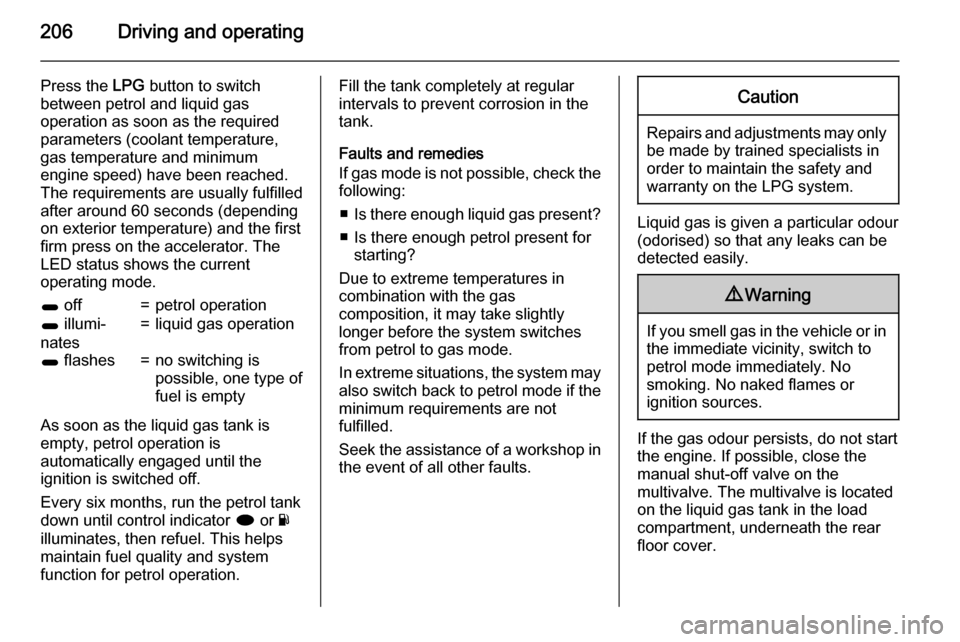
LED status shows the current
operating mode.1 off=petrol operation1 illumi‐
nates=liquid gas operation1 flashes=no switching is
possible, one type of
fuel is empty
As soon as the liquid gas tank is
empty, petrol operation is
automatically engaged until the
ignition is switched off.
Every six months, run the petrol tank
down until control indicator i or Y
illuminates, then refuel. This helps
maintain fuel quality and system
function for petrol operation.
Fill the tank completely at regular
intervals to prevent corrosion in the
tank.
Faults and remedies
If gas mode is not possible, check the following:
■ Is there enough liquid gas present?
■ Is there enough petrol present for starting?
Due to extreme temperatures in
combination with the gas
composition, it may take slightly
longer before the system switches
from petrol to gas mode.
In extreme situations, the system may
also switch back to petrol mode if the
minimum requirements are not
fulfilled.
Seek the assistance of a workshop in the event of all other faults.Caution
Repairs and adjustments may onlybe made by trained specialists in
order to maintain the safety and
warranty on the LPG system.
Liquid gas is given a particular odour
(odorised) so that any leaks can be
detected easily.
9 Warning
If you smell gas in the vehicle or in
the immediate vicinity, switch to petrol mode immediately. No
smoking. No naked flames or
ignition sources.
If the gas odour persists, do not start
the engine. If possible, close the
manual shut-off valve on the
multivalve. The multivalve is located
on the liquid gas tank in the load
compartment, underneath the rear
floor cover.
Page 213 of 321

Driving and operating211
General informationThe official fuel consumption and
specific CO 2 emission figures quoted
relate to the EU base model with standard equipment.
Fuel consumption data and CO 2
emission data are determined
according to regulation R (EC) No.
715/2007 (in the version respectively
applicable), taking into consideration
the vehicle weight in running order, as specified by the regulation.
The figures are provided only for the
purpose of comparison between
different vehicle variants and must not be taken as a guarantee for the
actual fuel consumption of a
particular vehicle. Additional
equipment may result in slightly
higher results than the stated
consumption and CO 2 figures.
Furthermore, fuel consumption is
dependent on personal driving style
as well as road and traffic conditions.Trailer hitch
General information
The factory-fitted towing equipment is folded up under the rear bumper
fascia.
Entrust retrofitting of towing
equipment to a workshop. It may be
necessary to make changes that
affect the cooling system, heat
shields or other equipment. Only use
towing equipment that has been
approved for your vehicle.
To avoid vehicle damage, the power
tailgate cannot be operated with the
radio remote control when a trailer is
electrically connected.
Fitting of towing equipment could
cover the opening of the towing eye.
If this is the case use the coupling ball
bar for towing.Driving characteristics and
towing tips Before attaching a trailer, lubricate
the coupling ball. However, do not do
so if a stabiliser, which acts on the coupling ball, is being used to reduce snaking movements.
For trailers with low driving stability
and trailers with a permitted gross
vehicle weight of more than 1400 kg
(Front-wheel drive)/1600 kg (All- wheel drive) the use of a stabiliser is
strongly recommended when driving
above 50 mph.
If the trailer starts snaking, drive more
slowly, do not attempt to correct the
steering and brake sharply if
necessary.
When driving downhill, drive in the
same gear as if driving uphill and
drive at a similar speed.
Adjust tyre pressure to the value
specified for full load 3 286.
Page 320 of 321

318
Transmission ............................... 16
Transmission display .................160
Tread depth ............................... 245
Trip odometer .............................. 99
Turn and lane-change signals ...131
Turn signal ................................. 103
Tyre chains ................................ 247
Tyre designations ......................242
Tyre pressure ............................ 243
Tyre pressure monitoring system ............................ 107, 243
Tyre pressures ........................... 286
Tyre repair kit ............................. 247
U Ultrasonic parking assist ...106, 189
Upholstery .................................. 262
Upshift ........................................ 106
Using this manual ..........................3
V Valet mode ................................. 117
Variable effort steering ...............106
Vehicle battery ........................... 221
Vehicle checks............................ 216
Vehicle data ................................ 269
Vehicle data recording and privacy ..................................... 311
Vehicle detected ahead ..............109
Vehicle dimensions .................... 284Vehicle Identification Number ....267
Vehicle jack ................................ 241
Vehicle messages .....................119
Vehicle personalisation .............121
Vehicle security ............................ 32
Vehicle specific data ......................3
Vehicle storage ........................... 215
Vehicle tools ............................... 241
Vehicle unlocking ........................... 6
Vehicle weight ........................... 278
Ventilating ..................................... 53
Ventilation ................................... 137
W
Warning chimes .........................120
Warning lights ............................... 99
Warning triangle .......................... 81
Washer and wiper systems .........13
Washer fluid ............................... 221
Wheel changing .........................250
Wheel covers ............................. 246
Wheels and tyres .......................242
Windows ....................................... 38
Windscreen................................... 38
Windscreen wiper/washer ...........87
Winter tyres ............................... 242
Wiper blade replacement ..........224
X Xenon headlights .......................228