ECU VAUXHALL INSIGNIA 2015 Owner's Guide
[x] Cancel search | Manufacturer: VAUXHALL, Model Year: 2015, Model line: INSIGNIA, Model: VAUXHALL INSIGNIA 2015Pages: 321, PDF Size: 8.99 MB
Page 234 of 321
232Vehicle care
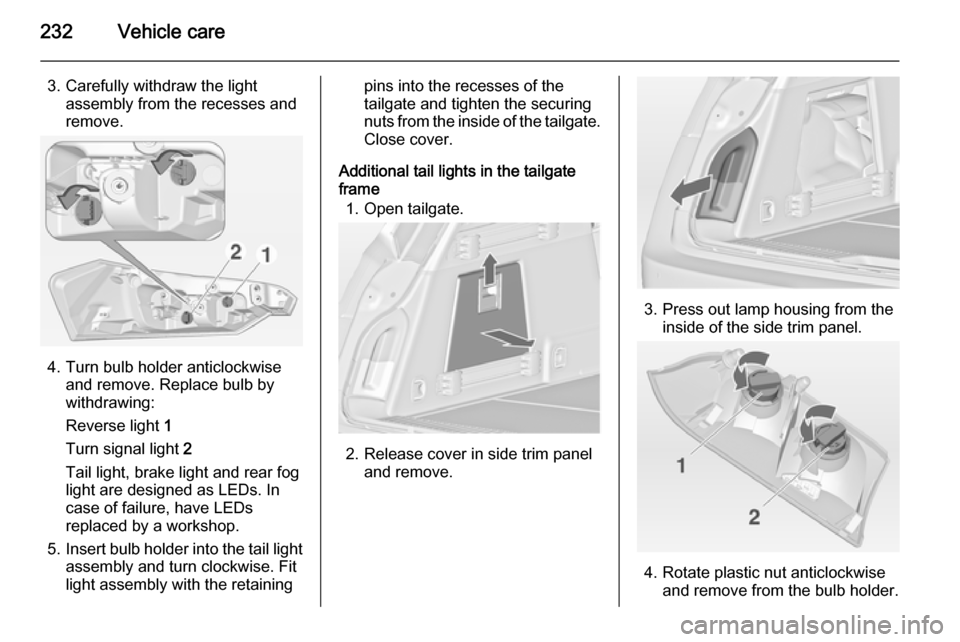
3. Carefully withdraw the lightassembly from the recesses and
remove.
4. Turn bulb holder anticlockwise and remove. Replace bulb by
withdrawing:
Reverse light 1
Turn signal light 2
Tail light, brake light and rear fog
light are designed as LEDs. In
case of failure, have LEDs
replaced by a workshop.
5. Insert bulb holder into the tail light
assembly and turn clockwise. Fit
light assembly with the retaining
pins into the recesses of the
tailgate and tighten the securing
nuts from the inside of the tailgate. Close cover.
Additional tail lights in the tailgate
frame
1. Open tailgate.
2. Release cover in side trim panel and remove.
3. Press out lamp housing from theinside of the side trim panel.
4. Rotate plastic nut anticlockwiseand remove from the bulb holder.
Page 244 of 321

242Vehicle care
Vehicles with spare wheel
The jack with wheel wrench, the tools,
an extension bolt for securing a
damaged wheel and the towing eye
are placed in the tool box below the
spare wheel in the load compartment. Spare wheel 3 253.
Wheels and tyres
Tyre condition, wheel condition
Drive over edges slowly and at right
angles if possible. Driving over sharp
edges can cause tyre and wheel
damage. Do not trap tyres on the kerb when parking.
Regularly check the wheels for
damage. Seek the assistance of a
workshop in the event of damage or
unusual wear.
Winter tyres Winter tyres improve driving safety at
temperatures below 7 °C and should
therefore be fitted on all wheels.
In accordance with country-specific
regulations, affix the speed sticker in
the driver's field of view.
All tyre sizes are permitted as winter
tyres 3 286.
5-door Hatchback, 4-door Saloon,
Sports TourerTyre sizes 205/60 R 16 and
235/45 R 18 are only suitable as
winter tyres.
Tyre designations E.g. 215/60 R 16 95 H215=Tyre width, mm60=Cross-section ratio (tyre height
to tyre width), %R=Belt type: RadialRF=Type: RunFlat16=Wheel diameter, inches95=Load index e.g. 95 is
equivalent to 690 kgH=Speed code letter
Speed code letter:
Q=up to 100 mphS=up to 112 mphT=up to 118 mphH=up to 130 mphV=up to 150 mphW=up to 168 mph
Page 253 of 321
Vehicle care251
■ Do not start the vehicle when it israised on the jack.
■ Clean wheel nuts and thread with a
clean cloth before mounting the
wheel.9 Warning
Do not grease wheel bolt, wheel
nut and wheel nut cone.
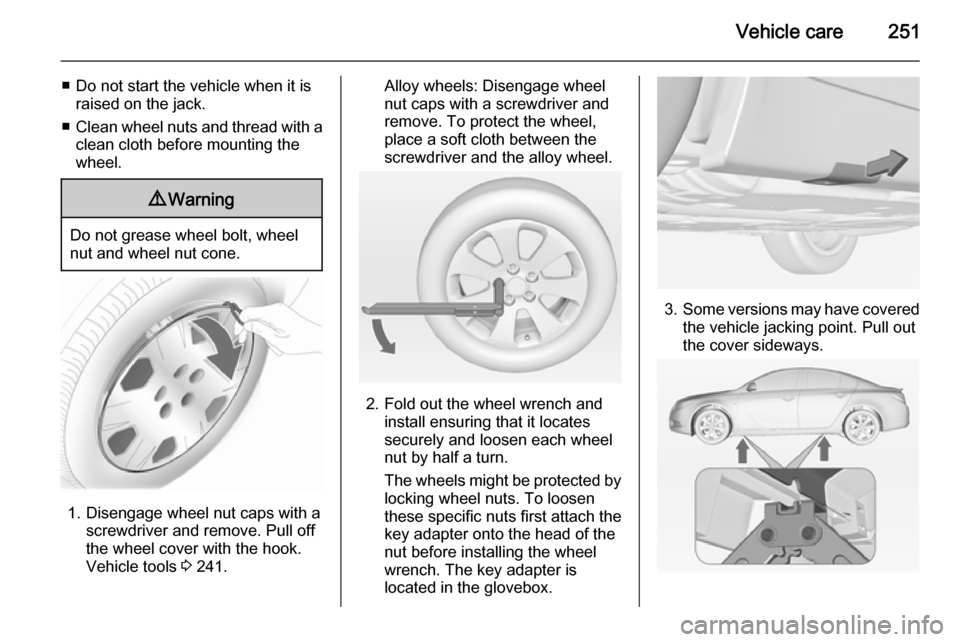
1. Disengage wheel nut caps with a screwdriver and remove. Pull off
the wheel cover with the hook.
Vehicle tools 3 241.
Alloy wheels: Disengage wheel
nut caps with a screwdriver and
remove. To protect the wheel,
place a soft cloth between the
screwdriver and the alloy wheel.
2. Fold out the wheel wrench and install ensuring that it locates
securely and loosen each wheel
nut by half a turn.
The wheels might be protected by
locking wheel nuts. To loosen
these specific nuts first attach the
key adapter onto the head of the
nut before installing the wheel
wrench. The key adapter is
located in the glovebox.
3. Some versions may have covered
the vehicle jacking point. Pull out
the cover sideways.
Page 254 of 321
252Vehicle care
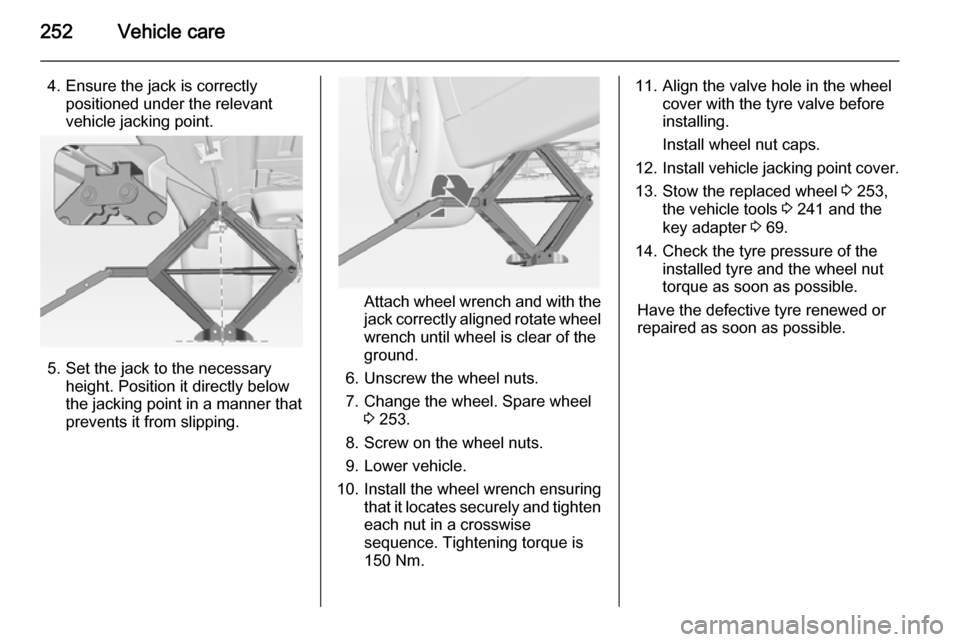
4. Ensure the jack is correctlypositioned under the relevant
vehicle jacking point.
5. Set the jack to the necessary height. Position it directly below
the jacking point in a manner that
prevents it from slipping.
Attach wheel wrench and with the
jack correctly aligned rotate wheel wrench until wheel is clear of the
ground.
6. Unscrew the wheel nuts. 7. Change the wheel. Spare wheel 3 253.
8. Screw on the wheel nuts.
9. Lower vehicle.
10. Install the wheel wrench ensuring that it locates securely and tighten
each nut in a crosswise
sequence. Tightening torque is
150 Nm.
11. Align the valve hole in the wheel cover with the tyre valve before
installing.
Install wheel nut caps.
12. Install vehicle jacking point cover.
13. Stow the replaced wheel 3 253,
the vehicle tools 3 241 and the
key adapter 3 69.
14. Check the tyre pressure of the installed tyre and the wheel nuttorque as soon as possible.
Have the defective tyre renewed or
repaired as soon as possible.
Page 256 of 321
254Vehicle care
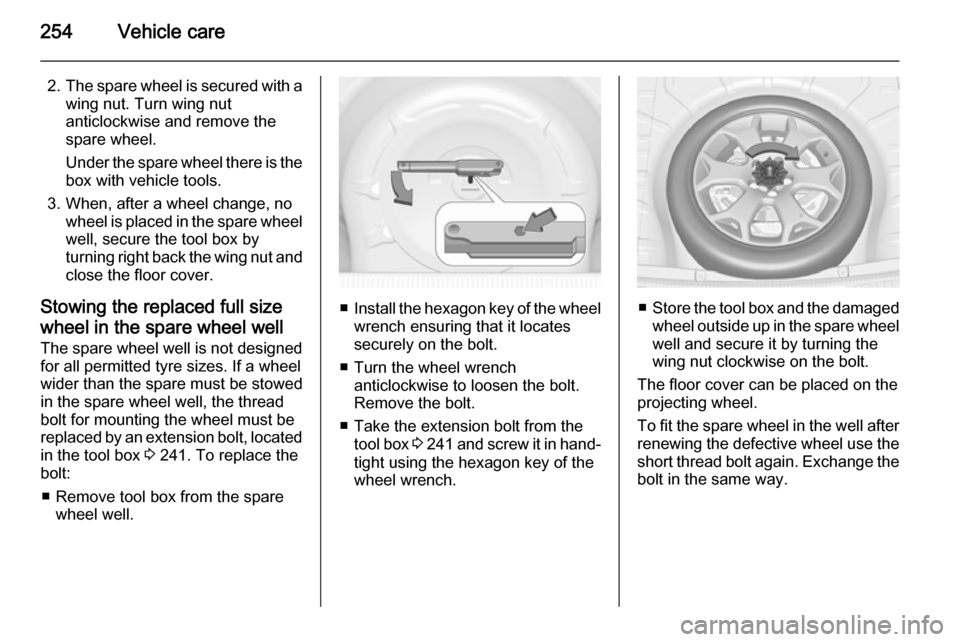
2.The spare wheel is secured with a
wing nut. Turn wing nut
anticlockwise and remove the
spare wheel.
Under the spare wheel there is the
box with vehicle tools.
3. When, after a wheel change, no wheel is placed in the spare wheelwell, secure the tool box by
turning right back the wing nut and
close the floor cover.
Stowing the replaced full size wheel in the spare wheel well The spare wheel well is not designed
for all permitted tyre sizes. If a wheel
wider than the spare must be stowed
in the spare wheel well, the thread
bolt for mounting the wheel must be
replaced by an extension bolt, located
in the tool box 3 241. To replace the
bolt:
■ Remove tool box from the spare wheel well.
■Install the hexagon key of the wheel
wrench ensuring that it locates
securely on the bolt.
■ Turn the wheel wrench anticlockwise to loosen the bolt.
Remove the bolt.
■ Take the extension bolt from the tool box 3 241 and screw it in hand-
tight using the hexagon key of the
wheel wrench.■ Store the tool box and the damaged
wheel outside up in the spare wheel well and secure it by turning the
wing nut clockwise on the bolt.
The floor cover can be placed on the
projecting wheel.
To fit the spare wheel in the well after
renewing the defective wheel use the
short thread bolt again. Exchange the bolt in the same way.
Page 257 of 321
Vehicle care2559Warning
Storing a jack, a wheel or other
equipment in the load
compartment could cause injury if they are not fixed properly. During a sudden stop or a collision, looseequipment could strike someone.
Store wheel, jack and tools always
in the original storage location and secure them by fixing.
Temporary spare wheel
Caution
The use of a spare wheel that issmaller than the other wheels or in
combination with winter tyres
could affect driveability. Have the defective tyre replaced as soon as
possible.
Only mount one temporary spare
wheel. Do not drive faster than
50 mph. Take curves slowly. Do not
use for a long period of time.
If your vehicle gets a flat tyre on the
rear while towing another vehicle,
mount the temporary spare wheel in
the front and the full tyre in the rear.
Tyre chains 3 247.
Directional tyres Fit directional tyres such that they roll
in the direction of travel. The rolling
direction is indicated by a symbol
(e.g. an arrow) on the sidewall.
The following applies to tyres fitted
opposing the rolling direction:
■ Driveability may be affected. Have the defective tyre renewed or
repaired as soon as possible.
■ Drive particularly carefully on wet and snow-covered road surfaces.Jump starting
Do not start with quick charger.
A vehicle with a discharged vehicle
battery can be started using jump
leads and the vehicle battery of
another vehicle.9 Warning
Be extremely careful when starting
with jump leads. Any deviation
from the following instructions can
lead to injuries or damage caused
by battery explosion or damage to the electrical systems of both
vehicles.
9 Warning
Avoid contact of the battery with
eyes, skin, fabrics and painted
surfaces. The fluid contains
sulphuric acid which can cause
injuries and damage in the event
of direct contact.
Page 314 of 321

312Customer information
■ Vehicle reactions in particulardriving situations (e.g. inflation of
an airbag, activation of the stability
regulation system)
■ Environmental conditions (e.g. temperature)
These data are exclusively technical
and help identifying and correcting
errors as well as optimizing vehicle
functions.
Motion profiles indicating travelled
routes cannot be created with these
data.
If services are used (e.g. repair
works, service processes, warranty
cases, quality assurance),
employees of the service network
(manufacturer included) are able to
read out this technical information
from the event and error data storage
modules applying special diagnostic
devices. If required, you will receive
further information at these
workshops. After an error has been
corrected, the data are deleted from
the error storage module or they are
constantly overwritten.When using the vehicle, situations
may occur in which these technical
data related to other information
(accident report, damages on the
vehicle, witness statements etc.) may be associated with a specific person -
possibly, with the assistance of an
expert.
Additional functions contractually
agreed upon with the client (e.g.
vehicle location in emergency cases)
allow the transmission of particular vehicle data from the vehicle.Radio Frequency
Identification (RFID) RFID technology is used in somevehicles for functions such as tyre
pressure monitoring and ignition
system security. It is also used in
connection with conveniences such
as radio remote controls for door
locking/unlocking and starting, and in-
vehicle transmitters for garage door
openers. RFID technology in
Vauxhall vehicles does not use or
record personal information or link with any other Vauxhall system
containing personal information.
Page 320 of 321

318
Transmission ............................... 16
Transmission display .................160
Tread depth ............................... 245
Trip odometer .............................. 99
Turn and lane-change signals ...131
Turn signal ................................. 103
Tyre chains ................................ 247
Tyre designations ......................242
Tyre pressure ............................ 243
Tyre pressure monitoring system ............................ 107, 243
Tyre pressures ........................... 286
Tyre repair kit ............................. 247
U Ultrasonic parking assist ...106, 189
Upholstery .................................. 262
Upshift ........................................ 106
Using this manual ..........................3
V Valet mode ................................. 117
Variable effort steering ...............106
Vehicle battery ........................... 221
Vehicle checks............................ 216
Vehicle data ................................ 269
Vehicle data recording and privacy ..................................... 311
Vehicle detected ahead ..............109
Vehicle dimensions .................... 284Vehicle Identification Number ....267
Vehicle jack ................................ 241
Vehicle messages .....................119
Vehicle personalisation .............121
Vehicle security ............................ 32
Vehicle specific data ......................3
Vehicle storage ........................... 215
Vehicle tools ............................... 241
Vehicle unlocking ........................... 6
Vehicle weight ........................... 278
Ventilating ..................................... 53
Ventilation ................................... 137
W
Warning chimes .........................120
Warning lights ............................... 99
Warning triangle .......................... 81
Washer and wiper systems .........13
Washer fluid ............................... 221
Wheel changing .........................250
Wheel covers ............................. 246
Wheels and tyres .......................242
Windows ....................................... 38
Windscreen................................... 38
Windscreen wiper/washer ...........87
Winter tyres ............................... 242
Wiper blade replacement ..........224
X Xenon headlights .......................228