light VAUXHALL INSIGNIA 2015 Manual Online
[x] Cancel search | Manufacturer: VAUXHALL, Model Year: 2015, Model line: INSIGNIA, Model: VAUXHALL INSIGNIA 2015Pages: 321, PDF Size: 8.99 MB
Page 246 of 321
244Vehicle careCaution
Tyre pressure monitoring system
warns just about low tyre pressure condition and does not replace
regular tyre maintenance by the
driver.
All wheels must be equipped with
pressure sensors and the tyres must
have the prescribed pressure.
Notice
In countries where the tyre pressure monitoring system is legally
required, the use of wheels without
pressure sensors will invalidate the
vehicle type approval.
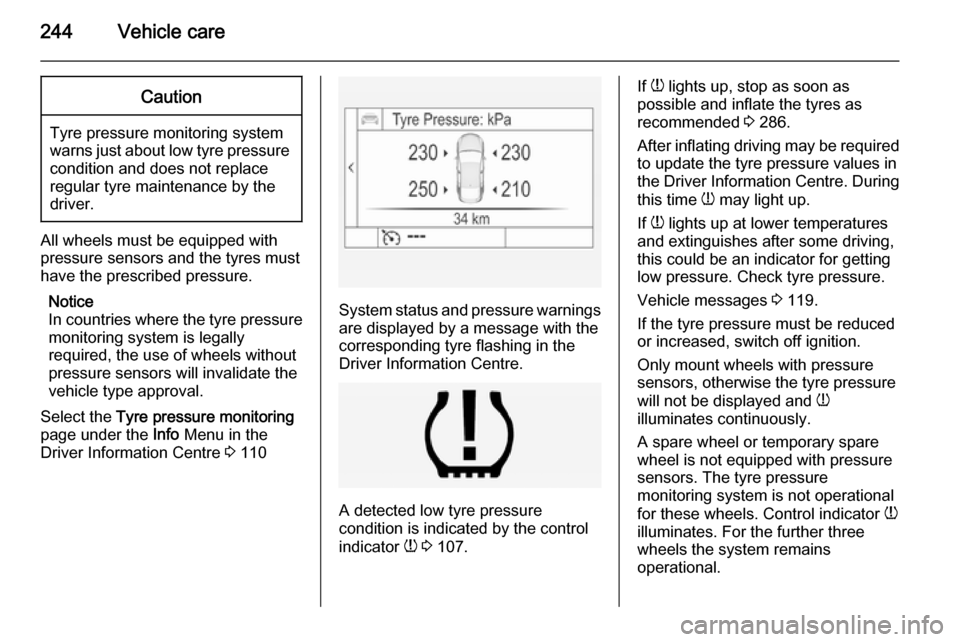
Select the Tyre pressure monitoring
page under the Info Menu in the
Driver Information Centre 3 110
System status and pressure warnings
are displayed by a message with the
corresponding tyre flashing in the
Driver Information Centre.
A detected low tyre pressure
condition is indicated by the control
indicator w 3 107.
If
w lights up, stop as soon as
possible and inflate the tyres as
recommended 3 286.
After inflating driving may be required
to update the tyre pressure values in
the Driver Information Centre. During
this time w may light up.
If w lights up at lower temperatures
and extinguishes after some driving,
this could be an indicator for getting
low pressure. Check tyre pressure.
Vehicle messages 3 119.
If the tyre pressure must be reduced
or increased, switch off ignition.
Only mount wheels with pressure
sensors, otherwise the tyre pressure
will not be displayed and w
illuminates continuously.
A spare wheel or temporary spare
wheel is not equipped with pressure
sensors. The tyre pressure
monitoring system is not operational
for these wheels. Control indicator w
illuminates. For the further three
wheels the system remains
operational.
Page 247 of 321
Vehicle care245
The use of commercially available
liquid tyre repair kits can impair the
function of the system. Factory
approved repair kits can be used.
External high-power radio equipment
could disrupt the tyre pressure
monitoring system.
Each time the tyres are replaced tyre
pressure monitoring system sensors
must be dismounted and serviced.
For the screwed sensor replace valve core and sealing ring, for clipped
sensor replace complete valve stem.
Vehicle loading status Adjust tyre pressure to load condition according tyre information label or
tyre pressure chart 3 286, and select
the according setting in the Tyre
loading page under the Settings
menu in the Driver Information Centre
3 110.
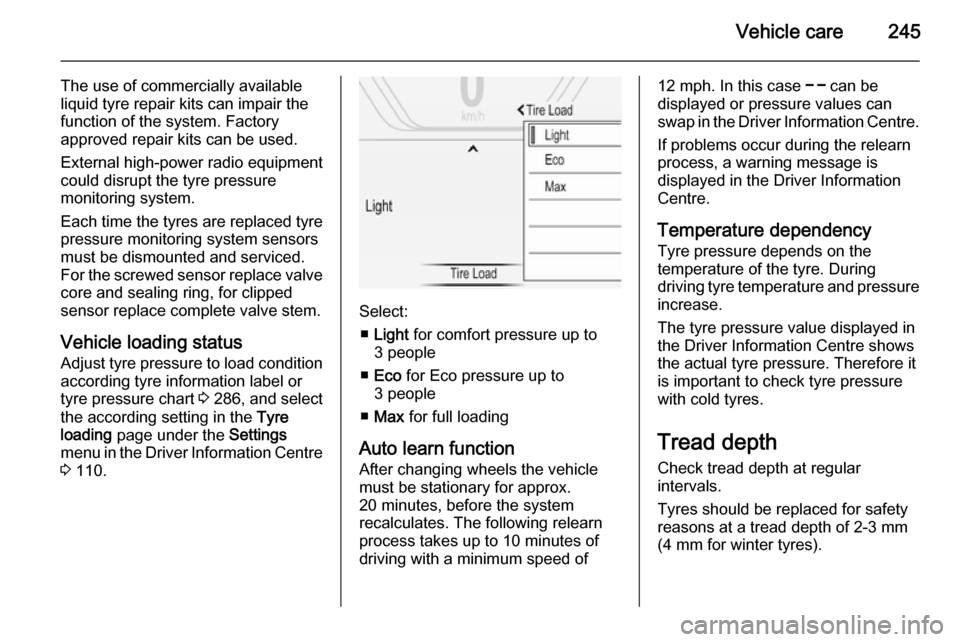
Select:
■ Light for comfort pressure up to
3 people
■ Eco for Eco pressure up to
3 people
■ Max for full loading
Auto learn function
After changing wheels the vehicle
must be stationary for approx.
20 minutes, before the system
recalculates. The following relearn
process takes up to 10 minutes of
driving with a minimum speed of
12 mph. In this case $ can be
displayed or pressure values can
swap in the Driver Information Centre.
If problems occur during the relearn
process, a warning message is
displayed in the Driver Information
Centre.
Temperature dependency Tyre pressure depends on the
temperature of the tyre. During
driving tyre temperature and pressure
increase.
The tyre pressure value displayed in
the Driver Information Centre shows
the actual tyre pressure. Therefore it
is important to check tyre pressure
with cold tyres.
Tread depth Check tread depth at regular
intervals.
Tyres should be replaced for safety
reasons at a tread depth of 2-3 mm
(4 mm for winter tyres).
Page 250 of 321
248Vehicle care
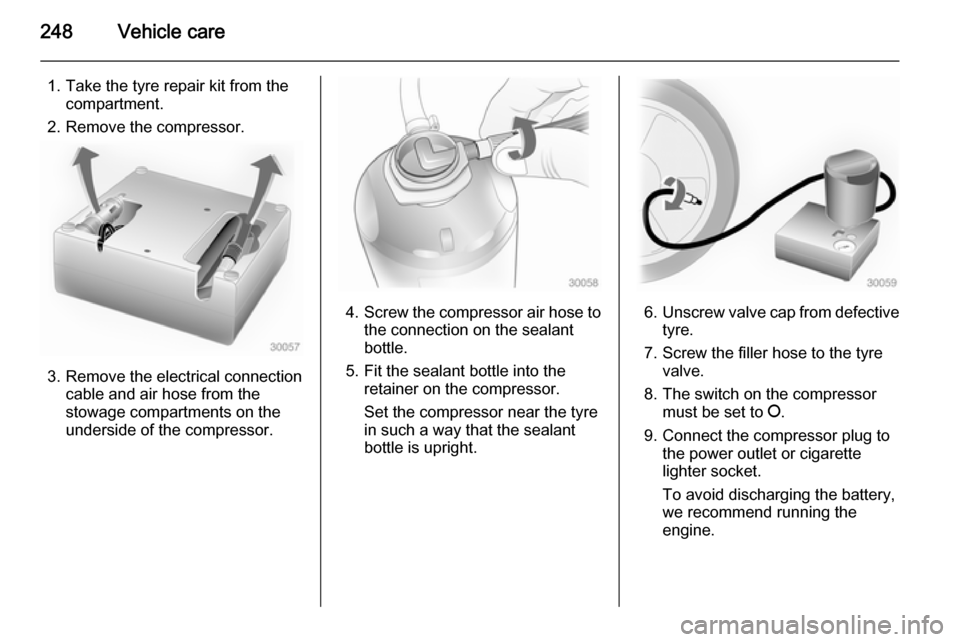
1. Take the tyre repair kit from thecompartment.
2. Remove the compressor.
3. Remove the electrical connection cable and air hose from the
stowage compartments on the
underside of the compressor.
4. Screw the compressor air hose to
the connection on the sealant
bottle.
5. Fit the sealant bottle into the retainer on the compressor.
Set the compressor near the tyre
in such a way that the sealant
bottle is upright.6. Unscrew valve cap from defective
tyre.
7. Screw the filler hose to the tyre valve.
8. The switch on the compressor must be set to J.
9. Connect the compressor plug to the power outlet or cigarette
lighter socket.
To avoid discharging the battery, we recommend running the
engine.
Page 259 of 321
Vehicle care257
far away from the discharged
battery as possible, however at
least 60 cm.
Route the leads so that they cannot
catch on rotating parts in the engine
compartment.
To start the engine: 1. Start the engine of the vehicle providing the jump.
2. After 5 minutes, start the other engine. Start attempts should be
made for no longer than
15 seconds at an interval of
1 minute.
3. Allow both engines to idle for approx. 3 minutes with the leads
connected.
4. Switch on electrical consumers (e.g. headlights, heated rear
window) of the vehicle receiving
the jump start.
5. Reverse above sequence exactly when removing leads.Towing
Towing the vehicle
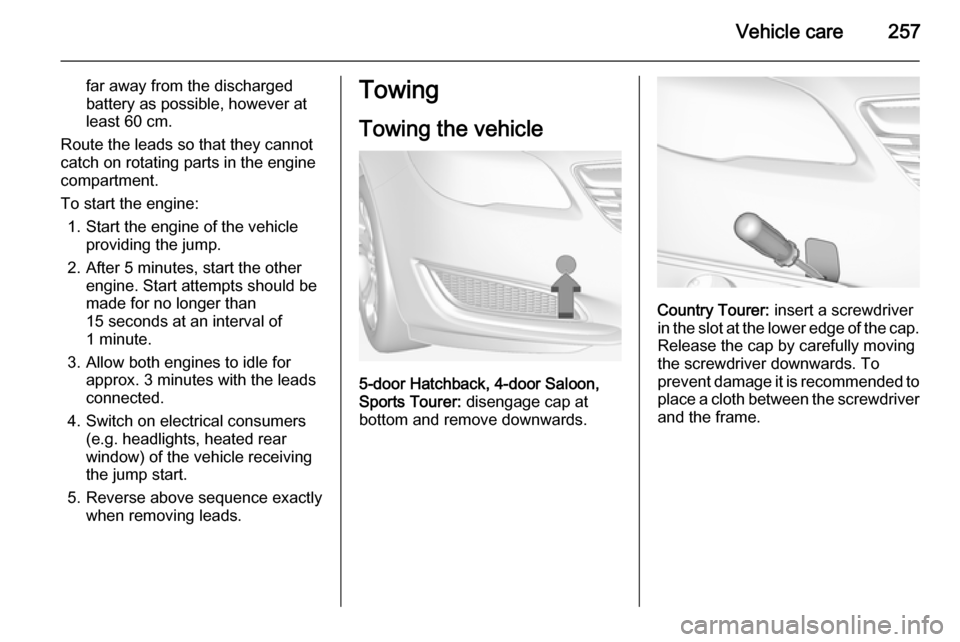
5-door Hatchback, 4-door Saloon,
Sports Tourer: disengage cap at
bottom and remove downwards.
Country Tourer: insert a screwdriver
in the slot at the lower edge of the cap. Release the cap by carefully moving
the screwdriver downwards. To
prevent damage it is recommended to place a cloth between the screwdriver
and the frame.
Page 260 of 321
258Vehicle care
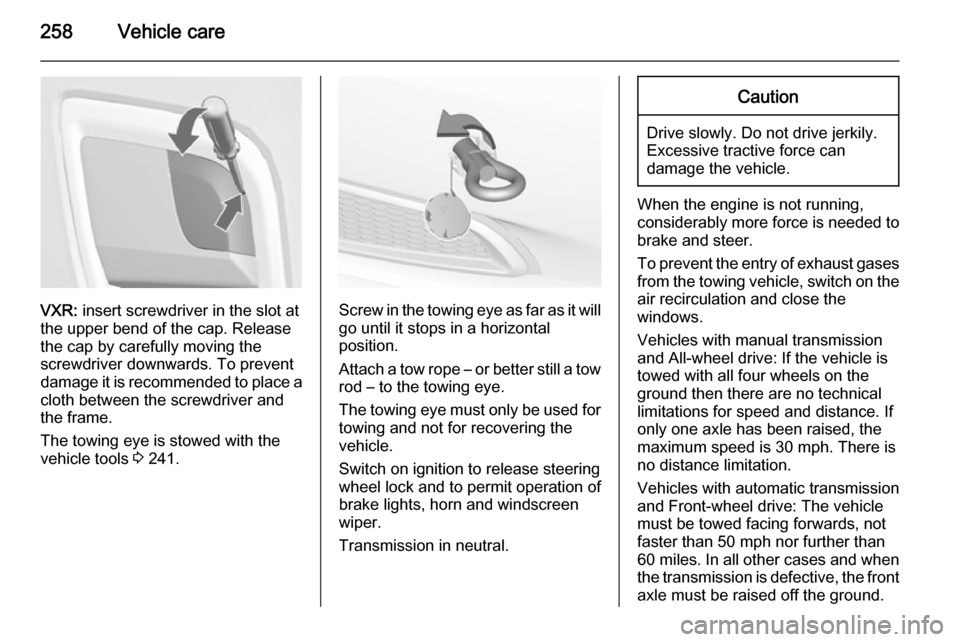
VXR: insert screwdriver in the slot at
the upper bend of the cap. Release
the cap by carefully moving the
screwdriver downwards. To prevent
damage it is recommended to place a cloth between the screwdriver and
the frame.
The towing eye is stowed with the vehicle tools 3 241.Screw in the towing eye as far as it will
go until it stops in a horizontal
position.
Attach a tow rope – or better still a tow
rod – to the towing eye.
The towing eye must only be used for towing and not for recovering the
vehicle.
Switch on ignition to release steering wheel lock and to permit operation of
brake lights, horn and windscreen
wiper.
Transmission in neutral.
Caution
Drive slowly. Do not drive jerkily.
Excessive tractive force can
damage the vehicle.
When the engine is not running,
considerably more force is needed to
brake and steer.
To prevent the entry of exhaust gases from the towing vehicle, switch on the
air recirculation and close the
windows.
Vehicles with manual transmission
and All-wheel drive: If the vehicle is
towed with all four wheels on the
ground then there are no technical
limitations for speed and distance. If
only one axle has been raised, the
maximum speed is 30 mph. There is
no distance limitation.
Vehicles with automatic transmission
and Front-wheel drive: The vehicle
must be towed facing forwards, not
faster than 50 mph nor further than
60 miles . In all other cases and when
the transmission is defective, the front
axle must be raised off the ground.
Page 261 of 321
Vehicle care259
Vehicles with automatic transmission
and All-wheel drive: The vehicle must
be towed facing forwards. If the
vehicle is towed with all four wheels
on the ground, the maximum speed is 30 mph and for a maximum of
30 miles. If the front axle has been
raised, the maximum speed is
30 mph. There is no distance
limitation.
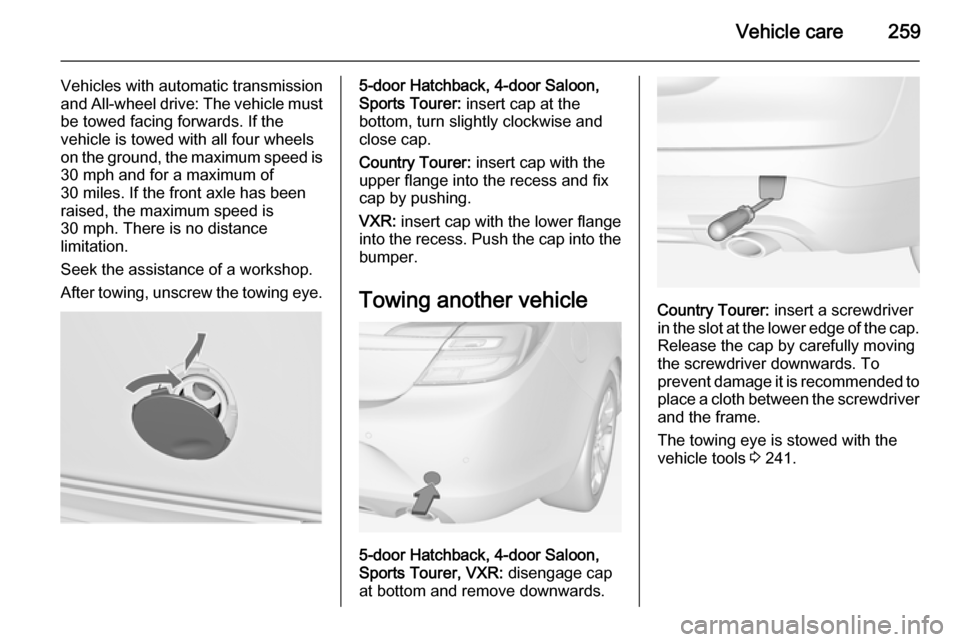
Seek the assistance of a workshop. After towing, unscrew the towing eye.5-door Hatchback, 4-door Saloon,
Sports Tourer: insert cap at the
bottom, turn slightly clockwise and
close cap.
Country Tourer: insert cap with the
upper flange into the recess and fix
cap by pushing.
VXR: insert cap with the lower flange
into the recess. Push the cap into the bumper.
Towing another vehicle
5-door Hatchback, 4-door Saloon,
Sports Tourer, VXR: disengage cap
at bottom and remove downwards.
Country Tourer: insert a screwdriver
in the slot at the lower edge of the cap. Release the cap by carefully moving
the screwdriver downwards. To
prevent damage it is recommended to place a cloth between the screwdriver
and the frame.
The towing eye is stowed with the
vehicle tools 3 241.
Page 262 of 321
260Vehicle care
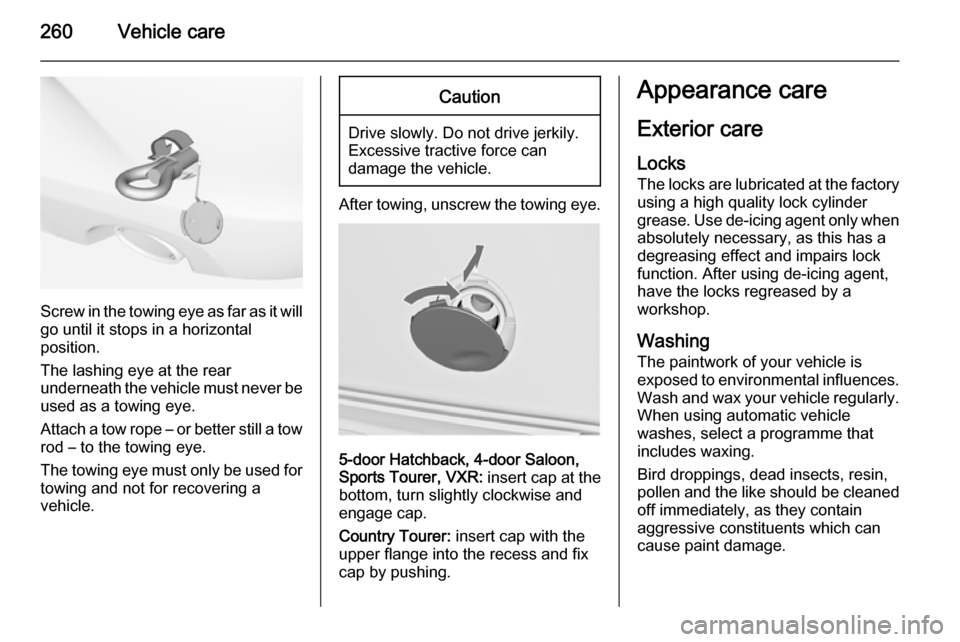
Screw in the towing eye as far as it will
go until it stops in a horizontal
position.
The lashing eye at the rear
underneath the vehicle must never be used as a towing eye.
Attach a tow rope – or better still a tow
rod – to the towing eye.
The towing eye must only be used for towing and not for recovering a
vehicle.
Caution
Drive slowly. Do not drive jerkily.
Excessive tractive force can
damage the vehicle.
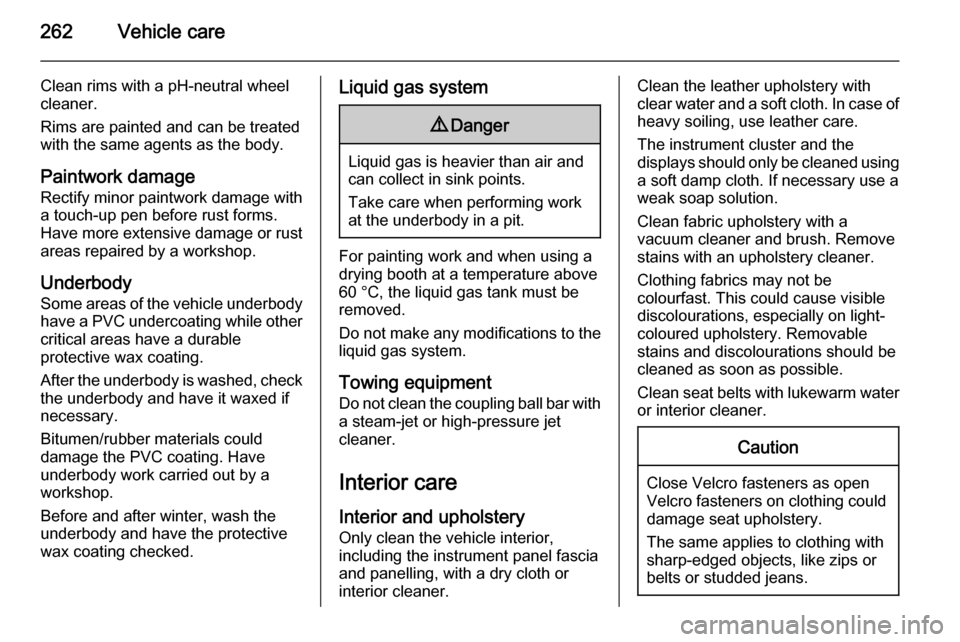
After towing, unscrew the towing eye.
5-door Hatchback, 4-door Saloon,
Sports Tourer, VXR: insert cap at the
bottom, turn slightly clockwise and
engage cap.
Country Tourer: insert cap with the
upper flange into the recess and fix
cap by pushing.
Appearance care
Exterior care LocksThe locks are lubricated at the factory
using a high quality lock cylinder
grease. Use de-icing agent only when absolutely necessary, as this has a
degreasing effect and impairs lock
function. After using de-icing agent,
have the locks regreased by a
workshop.
Washing The paintwork of your vehicle is
exposed to environmental influences.
Wash and wax your vehicle regularly.
When using automatic vehicle
washes, select a programme that
includes waxing.
Bird droppings, dead insects, resin,
pollen and the like should be cleaned
off immediately, as they contain
aggressive constituents which can
cause paint damage.
Page 263 of 321

Vehicle care261
If using a vehicle wash, comply with
the vehicle wash manufacturer's
instructions. The windscreen wiper and rear window wiper must be
switched off. Remove antenna and
external accessories such as roof
racks etc.
If you wash your vehicle by hand,
make sure that the insides of the
wheel housings are also thoroughly
rinsed out.
Wax painted parts of the vehicle
regularly.
Clean edges and folds on opened
doors and the bonnet as well as the
areas they cover.Caution
Always use a cleaning agent with
a pH value of 4 to 9.
Do not use cleaning agents on hot surfaces.
Do not clean the engine compartmentwith a steam-jet or high-pressure jet
cleaner.
Thoroughly rinse and leather-off the vehicle. Rinse leather frequently. Use
separate leathers for painted and
glass surfaces: remnants of wax on
the windows will impair vision.
Have the door hinges of all doors
greased by a workshop.
Exterior lights Headlight and other light covers aremade of plastic. Do not use any
abrasive or caustic agents, do not use
an ice scraper, and do not clean them dry.
Polishing and waxing
Wax the vehicle regularly (at the
latest when water no longer beads).
Otherwise, the paintwork will dry out.
Polishing is necessary only if the paint
has become dull or if solid deposits
have become attached to it.
Paintwork polish with silicone forms a
protective film, making waxing
unnecessary.
Plastic body parts must not be treated with wax or polishing agents.Windows and windscreen wiper
blades
Use a soft lint-free cloth or chamois leather together with window cleaner and insect remover.
When cleaning the rear window from
inside, always wipe in parallel to the
heating element to prevent damage.
For mechanical removal of ice, use a
sharp-edged ice scraper. Press the
scraper firmly against the glass so
that no dirt can get under it and
scratch the glass.
Clean smearing wiper blades with a
soft cloth and window cleaner.
Sunroof
Never clean with solvents or abrasive
agents, fuels, aggressive media
(e.g. paint cleaner, acetone-
containing solutions etc.), acidic or
highly alkaline media or abrasive
pads. Do not apply wax or polishing
agents to the sunroof.
Wheels and tyres
Do not use high-pressure jet
cleaners.
Page 264 of 321
262Vehicle care
Clean rims with a pH-neutral wheel
cleaner.
Rims are painted and can be treated
with the same agents as the body.
Paintwork damageRectify minor paintwork damage with
a touch-up pen before rust forms.
Have more extensive damage or rust areas repaired by a workshop.
Underbody Some areas of the vehicle underbody
have a PVC undercoating while other
critical areas have a durable
protective wax coating.
After the underbody is washed, check the underbody and have it waxed if
necessary.
Bitumen/rubber materials could
damage the PVC coating. Have
underbody work carried out by a
workshop.
Before and after winter, wash the
underbody and have the protective
wax coating checked.Liquid gas system9 Danger
Liquid gas is heavier than air and
can collect in sink points.
Take care when performing work
at the underbody in a pit.
For painting work and when using a
drying booth at a temperature above
60 °C, the liquid gas tank must be
removed.
Do not make any modifications to the
liquid gas system.
Towing equipment Do not clean the coupling ball bar with
a steam-jet or high-pressure jet
cleaner.
Interior care Interior and upholsteryOnly clean the vehicle interior,
including the instrument panel fascia
and panelling, with a dry cloth or
interior cleaner.
Clean the leather upholstery with clear water and a soft cloth. In case of
heavy soiling, use leather care.
The instrument cluster and the
displays should only be cleaned using
a soft damp cloth. If necessary use a
weak soap solution.
Clean fabric upholstery with a
vacuum cleaner and brush. Remove
stains with an upholstery cleaner.
Clothing fabrics may not be
colourfast. This could cause visible
discolourations, especially on light-
coloured upholstery. Removable
stains and discolourations should be
cleaned as soon as possible.
Clean seat belts with lukewarm water or interior cleaner.Caution
Close Velcro fasteners as open
Velcro fasteners on clothing could damage seat upholstery.
The same applies to clothing with
sharp-edged objects, like zips or
belts or studded jeans.
Page 316 of 321

314IndexAAccessories and vehicle modifications .......................... 215
Active Emergency Braking .........187
Active head restraints ...................45
Adaptive cruise control .......109, 175
Adaptive forward lighting ...109, 128
Adjustable air vents ...................148
Airbag and belt tensioners .........104
Airbag deactivation ..............62, 104
Airbag label................................... 57 Airbag system .............................. 57
Air conditioning regular operation ................................ 150
Air conditioning system .............. 137
Air intake .................................... 149
Air vents...................................... 148
All-wheel drive ........................... 165
Antilock brake system ................ 165
Antilock brake system (ABS) .....106
Anti-theft alarm system ................33
Anti-theft locking system .............. 32
Appearance care ........................260
Armrest ................................... 52, 53
Armrest storage ........................... 71
Ashtrays ....................................... 92
Automatic anti-dazzle ..................38
Automatic climate control system .................................... 139Automatic dimming ......................37
Automatic light control ...............126
Automatic locking ........................26
Automatic transmission .............160
Automatic transmission fluid .......219
Autostop ..................................... 108
Auxiliary heater ........................... 148
B Battery discharge protection ......135
Battery voltage ........................... 121
Belts.............................................. 53
Bonnet ....................................... 217
Brake and clutch fluid .................265
Brake and clutch system ...........105
Brake assist ............................... 167
Brake fluid .................................. 221
Brakes ............................... 165, 221
Breakdown.................................. 257
Bulb replacement ....................... 225
C
Capacities .................................. 285
Cargo management system ........76
Car Pass ...................................... 20
Catalytic converter .....................160
Central locking system ................22
Centre console lighting ..............134
Changing tyre and wheel size ...246
Charging system ........................ 104