fuel pressure VAUXHALL INSIGNIA 2017 User Guide
[x] Cancel search | Manufacturer: VAUXHALL, Model Year: 2017, Model line: INSIGNIA, Model: VAUXHALL INSIGNIA 2017Pages: 327, PDF Size: 9.34 MB
Page 228 of 327
226Vehicle careGeneral Information
Accessories and vehicle modifications
We recommend using genuine parts
and accessories and factory
approved parts specific for your
vehicle type. We cannot assess or guarantee reliability of other products
- even if they have a regulatory or
otherwise granted approval.
Any modification, conversion or other changes made to standard vehicle
specifications (including, without
limitation, software modifications,
modifications of the electronic control units) may invalidate the warranty
offered by Vauxhall. Furthermore,
such changes may impact fuel
consumption, CO 2 emissions and
other emissions of the vehicle and
cause the vehicle to no longer
conform to the type approval,
impacting the validity of your vehicle
registration.Caution
When transporting the vehicle on
a train or on a recovery vehicle, the
mud flaps may be damaged.
Vehicle storage
Storage for a long period of time
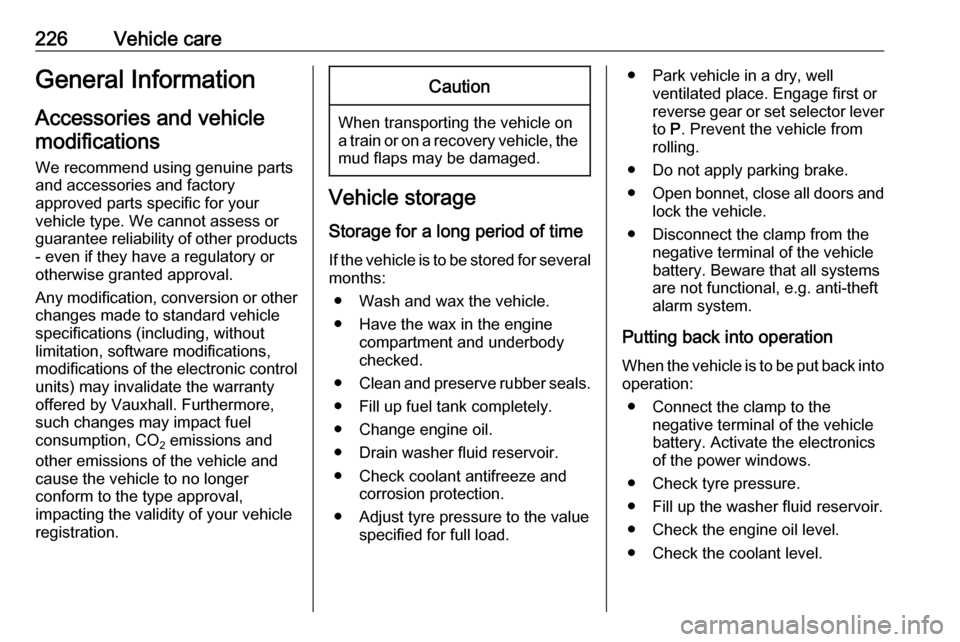
If the vehicle is to be stored for several months:
● Wash and wax the vehicle.
● Have the wax in the engine compartment and underbody
checked.
● Clean and preserve rubber seals.
● Fill up fuel tank completely.
● Change engine oil.
● Drain washer fluid reservoir. ● Check coolant antifreeze and corrosion protection.
● Adjust tyre pressure to the value specified for full load.
● Park vehicle in a dry, wellventilated place. Engage first or
reverse gear or set selector lever
to P. Prevent the vehicle from
rolling.
● Do not apply parking brake.
● Open bonnet, close all doors and
lock the vehicle.
● Disconnect the clamp from the negative terminal of the vehicle
battery. Beware that all systems
are not functional, e.g. anti-theft
alarm system.
Putting back into operation When the vehicle is to be put back into
operation:
● Connect the clamp to the negative terminal of the vehicle
battery. Activate the electronics
of the power windows.
● Check tyre pressure.
● Fill up the washer fluid reservoir.
● Check the engine oil level.
● Check the coolant level.
Page 256 of 327
254Vehicle careThe tyre pressure information labelon the left door frame indicates the
original equipment tyres and the
correspondent tyre pressures.
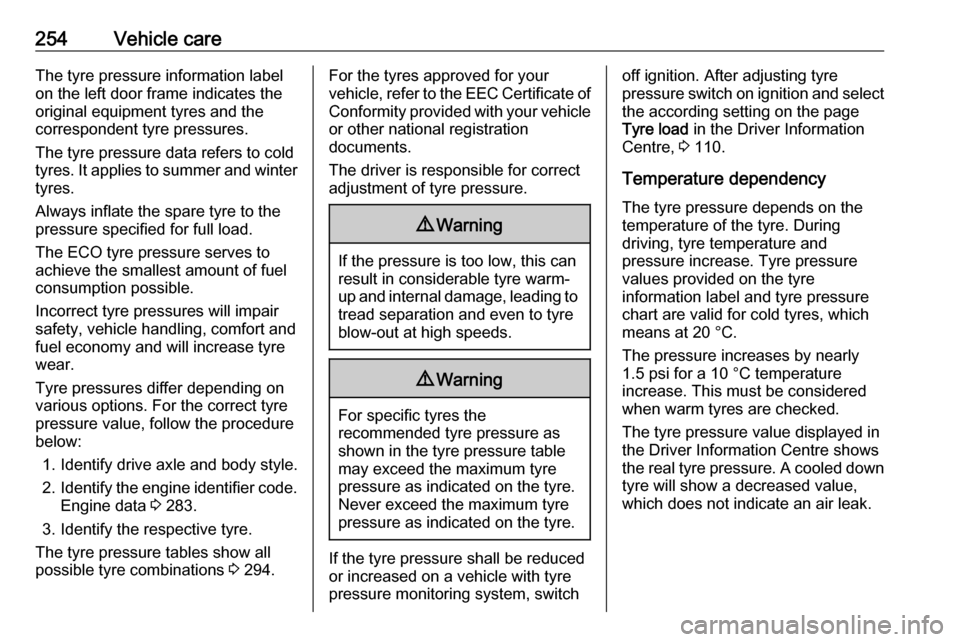
The tyre pressure data refers to cold
tyres. It applies to summer and winter tyres.
Always inflate the spare tyre to the
pressure specified for full load.
The ECO tyre pressure serves to
achieve the smallest amount of fuel
consumption possible.
Incorrect tyre pressures will impair
safety, vehicle handling, comfort and fuel economy and will increase tyre
wear.
Tyre pressures differ depending on
various options. For the correct tyre
pressure value, follow the procedure
below:
1. Identify drive axle and body style.
2. Identify the engine identifier code.
Engine data 3 283.
3. Identify the respective tyre.
The tyre pressure tables show all
possible tyre combinations 3 294.For the tyres approved for your
vehicle, refer to the EEC Certificate of
Conformity provided with your vehicle
or other national registration
documents.
The driver is responsible for correct
adjustment of tyre pressure.9 Warning
If the pressure is too low, this can
result in considerable tyre warm-
up and internal damage, leading to tread separation and even to tyre
blow-out at high speeds.
9 Warning
For specific tyres the
recommended tyre pressure as
shown in the tyre pressure table may exceed the maximum tyre
pressure as indicated on the tyre.
Never exceed the maximum tyre
pressure as indicated on the tyre.
If the tyre pressure shall be reduced
or increased on a vehicle with tyre
pressure monitoring system, switch
off ignition. After adjusting tyre
pressure switch on ignition and select
the according setting on the page
Tyre load in the Driver Information
Centre, 3 110.
Temperature dependency The tyre pressure depends on the
temperature of the tyre. During
driving, tyre temperature and
pressure increase. Tyre pressure
values provided on the tyre
information label and tyre pressure
chart are valid for cold tyres, which means at 20 °C.
The pressure increases by nearly
1.5 psi for a 10 °C temperature
increase. This must be considered
when warm tyres are checked.
The tyre pressure value displayed in
the Driver Information Centre shows
the real tyre pressure. A cooled down tyre will show a decreased value,
which does not indicate an air leak.
Page 274 of 327
272Vehicle carePlastic body parts must not be treatedwith wax or polishing agents.
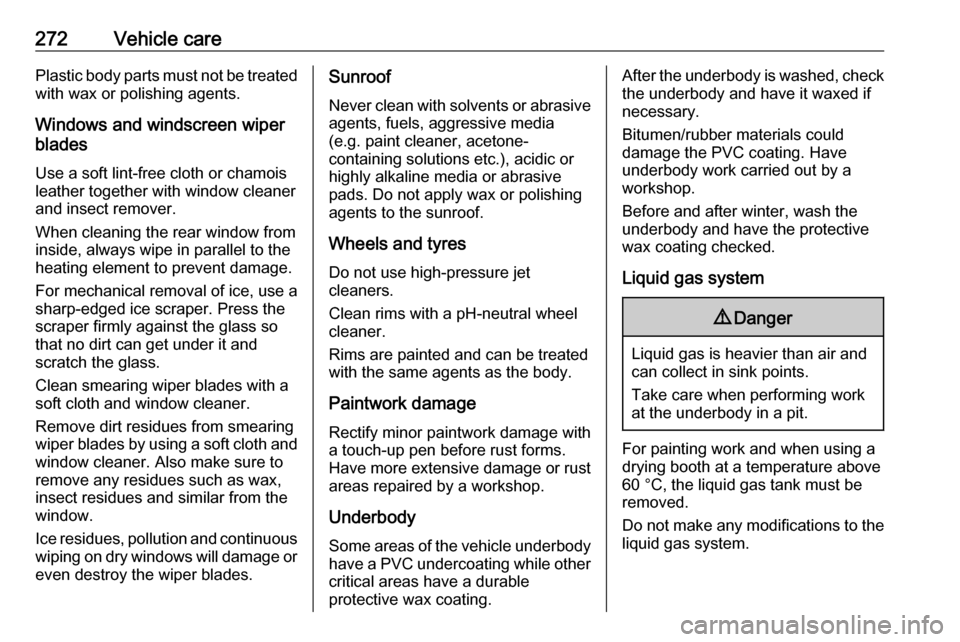
Windows and windscreen wiper
blades
Use a soft lint-free cloth or chamois
leather together with window cleaner and insect remover.
When cleaning the rear window from
inside, always wipe in parallel to the
heating element to prevent damage.
For mechanical removal of ice, use a
sharp-edged ice scraper. Press the
scraper firmly against the glass so
that no dirt can get under it and
scratch the glass.
Clean smearing wiper blades with a
soft cloth and window cleaner.
Remove dirt residues from smearing
wiper blades by using a soft cloth and window cleaner. Also make sure to
remove any residues such as wax,
insect residues and similar from the
window.
Ice residues, pollution and continuous
wiping on dry windows will damage or
even destroy the wiper blades.Sunroof
Never clean with solvents or abrasive
agents, fuels, aggressive media
(e.g. paint cleaner, acetone-
containing solutions etc.), acidic or
highly alkaline media or abrasive
pads. Do not apply wax or polishing
agents to the sunroof.
Wheels and tyres
Do not use high-pressure jet
cleaners.
Clean rims with a pH-neutral wheel
cleaner.
Rims are painted and can be treated
with the same agents as the body.
Paintwork damageRectify minor paintwork damage with
a touch-up pen before rust forms.
Have more extensive damage or rust
areas repaired by a workshop.
Underbody Some areas of the vehicle underbody
have a PVC undercoating while other
critical areas have a durable
protective wax coating.After the underbody is washed, check the underbody and have it waxed if
necessary.
Bitumen/rubber materials could
damage the PVC coating. Have
underbody work carried out by a
workshop.
Before and after winter, wash the
underbody and have the protective
wax coating checked.
Liquid gas system9 Danger
Liquid gas is heavier than air and
can collect in sink points.
Take care when performing work
at the underbody in a pit.
For painting work and when using a
drying booth at a temperature above
60 °C, the liquid gas tank must be
removed.
Do not make any modifications to the
liquid gas system.
Page 323 of 327
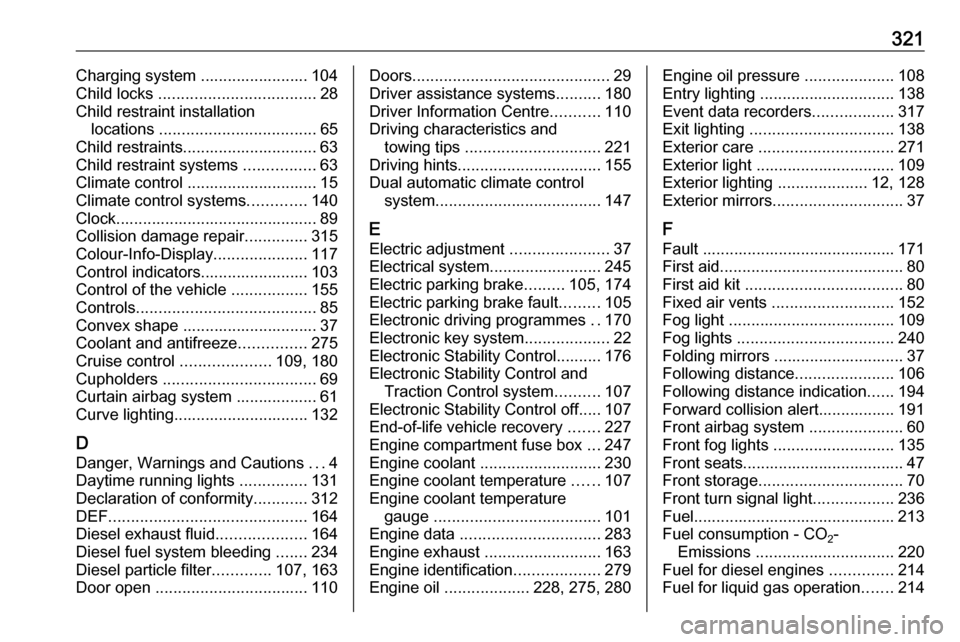
321Charging system ........................ 104
Child locks ................................... 28
Child restraint installation locations ................................... 65
Child restraints.............................. 63
Child restraint systems ................63
Climate control ............................. 15
Climate control systems .............140
Clock............................................. 89
Collision damage repair ..............315
Colour-Info-Display .....................117
Control indicators........................ 103
Control of the vehicle .................155
Controls ........................................ 85
Convex shape .............................. 37
Coolant and antifreeze ...............275
Cruise control ....................109, 180
Cupholders .................................. 69
Curtain airbag system .................. 61
Curve lighting.............................. 132
D Danger, Warnings and Cautions ...4
Daytime running lights ...............131
Declaration of conformity ............312
DEF ............................................ 164
Diesel exhaust fluid ....................164
Diesel fuel system bleeding .......234
Diesel particle filter .............107, 163
Door open .................................. 110Doors............................................ 29
Driver assistance systems ..........180
Driver Information Centre ...........110
Driving characteristics and towing tips .............................. 221
Driving hints ................................ 155
Dual automatic climate control system ..................................... 147
E Electric adjustment ......................37
Electrical system......................... 245
Electric parking brake .........105, 174
Electric parking brake fault .........105
Electronic driving programmes ..170
Electronic key system ...................22
Electronic Stability Control.......... 176
Electronic Stability Control and Traction Control system ..........107
Electronic Stability Control off..... 107
End-of-life vehicle recovery .......227
Engine compartment fuse box ...247
Engine coolant ........................... 230
Engine coolant temperature ......107
Engine coolant temperature gauge ..................................... 101
Engine data ............................... 283
Engine exhaust .......................... 163
Engine identification ...................279
Engine oil ................... 228, 275, 280Engine oil pressure ....................108
Entry lighting .............................. 138
Event data recorders ..................317
Exit lighting ................................ 138
Exterior care .............................. 271
Exterior light ............................... 109
Exterior lighting ....................12, 128
Exterior mirrors ............................. 37
F
Fault ........................................... 171
First aid ......................................... 80
First aid kit ................................... 80
Fixed air vents ........................... 152
Fog light ..................................... 109
Fog lights ................................... 240
Folding mirrors ............................. 37
Following distance ......................106
Following distance indication ......194
Forward collision alert................. 191
Front airbag system .....................60
Front fog lights ........................... 135
Front seats.................................... 47
Front storage ................................ 70
Front turn signal light ..................236
Fuel............................................. 213
Fuel consumption - CO 2-
Emissions ............................... 220
Fuel for diesel engines ..............214
Fuel for liquid gas operation .......214