roof VAUXHALL INSIGNIA 2017 Owner's Guide
[x] Cancel search | Manufacturer: VAUXHALL, Model Year: 2017, Model line: INSIGNIA, Model: VAUXHALL INSIGNIA 2017Pages: 327, PDF Size: 9.34 MB
Page 250 of 327

248Vehicle careNo.Circuit16Vacuum pump/Mass air flow
meter/Water in fuel sensor/DC
transformer17Additional tail lights (type B)18Adaptive forward lighting19Adaptive forward lighting20Fuel pump21Rear power windows22ABS23Variable effort steering24Front power windows25Power outlets (type A)
Additional tail lights (type B)26ABS27Electric parking brake28Heated rear window29Left power seat30Right power seatNo.Circuit31Air conditioning system32Body control module33Heated front seats34Sunroof (type A)
Tailgate locking (type B)35Infotainment system (type A)
Tailgate locking (type B)36–37Right high beam38Left high beam39–40–41Vacuum pump42Radiator fan43Vehicle battery/DC transformer
(only on vehicles with stop-start
system)44Headlamp washer systemNo.Circuit45Radiator fan46Terminal 87/Main relay47Lambda probe48Fog lights49Right low beam50Left low beam51Horn52Ignition53Ignition/Ventilated front seats54Ignition55Power windows/Mirror folding56Windscreen washer57–58–59Diesel fuel heating/Emission
control system60Mirror heating61Mirror heating
Page 253 of 327
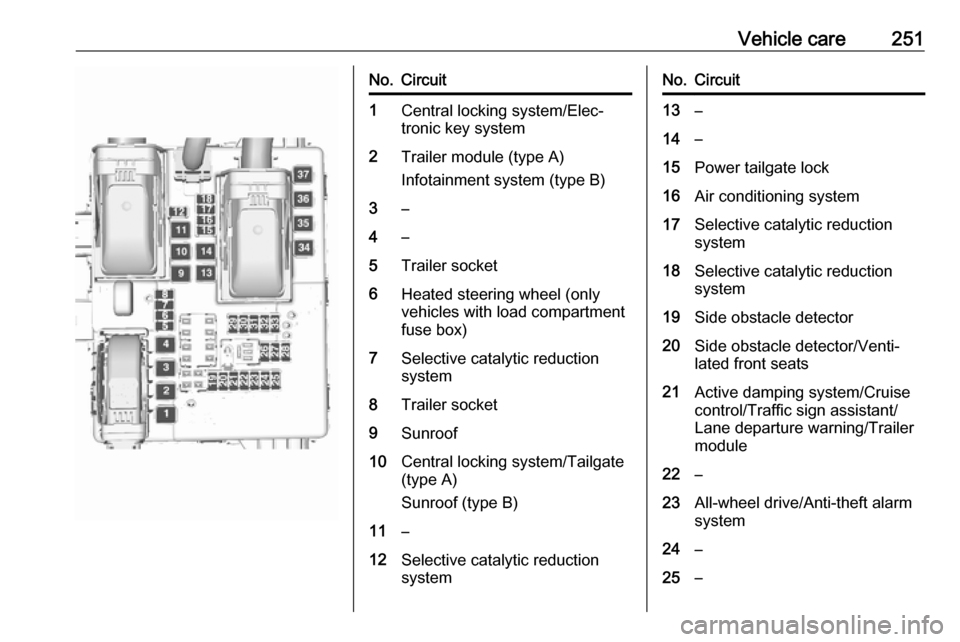
Vehicle care251No.Circuit1Central locking system/Elec‐
tronic key system2Trailer module (type A)
Infotainment system (type B)3–4–5Trailer socket6Heated steering wheel (only
vehicles with load compartment
fuse box)7Selective catalytic reduction
system8Trailer socket9Sunroof10Central locking system/Tailgate
(type A)
Sunroof (type B)11–12Selective catalytic reduction
systemNo.Circuit13–14–15Power tailgate lock16Air conditioning system17Selective catalytic reduction
system18Selective catalytic reduction
system19Side obstacle detector20Side obstacle detector/Venti‐
lated front seats21Active damping system/Cruise
control/Traffic sign assistant/
Lane departure warning/Trailer
module22–23All-wheel drive/Anti-theft alarm
system24–25–
Page 254 of 327
252Vehicle careNo.Circuit26–27–28–29Trailer module/Transportationfuse (type A)30Side obstacle detector31–32–33–34Sunroof35–36–37–Vehicle tools
Tools
Vehicles with tyre repair kit
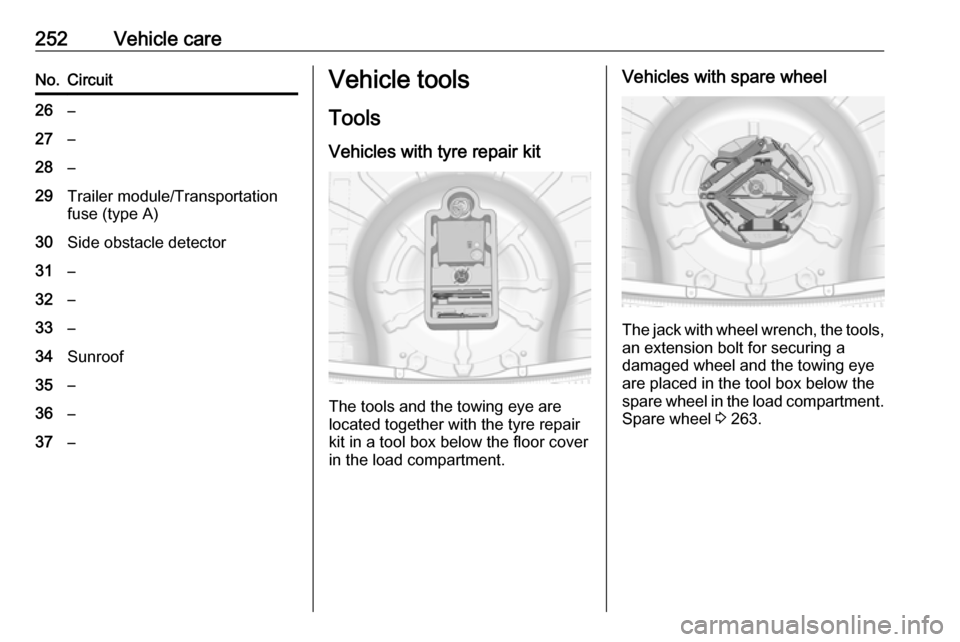
The tools and the towing eye are
located together with the tyre repair
kit in a tool box below the floor cover
in the load compartment.
Vehicles with spare wheel
The jack with wheel wrench, the tools,
an extension bolt for securing a
damaged wheel and the towing eye
are placed in the tool box below the
spare wheel in the load compartment. Spare wheel 3 263.
Page 273 of 327

Vehicle care271Appearance care
Exterior care LocksThe locks are lubricated at the factoryusing a high quality lock cylinder
grease. Use a de-icing agent only
when absolutely necessary, as this
has a degreasing effect and impairs
lock function. After using a de-icing
agent, have the locks regreased by a
workshop.
Washing
The paintwork of your vehicle is
exposed to environmental influences. Wash and wax your vehicle regularly.
When using automatic vehicle
washes, select a programme that
includes waxing.
Bird droppings, dead insects, resin,
pollen and the like should be cleaned
off immediately, as they contain
aggressive constituents which can
cause paint damage.If using a vehicle wash, comply with
the vehicle wash manufacturer's instructions. The windscreen wiperand rear window wiper must be
switched off. Remove antenna and
external accessories such as roof
racks etc.
If you wash your vehicle by hand,
make sure that the insides of the
wheel housings are also thoroughly
rinsed out.
Wax painted parts of the vehicle
regularly.
Clean edges and folds on opened
doors and the bonnet as well as the
areas they cover.
Clean bright metal mouldings with a
cleaning solution approved for
aluminium to avoid damages.Caution
Always use a cleaning agent with
a pH value of four to nine.
Do not use cleaning agents on hot surfaces.
Do not clean the engine compartmentwith a steam-jet or high-pressure jet
cleaner.
Thoroughly rinse and leather-off the vehicle. Rinse leather frequently. Use
separate leathers for painted and
glass surfaces: remnants of wax on
the windows will impair vision.
Have the door hinges of all doors
greased by a workshop.
Exterior lights
Headlight and other light covers are
made of plastic. Do not use any
abrasive or caustic agents, do not use an ice scraper, and do not clean them
dry.
Polishing and waxing
Wax the vehicle regularly (at the
latest when water no longer beads).
Otherwise, the paintwork will dry out.
Polishing is necessary only if the paint
has become dull or if solid deposits
have become attached to it.
Paintwork polish with silicone forms a
protective film, making waxing
unnecessary.
Page 274 of 327

272Vehicle carePlastic body parts must not be treatedwith wax or polishing agents.
Windows and windscreen wiper
blades
Use a soft lint-free cloth or chamois
leather together with window cleaner and insect remover.
When cleaning the rear window from
inside, always wipe in parallel to the
heating element to prevent damage.
For mechanical removal of ice, use a
sharp-edged ice scraper. Press the
scraper firmly against the glass so
that no dirt can get under it and
scratch the glass.
Clean smearing wiper blades with a
soft cloth and window cleaner.
Remove dirt residues from smearing
wiper blades by using a soft cloth and window cleaner. Also make sure to
remove any residues such as wax,
insect residues and similar from the
window.
Ice residues, pollution and continuous
wiping on dry windows will damage or
even destroy the wiper blades.Sunroof
Never clean with solvents or abrasive
agents, fuels, aggressive media
(e.g. paint cleaner, acetone-
containing solutions etc.), acidic or
highly alkaline media or abrasive
pads. Do not apply wax or polishing
agents to the sunroof.
Wheels and tyres
Do not use high-pressure jet
cleaners.
Clean rims with a pH-neutral wheel
cleaner.
Rims are painted and can be treated
with the same agents as the body.
Paintwork damageRectify minor paintwork damage with
a touch-up pen before rust forms.
Have more extensive damage or rust
areas repaired by a workshop.
Underbody Some areas of the vehicle underbody
have a PVC undercoating while other
critical areas have a durable
protective wax coating.After the underbody is washed, check the underbody and have it waxed if
necessary.
Bitumen/rubber materials could
damage the PVC coating. Have
underbody work carried out by a
workshop.
Before and after winter, wash the
underbody and have the protective
wax coating checked.
Liquid gas system9 Danger
Liquid gas is heavier than air and
can collect in sink points.
Take care when performing work
at the underbody in a pit.
For painting work and when using a
drying booth at a temperature above
60 °C, the liquid gas tank must be
removed.
Do not make any modifications to the
liquid gas system.
Page 277 of 327

Service and maintenance275driving at high altitude and large
variations of temperature. Under
these severe operating conditions, certain service work may be required
more frequently than the regular service interval.
The international service intervals are
valid for the countries which are not
listed in the European service
intervals.
Service display 3 101.
Confirmations Confirmation of service is recorded inthe Service and Warranty Booklet.
The date and mileage is completed
with the stamp and signature of the
servicing workshop.
Make sure that the Service and
Warranty Booklet is completed
correctly as continuous proof of
service is essential if any warranty or
goodwill claims are to be met, and is
also a benefit when selling the
vehicle.Service interval with remaining
engine oil life duration
The service interval is based on
several parameters depending on
usage.
The service display lets you know
when to change the engine oil.
Service display 3 101.Recommended fluids,
lubricants and parts
Recommended fluids andlubricants
Only use products that meet the
recommended specifications.9 Warning
Operating materials are
hazardous and could be
poisonous. Handle with care. Pay
attention to information given on
the containers.
Engine oil
Engine oil is identified by its quality
and its viscosity. Quality is more
important than viscosity when
selecting which engine oil to use. The oil quality ensures e.g. engine
cleanliness, wear protection and oil
aging control, whereas viscosity
grade gives information on the oil's
thickness over a temperature range.
Page 325 of 327

323Oil, engine.......................... 275, 280
OnStar ........................................ 124
Operate pedal ............................. 105
Outside temperature ....................89
Overrun cut-off ........................... 159
P Parking ................................ 18, 162
Parking assist ...................... 38, 196
Parking brake ............................ 174
Parking lights ............................. 135
Performance .............................. 285
Performing work ........................227
Pollen filter ................................. 152
Power button .............................. 156
Power outlets ............................... 91
Power seat adjustment .................50
Power steering fluid ....................231
Power windows ............................ 40
Preheating ................................. 107
Puncture ..................................... 261
Q
Quickheat ................................... 151
R Radio Frequency Identification (RFID) ..................................... 318
Radio remote control ...................21
Reading lights ............................ 137
Rear cross traffic alert ................207Rear floor storage cover ..............74
Rear fog light ............................. 109
Rear fog lights ........................... 135
Rear seats .................................... 53
Rear view camera ...................... 205
Rear window wiper/washer .......... 88
Recommended fluids and lubricants ........................ 275, 280
Refuelling ................................... 216 Registered trademarks ...............317
Retained power off .....................157
Reversing lights .........................136
Ride control systems ..................176
Roller blinds ................................. 42
Roof .............................................. 43
Roof load ...................................... 82
Roof rack ..................................... 81
S Safety belts ................................... 54
Safety net .................................... 77
Seat adjustment ............................. 6 Seat belt ........................................ 8
Seat belt reminder .....................103
Seat belts ..................................... 54
Seat heating ................................. 53
Seat position ................................ 47
Selective catalytic reduction .......164
Selector lever ............................. 168
Service ............................... 153, 274Service display .......................... 101
Service information ....................274
Side airbag system ......................61
Side blind spot alert ....................202
Sidelights .................................... 128
Side turn signal lights ................243
Smartphone controller ................118
Software acknowledgement .......315
Spare wheel ............................... 263
Speed limiter....................... 110, 182
Speedometer ............................... 99
Starting and operating ................155
Starting off ................................... 16
Starting the engine ....................158
Steering ...................................... 155
Steering wheel adjustment ......9, 85
Steering wheel controls ...............85
Stop-start system........................ 159
Storage ......................................... 69
Storage compartments .................69
Sunroof ........................................ 43
Sunvisor lights ........................... 137
Sun visors .................................... 42
Symbols ......................................... 4
T
Tachometer ............................... 100
Tail lights ................................... 241
Three-point seat belt .................... 55 Tools .......................................... 252