fuel pressure VAUXHALL INSIGNIA 2020 User Guide
[x] Cancel search | Manufacturer: VAUXHALL, Model Year: 2020, Model line: INSIGNIA, Model: VAUXHALL INSIGNIA 2020Pages: 313, PDF Size: 9.32 MB
Page 256 of 313
254Vehicle careGSi with Michelin Pilot Super Sport orPilot Sport 4 S tyres
This model is factory-fitted with high
performance sports tyres, which have
a reduced performance at low
temperature.9 Danger
Use winter tyres at temperatures
below 0 °C, otherwise damage of
the high performance sports tyres
is possible.
Tyre designations
E.g. 215/60 R 16 95 V
215:tyre width, mm60:cross-section ratio (tyre height
to tyre width), %R:belt type: RadialRF:type: RunFlat16:wheel diameter, inches95:load index e.g. 95 is equivalent
to 690 kgV:speed code letter
Speed code letter:
Q:up to 100 mphS:up to 112 mphT:up to 118 mphH:up to 130 mphV:up to 150 mphW:up to 168 mph
Choose a tyre appropriate for the
maximum speed of this vehicle. Refer
to the EEC Certificate of Conformity
provided with the vehicle or other national registration documents.
Optional equipment could reduce the
maximum speed of the vehicle.
Directional tyres
Directional tyres should be mounted so that they rotate in the correct
direction. The proper rotation
direction is indicated by a symbol (e.g. an arrow) on the sidewall.
Tyre pressure
Check the pressure of cold tyres at
least every 14 days and before any
long journey. Do not forget the spare
wheel.
This also applies to vehicles with tyre pressure monitoring system.
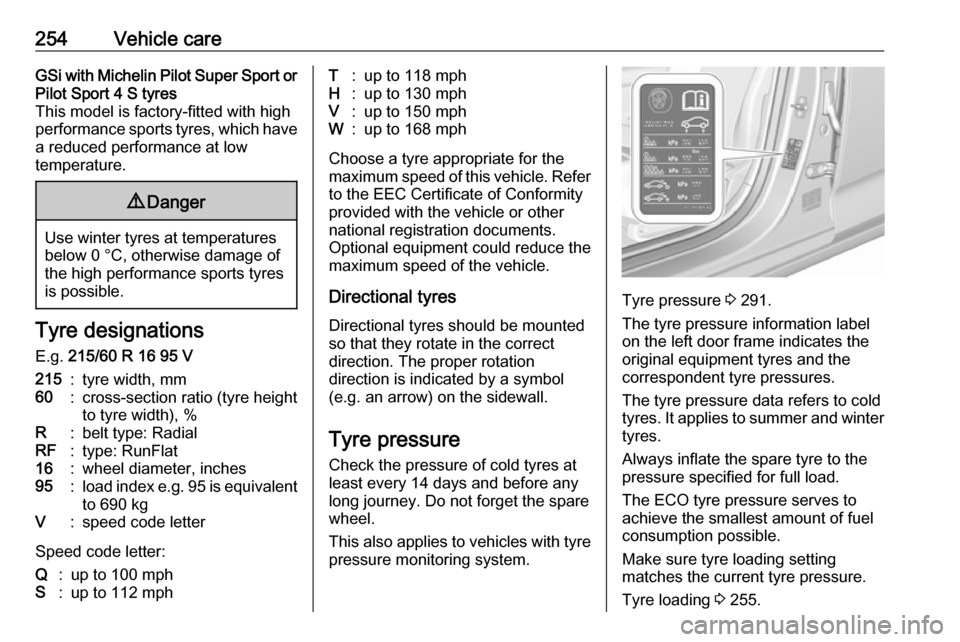
Tyre pressure 3 291.
The tyre pressure information label
on the left door frame indicates the
original equipment tyres and the
correspondent tyre pressures.
The tyre pressure data refers to cold
tyres. It applies to summer and winter tyres.
Always inflate the spare tyre to the
pressure specified for full load.
The ECO tyre pressure serves to
achieve the smallest amount of fuel
consumption possible.
Make sure tyre loading setting
matches the current tyre pressure.
Tyre loading 3 255.
Page 257 of 313

Vehicle care255Incorrect tyre pressures will impair
safety, vehicle handling, comfort and
fuel economy and will increase tyre
wear.
Tyre pressures differ depending on
various options. For the correct tyre
pressure value, follow the procedure
below:
1. Identify drive axle and body style.2. Identify the engine identifier code.
Engine data 3 284.
3. Identify the respective tyre.
The tyre pressure tables show all
possible tyre combinations 3 291.
For the tyres approved for your
vehicle, refer to the EEC Certificate of Conformity provided with your vehicle
or other national registration
documents.
The driver is responsible for correct
adjustment of tyre pressure.9 Warning
If the pressure is too low, this can
result in considerable tyre warm-
up and internal damage, leading to tread separation and even to tyre
blow-out at high speeds.
9 Warning
For specific tyres the
recommended tyre pressure as
shown in the tyre pressure table may exceed the maximum tyre
pressure as indicated on the tyre.
Never exceed the maximum tyre
pressure as indicated on the tyre.
After adjusting tyre pressure, select
the according tyre loading setting on
the page Tyre load in the Driver
Information Centre 3 110.
Temperature dependency The tyre pressure depends on the
temperature of the tyre. During
driving, tyre temperature and
pressure increase. Tyre pressure
values provided on the tyre
information label and tyre pressure
chart are valid for cold tyres, which means at 20 °C.
The pressure increases by nearly
1.5 psi for a 10 °C temperature
increase. This must be considered
when warm tyres are checked.
The tyre pressure value displayed in
the Driver Information Centre shows
the real tyre pressure. A cooled down tyre will show a decreased value,
which does not indicate an air leak.
Tyre pressure monitoring system
The tyre pressure monitoring system
checks the pressure of all four wheels once a minute when vehicle speed
exceeds a certain limit.Caution
Tyre pressure monitoring system
warns just about low tyre pressure condition and does not replace
regular tyre maintenance by the
driver.
Page 275 of 313

Vehicle care273Thoroughly rinse and leather-off the
vehicle. Rinse leather frequently. Use
separate leathers for painted and
glass surfaces: remnants of wax on the windows will impair vision.
Have the door hinges of all doors
greased by a workshop.
Exterior lights
Headlight and other light covers are
made of plastic. Do not use any
abrasive or caustic agents, do not use an ice scraper, and do not clean them
dry.
Polishing and waxing
Wax the vehicle regularly (at the
latest when water no longer beads).
Otherwise, the paintwork will dry out.
Polishing is necessary only if the paint
has become dull or if solid deposits
have become attached to it.
Paintwork polish with silicone forms a
protective film, making waxing
unnecessary.
Plastic body parts must not be treated with wax or polishing agents.Windows and windscreen wiper
blades
Switch off wipers before handling in
their areas.
Use a soft lint-free cloth or chamois leather together with window cleaner and insect remover.
When cleaning the rear window from
inside, always wipe in parallel to the
heating element to prevent damage.
For mechanical removal of ice, use a
sharp-edged ice scraper. Press the
scraper firmly against the glass so
that no dirt can get under it and
scratch the glass.
Clean smearing wiper blades with a
soft cloth and window cleaner.
Remove dirt residues from smearing
wiper blades by using a soft cloth and window cleaner. Also make sure to
remove any residues such as wax,
insect residues and similar from the
window.
Ice residues, pollution and continuous
wiping on dry windows will damage or
even destroy the wiper blades.Sunroof
Never clean with solvents or abrasive
agents, fuels, aggressive media
(e.g. paint cleaner, acetone-
containing solutions etc.), acidic or
highly alkaline media or abrasive
pads. Do not apply wax or polishing
agents to the sunroof.
Wheels and tyres
Do not use high-pressure jet
cleaners.
Clean rims with a pH-neutral wheel
cleaner.
Rims are painted and can be treated
with the same agents as the body.
Paintwork damageRectify minor paintwork damage witha touch-up pen before rust forms.
Have more extensive damage or rust
areas repaired by a workshop.
Underbody Some areas of the vehicle underbody
have a PVC undercoating while other
critical areas have a durable
protective wax coating.
Page 309 of 313

307Child restraint systems ................64
Climate control ............................. 15
Clock............................................. 92
Collision damage repair ..............299
Control indicators........................ 104
Control of the vehicle .................151
Controls ........................................ 88
Convex shape .............................. 37
Coolant and antifreeze ...............277
Cruise control ....................109, 177
Cupholders .................................. 73
Curtain airbag system .................. 62
Curve lighting.............................. 132
D Danger, Warnings and Cautions ...4
Daytime running lights ...............132
Declaration of conformity ............295
DEF ............................................ 161
Diesel exhaust fluid ....................161
Diesel fuel system bleeding .......236
Door open .................................. 110
Doors ............................................ 29
Driver assistance systems ..........177
Driver Information Centre ...........110
Driving characteristics and towing tips .............................. 224
Driving hints ................................ 151E
Electric adjustment ......................37
Electrical system......................... 247
Electric parking brake .........106, 170
Electric parking brake fault .........106
Electronic climate control system 142
Electronic driving programmes ..166
Electronic key system ...................22
Electronic Stability Control.......... 174
Electronic Stability Control and Traction Control system ..........107
Electronic Stability Control off..... 107
Emergency call ........................... 126
End-of-life vehicle recovery .......229
Engine compartment fuse box ...248
Engine coolant ........................... 232
Engine coolant temperature ......107
Engine coolant temperature gauge ..................................... 102
Engine data ............................... 284
Engine exhaust .......................... 159
Engine identification ...................280
Engine oil ................... 231, 277, 281
Engine oil pressure ....................108
Entry lighting .............................. 137
Event data recorders ..................302
Exhaust filter ............................... 159
Exit lighting ................................ 137
Exterior care .............................. 272
Exterior light ............................... 109Exterior lighting ....................12, 128
Exterior mirrors ............................. 37
F
Fault ........................................... 167
First aid kit ................................... 84
Fixed air vents ........................... 149
Floor mats................................... 275
Folding mirrors ............................. 38
Following distance ......................107
Following distance indication ......192
Forward collision alert................. 189
Front airbag system .....................61
Front fog lights ...........109, 134, 239
Front pedestrian protection ........196
Front seats.................................... 47
Front storage ................................ 74
Fuel............................................. 220
Fuel for diesel engines ..............221
Fuel for petrol engines ...............220
Fuel gauge ................................. 102
Funnel......................................... 222
Fuses ......................................... 247
G Gauges ....................................... 100
Gear selection ........................... 164
Gear shifting ............................... 107
General information ...................224
Glovebox ..................................... 73