ECU VAUXHALL MERIVA 2014.5 User Guide
[x] Cancel search | Manufacturer: VAUXHALL, Model Year: 2014.5, Model line: MERIVA, Model: VAUXHALL MERIVA 2014.5Pages: 237, PDF Size: 7.59 MB
Page 72 of 237
70Storage
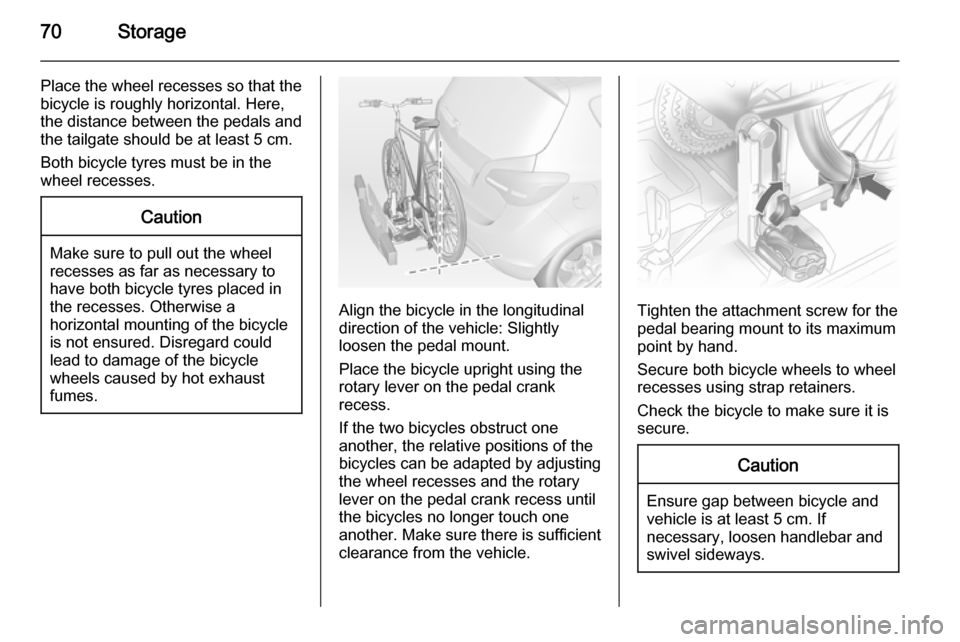
Place the wheel recesses so that thebicycle is roughly horizontal. Here,
the distance between the pedals and
the tailgate should be at least 5 cm.
Both bicycle tyres must be in the
wheel recesses.Caution
Make sure to pull out the wheel
recesses as far as necessary to
have both bicycle tyres placed in
the recesses. Otherwise a
horizontal mounting of the bicycle
is not ensured. Disregard could
lead to damage of the bicycle
wheels caused by hot exhaust
fumes.
Align the bicycle in the longitudinal direction of the vehicle: Slightly
loosen the pedal mount.
Place the bicycle upright using the
rotary lever on the pedal crank
recess.
If the two bicycles obstruct one
another, the relative positions of the
bicycles can be adapted by adjusting
the wheel recesses and the rotary
lever on the pedal crank recess until
the bicycles no longer touch one
another. Make sure there is sufficient
clearance from the vehicle.Tighten the attachment screw for the
pedal bearing mount to its maximum
point by hand.
Secure both bicycle wheels to wheel
recesses using strap retainers.
Check the bicycle to make sure it is
secure.
Caution
Ensure gap between bicycle and
vehicle is at least 5 cm. If
necessary, loosen handlebar and swivel sideways.
Page 76 of 237
74Storage
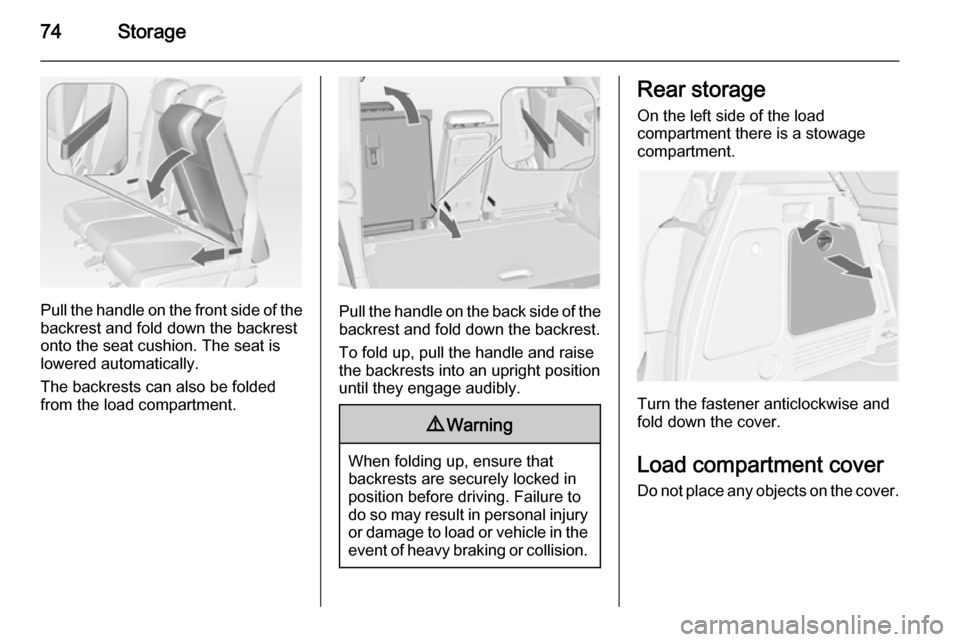
Pull the handle on the front side of the
backrest and fold down the backrest
onto the seat cushion. The seat is
lowered automatically.
The backrests can also be folded
from the load compartment.Pull the handle on the back side of the backrest and fold down the backrest.
To fold up, pull the handle and raise
the backrests into an upright position
until they engage audibly.
9 Warning
When folding up, ensure that
backrests are securely locked in
position before driving. Failure to
do so may result in personal injury or damage to load or vehicle in the event of heavy braking or collision.
Rear storage
On the left side of the load
compartment there is a stowage
compartment.
Turn the fastener anticlockwise and
fold down the cover.
Load compartment cover
Do not place any objects on the cover.
Page 78 of 237
76Storage
Double load-bay floor
The double load-bay floor can be
inserted in the load compartment in
two positions:
■ directly above the cover for the spare wheel well or the rear floor
cover,
■ in the upper openings in the load compartment.
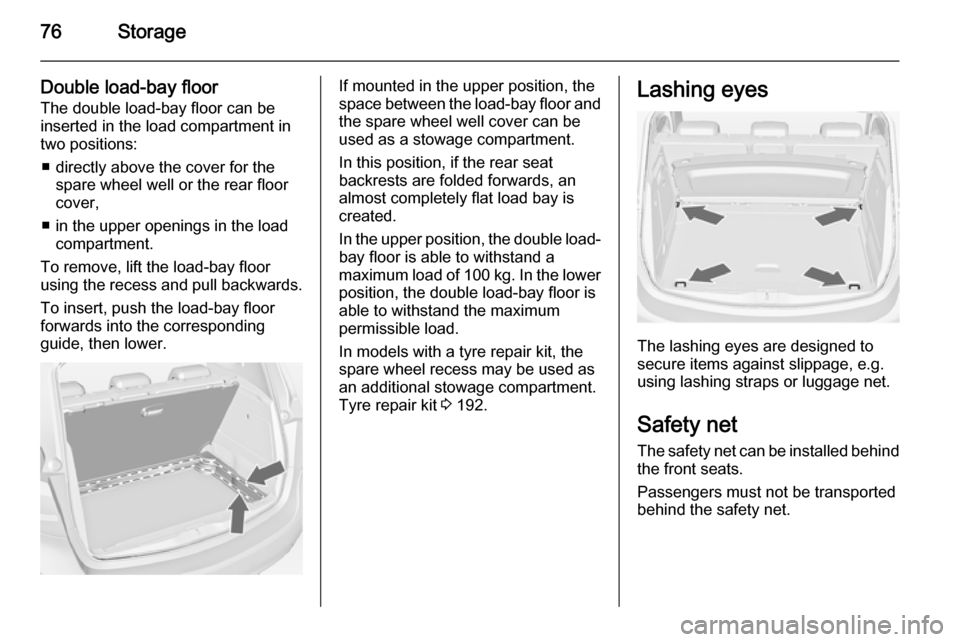
To remove, lift the load-bay floor
using the recess and pull backwards.
To insert, push the load-bay floor
forwards into the corresponding
guide, then lower.If mounted in the upper position, the
space between the load-bay floor and
the spare wheel well cover can be
used as a stowage compartment.
In this position, if the rear seat
backrests are folded forwards, an
almost completely flat load bay is
created.
In the upper position, the double load-
bay floor is able to withstand a
maximum load of 100 kg. In the lower position, the double load-bay floor is
able to withstand the maximum
permissible load.
In models with a tyre repair kit, the
spare wheel recess may be used as an additional stowage compartment.
Tyre repair kit 3 192.Lashing eyes
The lashing eyes are designed to
secure items against slippage, e.g.
using lashing straps or luggage net.
Safety net The safety net can be installed behind the front seats.
Passengers must not be transported
behind the safety net.
Page 81 of 237

Storage79
Depending on the vehicle, a box is
located under the driver's seat. Pull handle and fold down the cover.
Maximum load: 1.5 kg.
Roof rack system
Roof rack For safety reasons and to avoid
damage to the roof, the vehicle
approved roof rack system is
recommended. For further
information contact your workshop.
Follow the installation instructions
and remove the roof rack when not in
use.
Detach the cover from each mounting
point.
Loading information
■ Heavy objects in the load compartment should be placedagainst the seat backrests. Ensure
that the backrests are securely
engaged. If objects can be stacked, heavier objects should be placed at
the bottom.
■ Secure objects with lashing straps attached to the lashing eyes 3 76.
Page 82 of 237

80Storage
■ Use the hook at the left sidewall ofthe load compartment for hanging
up carrier bags. Pull out the hook.
Maximum load: 3 kg.
■ Secure loose objects in the load compartment to prevent them from
sliding.
■ When transporting objects in the load compartment, the backrests of
the rear seats must not be angled
forward.
■ Do not allow the load to protrude above the upper edge of the
backrests.
■ Do not place any objects on the load compartment cover or the
instrument panel, and do not cover
the sensor on top of the instrument panel.
■ The load must not obstruct the operation of the pedals, parking
brake and gear selector, or hinder
the freedom of movement of the
driver. Do not place any unsecured objects in the interior.
■ Do not drive with an open load compartment.9 Warning
Always make sure that the load in
the vehicle is securely stowed.
Otherwise objects can be thrown
around inside the vehicle and
cause personal injury or damage
to the load or vehicle.
■ The payload is the difference between the permitted gross
vehicle weight (see identification
plate 3 211) and the EC kerb
weight.
To calculate the payload, enter the
data for your vehicle in the Weights
table at the front of this manual.
The EC kerb weight includes
weights for the driver (68 kg),
luggage (7 kg) and all fluids (tank
90 % full).
Optional equipment and
accessories increase the kerb
weight.
■ Driving with a roof load increases the sensitivity of the vehicle to
cross-winds and has a detrimental
effect on vehicle handling due to
the vehicle's higher centre of
gravity. Distribute the load evenly
and secure it properly with retaining
straps. Adjust the tyre pressure and vehicle speed according to the load
conditions. Check and retighten the straps frequently.
Do not drive faster than 75 mph.
The permissible roof load is 60 kg. The roof load is the combined
weight of the roof rack and the load.
Page 100 of 237

98Instruments and controls
Additionally a warning message is
displayed on vehicles with Midlevel-
and Uplevel-Display.
Catalytic converter 3 138.
Bleeding the diesel fuel system
3 171.
Immobiliser
d flashes yellow.
Fault in the immobiliser system. The
engine cannot be started.
Reduced engine power
# illuminates yellow.
The engine power is limited. Consult
a workshop.
Exterior light
8 illuminates green.
The exterior lights are on 3 113.
High beam C illuminates blue.Illuminated when high beam is on and
during headlight flash 3 114.
Adaptive forward lighting
f illuminates or flashes yellow.
Illuminates Fault in system.
Seek the assistance of a workshop.
Flashes
System switched to symmetrical low
beam.
Control indicator f flashes for approx.
4 seconds after the ignition is
switched on as a reminder that the
system has been activated 3 115.
Automatic light control 3 114.
Fog light > illuminates green.
The front fog lights are on 3 117.
Rear fog light
r illuminates yellow.The rear fog light is on 3 118.
Cruise control
m illuminates white or green.
Illuminates white
The system is on.
Illuminates green A certain speed is stored.
Cruise control 3 147.
Door open
h illuminates red.
A door or the tailgate is open.
Automatic locking
^ illuminates amber.
Fault in the automatic locking system. The rear doors are possibly not
secured against opening.
Page 142 of 237

140Driving and operating
Without brake pedal applied, the
control indicator j illuminates.
If the selector lever is not in P when
the ignition is switched off, the control
indicator j and P flash.
To engage P or R, press the release
button.
The engine can only be started with the lever in position P or N. When
position N is selected, press the brake
pedal or apply the parking brake
before starting.
Do not accelerate while engaging a
gear. Never depress the accelerator
pedal and brake pedal at the same
time.
When a gear is engaged, the vehicle
slowly begins to creep when the
brake is released.
Engine braking To utilise the engine braking effect,select a lower gear in good time when
driving downhill, see manual mode.
Rocking the vehicle
Rocking the vehicle is only
permissible if the vehicle is stuck in
sand, mud or snow. Move the selector
lever between D and R in a repeat
pattern. Do not race the engine and
avoid sudden acceleration.
Parking
Apply the parking brake and engage P .
The ignition key can only be removed
when the selector lever is in position
P .Manual mode
Move selector lever out of position D
towards the left and then forwards or backwards.
<=Shift to a higher gear.]=Shift to a lower gear.
If a higher gear is selected when
vehicle speed is too low, or a lower
gear when vehicle speed is too high,
the shift is not executed. This can
cause a message in the Driver
Information Centre.
Page 163 of 237

Driving and operating161
Stowage of the detachable
coupling ball bar
The bag with the coupling ball bar is
stowed in the rear stowage
compartment on the floor.
Run the strap through the lashing eye and tighten the strap to secure the
bag.
Fitting the detachable coupling
ball bar
Disengage and fold down the socket. Remove the sealing plug from the
opening for the coupling ball bar and
stow it.
Checking the tensioning of the
coupling ball bar
■ Red marking on rotary knob must
point towards green marking on
coupling ball bar.
■ The gap between the rotary knob and the coupling ball bar must beapprox. 5 mm.
Otherwise, the coupling ball bar must be tensioned before being inserted:
Page 168 of 237

166Vehicle care9Danger
The ignition system use extremely
high voltage. Do not touch.
Bonnet
Opening
Pull the release lever and return it to
its original position.
Press the safety catch and open the
bonnet.
Secure the bonnet support.
If the bonnet is opened during an
Autostop, the engine will be restarted automatically for safety reasons.
Closing Before closing the bonnet, press the
support into the holder.
Lower the bonnet and allow it to drop
into the catch. Check that the bonnet
is engaged.
Engine oil
Check the engine oil level manually
on a regular basis to prevent damage
to the engine.
Ensure that the correct specification
of oil is used. Recommended fluids
and lubricants 3 208.
Check with the vehicle on a level
surface. The engine must be at
operating temperature and switched
off for at least 5 minutes.
Pull out the dipstick, wipe it clean, insert it to the stop on the handle, pull
out and read the engine oil level.
Insert dipstick to the stop on the
handle and make half a turn.
Page 177 of 237

Vehicle care175
2. Rotate the bulb holder clockwiseto disengage. Withdraw the bulb
holder from the reflector.
3. Disengage the bulb holder from the plug connector by pressing
the retaining lug.
4. Replace the bulb and connect bulb holder with the plug
connector.
5. Insert the bulb holder, engaging the two lugs into the reflector and
rotate anticlockwise to secure.
6. Fit the cap and rotate clockwise.
Cornering light
1. Rotate protective cover 2
anticlockwise and remove.
2. Rotate the bulb holder anticlockwise to disengage.
Withdraw the bulb holder from the
reflector.
3. Disengage the bulb holder from the plug connector by pressing
the retaining lugs.
4. Replace the bulb and connect bulb holder with the plug
connector.
5. Insert the bulb holder, engaging the two lugs into the reflector and
rotate clockwise to secure.
6. Fit the cap and rotate clockwise.