automatic transmission VAUXHALL MERIVA 2014.5 User Guide
[x] Cancel search | Manufacturer: VAUXHALL, Model Year: 2014.5, Model line: MERIVA, Model: VAUXHALL MERIVA 2014.5Pages: 237, PDF Size: 7.59 MB
Page 149 of 237

Driving and operating147
ESC is reactivated by pressing the
b button again. If the TC system was
previously disabled, both TC and
ESC are reactivated.
ESC is also reactivated the next time
the ignition is switched on.Driver assistance
systems9 Warning
Driver assistance systems are
developed to support the driver
and not to replace the driver's
attention.
The driver accepts full
responsibility when driving the
vehicle.
When using driver assistance
systems, always take care
regarding the current traffic
situation.
Cruise control
The cruise control can store and
maintain speeds of approx. 20 to
120 mph. Deviations from the stored
speeds may occur when driving uphill or downhill.
For safety reasons the cruise controlcannot be activated until the foot
brake has been operated once.
Activating in first gear is not possible.
Do not use the cruise control if it is not advisable to maintain a constant
speed.
With automatic transmission, only
activate cruise control in automatic
mode.
Control indicator m 3 98.
Page 203 of 237
Vehicle care201
■Never expose the vehicle battery to
naked flames or sparks.
■ A discharged vehicle battery can already freeze at a temperature of
0 °C. Defrost the frozen battery
before connecting jump leads.
■ Wear eye protection and protective
clothing when handling a vehicle
battery.
■ Use a booster battery with the same voltage (12 volts). Its capacity(Ah) must not be much less than
that of the discharged battery.
■ Use jump leads with insulated terminals and a cross section of at
least 16 mm 2
(25 mm 2
for diesel
engines).
■ Do not disconnect the discharged battery from the vehicle.
■ Switch off all unnecessary electrical
consumers.
■ Do not lean over the battery during jump starting.
■ Do not allow the terminals of one lead to touch those of the other
lead.■ The vehicles must not come into contact with each other during the
jump starting process.
■ Apply the parking brake, transmission in neutral, automatictransmission in P.
■ Open the positive terminal protection caps of both batteries.
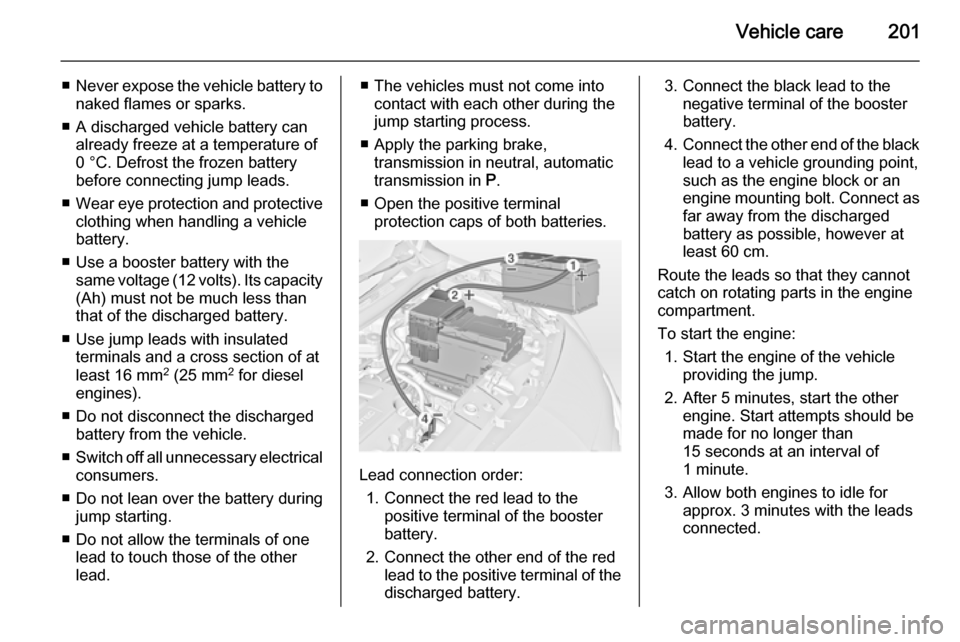
Lead connection order:
1. Connect the red lead to the positive terminal of the booster
battery.
2. Connect the other end of the red lead to the positive terminal of the
discharged battery.
3. Connect the black lead to the negative terminal of the booster
battery.
4. Connect the other end of the black
lead to a vehicle grounding point,
such as the engine block or an
engine mounting bolt. Connect as far away from the discharged
battery as possible, however at
least 60 cm.
Route the leads so that they cannot
catch on rotating parts in the engine
compartment.
To start the engine: 1. Start the engine of the vehicle providing the jump.
2. After 5 minutes, start the other engine. Start attempts should be
made for no longer than
15 seconds at an interval of
1 minute.
3. Allow both engines to idle for approx. 3 minutes with the leads
connected.
Page 205 of 237
Vehicle care203
Switch on ignition to release steering
wheel lock and to permit operation of
brake lights, horn and windscreen
wiper.
Transmission in neutral.Caution
Drive slowly. Do not drive jerkily.
Excessive tractive force can
damage the vehicle.
When the engine is not running,
considerably more force is needed to
brake and steer.
To prevent the entry of exhaust gases from the towing vehicle, switch on the
air recirculation and close the
windows.
Vehicles with automatic transmission: The vehicle must be towed facing
forwards, not faster than 50 mph nor further than 60 miles. In all other
cases and when the transmission is
defective, the front axle must be
raised off the ground.
Seek the assistance of a workshop. After towing, unscrew the towing eye.
Insert cap at the bottom and close
cap.
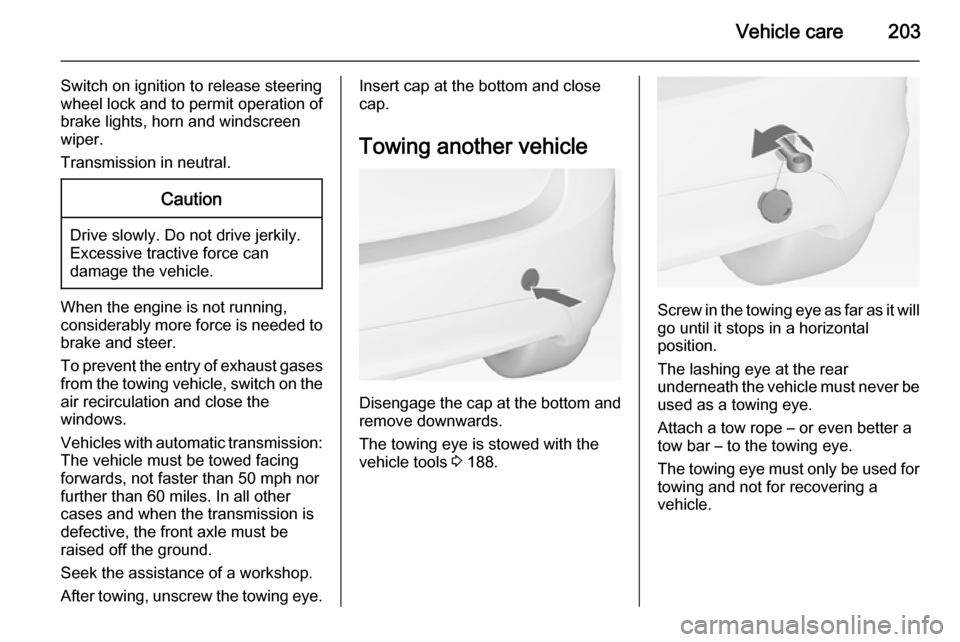
Towing another vehicle
Disengage the cap at the bottom and
remove downwards.
The towing eye is stowed with the
vehicle tools 3 188.
Screw in the towing eye as far as it will
go until it stops in a horizontal
position.
The lashing eye at the rear
underneath the vehicle must never be used as a towing eye.
Attach a tow rope – or even better a
tow bar – to the towing eye.
The towing eye must only be used for
towing and not for recovering a
vehicle.
Page 220 of 237
![VAUXHALL MERIVA 2014.5 User Guide 218Technical dataPerformanceEngineB14XERB14NELB14NETMaximum speed4)
[mph]Manual transmission5)5)5)Automatic transmission–1155)4) The maximum speed indicated is achievable at kerb weight (without dr](/img/38/19512/w960_19512-219.png "VAUXHALL MERIVA 2014.5 User Guide 218Technical dataPerformanceEngineB14XERB14NELB14NETMaximum speed4)
[mph]Manual transmission5)5)5)Automatic transmission–1155)4) The maximum speed indicated is achievable at kerb weight (without dr")
218Technical dataPerformanceEngineB14XERB14NELB14NETMaximum speed4)
[mph]Manual transmission5)5)5)Automatic transmission–1155)4) The maximum speed indicated is achievable at kerb weight (without driver) plus 200 kg payload. Optional equipment could reduce the specified maximum
speed of the vehicle.
5) Value was not available at time of printing.EngineB16DTCB16DTLB16DTNB16DTHMaximum speed 4)
[mph]Manual transmission5)5)5)5)Automatic transmission––––4) The maximum speed indicated is achievable at kerb weight (without driver) plus 200 kg payload. Optional equipment could reduce the specified maximum
speed of the vehicle.
5) Value was not available at time of printing.
Page 221 of 237
![VAUXHALL MERIVA 2014.5 User Guide Technical data219
EngineA13DTCA13DTEA17DTIMaximum speed4)
[mph]Manual transmission99104–Automatic transmission––1114) The maximum speed indicated is achievable at kerb weight (without driver) p](/img/38/19512/w960_19512-220.png "VAUXHALL MERIVA 2014.5 User Guide Technical data219
EngineA13DTCA13DTEA17DTIMaximum speed4)
[mph]Manual transmission99104–Automatic transmission––1114) The maximum speed indicated is achievable at kerb weight (without driver) p")
Technical data219
EngineA13DTCA13DTEA17DTIMaximum speed4)
[mph]Manual transmission99104–Automatic transmission––1114) The maximum speed indicated is achievable at kerb weight (without driver) plus 200 kg payload. Optional equipment could reduce the specified maximum
speed of the vehicle.
Page 222 of 237
![VAUXHALL MERIVA 2014.5 User Guide 220Technical dataVehicle weight
Kerb weight, basic model without any optional equipmentEngineManual transmissionAutomatic transmissionwithout/with air conditioning
[kg]B14XER1361/1376–B14NEL1393 6)](/img/38/19512/w960_19512-221.png "VAUXHALL MERIVA 2014.5 User Guide 220Technical dataVehicle weight
Kerb weight, basic model without any optional equipmentEngineManual transmissionAutomatic transmissionwithout/with air conditioning
[kg]B14XER1361/1376–B14NEL1393 6)")
220Technical dataVehicle weight
Kerb weight, basic model without any optional equipmentEngineManual transmissionAutomatic transmissionwithout/with air conditioning
[kg]B14XER1361/1376–B14NEL1393 6)
/1408 6)1471/1486B14NET1393/14081471/1486B16DTC1503/1518–B16DTL1503/1518–B16DTN1503/1518–B16DTH1503/1518–A13DTC1393/1408–A13DTE1393/1408–A17DTI–1503/15186)
With LPG engine, weight increased by 78 kg.
Page 223 of 237
![VAUXHALL MERIVA 2014.5 User Guide Technical data221
Kerb weight, basic model with all optional equipmentEngineManual transmissionAutomatic transmissionwithout/with air conditioning
[kg]B14XER–/1571–B14NEL–/1613–/1664B14NET–/](/img/38/19512/w960_19512-222.png "VAUXHALL MERIVA 2014.5 User Guide Technical data221
Kerb weight, basic model with all optional equipmentEngineManual transmissionAutomatic transmissionwithout/with air conditioning
[kg]B14XER–/1571–B14NEL–/1613–/1664B14NET–/")
Technical data221
Kerb weight, basic model with all optional equipmentEngineManual transmissionAutomatic transmissionwithout/with air conditioning
[kg]B14XER–/1571–B14NEL–/1613–/1664B14NET–/1613–/1664B16DTC–/1701–B16DTL–/1701–B16DTN–/1701–B16DTH–/1701–A13DTC–/1613–A13DTE–/1408–A17DTI––/1733Vehicle dimensionsLength [mm]4300Width without exterior mirrors [mm]1812Width with two exterior mirrors [mm]1994Height (without antenna) [mm]1615
Page 232 of 237

230IndexAAccessories and vehicle modifications .......................... 164
Active head restraints ..................35
Adaptive brake light ....................143
Adaptive forward lighting ..........
.................................. 98, 116, 174
Adjustable air vents ...................129
Airbag and belt tensioners ...........93
Airbag deactivation ................53, 94
Airbag label................................... 48 Airbag system .............................. 48
Air conditioning regular operation ................................ 130
Air conditioning system .............. 123
Air intake .................................... 130
Air vents...................................... 129
Alert ............................................ 106
Antifreeze ................................... 167
Antilock brake system ................ 143
Antilock brake system (ABS) .......95
Anti-theft alarm system ................27
Anti-theft locking system .............. 26 Appearance care ........................204
Armrest ................................... 39, 42
Armrest storage ........................... 63
Ashtrays ....................................... 88
Automatic anti-dazzle ..................30
Automatic light control ...............114Automatic locking ..................24, 98
Automatic transmission .............139
Auxiliary heater .......................... 129
B Battery discharge protection ......121
Battery voltage ........................... 106
Belts.............................................. 44 Bicycle rack .................................. 64
Bonnet ....................................... 166
Brake and clutch fluid .................208
Brake and clutch system .............95
Brake assist ............................... 145
Brake fluid .................................. 168
Brakes ............................... 143, 168
Breakdown.................................. 202
Bulb replacement ....................... 172
C Capacities .................................. 223
Car Pass ...................................... 19
Catalytic converter .....................138
Central locking system ................21
Centre console lighting ..............120
Changing tyre and wheel size ...191
Charging system .......................... 94
Child locks ................................... 24
Child restraint installation locations ................................... 57
Child restraints.............................. 54