automatic transmission VAUXHALL MERIVA 2015.5 User Guide
[x] Cancel search | Manufacturer: VAUXHALL, Model Year: 2015.5, Model line: MERIVA, Model: VAUXHALL MERIVA 2015.5Pages: 247, PDF Size: 7.83 MB
Page 149 of 247

Driving and operating147
Fault9Warning
If there is a fault in the ABS, the
wheels may be liable to lock due
to braking that is heavier than
normal. The advantages of ABS are no longer available. During
hard braking, the vehicle can no longer be steered and may
swerve.
Have the cause of the fault remedied
by a workshop.
Parking brake
Electric parking brake
Applying when vehicle is stationary
9 Warning
Pull switch m for approx. one
second, the electric parking brake
operates automatically with an
adequate force. For maximum
force, e.g. parking with trailer or on
inclines, pull switch m twice.
The electric parking brake is
applied when control indicator m
illuminates 3 96.
The electric parking brake can always
be activated, even if the ignition is off.
Do not operate electric parking brake
system too often with engine not
running as this will discharge the
vehicle battery.
Before leaving the vehicle, check the electric parking brake status.
Control indicator m 3 96.
Releasing
Switch on ignition. Keep brake pedal
depressed and then push switch m.
Drive away function
Depressing clutch pedal (manual
transmission) or engaging D
(automatic transmission) and then
depressing the accelerator pedal
releases the electric parking brake
Page 153 of 247
Driving and operating151
For safety reasons the cruise control
cannot be activated until the foot
brake has been operated once.
Activating in first gear is not possible.
Do not use the cruise control if it is not advisable to maintain a constant
speed.
With automatic transmission, only
activate cruise control in automatic
mode.
Control indicator m 3 99.
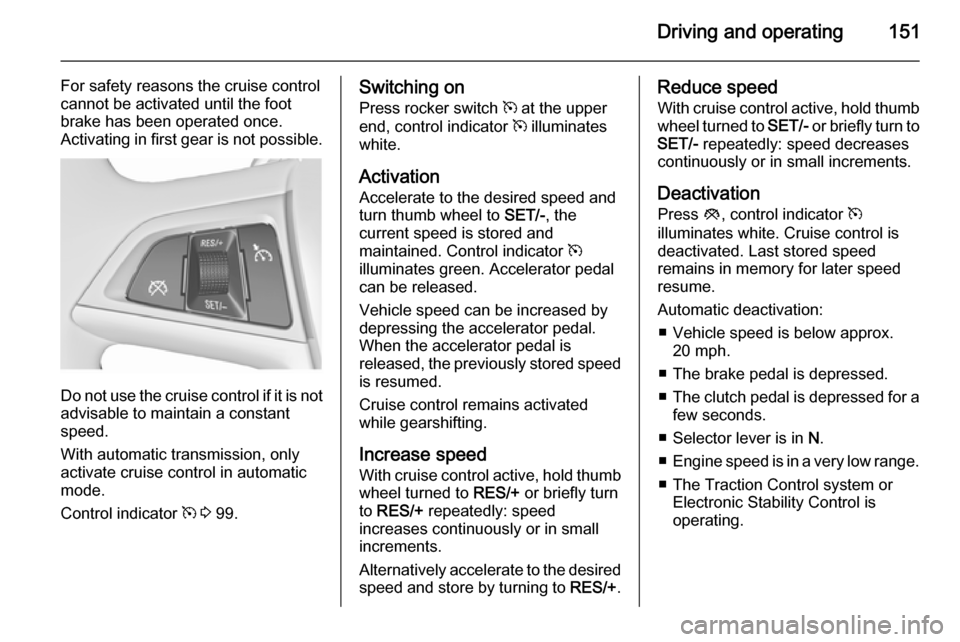
Switching on
Press rocker switch m at the upper
end, control indicator m illuminates
white.
Activation Accelerate to the desired speed and
turn thumb wheel to SET/-, the
current speed is stored and
maintained. Control indicator m
illuminates green. Accelerator pedal
can be released.
Vehicle speed can be increased by depressing the accelerator pedal.
When the accelerator pedal is
released, the previously stored speed
is resumed.
Cruise control remains activated
while gearshifting.
Increase speed With cruise control active, hold thumb
wheel turned to RES/+ or briefly turn
to RES/+ repeatedly: speed
increases continuously or in small
increments.
Alternatively accelerate to the desired speed and store by turning to RES/+.Reduce speed
With cruise control active, hold thumb
wheel turned to SET/- or briefly turn to
SET/- repeatedly: speed decreases
continuously or in small increments.
Deactivation
Press y, control indicator m
illuminates white. Cruise control is deactivated. Last stored speed
remains in memory for later speed
resume.
Automatic deactivation: ■ Vehicle speed is below approx. 20 mph.
■ The brake pedal is depressed.
■ The clutch pedal is depressed for a
few seconds.
■ Selector lever is in N.
■ Engine speed is in a very low range.
■ The Traction Control system or Electronic Stability Control is
operating.
Page 199 of 247

Vehicle care197
matching process should also be
performed after replacing a spare tyre with a road tyre containing the TPMS
sensor.
The malfunction light w and the
warning message or code should go
off at the next ignition cycle. The
sensors are matched to the tyre/
wheel positions, using a TPMS
relearn tool, in the following order: left
side front tyre, right side front tyre,
right side rear tyre and left side rear
tyre. The turn light at the current
active position is illuminated until
sensor is matched.
Consult your workshop for service or
to purchase a relearn tool. There are
2 minutes to match the first tyre/wheel position, and 5 minutes overall to
match all four tyre/wheel positions. If
it takes longer, the matching process
stops and must be restarted.The TPMS sensor matching process is:
1. Apply the parking brake; on vehicles with automatic
transmission set the selector lever
to P.
2. Turn the ignition on.
3. Press MENU on the turn signal
lever to select the Vehicle
Information Menu in the Driver
Information Centre (DIC).
4. Turn the adjuster wheel to scroll to
the tyre pressure menu.
5. Press the SET/CLR button to
begin the sensor matching
process. A message requesting
acceptance of the process should
display.
6. Press the SET/CLR button again
to confirm the selection. The horn sounds twice to signal the
receiver is in relearn mode.
7. Start with the left side front tyre.
8. Place the relearn tool against the tyre sidewall, near the valve stem.Then press the button to activate
the TPMS sensor. A horn chirpconfirms that the sensor
identification code has been
matched to this tyre and wheel
position.
9. Proceed to the right side front tyre,
and repeat the procedure in Step 8.
10. Proceed to the right side rear tyre,
and repeat the procedure in
Step 8.
11. Proceed to the left side rear tyre, and repeat the procedure in
Step 8. The horn sounds twice to
indicate the sensor identification
code has been matched to the left side rear tyre, and the TPMS
sensor matching process is no
longer active.
12. Turn off the ignition.
13. Set all four tyres to the recommended air pressure level
as indicated on the tyre pressure
label.
14. Ensure the tyre loading status is set according selected pressure
3 100.
Page 213 of 247
Vehicle care211
■ The vehicles must not come intocontact with each other during the
jump starting process.
■ Apply the parking brake, transmission in neutral, automatic
transmission in P.
■ Open the positive terminal protection caps of both batteries.
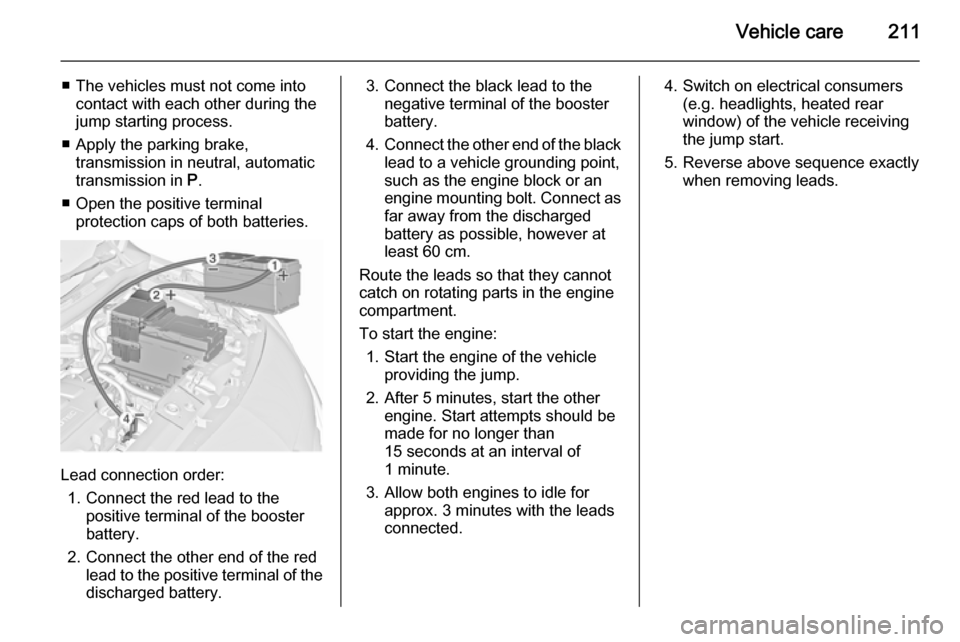
Lead connection order:
1. Connect the red lead to the positive terminal of the booster
battery.
2. Connect the other end of the red lead to the positive terminal of the
discharged battery.
3. Connect the black lead to the negative terminal of the booster
battery.
4. Connect the other end of the black
lead to a vehicle grounding point,
such as the engine block or an
engine mounting bolt. Connect as far away from the discharged
battery as possible, however at
least 60 cm.
Route the leads so that they cannot
catch on rotating parts in the engine
compartment.
To start the engine: 1. Start the engine of the vehicle providing the jump.
2. After 5 minutes, start the other engine. Start attempts should be
made for no longer than
15 seconds at an interval of
1 minute.
3. Allow both engines to idle for approx. 3 minutes with the leads
connected.4. Switch on electrical consumers (e.g. headlights, heated rear
window) of the vehicle receiving
the jump start.
5. Reverse above sequence exactly when removing leads.
Page 214 of 247
212Vehicle careTowing
Towing the vehicle
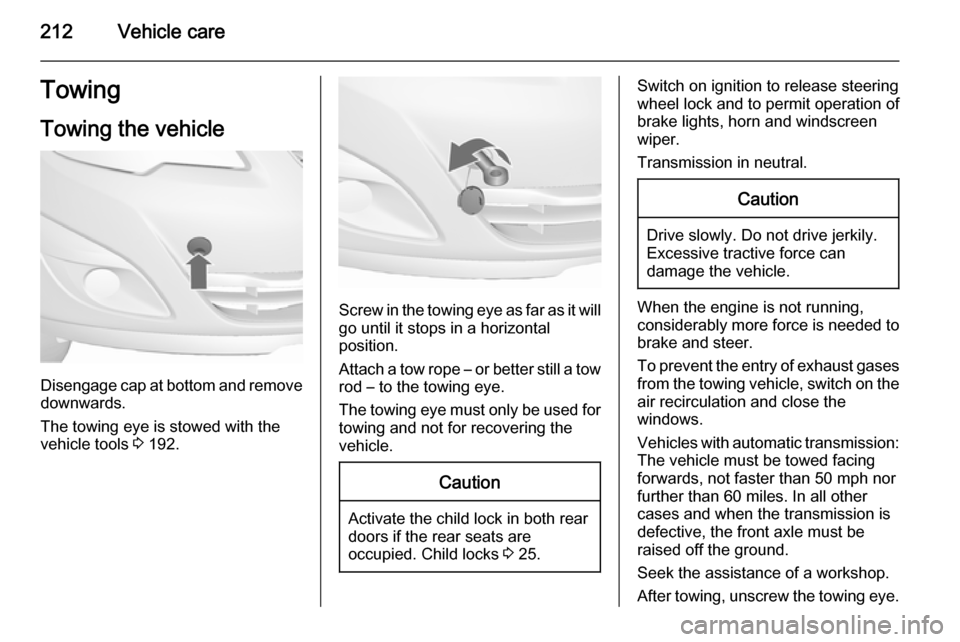
Disengage cap at bottom and remove downwards.
The towing eye is stowed with the
vehicle tools 3 192.
Screw in the towing eye as far as it will
go until it stops in a horizontal
position.
Attach a tow rope – or better still a tow
rod – to the towing eye.
The towing eye must only be used for towing and not for recovering the
vehicle.
Caution
Activate the child lock in both rear
doors if the rear seats are
occupied. Child locks 3 25.
Switch on ignition to release steering
wheel lock and to permit operation of
brake lights, horn and windscreen
wiper.
Transmission in neutral.Caution
Drive slowly. Do not drive jerkily.
Excessive tractive force can
damage the vehicle.
When the engine is not running,
considerably more force is needed to
brake and steer.
To prevent the entry of exhaust gases from the towing vehicle, switch on the
air recirculation and close the
windows.
Vehicles with automatic transmission: The vehicle must be towed facing
forwards, not faster than 50 mph nor further than 60 miles. In all other
cases and when the transmission is
defective, the front axle must be
raised off the ground.
Seek the assistance of a workshop. After towing, unscrew the towing eye.
Page 230 of 247
![VAUXHALL MERIVA 2015.5 User Guide 228Technical dataPerformanceEngineB14XERB14NELB14NEL LPGB14NETMaximum speed4)
[mph]Manual transmission110117117122Automatic transmission–115–1204) The maximum speed indicated is achievable at ker](/img/38/19516/w960_19516-229.png "VAUXHALL MERIVA 2015.5 User Guide 228Technical dataPerformanceEngineB14XERB14NELB14NEL LPGB14NETMaximum speed4)
[mph]Manual transmission110117117122Automatic transmission–115–1204) The maximum speed indicated is achievable at ker")
228Technical dataPerformanceEngineB14XERB14NELB14NEL LPGB14NETMaximum speed4)
[mph]Manual transmission110117117122Automatic transmission–115–1204) The maximum speed indicated is achievable at kerb weight (without driver) plus 200 kg payload. Optional equipment could reduce the specified maximum
speed of the vehicle.EngineB16DTCB16DTLB16DTNB16DTHB16DTEMaximum speed 4)
[mph]Manual transmission108115113122115Automatic transmission–––––4) The maximum speed indicated is achievable at kerb weight (without driver) plus 200 kg payload. Optional equipment could reduce the specified maximum
speed of the vehicle.
Page 231 of 247
![VAUXHALL MERIVA 2015.5 User Guide Technical data229
EngineA13DTCA13DTEA17DTIMaximum speed4)
[mph]Manual transmission99104–Automatic transmission––1114) The maximum speed indicated is achievable at kerb weight (without driver) p](/img/38/19516/w960_19516-230.png "VAUXHALL MERIVA 2015.5 User Guide Technical data229
EngineA13DTCA13DTEA17DTIMaximum speed4)
[mph]Manual transmission99104–Automatic transmission––1114) The maximum speed indicated is achievable at kerb weight (without driver) p")
Technical data229
EngineA13DTCA13DTEA17DTIMaximum speed4)
[mph]Manual transmission99104–Automatic transmission––1114) The maximum speed indicated is achievable at kerb weight (without driver) plus 200 kg payload. Optional equipment could reduce the specified maximum
speed of the vehicle.
Page 232 of 247
![VAUXHALL MERIVA 2015.5 User Guide 230Technical dataVehicle weight
Kerb weight, basic model without any optional equipmentEngineManual transmissionAutomatic transmissionwithout/with air conditioning
[kg]B14XER1361/1376–B14NEL LPG1471](/img/38/19516/w960_19516-231.png "VAUXHALL MERIVA 2015.5 User Guide 230Technical dataVehicle weight
Kerb weight, basic model without any optional equipmentEngineManual transmissionAutomatic transmissionwithout/with air conditioning
[kg]B14XER1361/1376–B14NEL LPG1471")
230Technical dataVehicle weight
Kerb weight, basic model without any optional equipmentEngineManual transmissionAutomatic transmissionwithout/with air conditioning
[kg]B14XER1361/1376–B14NEL LPG1471/1486–B14NEL1393/14081471/1486B14NET1393/14081471/1486B16DTC1503/1518–B16DTL1503/1518–B16DTN1503/1518–B16DTH1503/1518–B16DTE1503/1518–A13DTC1393/1408–A13DTE1393/1408–A17DTI–1503/1518
Optional equipment and accessories increase the kerb weight.
Loading information 3 80.
Page 242 of 247

240IndexAAccessories and vehicle modifications .......................... 168
Active head restraints ..................35
Adaptive brake light ....................146
Adaptive forward lighting ..........
.................................. 99, 119, 179
Adjustable air vents ...................132
Airbag and belt tensioners ...........94
Airbag deactivation ................53, 95
Airbag label................................... 48 Airbag system .............................. 48
Air conditioning regular operation ................................ 133
Air conditioning system .............. 126
Air intake .................................... 133
Air vents...................................... 132
Alert ............................................ 108
Antifreeze ................................... 171
Antilock brake system ................ 146
Antilock brake system (ABS) .......96
Anti-theft alarm system ................27
Anti-theft locking system .............. 27 Appearance care ........................214
Armrest ................................... 39, 42
Armrest storage ........................... 63
Ashtrays ....................................... 89
Automatic anti-dazzle ..................30
Automatic light control ...............117Automatic locking ..................24, 99
Automatic transmission .............142
Auxiliary heater .......................... 132
B Battery discharge protection ......124
Battery voltage ........................... 108
Belts.............................................. 44 Bicycle rack .................................. 64
Bonnet ....................................... 170
Brake and clutch fluid .................218
Brake and clutch system .............96
Brake assist ............................... 148
Brake fluid .................................. 173
Brakes ............................... 146, 173
Breakdown.................................. 212
Bulb replacement ....................... 176
C Capacities .................................. 232
Car Pass ...................................... 19
Catalytic converter .....................142
Central locking system ................21
Centre console lighting ..............123
Changing tyre and wheel size ...198
Charging system .......................... 95
Child locks ................................... 25
Child restraint installation locations ................................... 57
Child restraints.............................. 54