stop start VAUXHALL MERIVA 2015.5 Owner's Guide
[x] Cancel search | Manufacturer: VAUXHALL, Model Year: 2015.5, Model line: MERIVA, Model: VAUXHALL MERIVA 2015.5Pages: 247, PDF Size: 7.83 MB
Page 142 of 247

140Driving and operating
■ The stop-start system is manuallydeactivated.
■ The bonnet is opened.
■ The driver's seat belt is unfastened
and the driver's door is opened.
■ The engine temperature is too low.
■ The charging level of the vehicle battery is below a defined level.
■ The brake vacuum is not sufficient.
■ The vehicle is driven at least at walking speed.
■ The climate control system requests an engine start.
■ The air conditioning is manually switched on.
If the bonnet is not fully closed, a warning message is displayed in the
Driver Information Centre.
If an electrical accessory, e.g. a
portable CD player, is connected to
the power outlet, a brief power drop during restart might be noticeable.Parking9 Warning
■ Do not park the vehicle on an
easily ignitable surface. The
high temperature of the exhaust system could ignite the surface.
■ Always apply parking brake. Pull switch m for approx.
one second.
The electric parking brake is
applied when control indicator
m illuminates 3 96.
■ Switch off the engine.
■ If the vehicle is on a level surface or uphill slope, engage
first gear or set the selector lever to position P before removing
the ignition key. On an uphill
slope, turn the front wheels
away from the kerb.
If the vehicle is on a downhill
slope, engage reverse gear or
set the selector lever to position
P before removing the ignition
key. Turn the front wheels
towards the kerb.
■ Remove the ignition key. Turn the steering wheel until the
steering wheel lock is felt to
engage.
For vehicles with automatic
transmission, the key can only
be removed when the selector
lever is in position P.
Lock the vehicle and activate the anti-
theft alarm system.
Notice
In the event of an accident with
airbag deployment, the engine is
turned off automatically if the vehicle
comes to a standstill within a certain
time.
Page 143 of 247

Driving and operating141Engine exhaust9Danger
Engine exhaust gases contain
poisonous carbon monoxide,
which is colourless and odourless and could be fatal if inhaled.
If exhaust gases enter the interior
of the vehicle, open the windows.
Have the cause of the fault
rectified by a workshop.
Avoid driving with an open load
compartment, otherwise exhaust
gases could enter the vehicle.
Diesel particle filter
The diesel particle filter system filters
harmful soot particles out of the
exhaust gases. The system includes
a self-cleaning function that runs
automatically during driving without
any notification. The filter is cleaned
by periodically burning off the soot
particles at high temperature. This
process takes place automatically
under set driving conditions and may
take up to 25 minutes. Typically it
needs between 7 and 12 minutes.
Autostop is not available and fuel
consumption may be higher during
this period. The emission of smells
and smoke during this process is
normal.
Under certain driving conditions, e.g.
short distances, the system cannot
clean itself automatically.
If the cleaning of the filter is required
and if previous driving conditions did
not enable automatic cleaning, it will
be indicated by control indicator %.
Simultaneously Diesel partic. filter is
full continue driving or warning
code 55 appears in the Driver
Information Centre.
% illuminates when diesel particle
filter is full. Start cleaning process as
soon as possible.
% flashes when diesel particle filter
has reached the maximum filling
level. Start cleaning process
immediately to avoid damage to the
engine.
Cleaning process
To activate cleaning process,
continue driving, keeping engine
speed above 2000 revolutions per
minute. Shift down if necessary.
Diesel particle filter cleaning is then
started.
If control indicator g illuminates
additionally, cleaning is not possible,
seek the assistance of a workshop.Caution
If the cleaning process is
interrupted, there is a risk of
provoking severe engine damage.
Page 146 of 247
![VAUXHALL MERIVA 2015.5 Owners Guide 144Driving and operatingManual mode
Move selector lever out of position D
towards the left and then forwards or backwards.
<=shift to a higher gear]=shift to a lower gear
If a higher gear is selected](/img/38/19516/w960_19516-145.png "VAUXHALL MERIVA 2015.5 Owners Guide 144Driving and operatingManual mode
Move selector lever out of position D
towards the left and then forwards or backwards.
<=shift to a higher gear]=shift to a lower gear
If a higher gear is selected")
144Driving and operatingManual mode
Move selector lever out of position D
towards the left and then forwards or backwards.
<=shift to a higher gear]=shift to a lower gear
If a higher gear is selected when
vehicle speed is too low, or a lower
gear when vehicle speed is too high,
the shift is not executed. This can
cause a message in the Driver
Information Centre.
In manual mode, no automatic
shifting to a higher gear takes place
at high engine revolutions.
Electronic driving
programmes ■ Following a cold start, the operating
temperature programme increases
engine speed to quickly bring the
catalytic converter to the required
temperature.
■ The automatic neutral shift function
automatically shifts to idling when
the vehicle is stopped with a
forward gear engaged and the
brake pedal is pressed.
■ Special programmes automatically adapt the shifting points when
driving up inclines or down hills.
Kickdown If the accelerator pedal is pressed
down completely in automatic mode, the transmission shifts to a lower gear
depending on engine speed.Fault
In the event of a fault, g illuminates.
Additionally a code number or a
vehicle message is displayed in the
Driver Information Centre. Vehicle
messages 3 105.
The transmission no longer shifts
automatically. Continued travel is
possible with manual shifting.
Only the highest gear is available.
Depending on the fault, second gear
may also be available in manual
mode. Shift only when vehicle is at a
standstill.
Have the cause of the fault remedied
by a workshop.
Interruption of power
supply
In the event of an interruption of
power supply, the selector lever
cannot be moved out of the P
position. The ignition key cannot be
removed from the ignition switch.
Page 150 of 247

148Driving and operating
automatically. This is not possible
when the switch m is pulled at the
same time.
This function also helps driving away
on inclines.
Aggressive drive-away may reduce
lifetime of wear parts.
Dynamic braking when vehicle is
moving
When the vehicle is moving and
switch m is kept pulled, the electric
parking brake system will decelerate the vehicle, but will not apply
statically.
As soon as switch m is released,
dynamic braking will be stopped.
Fault
Failure mode of electric parking brake
is indicated by control indicator j and
by a code number or a vehicle
message which is displayed in the
Driver Information Centre.
Control indicator j 3 96, vehicle
messages 3 105.Apply electric parking brake: pull and
hold switch m for more than
5 seconds. If control indicator m
illuminates, electric parking brake is
applied.
Release electric parking brake: push
and hold switch m for more than
2 seconds. If control indicator m
extinguishes, electric parking brake is
released.
Control indicator m flashes: electric
parking brake is not fully applied or released. When continuously
flashing, release electric parking
brake and retry applying.
Control indicator m 3 96.
Brake assist
If the brake pedal is depressed
quickly and forcefully, maximum
brake force is automatically applied
(full braking).
Maintain steady pressure on the
brake pedal for as long as full braking
is required. Maximum brake force is
automatically reduced when the
brake pedal is released.Hill start assist
The system helps prevent unintended movement when driving away on
inclines.
When releasing the foot brake after
stopping on an incline, the brakes
remain on for a further 2 seconds. The brakes release automatically as soon
as the vehicle begins to accelerate.
The hill start assist is not active during
an Autostop.
Page 172 of 247
170Vehicle care9Danger
The ignition system use extremely
high voltage. Do not touch.
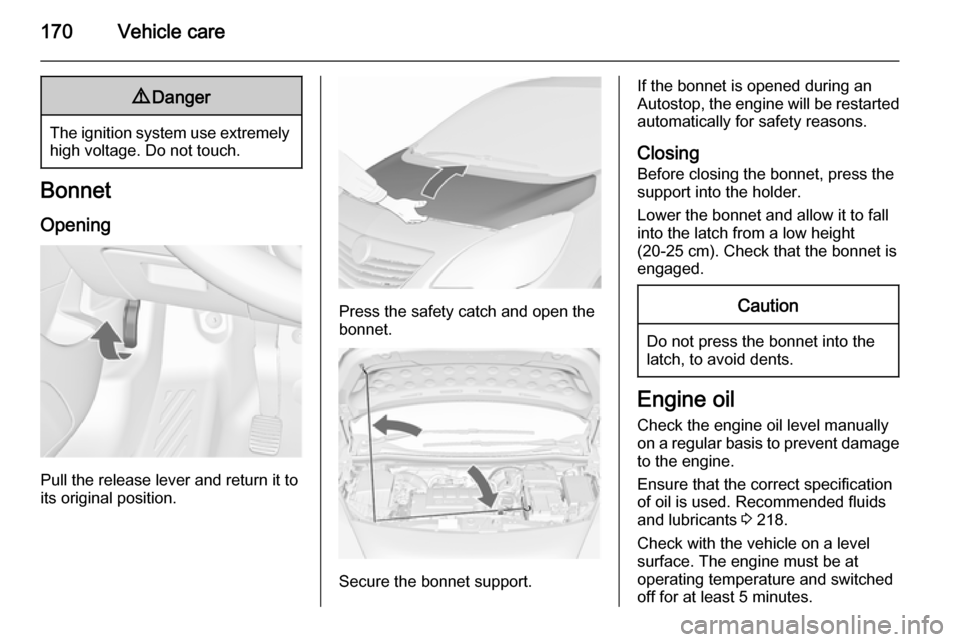
Bonnet
Opening
Pull the release lever and return it to
its original position.
Press the safety catch and open the
bonnet.
Secure the bonnet support.
If the bonnet is opened during an
Autostop, the engine will be restarted automatically for safety reasons.
Closing Before closing the bonnet, press the
support into the holder.
Lower the bonnet and allow it to fall
into the latch from a low height
(20-25 cm). Check that the bonnet is engaged.Caution
Do not press the bonnet into the
latch, to avoid dents.
Engine oil
Check the engine oil level manuallyon a regular basis to prevent damage
to the engine.
Ensure that the correct specification
of oil is used. Recommended fluids
and lubricants 3 218.
Check with the vehicle on a level
surface. The engine must be at
operating temperature and switched
off for at least 5 minutes.
Page 176 of 247
174Vehicle careVehicle batteryVehicles without stop-start systemwill be equipped with a lead acid
battery. Vehicles with stop-start
system will be equipped with an
AGM battery which is not a lead acid
battery.
The vehicle battery is maintenance-
free provided that the driving profile
allows sufficient charging of the
battery. Short-distance-driving and
frequent engine starts can discharge
the battery. Avoid the use of
unnecessary electrical consumers.
Batteries do not belong in household
waste. They must be disposed of at
an appropriate recycling collection
point.
Laying up the vehicle for more than
4 weeks can lead to battery
discharge. Disconnect the clamp from the negative terminal of the vehicle
battery.
Ensure the ignition is switched off
before connecting or disconnecting
the vehicle battery.
The anti-theft alarm siren must be
deactivated as follows: Switch the ignition on then off, disconnect the
vehicle's battery within 15 seconds.
Vehicle battery discharge protection
3 124.
Replacing the vehicle battery Notice
Any deviation from the instructions
given in this paragraph may lead to
a temporary deactivation of the stop-
start system.
When the vehicle battery is being
replaced, please ensure that there
are no open ventilation holes in the
vicinity of the positive terminal. If a
ventilation hole is open in this area, itmust be closed off with a dummy cap, and the ventilation in the vicinity of the
negative terminal must be opened.
Only use vehicle batteries that allow
the fuse box to be mounted above the
vehicle battery.
In vehicles with stop-start system, ensure to have the AGM (Absorptive
Glass Mat) battery replaced with an
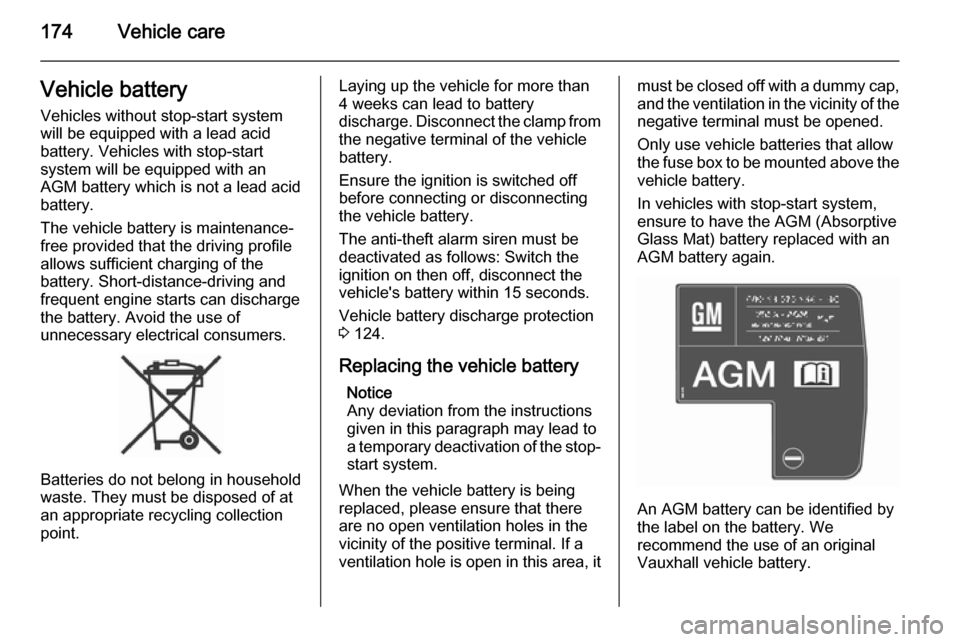
AGM battery again.
An AGM battery can be identified by
the label on the battery. We
recommend the use of an original
Vauxhall vehicle battery.
Page 177 of 247
Vehicle care175
Notice
Using an AGM vehicle battery
different from the original Vauxhall vehicle battery may result in a lower performance of the stop-start
system.9 Warning
When fitting a battery with a length
deviating from the original one, itis essential to ensure a proper
fitting of the buffer element.
We recommend that you have the
vehicle battery replaced by a
workshop.
Stop-start system 3 138.
Charging the vehicle battery9 Warning
On vehicles with stop-start
system, ensure that the charging potential does not exceed
14.6 volts when using a battery
charger. Otherwise the vehicle
battery might be damaged.
Jump starting 3 210.
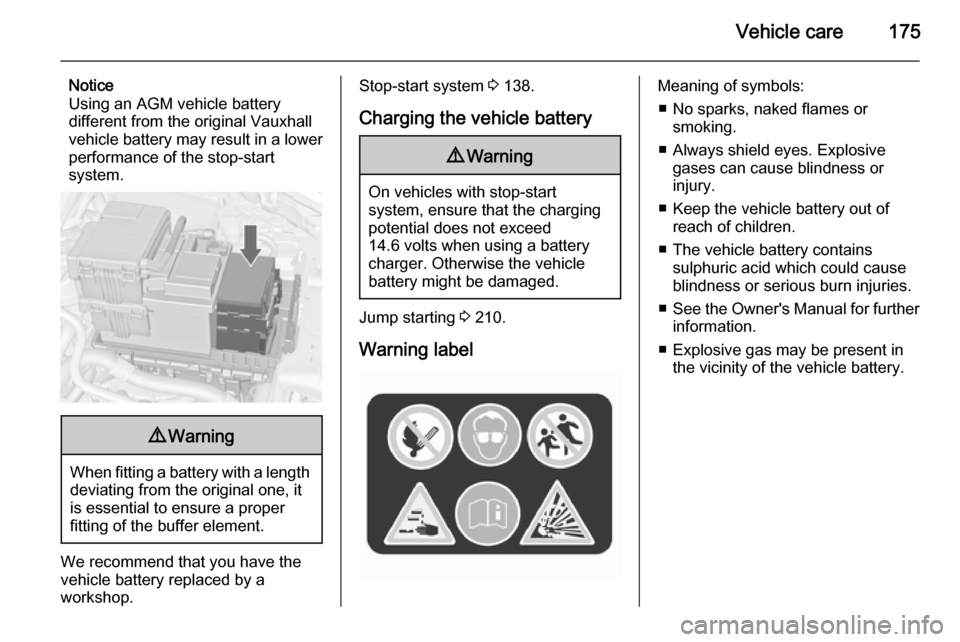
Warning label
Meaning of symbols: ■ No sparks, naked flames or smoking.
■ Always shield eyes. Explosive gases can cause blindness or
injury.
■ Keep the vehicle battery out of reach of children.
■ The vehicle battery contains sulphuric acid which could cause
blindness or serious burn injuries.
■ See the Owner's Manual for further
information.
■ Explosive gas may be present in the vicinity of the vehicle battery.
Page 199 of 247

Vehicle care197
matching process should also be
performed after replacing a spare tyre with a road tyre containing the TPMS
sensor.
The malfunction light w and the
warning message or code should go
off at the next ignition cycle. The
sensors are matched to the tyre/
wheel positions, using a TPMS
relearn tool, in the following order: left
side front tyre, right side front tyre,
right side rear tyre and left side rear
tyre. The turn light at the current
active position is illuminated until
sensor is matched.
Consult your workshop for service or
to purchase a relearn tool. There are
2 minutes to match the first tyre/wheel position, and 5 minutes overall to
match all four tyre/wheel positions. If
it takes longer, the matching process
stops and must be restarted.The TPMS sensor matching process is:
1. Apply the parking brake; on vehicles with automatic
transmission set the selector lever
to P.
2. Turn the ignition on.
3. Press MENU on the turn signal
lever to select the Vehicle
Information Menu in the Driver
Information Centre (DIC).
4. Turn the adjuster wheel to scroll to
the tyre pressure menu.
5. Press the SET/CLR button to
begin the sensor matching
process. A message requesting
acceptance of the process should
display.
6. Press the SET/CLR button again
to confirm the selection. The horn sounds twice to signal the
receiver is in relearn mode.
7. Start with the left side front tyre.
8. Place the relearn tool against the tyre sidewall, near the valve stem.Then press the button to activate
the TPMS sensor. A horn chirpconfirms that the sensor
identification code has been
matched to this tyre and wheel
position.
9. Proceed to the right side front tyre,
and repeat the procedure in Step 8.
10. Proceed to the right side rear tyre,
and repeat the procedure in
Step 8.
11. Proceed to the left side rear tyre, and repeat the procedure in
Step 8. The horn sounds twice to
indicate the sensor identification
code has been matched to the left side rear tyre, and the TPMS
sensor matching process is no
longer active.
12. Turn off the ignition.
13. Set all four tyres to the recommended air pressure level
as indicated on the tyre pressure
label.
14. Ensure the tyre loading status is set according selected pressure
3 100.
Page 245 of 247

243
Oil............................................... 170
Oil, engine .......................... 218, 222
Oil pressure .................................. 98
Operate pedal ............................... 96
Outside temperature ....................86
Overrun cut-off ........................... 137
P Parking ................................ 17, 140
Parking assist ............................ 152
Parking brake ............................ 147
Parking lights ............................. 121
Particulate filter ........................... 141
Performance .............................. 228
Performing work ........................169
Personalisation ........................... 112
Pollen filter ................................. 133
Power outlets ............................... 88
Power steering fluid ....................172
Power windows ............................ 31
Preheating ................................... 97
Puncture ..................................... 204
Q
Quickheat ................................... 132
R Radio Frequency Identification (RFID) ..................................... 238
Radio remote control ...................20Reading lights ............................ 123
Rear carrier system ......................64
Rear doors ................................... 25
Rear floor storage cover ..............76
Rear fog light ............................... 99
Rear fog lights ........................... 121
Rear seats .................................... 41
Rear storage ................................. 75
Rear view camera ...................... 154
Rear window wiper/washer .......... 85
Recommended fluids and lubricants ........................ 218, 222
Reduced engine power ...............99
Refuelling ................................... 159 Remote control ............................. 20
Retained power off .....................136
Reversing lights .........................121
Ride control systems ..................149
Roof .............................................. 33
Roof load ...................................... 80
Roof rack ..................................... 79
S
Safety belts ................................... 44
Safety net .................................... 77
Seat adjustment ....................... 6, 36
Seat belt ........................................ 8
Seat belt reminder .......................94
Seat belts ..................................... 44
Seat heating ................................. 40Seat position ................................ 36
Selector lever ............................. 143
Service ............................... 133, 217
Service display ............................ 91
Service information ....................217
Service vehicle soon .................... 95
Side airbag system ......................52
Sidelights .................................... 116
Side turn signal lights ................184
Spare wheel ............................... 208
Speedometer ............................... 89
Starting and operating ................136
Starting off ................................... 16
Starting the engine ....................136
Steering ...................................... 135
Steering wheel adjustment ......9, 82
Steering wheel controls ...............82
Steering wheel, heated .................83
Stop-start system........................ 138
Storage ......................................... 61
Storage compartments .................61
Sunvisor lights ........................... 123
Sun visors .................................... 33
Symbols ......................................... 4
T
Tachometer ................................. 90
Tailgate ......................................... 26
Tail lights ................................... 182
Technical data ............................ 225