wheel VAUXHALL MERIVA 2015 Repair Manual
[x] Cancel search | Manufacturer: VAUXHALL, Model Year: 2015, Model line: MERIVA, Model: VAUXHALL MERIVA 2015Pages: 245, PDF Size: 7.76 MB
Page 210 of 245
208Vehicle care
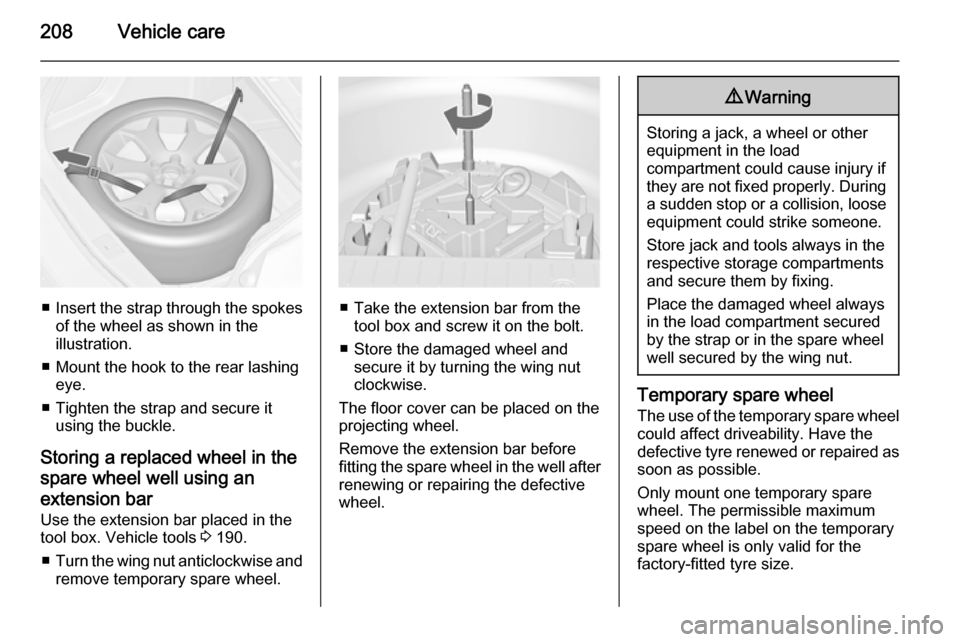
■Insert the strap through the spokes
of the wheel as shown in the
illustration.
■ Mount the hook to the rear lashing eye.
■ Tighten the strap and secure it using the buckle.
Storing a replaced wheel in the
spare wheel well using an
extension bar Use the extension bar placed in the
tool box. Vehicle tools 3 190.
■ Turn the wing nut anticlockwise and
remove temporary spare wheel.■ Take the extension bar from the tool box and screw it on the bolt.
■ Store the damaged wheel and secure it by turning the wing nut
clockwise.
The floor cover can be placed on the
projecting wheel.
Remove the extension bar before
fitting the spare wheel in the well after
renewing or repairing the defective
wheel.
9 Warning
Storing a jack, a wheel or other
equipment in the load
compartment could cause injury if they are not fixed properly. During a sudden stop or a collision, looseequipment could strike someone.
Store jack and tools always in the
respective storage compartments
and secure them by fixing.
Place the damaged wheel always
in the load compartment secured
by the strap or in the spare wheel
well secured by the wing nut.
Temporary spare wheel
The use of the temporary spare wheel could affect driveability. Have thedefective tyre renewed or repaired as soon as possible.
Only mount one temporary spare
wheel. The permissible maximum
speed on the label on the temporary
spare wheel is only valid for the
factory-fitted tyre size.
Page 211 of 245
Vehicle care209
If your vehicle gets a flat tyre in the
rear while towing another vehicle,
mount the temporary spare wheel in
the front and the full tyre in the rear.
Tyre chains 3 197.
Directional tyres Fit directional tyres such that they rollin the direction of travel. The rolling
direction is indicated by a symbol
(e.g. an arrow) on the sidewall.
The following applies to tyres fitted
opposing the rolling direction:
■ Driveability may be affected. Have the defective tyre renewed or
repaired as soon as possible.
■ Drive particularly carefully on wet and snow-covered road surfaces.Jump starting
Do not start with quick charger.
A vehicle with a discharged vehicle
battery can be started using jump
leads and the vehicle battery of
another vehicle.9 Warning
Be extremely careful when starting
with jump leads. Any deviation
from the following instructions can
lead to injuries or damage caused
by vehicle battery explosion or
damage to the electrical systems
of both vehicles.
9 Warning
Avoid contact of the vehicle
battery with eyes, skin, fabrics and painted surfaces. The fluid
contains sulphuric acid which can
cause injuries and damage in the
event of direct contact.
■ Never expose the vehicle battery to
naked flames or sparks.
■ A discharged vehicle battery can already freeze at a temperature of
0 °C. Defrost the frozen battery
before connecting jump leads.
■ Wear eye protection and protective
clothing when handling a vehicle
battery.
■ Use a booster battery with the same voltage (12 volts). Its capacity(Ah) must not be much less than
that of the discharged battery.
■ Use jump leads with insulated terminals and a cross section of at
least 16 mm 2
(25 mm 2
for diesel
engines).
■ Do not disconnect the discharged battery from the vehicle.
■ Switch off all unnecessary electrical
consumers.
■ Do not lean over the battery during jump starting.
■ Do not allow the terminals of one lead to touch those of the other
lead.
Page 213 of 245
Vehicle care211Towing
Towing the vehicle
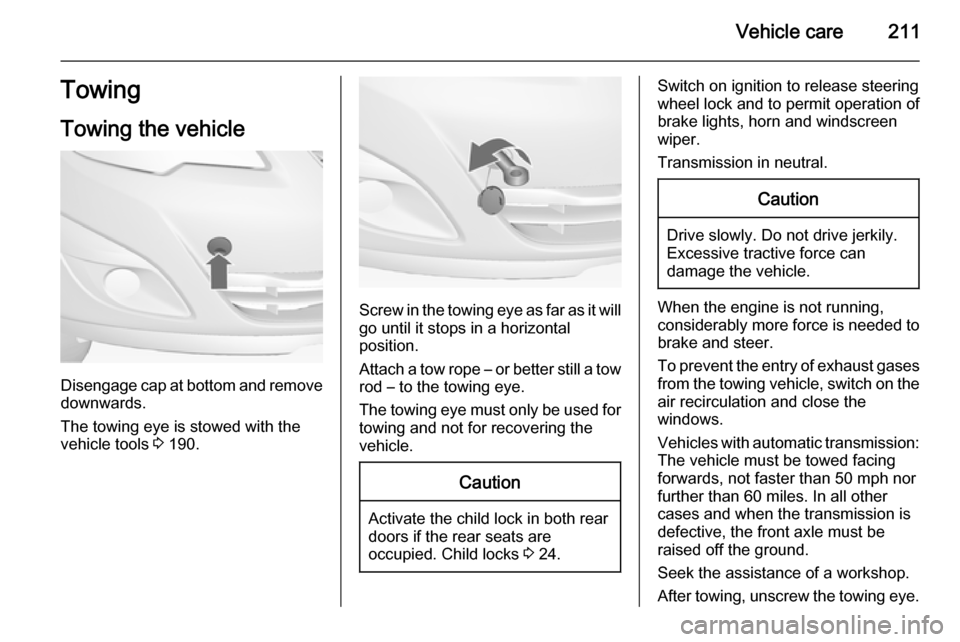
Disengage cap at bottom and remove downwards.
The towing eye is stowed with the
vehicle tools 3 190.
Screw in the towing eye as far as it will
go until it stops in a horizontal
position.
Attach a tow rope – or better still a tow
rod – to the towing eye.
The towing eye must only be used for towing and not for recovering the
vehicle.
Caution
Activate the child lock in both rear
doors if the rear seats are
occupied. Child locks 3 24.
Switch on ignition to release steering
wheel lock and to permit operation of
brake lights, horn and windscreen
wiper.
Transmission in neutral.Caution
Drive slowly. Do not drive jerkily.
Excessive tractive force can
damage the vehicle.
When the engine is not running,
considerably more force is needed to
brake and steer.
To prevent the entry of exhaust gases from the towing vehicle, switch on the
air recirculation and close the
windows.
Vehicles with automatic transmission: The vehicle must be towed facing
forwards, not faster than 50 mph nor further than 60 miles. In all other
cases and when the transmission is
defective, the front axle must be
raised off the ground.
Seek the assistance of a workshop. After towing, unscrew the towing eye.
Page 215 of 245
Vehicle care213Appearance care
Exterior care
Locks The locks are lubricated at the factoryusing a high quality lock cylinder
grease. Use de-icing agent only when
absolutely necessary, as this has a
degreasing effect and impairs lock function. After using de-icing agent,
have the locks regreased by a
workshop.
Washing The paintwork of your vehicle is
exposed to environmental influences.
Wash and wax your vehicle regularly.
When using automatic vehicle
washes, select a programme that
includes waxing.
Bird droppings, dead insects, resin,
pollen and the like should be cleaned off immediately, as they contain
aggressive constituents which can
cause paint damage.If using a vehicle wash, comply with
the vehicle wash manufacturer's
instructions. The windscreen wiper
and rear window wiper must be
switched off. Remove antenna and
external accessories such as roof
racks etc.
If you wash your vehicle by hand,
make sure that the insides of the
wheel housings are also thoroughly
rinsed out.
Clean edges and folds on opened
doors and the bonnet as well as the
areas they cover.Caution
Always use a cleaning agent with
a pH value of 4 to 9.
Do not use cleaning agents on hot surfaces.
Have the door hinges of all doors
greased by a workshop.
Do not clean the engine compartment with a steam-jet or high-pressure jet
cleaner.
Thoroughly rinse and leather-off the vehicle. Rinse leather frequently. Use
separate leathers for painted and
glass surfaces: remnants of wax on
the windows will impair vision.
Exterior lights
Headlight and other light covers are
made of plastic. Do not use any
abrasive or caustic agents, do not use an ice scraper, and do not clean them
dry.
Polishing and waxing Wax the vehicle regularly (at the
latest when water no longer beads).
Otherwise, the paintwork will dry out.
Polishing is necessary only if the paint
has become dull or if solid deposits
have become attached to it.
Paintwork polish with silicone forms a
protective film, making waxing
unnecessary.
Plastic body parts must not be treated with wax or polishing agents.
Page 216 of 245

214Vehicle care
Windows and windscreen wiperblades
Use a soft lint-free cloth or chamois leather together with window cleanerand insect remover.
When cleaning the rear window from
inside, always wipe in parallel to the
heating element to prevent damage.
For mechanical removal of ice, use a
sharp-edged ice scraper. Press the
scraper firmly against the glass so
that no dirt can get under it and
scratch the glass.
Clean smearing wiper blades with a
soft cloth and window cleaner.
Moonroof
Never clean with solvents or abrasive agents, fuels, aggressive media (e.g.
paint cleaner, acetone-containing
solutions etc.), acidic or highly
alkaline media or abrasive pads. Do
not apply wax or polishing agents to
the middle part of the moonroof.
Wheels and tyres Do not use high-pressure jet
cleaners.Clean rims with a pH-neutral wheel
cleaner.
Rims are painted and can be treated
with the same agents as the body.
Paintwork damageRectify minor paintwork damage witha touch-up pen before rust forms.
Have more extensive damage or rust
areas repaired by a workshop.
Underbody
Some areas of the vehicle underbody
have a PVC undercoating while other critical areas have a durable
protective wax coating.
After the underbody is washed, check
the underbody and have it waxed if
necessary.
Bitumen/rubber materials could
damage the PVC coating. Have
underbody work carried out by a
workshop.
Before and after winter, wash the
underbody and have the protective
wax coating checked.Liquid gas system9 Danger
Liquid gas is heavier than air and
can collect in sink points.
Take care when performing work
at the underbody in a pit.
For painting work and when using a
drying booth at a temperature above
60 °C, the liquid gas tank must be
removed.
Do not make any modifications to the
liquid gas system.
Towing equipment Do not clean the coupling ball bar with
a steam-jet or high-pressure jet
cleaner.
Rear carrier system Clean the rear carrier system with a
steam-jet or high-pressure jet cleaner
at least once a year.
Operate the rear carrier system
periodically if not in regular use, in
particular during winter.
Page 232 of 245
![VAUXHALL MERIVA 2015 Repair Manual 230Technical dataVehicle dimensionsMerivaLength [mm]4300Width without exterior mirrors [mm]1812Width with two exterior mirrors [mm]1994Height (without antenna) [mm]1615Length of load compartment floor](/img/38/19514/w960_19514-231.png "VAUXHALL MERIVA 2015 Repair Manual 230Technical dataVehicle dimensionsMerivaLength [mm]4300Width without exterior mirrors [mm]1812Width with two exterior mirrors [mm]1994Height (without antenna) [mm]1615Length of load compartment floor")
230Technical dataVehicle dimensionsMerivaLength [mm]4300Width without exterior mirrors [mm]1812Width with two exterior mirrors [mm]1994Height (without antenna) [mm]1615Length of load compartment floor [mm]815Length of load compartment with folded rear seats [mm]1642Load compartment width [mm]1038Load compartment height [mm]803Height of load compartment opening [mm]791Wheelbase [mm]2644Turning circle diameter [m]11.48-11.605)5)
Depending on equipment.
Page 236 of 245
![VAUXHALL MERIVA 2015 Repair Manual 234Technical data
Comfort with up to 3
peopleECO with up to 3 peopleWith full loadEngineTyresfrontrearfrontrearfrontrear[kPa/bar]
([psi])[kPa/bar]
([psi])[kPa/bar]
([psi])[kPa/bar]
([psi])[kPa/bar]
([](/img/38/19514/w960_19514-235.png "VAUXHALL MERIVA 2015 Repair Manual 234Technical data
Comfort with up to 3
peopleECO with up to 3 peopleWith full loadEngineTyresfrontrearfrontrearfrontrear[kPa/bar]
([psi])[kPa/bar]
([psi])[kPa/bar]
([psi])[kPa/bar]
([psi])[kPa/bar]
([")
234Technical data
Comfort with up to 3
peopleECO with up to 3 peopleWith full loadEngineTyresfrontrearfrontrearfrontrear[kPa/bar]
([psi])[kPa/bar]
([psi])[kPa/bar]
([psi])[kPa/bar]
([psi])[kPa/bar]
([psi])[kPa/bar]
([psi])A17DTI205/55 R16,250/2.5 (36)230/2.3 (33)300/3.0 (43)280/2.8 (41)270/2.7 (39)320/3.2 (46)225/45 R17225/40 R18270/2.7 (39)250/2.5 (36)300/3.0 (43)280/2.8 (41)280/2.8 (41)320/3.2 (46)AllTemporary spare wheel420/4.2 (61)420/4.2 (61)––420/4.2 (61)420/4.2 (61)
Page 238 of 245

236Customer informationVehicle data recording
and privacy
Event data recorders
Data storage modules in the vehicle
A large number of electronic
components of your vehicle contain
data storage modules temporarily or
permanently storing technical data
about the condition of the vehicle,
events and errors. In general, this
technical information documents the
condition of parts, modules, systems
or the environment:
■ Operating conditions of system components (e.g. filling levels)
■ Status messages of the vehicle and
its single components (e.g. number
of wheel revolutions / rotational
speed, deceleration, lateral
acceleration)
■ Dysfunctions and defects in important system components■ Vehicle reactions in particulardriving situations (e.g. inflation of
an airbag, activation of the stability
regulation system)
■ Environmental conditions (e.g. temperature)
These data are exclusively technical
and help identifying and correcting
errors as well as optimizing vehicle
functions.
Motion profiles indicating travelled
routes cannot be created with these
data.
If services are used (e.g. repair
works, service processes, warranty
cases, quality assurance),
employees of the service network
(manufacturer included) are able to
read out this technical information
from the event and error data storage
modules applying special diagnostic
devices. If required, you will receive
further information at these
workshops. After an error has been
corrected, the data are deleted from
the error storage module or they are
constantly overwritten.When using the vehicle, situations
may occur in which these technical
data related to other information
(accident report, damages on the
vehicle, witness statements etc.) may be associated with a specific person -possibly, with the assistance of an
expert.
Additional functions contractually
agreed upon with the client (e.g.
vehicle location in emergency cases)
allow the transmission of particular vehicle data from the vehicle.
Page 240 of 245

238IndexAAccessories and vehicle modifications .......................... 167
Active head restraints ..................35
Adaptive brake light ....................145
Adaptive forward lighting ..........
.................................. 98, 118, 177
Adjustable air vents ...................131
Airbag and belt tensioners ...........93
Airbag deactivation ................53, 94
Airbag label................................... 48 Airbag system .............................. 48
Air conditioning regular operation ................................ 132
Air conditioning system .............. 125
Air intake .................................... 132
Air vents...................................... 131
Alert ............................................ 107
Antifreeze ................................... 170
Antilock brake system ................ 145
Antilock brake system (ABS) .......95
Anti-theft alarm system ................27
Anti-theft locking system .............. 26 Appearance care ........................213
Armrest ................................... 39, 42
Armrest storage ........................... 63
Ashtrays ....................................... 88
Automatic anti-dazzle ..................30
Automatic light control ...............116Automatic locking ..................24, 98
Automatic transmission .............141
Auxiliary heater .......................... 131
B Battery discharge protection ......123
Battery voltage ........................... 107
Belts.............................................. 44 Bicycle rack .................................. 64
Bonnet ....................................... 169
Brake and clutch fluid .................217
Brake and clutch system .............95
Brake assist ............................... 147
Brake fluid .................................. 172
Brakes ............................... 145, 172
Breakdown.................................. 211
Bulb replacement ....................... 175
C Capacities .................................. 231
Car Pass ...................................... 19
Catalytic converter .....................141
Central locking system ................21
Centre console lighting ..............122
Changing tyre and wheel size ...197
Charging system .......................... 94
Child locks ................................... 24
Child restraint installation locations ................................... 57
Child restraints.............................. 54
Page 241 of 245

239
Child restraint systems ................54
Cigarette lighter ........................... 88
Climate control ............................. 15
Climate control, service ..............132
Climate control systems .............124
Clock............................................. 85
Code ........................................... 104
Control indicators.......................... 91
Control of the vehicle .................134
Controls ........................................ 81
Controls in steering wheel ............81
Convex shape .............................. 28
Coolant ....................................... 170
Coolant and antifreeze ...............217
Coolant temperature gauge ..........90
Coupling ball bar ........................163
Cruise control ...................... 98, 149
Cupholders .................................. 61
Curtain airbag system .................. 52
Curve lighting.............................. 118
D Danger, Warnings and Cautions ...4
Dashboard .................................... 10
Daytime running light ..................116
Daytime running lights ...............118
Declaration of conformity ............235
Diesel fuel system bleeding .......174
Diesel particle filter ....................140
Door open .................................... 98Doors............................................ 25
Driver assistance systems ..........149
Driver Information Centre .............99
Driving characteristics and towing tips .............................. 162
Driving hints ................................ 134
E Electric adjustment ......................28
Electrical system......................... 185
Electric parking brake ...........95, 146
Electric parking brake fault ...........95
Electronic climate control system 126
Electronic driving programmes ..143
Electronic Stability Control.......... 148
Electronic Stability Control and Traction Control system ...........96
Electronic Stability Control off ...... 96
End-of-life vehicle recovery .......168
Engine compartment fuse box ...186
Engine coolant ........................... 170
Engine coolant temperature gauge ....................................... 90
Engine data ............................... 224
Engine exhaust .......................... 140
Engine identification ...................220
Engine oil ................... 169, 217, 221
Engine oil pressure ......................97
Entry lighting .............................. 122
Event data recorders ..................236Exhaust gases ............................ 140
Exit lighting ................................ 122
Exterior care .............................. 213
Exterior light ................................. 98
Exterior lighting ....................12, 115
Exterior mirrors ............................. 28
F
Fault ........................................... 143 First aid ......................................... 78
First aid kit ................................... 78
Fixed air vents ........................... 132
Flex-Fix system ............................ 64
Fog light ....................................... 98
Fog lights .................... 119, 120, 179
Folding mirrors ............................. 29
Folding tray .................................. 78
Front airbag system .....................51
Front fog lights ........................... 119
Front seats.................................... 36
Front storage ............................... 63
Front turn signal light ..................175
Front turn signal lights ...............180
Fuel............................................. 155
Fuel consumption - CO 2-
Emissions ............................... 161
Fuel for diesel engines ..............155
Fuel for liquid gas operation .......156
Fuel for petrol engines ...............155
Fuel gauge ................................... 89